

Nothing ‘Unheard Of’ or ‘Affordable’ about New Garth Brooks Tour
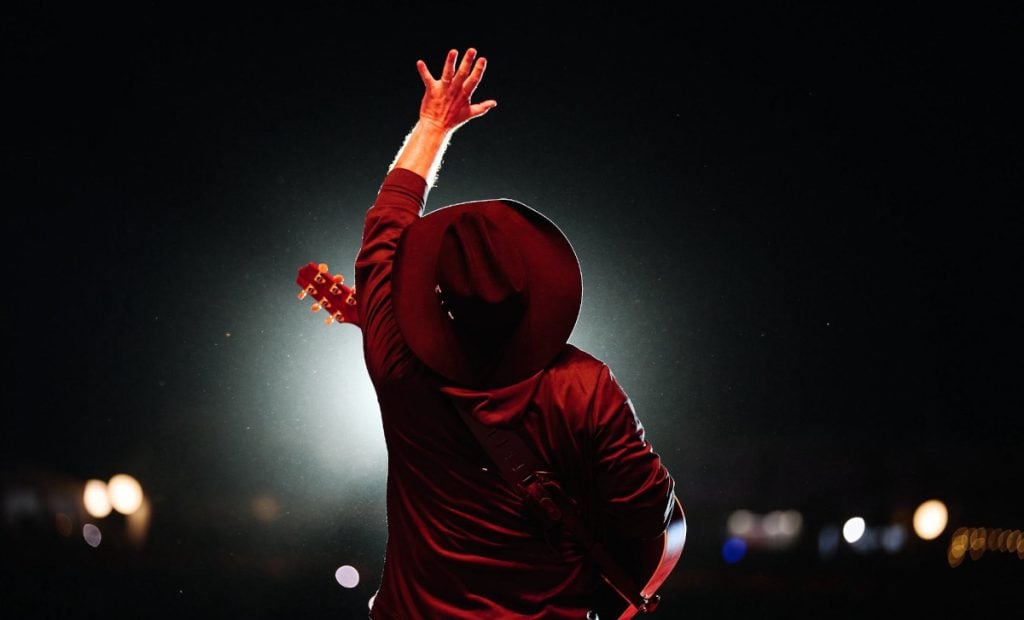
Nostalgia is a hell of a drug. And that’s what Garth Brooks will be slinging on his upcoming tour. Announced on July 7th after a countdown clock on his website went to zero, some were hoping maybe he’d announce he’s finally bringing his music to all streaming platforms. Others were hoping maybe Garth would announce the release of a new album, and not in some weird format where you had to buy it with a bunch of other CDs you already had in a Bass Pro Shop box set to goose his sales numbers.
But instead what we’re getting is an arena tour called “Blame It All On My Roots” that promises to take fans back to 1996 and the peak of Garthmania when the country star packed venues and had his weird glass-covered drum pod at center stage that he’d leap off of. A video of Garth going to some barn to uncover the old concert relic accompanied the announcement. The first two shows will be in Indianapolis at the Gainbridge Fieldhouse on August 21st and 22nd. Many more dates are coming.
Garth Brooks puts on a hell of a live show, and this arena tour will certainly be highly anticipated. Expect Garth to reveal cities one at a time as he’s done in the past as opposed to announcing the entire tour at once like most performers do. And unlike other arena acts, or really any live show these days, Garth Brooks won’t be offered tiered pricing depending on how close or far your are from the stage.
As part of the tour announcement, it was revealed that all the tickets on the arena tour would be the same price: no VIP, no “golden bowl” as Garth likes to call it, and no cheap seats either. Every single ticket from the front row to the nosebleeds will be $154 dollars, full stop. This accounts for a $140 ticket, and a set $14 for facility fees and service charges at each stop.
At the news of the fixed price tickets, media outlets and online influencers were touting its vision, how “unheard of” this approach to ticketing was as Whiskey Riff said, and that Garth is “leaning into affordability” as Rolling Stone Country put it. But in truth, it’s neither of these things. It’s not unprecedented because this is the same exact approach Garth Brooks brought to ticketing his arena tours when he came out of retirement in 2014, and for the years afterwards. And $154 for nosebleed tickets in an arena isn’t exactly “affordable” by the standards of most consumers, or even for a Garth Brooks tour.
When Garth Brooks came out of retirement in 2014 and went on an extended arena tour, he took the same exact fixed price approach to ticketing. But tickets were not $154 a pop, they were $65.50, or nearly 3 times cheaper than they are for the upcoming tour. Later in the tour around 2017, Garth raised the price $9 to $74.98, which is still under half the price he’s charging for the upcoming tour. On his 30-stop stadium tour between 2018 and 2022, tickets were fixed at $94.95, so less than 2/3rds of the upcoming arena tour price, and under that psychological $100 range.
Make no mistake, seeing an arena act like Garth Brooks from the front rows for $154 is probably a hell of a deal. Seeing him from the rafters of an area for that price where most of the seats are located doesn’t feel like a deal at all, especially looking back at the history of Garth’s ticket prices.
Undoubtedly, costs aren’t just rising for consumers, but for productions like a Garth Brooks arena tour. It makes total sense that the prices for the new tour did not remain static compared to previous years. But Garth could have tried to keep it under $100. Then you could tout the tour’s affordability.
Looking at the ticket price rise on Garth tours, you see the very type of greedflation that has affected all sectors of the American economy, slowly but surely scaling up consumer costs to see what the public can stomach, and often finding or surpassing that limit. That’s one of the reasons for the “Blue Dot Fever” phenomenon we’ve been witnessing in music in 2026.
Let’s give Garth credit where credit’s due though. The fixed price approach to ticketing is one way to counteract the ticket bots and scalpers. It’s a way to democratize ticketing so it’s not just the elites of society that are allowed to get close to the action. It’s the wild range in ticket prices that have allowed things like “dynamic pricing” to creep into the marketplace, fleecing consumers, and increasing the gulf between the have’s and the have not’s in the live music experience.
In 2016, Saving Country Music strongly praised Garth Brooks for this approach, and presented it as a solution to America’s ticketing problem. Many of the same points then apply to big arena tours today.
Though Garth may symbolize the embodiment of the money hungry music performer to many, his comeback tour has made it possible for most all consumers to pay face value for tickets at a reasonable price, while eliminating the need for scalpers by scaling inventory to demand. When Garth Brooks announces a tour stop, he may begin with one or two shows, but if they sell out quickly, he may add additional performances, either as matinees or on additional nights. This way ticket supply stays ahead of the secondary market. It also allows Garth to book arenas as opposed to stadiums and other big venues where the sound and presentation aren’t as easily controlled.
Garth also didn’t announce all the dates for his comeback tour at once, or even separate legs of it. Instead, he announces cities he will be performing in one at a time, and as soon as performances sell out, additional ones are booked. By implementing this strategy, not only has Garth been able to keep ticket prices low for all of his fans, he also is able to rake in incredible profits, without the scalping industry skimming anything off the top due to secondary market sales.
Garth Brooks also doesn’t have what he calls a “golden bowl” at his concerts, or an area near the stage where tickets are more expensive. All tickets are of equal value, creating an even more equitable environment in the concert space. And to counteract scalpers, ticket holders all must present both an ID, and the credit card used to purchase the tickets when arriving at the venue, and all members of a party must be present and enter the venue at once. These simple procedures stop scalpers and counterfeiters in their tracks, and keeps the free flow of tickets to true fans unobstructed.
Of course, performers have to be willing to play more performances in a given city for the Garth Brooks model to work. But why wouldn’t they if it meant more profit, while incurring less overhead per performance since the concert stage and production is already constructed in a given venue.
Garth Brooks ended up playing a incredible 390 performance on his 2014-2017 arena tour by taking that approach. Those who witnessed it paid face value for their ticket. This was the way to democratize the process. Granted, there’s no guarantee if Garth will add shows to locations if demand calls for it on this new arena tour. He might though. He already announced two shows in Indianapolis to start the tour off as opposed to one.
Though Garth has really done a disservice to his music and his career by insisting on a ’90s era approach when it comes to releasing new music, it happens to be that his ’90s era approach to ticketing is much more progressive and egalitarian than the current system.
But let’s not tout it as “unprecedented.” It used to be that arena tours were packed on the floor by GA standing room ticket holders, who also happened to be the most enthusiastic concert goers as opposed to floor seats for the elite or cordoned off VIP-only sections. There also used to be less difference in the ticket prices, and no such thing as “dynamic pricing.” There also used to be more sellouts, and less empty seats.
And let’s not tout the tour as “affordable.” Sure, compared to the costs of tickets to Taylor Swift, Beyoncé, or other A-list headliners, $154 might be a deal. But that’s only because the American consumer has been slowly trained to stomach higher and higher ticket costs, including for inferior seats, under a system set up to rake as much money from enthusiastic music fans as possible.
– – – – – – – – – – –
If you found this article valuable, consider leaving Saving Country Music A TIP.
July 10, 2026 @ 10:23 am
Let the conversation begin
July 11, 2026 @ 6:52 am
Easily the best comment on this entire thread…the fact that it’s first makes it even more impressive. It’s like you’ve been waiting your entire life for this moment..and you get a standing ovation for your efforts.
July 10, 2026 @ 10:32 am
Not a fan of this one price for all tickets thing. Depending on the artist, I might be willing to pay for good seats or I might be content to sit up in the nosebleeds. I like to have options about how much I want to spend to go to a concert.
July 10, 2026 @ 10:42 am
I saw Garth once in a proper concert setting. 1997 Civic Arena tickets were given to me by the owner of a restaurant I was working at while attending Pitt. It was an ok show. But I never desired to pony up money to see him in concert. And certainly not $154 in an arena. I’d maybe pay $50-$75 for some grass to stand and dance and get rowdy.
The only other time I saw Garth perform was in 1991 or 1992 when the two competing radio stations in Nashville held a celebrity softball game at the ballpark the Nashville Sounds played. After the game, most of the artists played a concert on the flatbed of a tractor trailer. I remember Garth’s abbreviated set and Paul Overstreet’s (for some reason).
July 10, 2026 @ 11:07 am
That’s funny that you say— “and Paul Overstreet’s (for some reason).” Maybe you thought he was good. I prefer Paul Overstreet to Garth Brooks. I would have gone for a beer during Brooks abbreviated set, hoping it was over, and returned in time for Overstreet.
July 10, 2026 @ 11:35 am
Ditto
I saw Garth in 97 in Charleston SC, ticket was a gift, wouldn’t pay for it myself and wouldn’t go again. I’d rather see Paul Overstreet.
July 10, 2026 @ 10:57 am
Any thoughts on Charley Crockett’s recent discrimination towards his tour openers?
July 10, 2026 @ 11:02 am
Massive nontroversy on a slow news week the media is hyperventilating over to try and stir clicks. I guess I’ll have to weigh in at some point.
July 13, 2026 @ 6:35 am
Normal people discriminate against Satanism.
July 10, 2026 @ 11:06 am
Without hesitation, I’d pay $154 to sit in the nosebleeds for a Yearwood show, if there was a written guarantee that her husband wouldn’t show up to distract the proceedings. She’s the one with the actual musical talent.
July 10, 2026 @ 11:08 am
It’s amazing how much Garth believes his own hype this many years later. Due to holding out on putting his music on streaming services (and only one at that), his target audience is too old to leave the house.
July 10, 2026 @ 12:01 pm
Garth has recused himself from a massive listening population of younger folks bumping Alan Jackson and Brooks & Dunn from their beater cars in the high school parking lot. But make no mistake, this will be a massive tour. The old people will show up for Garth.
July 10, 2026 @ 2:28 pm
Old, he said. Shame on you.
For the record; I’m not planning to go. He belongs to my yesterdays.
July 10, 2026 @ 2:57 pm
I’m old, and in Oklahoma (where his roots actually are) and I wouldn’t attend a GB show if it was free in my back yard! I have however, happily attended both ‘Boys From Oklahoma’ events in Stillwater, which GB claimed would never happen. He was wrong. Massive success without his arrogant azz!😁
Still love reading your stuff tho Trigger!
July 10, 2026 @ 3:03 pm
It doesn’t really matter how any of us individually feel. These shows will sell out.
July 11, 2026 @ 9:45 pm
Damn so much hate. Yeah 150 is alot for a nosebleed ticket but for the people saying hes not a performer and that Trisha has all the talent, you either havent seen the man live or your an idiot because even if you dont like the man, you cannot deny that he is a top tier performer. Ive been listening to Garth since I was a kid, ive seen him multiple times in multiple settings and never once didnt enjoy myself. And lets be real, for that money you are guaranteed a 2 to 3 hour set and almost certainly get 4 or 5 song with Trisha as well. So you are getting your money’s worth no matter how you swing it. Yall are just hating to hate and not showing a real unbiased opinion on the topic.
July 10, 2026 @ 11:01 pm
I don’t know about that. I’m one of those old people who saw him twice in the 90s and wasn’t impressed either time. (I got into both shows free.) I’m happy to have seen so many now aging or deceased artists in their prime but have no desire to pay exhorbitant prices to see them now.
July 13, 2026 @ 6:36 am
Garth hate is so hipster.
July 10, 2026 @ 5:50 pm
Too old to leave the house? Seriously? WOW…Pretty judgemental.
July 10, 2026 @ 11:15 am
If they are really going to sell all tickets for the same price, that will give a bonanza to the scalpers on the secondary market, who will resell the best tickets for amounts in the range of $500 to over $1,000.
The best seats in a major league sports arena or stadium are easily worth ten times what the worst seats are worth.
July 10, 2026 @ 11:22 am
On both Garth’s arena and stadium tour, there were little or no resale tickets because each ticket had to be verified with the original purchaser. I have not seen any confirmation they’re doing that with this tour, but I’d be surprised if they didn’t.
July 10, 2026 @ 11:36 am
Genuine question. If Garth Brooks can set the ticket prices and also stop people from scalping them on stubhub or wherever, is that something any big artist could do? Or is that something only someone of his stature could pull off? I ask because I saw stories where Taylor Swift and Bruce Springsteen were bitching about high ticket prices and it sounded like it was out of their control.
July 10, 2026 @ 12:08 pm
Many big artists have tried. Zach Bryan tried. Eric Church tried. The problem was their solutions were imperfect and they ended up giving up. If nothing else, Garth knows how to get what he wants from the industry. If he insists on verified tickets and no resale, my guess is Ticketmaster will play ball.
The simple truth is the reason some artists will complain about ticket prices but then do little to actually address them is because they’re benefiting from “dynamic pricing” too.
But what’s so important to understand why the Garth Brooks arena concert was so successful previously was that he also surged supply to meet demand. If the first two shows sold out, he’d book a third. Everyone that wanted a ticket got one. That way there was no feeding frenzy skyrocketing prices. He played matinee shows, put on four shows in three days. You want to meet demand, raise the supply of tickets.
July 10, 2026 @ 4:32 pm
Thank you. I really appreciate you taking the time to answer and explain that.
July 10, 2026 @ 6:43 pm
Most don’t want to as they are in on it. It can be done.
July 14, 2026 @ 12:54 pm
FWIW, last summer Oasis more or less did what Garth is doing. Most tickets were the same price and they really controlled ticket resales. It wasn’t perfect but it was pretty good.
One thing they did was have an area in front that was accessible only via a ballot or by simply showing up early. For me, it was good enough to be towards the back so I didn’t have to deal with that.
I hope they do something similar when they tour again next year.
July 10, 2026 @ 11:42 am
I’m not a Garth Brooks fan, but I do have to give him credit for trying to keep his fans from paying scalper prices for his shows.
July 10, 2026 @ 1:37 pm
I understand the motive for non-transferable verified tickets, and hate ticket buying robots as much as anyone.
Do you think all of these rules around how a ticket can and can’t be transferred, along with the price of something that can no longer be easily resold has contributed to the blue dots?
Some of these ticket prices at on-sale date are a big commitment 6 months out with no idea what may come up in the meantime.
July 10, 2026 @ 1:57 pm
Absolutely. The rise in cancellations and postponements, the high prices, the fact that shows aren’t selling out immediately any more, there’s no reason NOT to wait until the last minute or a week out to purchase tickets. It used to be that if you wanted to get into any big show, you had to cue in the presale. Now that’s just not the case for many events.
July 10, 2026 @ 11:35 am
IIRC from last time, one reason all the tickets are the same price, is that they keep selling tickets until they exhaust demand. In many cities he was playing 7 or 8 shows. In addition to verification, it made resell non-existent. I do believe at this price point, many folks might be more reluctant, as that is not a good price for nose bleeds.
July 10, 2026 @ 12:10 pm
I agree. At $74 or even $99, I can see this concept working. $308 for two people to attend a 2-hour concert in the nosebleeds is not “affordable.” That’s a luxury.
July 10, 2026 @ 12:48 pm
$308 for Two people to attend a 2-hour concert in the nosebleeds, is affordable.
Quite affordable.
Especially for a consummate professional, such as Brooks.
Though, wouldn’t go unless had seats in the first tier, not too far from the stage.
July 10, 2026 @ 12:58 pm
No it’s not. Especially when 10 years ago, those two same tickets would have cost you $130. You’re just being contrarian because you’re a bitter Fox News boomer who is tired of everyone complaining about the economy and feel like they need to parrot out the talking points that everything is so great right now. It’s not.
“Though, wouldn’t go unless had seats in the first tier, not too far from the stage.”
Exactly. But it should be good enough for the proles.
July 10, 2026 @ 4:49 pm
: D You are such an idiot.
I can’t stand Fox news.
And, $308 for TWO seats, even in the nosebleeds, is still a good deal for Garth tickets.
For the record, would Maybe, just Maybe, go to a Garth concert, if only to see Jimmy Mattingly work his magic.
July 11, 2026 @ 1:39 pm
“bitter Fox News boomer” (?)…
Weird insult…why the disrespect directed at those of your readers who watch a certain news channel. I realize this may be personal between you and Di, but why fire such an indiscriminate broadside?
July 11, 2026 @ 2:18 pm
Hey Jocko,
This comment was in response to a very specifically mentally ill regular commenter. I certainly didn’t mean to disparage anyone who watches Fox News in general. I do think it’s unhelpful to try and gloss over the current economic situation in the United States, especially when it comes to young people. That is more what I was offended by.
July 10, 2026 @ 2:39 pm
No, it’s not. Not at all.
But his shows will probably sell out quickly because of nostalgia.
To pay that amount of money, it would take a Merle Haggard or a Jimmy Buffett in their prime, in a small venue with a guaranteed view.
July 10, 2026 @ 6:05 pm
Who is Jimmy Mattingly, Di?
July 10, 2026 @ 6:27 pm
Garth Brooks fiddle player.
An amazing musician. They just finished playing to a crowd of 70,000, in England.
July 12, 2026 @ 8:20 am
Tom,
Have you had a chance to look up Jimmy Mattingly?
He is a monster fiddle player.
July 10, 2026 @ 6:47 pm
Every time I’m at a big show, usually up front in the pit or at least in decent seats near the stage I always wonder how anyone can sit in the upper deck to watch a show. I’d rather just not go.
July 10, 2026 @ 7:46 pm
Exactly.
July 10, 2026 @ 11:08 pm
For that kind of money I’d expect to be sitting in air conditioned comfort in Vegas.
July 12, 2026 @ 5:58 pm
To be fair $65 in 2014 is the equivalent of about $92 now after adjusting for inflation so it’s not quite true he has tripled the prices. Doubled I guess.
July 10, 2026 @ 12:55 pm
To see an act like Garth ……..in a smaller venue…….i would pay it. It’s not cheap. It beats a stadium. He puts in a great show, Just seen Luke Combs play a small for him venue in Paris. Great show,
July 10, 2026 @ 12:58 pm
Jesus, this concert series sounds like South Park’s “memba berries” come to life.
“Memba when Garth Brooks had a drum shaped glass pod to jump off?”
Oh, we all memba….
July 10, 2026 @ 1:08 pm
This simple solution for the “same-price-for-nosebleed” is to not sell those seats. Block off sections that include high-level seats with limited views. I get that this cuts into the show revenue, but unless he’s only doing this for the money, it seems to me to be a reasonable idea. Or if he has to fill those seats, don’t price every section differently. Set one price, then give a discount on the “bad” seats. I don’t think too many people will gripe about giving people willing to sit up there a 25-40% discount. The seat gets sold and there’s fewer complaints.
July 10, 2026 @ 1:55 pm
If you have shows that you know will be sell outs, partitioning off seats seems silly just because you want to push this one ticket price idea. The one price idea is great at $65-$75, or maybe even $99. $154.00 just sort of breaks the idea, because whoever ends up in the upper sections where the majority of tickets are feels short changed knowing those seats would normally go for $75.
July 10, 2026 @ 2:22 pm
Tallahassee, Leon City Civic Center, March 12th, 1994; $18 (about $40 today), and I got to (accidentally) meet Martina McBride for a few seconds, as we almost ran into each other pre-show. Such a cute, little girl back then, quite a happening for the 18 year old recruit.
I kept the ticket, it was my first concert outside of the usual dives.
July 10, 2026 @ 2:34 pm
Adding additional shows to satisfy demand is not the best solution either. Saw Garth in Dallas a few years back. It was his 7th or 8 show in a week. He voice was almost gone. He put in the effort but did not sound good. Agree paying $154 to set in the top of the AAC in Dallas does not feel like a deal, especially when you tack on expensive parking, beers and merch, quickly turns into a 400 to 500 night for 2. Reality is going to see big stars in large arenas is a financial commitment which is why I mostly support the small live music venues and blessed that DFW has alot that showcase young talented bands and artist. Two the weekend, tonight (Haydine Redwine / Vincent Neal Emerson at the Kessler and tomorrow night (Teague Brothers Band ). Will see both for shows for a total of $50 and be within 50 feet of the stage. Not Garth but very affordable.
July 10, 2026 @ 2:56 pm
Guess he saw the success of Alan’s finale and decided he should join in. Too bad he doesnt sing near as well. Lost all respect after his lip syncing awards show peeformance
July 10, 2026 @ 2:59 pm
I wouldn’t pay 5 bucks to see Garth. His first album was decent but the rest have 1 or 2 good songs. Never been able to get into his music any more than that.
July 10, 2026 @ 4:22 pm
What about the SA allegations against Garth? Did they just go away?
July 10, 2026 @ 4:35 pm
They’re still pending.
July 10, 2026 @ 5:54 pm
I have seen Garth 14 times, never once disappointed. However no desire to go again, since it will be the same songs I heard on the 14 shows and nothing new. He does put on one heck of a show though.
July 10, 2026 @ 6:33 pm
Hopefully Garth and Miss Yearwood will sing a few duets.
July 10, 2026 @ 6:40 pm
People may not like this take, and I guess that’s fine, but I’ve never understood the “tickets on the secondary market are too expensive” argument. Seats are a scarce, in-demand item (i.e., a normal good with a seemingly pretty low elasticity of demand). Prices rise to meet demand. Demand is high. Seats become expensive. Water makes things wet. The Pope shits in the words. Bears are Catholic. News at 11.
I don’t go around whining that I can’t afford a Ferrari or a mansion in Beverly Hills. If you want a cheap concert, go see a local act. It’s a lot of fun.
July 10, 2026 @ 7:44 pm
Oh my word, this is hilarious.
Love it.
July 13, 2026 @ 6:38 am
Modern people want everything for free.
Schools neglect to teach economics.
July 10, 2026 @ 6:52 pm
To each their own but I never understood the draw of this guy at all. He always just struck me as being such a dork.
July 10, 2026 @ 9:34 pm
Seems to me the author has an axe to grind here
July 11, 2026 @ 6:22 am
Yes, when someone triples concert prices in a decade and then gets praised for the affordability of tickets, it grinds my axe. This is how concert prices have gotten where they are. I do appreciate Garth trying to do something to address the broken ticketing system. $154 for an upper bowl arena ticket is not “affordable.”
July 11, 2026 @ 1:55 am
He’s a hypocrite and a cheater and trisha.is a home wrecking ho so f them both
July 11, 2026 @ 10:34 am
Yeah,but I like Chris Gaines,I mean,Garth !!!!!
July 11, 2026 @ 12:14 pm
If you gave me a free ticket and $1,540 in cash to see this show I would pass. Could not stomach the cornball fakeness of Garth for two minutes. But to all who celebrate, hope you have a wonderful time.
July 11, 2026 @ 9:06 pm
To me 154 to see garth from anywhere is too much but lots of people liked him. So i expect many people to pay it just to say they were there or maybe cause they may never see him again. Id consider paying that much even for nosebleeds for paul mccartney just because it would fulfill a lifetime dream. So always depends on perspective.
July 12, 2026 @ 5:54 pm
I saw Garth once – in 1990 when he opened for Loretta Lynn in Salem, Ohio at Ponderosa Park. He was very good and it was pre rock star Garth. He was very kind to me with a conversation and taking a photograph. A nice memory.
I wouldn’t pay $154 to sit in nose bleed in an arena.
July 13, 2026 @ 5:58 am
Garth finally did a UK concert the other week in Hyde Park London. Many were delighted to see him perform all the classics. It’s been a long time coming. The rumours about arena gigs surfaced straight after with the possibility of them coming to the UK. As thrilled as so many were at seeing Garth, not sure the UK audience will be happy with these prices. I didn’t get to see him in London, would definitely consider an arena venue in the UK, but I guess it will need to be a big balanced decision about whether I commit. An artist I’ve always wanted to see live since his heyday, but can I justify it this many years on…
July 13, 2026 @ 6:18 am
But Garth is too fat to be a cowboy such as Yours Truly !!!!!!!!!!!!!!!!!!11
July 13, 2026 @ 6:39 am
Garth has to pay his legal bills! /s
Garth articles always bring out the most delightful people saying they don’t care about the guy and then they comment about him.
The tour will sell out.
July 13, 2026 @ 10:44 am
I think that anyone who is going to arena concerts in the 2020s would agree that $154 for a nosebleed is a pretty average price, if not significantly lower than many artists that would be considered more modern or relevant than Garth.
Personally I think the artists need to take more control/responsibility of the overall price of tickets. Playing multiple nights is a great way to match supple with demand (Garth, Metallica, Noah Kahn). Prohibiting ticket transfer and only allowing face value resale is a great way to combat resellers (Sturgil Simpson, et al.). The next step is cracking down on the fees the venue charges. It doesn’t really matter to consumers if the tickets price is $45 when someone is allowing the venue to charge a 40% facility fee… It’s a convenient thing for an artist to allow crazy fees on the backend while “keeping prices affordable.” I’m sure they get some of that money back, especially in a LN/TM collusion situation.
Overall I agree with the main point that this isn’t exactly affordable. Good try, but not quite… $99 tickets for all seats would look a lot better.
July 13, 2026 @ 3:59 pm
If tickets were $99, folks would scream bloody murder and demand $59.
July 13, 2026 @ 2:16 pm
Damn. I was hoping the announcement was that his albums would be available for streaming. Amazon Music sucks. And I don’t want to have to dig my CDs and a CD player out of a museum to listen to Garth.
July 15, 2026 @ 5:01 am
I’m not above paying $150 for a concert ticket if I’m sitting up close. I’ve done it numerous times. But when I have, that was the only concert I went to that year. The summer I went to four big concerts, all at amphitheaters, I paid about $50 per ticket to sit near the back of the seating area. But, EVERYTHING costs more now. I’m sure there is a profit threshold artists feel they have to reach in order to make it worth the time and effort to go on tour for a year. All the gear and crew you have to take with you on a big arena tour has to cost a small fortune.
So really, the music lover has to do a cost benefit analysis. Are you willing to pay $150 to sit up front for Garth Brooks? Are you willing to pay the same to sit in the back? If not, you just don’t go and it will be fine. It would be nice to see Garth, but if you don’t, life will go on.
I paid about $200 for two seats to see Alison Krauss and Union Station in a small auditorium. They played 36 songs over about two and a half hours. Worth every penny and worth being the only show I’ll go to this year. As costs go up, I just plan for one show a year now, I try to find out who is going on tour and pick the show I would most like to see. I plan for one big show, because I live in an area where we don’t get a lot of independent Country/Americana acts rolling through that I could expect to pay about $20 to $30 to get in and go to four or five small shows a year.
July 15, 2026 @ 5:42 am
I wonder how much gas prices are impacting this?
I know for my local bands who tour up and down the coast it has, to put it mildly SUCKED. Eating into already meager profits.