

An Honest Review of Dolly Parton’s “I Will Always Love You” Tribute
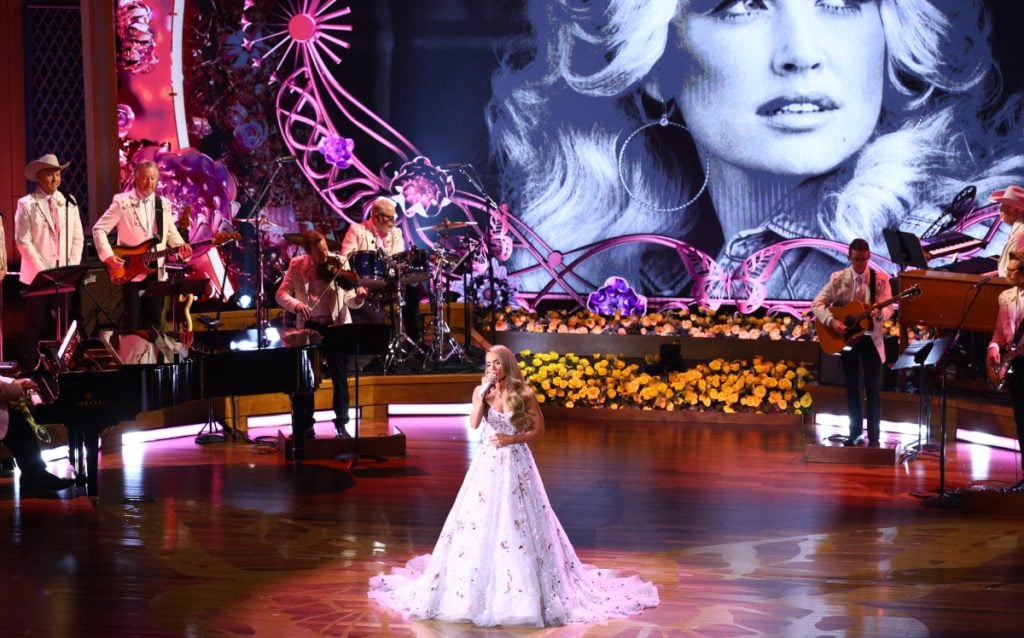
Dolly’s gone, but she definitely won’t be forgotten. On Wednesday evening, October 21st, the Country Music Association assembled an all-star cast to pay tribute to the country queen at the Fisher Center for the Performing Arts at Belmont University in Nashville. The two-hour special broadcast live on ABC was really the biggest moment so far for fans and performers alike to remember and pay tribute to Dolly.
The presentation would start and finish off strong, had some really touching moments in the form of both performances and oral remembrances worth remarking on and revisiting, yet meandered at times in the middle portions as mediocre talent was exposed for being pretty incapable of properly paying Dolly tribute, let alone evoking her memory, or presenting an inspiring moment. The special also was somewhat bisected by word of another Hall of Famer John Anderson passing away, with the news breaking in the middle of the tribute.
The presentation started where Dolly Parton started, with acoustic instruments, and the roots of bluegrass in east Tennessee. Vince Gill, Molly Tuttle, Ricky Skaggs, and Béla Fleck commenced the celebration with the old Hazel Dickens song “A Few Old Memories” that Dolly recorded on her 1999 album My Grass Is Blue. And right out of the chute, any worry that this special wouldn’t be reverent to Dolly’s deep roots in country music were put to bed as pictures from her career were displayed behind the stage.
Reba McEntire then came out on stage to speak. Reba would be one of the recurring characters of the evening. “We could be here all night talking about the songs she’s written, the awards she won … but tonight is not about that,” Reba explained, before continuing on that Dolly was “exactly who God made [her] to be. She never tried to fit into someone else’s idea of who she ought to be … Who we saw on stage is who Dolly was off stage too. Authentic. She became more that an songwriter or an entertainer. She became hope.”
“Authenticity” would be evoked numerous times during the presentation, from personalities inside of country music, and out like Dolly friend Oprah Winfrey. After the first couple of performances, a video montage played chronicling Dolly’s life as a little girl growing up in a one room cabin, to getting started in the music business with Uncle Bill, to debuting on the Porter Wagoner Show.
Lainey Wilson then came out to lead the same bluegrass ensemble that started the show off with a version of “Train, Train,” including Ricky Skaggs, Molly Tuttle, and fiddle player Stuart Duncan all taking hot leads. Lainey might’ve been a little loud and outspoken for the otherwise acoustic arrangement, but it did give some star power to an otherwise second straight bluegrass offering to start the show.
Ashley McBryde then came out to sing one of Dolly Parton’s signature songs, “Coat of Many Colors” in a very strong, if not slightly understated performance that included recitation of one of the verses. Then after Katy Perry came out for a speech and remembrance, the woman of the moment, Ella Langley, took the stage to sing another one of Dolly’s signature songs, “Jolene.” Similarly, it felt strong, but understated, especially since the performance was set in a lower key so Langley could be comfortable, which unfortunately took out all the sweet notes and opportunities for a spine-tingling “moment.”
After the initial bluegrass sets and the blazing vocals and instrumentation they illustrated, these next performances highlighted how there really are few who could ever do Dolly’s greatest songs the same justice that Dolly could herself, or at least not from the current crop of mainstream country talent. It’s fair to wonder if someone like Miley Cyrus or Sierra Ferrell could have done these songs better, and resulted in more memorable performances.
Later the video retrospective resumed and picked up with Dolly Parton leaving Porter Wagoner and writing “I Will Always Love You,” crossing over to pop with “Here You Come Again,” and getting into acting. Kelsea Ballerini came out to perform “Here You Come Again,” once again set in a lower key, likely to remain in the comfort zone of Ballerini’s range, and once again robbing the performance of any fireworks or goosebump moments. At one point, Kelsea had to lower the mic, and let a backup singer hit what was still only a moderately “high” note.
After an introduction by Little Big Town, Darius Rucker then came out to perform “Two Doors Down.” The performance at times was pitchy, and was just a little perplexing why this artist, and this song were selected for this presentation, except that having Hootie on the presentation helped goose the name recognition for folks outside of country. This was followed by Carly Pearce with Kristen Chenoweth yet again giving a lowered register performance that felt underwhelming.
Julia Roberts gave a great speech via recorded video, as did Oprah Winfrey, Bono, Barbara Mandrell, Carol Burnett, and others during the presentation. Lady A came out to perform “Islands in the Stream.” And once again, all the big notes were rendered inert by the key selected.
But the tail end of the presentation is where the performances finally began to soar again. Lukas Nelson came out to sing “You Can’t Make Old Friends” with Lainey Wilson joining in. That’s when we finally heard those sweet notes, and you felt like you were witnessing unique talent on stage. Little Big Town sang an intimate rendition of “Light of a Clear Blue Morning” that also felt more inspired.
Amy Grant came out to then talk about Dolly Parton’s faith, and how important it was to her, and guided so many of the decisions and choices throughout her life. To follow this up, Reba McEntire came out to sing “He’s Alive”—a song Dolly sang live many times, including famously on the 1989 CMA Awards in a now legendary performance. When Reba reached the final chorus and was backed by a Gospel choir, we finally got one of those spine-tingling moments we’d been waiting for, and the capacity crowd came to its feet in one of the evening’s few standing ovations.
Zac Brown didn’t sing a Dolly Parton song. But he did sing a song that he sang with Dolly Parton called “Butterfly” that was released in 2025. Zac said he didn’t write it initially about Dolly Parton. But that’s what the song became the more he pondered on it, and that’s why he asked her to sing on it. With Dolly’s portion piped in as a backing track, Zac Brown performed a very powerful live rendition of the song, with shots of the butterfly-arranged flower arrangements flanking the stages working as the stand-in for Dolly’s presence.
Then Brad Paisley came out to perform “When I Get Where I’m Going,” a song he also sang as a duet with Dolly, but with bluegrass maestro Sierra Hull singing Dolly’s parts and playing mandolin. It felt like one of the most inspired performances of the evening heading into the home stretch.
But throughout the whole night, we knew someone would have to sing “I Will Always Love You.” We knew it would be emotional, and we knew that it would take someone with an incredible voice to pull off the feat. We didn’t know it would be Carrie Underwood, but it made total sense when she walked out on stage. Along with Reba’s performance, it was a highlight of the night. Underwood was joined by Reba and the rest of the performers for the final portion of the celebration.
“I Will Always Love You: A Celebration of Dolly Parton” was probably worth the time investment, even if it could have been bolstered by allowing some of the artists to make more bold performances, or finding artists who could have been more bold with Dolly Parton songs. Where were the artists who can sing those soaring Dolly Parton songs? Where was Dolly Parton’s family like Stella Parton?
But overall, even getting a two-hour special in prime time was a true and worthy honor to the Dolly Parton legacy, and ultimately, a lot of great memories and music was shared.
– – – – – – – – – – –
If you found this article valuable, consider leaving Saving Country Music A TIP.
October 22, 2026 @ 9:10 am
Any reason why Miley Cyrus wasn’t involved in this Trig? I would have assumed given their close connection she would have been.
Also would have loved to have someone take on Dolly’s Travelin Thru, although I realize that’s be considered too risky in this day and age.
October 22, 2026 @ 9:17 am
Travelin’ Through would have been cool.
October 22, 2026 @ 9:20 am
Miley had 2 big shows on the west coast this weekend, after not doing big concerts for a couple of years, and probably wouldn’t have had enough time to prepare and practice for a live TV show on Tuesday.
October 22, 2026 @ 9:36 am
I watched a clip of Miley doing a tribute to Dolly at one of those concerts. She was super emotional. Could have been a scheduling conflict that kept her from participating, could also be that as close as she was to Dolly, it was just too painful. We will probably never know.
October 22, 2026 @ 9:22 am
When you’re trying to put something like this together, it’s super difficult to coordinate so many different schedules, and it’s not like they have the pick of the litter when it comes to talent. But I do feel like it would have benefited the presentation to find some artists who’ve proven to be able to turn in killer performances of Dolly Parton songs like Miley Cyrus and “Jolene,” or Sierra Ferrell and “Coat of Many Colors” that could have resulted in more memorable “moments.” Instead, they were lowering keys to make for safe performances of songs to fit the performers, and not the moment.
October 22, 2026 @ 9:13 am
It was an emotional tribute for her fans. Like you said, it felt like a lot of performers “backed off” some of Dolly’s songs, but Reba’s performance was amazing. Also glad they worked in Barbara Mandrell – she and Dolly were such close friends and their careers were linked in a lot of ways.
It was a fitting send off for a true queen and hero.
October 22, 2026 @ 9:24 am
I think Carrie was the obvious choice, given that in the CMA’s Forever Country mashup written by Shane MacAnally it was Carrie who sung I Will Always Love You.
Very fair write-up.
October 22, 2026 @ 9:36 am
I’m curious that you are OK with the choice of Carrie Underwood. I’m not saying she didn’t do well. I was pleasantly surprised that she did such a moving performance and stayed true to Dolly’s nature of the song without bringing Whitney Houston’s stuff into it.
My first choice was Reba for it. I was hoping that Reba’s not performing early meant they were saving her for last. When she performed, “I’m Alive,” (i’m not christian but it’ shard to argue that it wasn’t a powerful performance; i can’t knock the choice there) I was actually hoping for Vince Gill. Vince Gill RECORDED the song with her! How appropriate would it have been for Vince himself to sing one last time with Dolly herself doing the duet part. So while I’m not crtiicizing Carrie’s performance – she did a remarkable job – I did not agree with the CMA’s choice here.
Overall, I think it was a fair tribute, and much better than the Opry’s.
October 22, 2026 @ 9:51 am
Can Reba sing “I Will Always Love You” in Dolly’s original key? Reba’s amazing, but that’s such a difficult song. Carrie Underwood is one of the very few that can pull it off on live TV, and I felt like Reba got her “moment.” Vince couldn’t have gone where Reba went with “I’m Alive,” and maybe they wanted to keep the Dolly backing track performance exclusive to Zac Brown, who I thought did a surprisingly good job on a good song.
The final portions of the show I thought were really strong all the way around.
October 22, 2026 @ 10:37 am
Thanks for the reply. Yes, I hear you. i’m Alive is a powerful song, and i’m sure Reba chose that on purpose.
It’s possible that some of my hesitations regarding Carrie Underwood stem from the fact that I still don’t see her as a traditional country artist like Dolly was, so having her up there was automatically a let-down. Again, I’m not criticizing Carrie’s performance. She did a masterful, meaningful performance that was true to Dolly’s intentions with the song. Perhaps it’s my own hesitation about Carrie in general and I should just get over it… but I can’t help but be a little disappointed.
I agree with you in general that the last few performances were pretty spectacular.
October 22, 2026 @ 9:42 am
Like many others, I feel like Miley would’ve been perfect. Carter, Kaitlin, and Emily Ann also have had killer Dolly tributes. But at least we got Reba and Lainey
October 22, 2026 @ 9:46 am
Yes, I think Carter Faith, Kaitlin Butts, And Emily Ann Roberts would have all done better than other performers, and all three of them are in Nashville, and on major labels. I get why they’re not calling up Sierra Ferrell. She’s not in the Rolodex, and she’s signed to Rounder Records which is part of the AMA, not the CMA. But find the talent that can do the job. Is Lady A and Little Big Town really big ratings pullers these days? Let’s give some new performers an opportunity to shine on national television.
October 22, 2026 @ 10:15 am
Overall, I was disappointed by the quality of the sound, and the production of the show. Most performances lacked the emotional impact they should have had. There wasn’t a moment where the hair stood up on the back of my neck and the tingles went down my spine. I felt Dolly deserved better.
October 22, 2026 @ 10:19 am
Alison Krauss was noticeable in her absence. She’s on vocal rest right now, but would’ve been a fabulous addition to the show. She and Dolly worked together multiple times.
October 22, 2026 @ 10:31 am
Alison Krauss would have been another good name to include compared to some others.
October 22, 2026 @ 10:28 am
The most emotional moment for me was the Brad and Sierra duet. It was intimate yet powerful.
October 22, 2026 @ 10:28 am
I was late to turn it on, right before 9 to 5. Agree with a lot of this. The whole thing honestly just reminded me that nobody can sing Dolly, not really. I was shocked that Zac Brown was there, and shocked that his song was actually good, but piping Dolly’s vocals in really underscored the point.
I also love that Brad Paisley song, and Sierra hung in there, but she just couldn’t soar over it like Dolly would. Finally, bless Carrie Underwood for not just belting it out like I thought for sure she would. Still could have used a bit slower build up.
I did enjoy the special, but I think the remembrances were probably the best part. And Reba.
October 22, 2026 @ 10:32 am
I too was pleasantly surprised by the Zac Brown performance. He’s so all over the place these days. It would have been cheesy if they had piped in Dolly all night to sing duets. But it worked with Zac.
October 22, 2026 @ 10:53 am
I don’t mean to change the subject, but this is important — has anybody confirmed Tanya’s current health after she said she was bleeding internally at the HOF ceremony but delayed the ER trip? Very concerned.