

The CMA’s Sammy Kershaw Response was as Bad as Rolling Stone’s Take, But The Matter Resolves
At this point, it’s going to take years for us to truly asses how diabolically terrible the CMA’s handling of the Sammy Kershaw situation has been, and what the ultimate ramifications will be from it. And it’s a quagmire completely of their own doing. Forget about the red carpet, Sammy Kershaw, and even country music at the moment. This situation should be cataloged, chronicled, printed in textbook form, and taught to communications students in universities across to the world of how to not handle these types of situations.
What should have been squashed within the hour with someone from the CMA reaching out directly to Sammy Kershaw and saying, “Our mistake. Of course you can walk the red carpet,” instead took four days to address, and with a feckless, corporate speak gobbledygook response that of course has made the matter even worse, and has fueled the controversy and become lucrative meme fodder.
The good news is that late Tuesday (11-10), Sammy Kershaw released a statement saying that the matter had been resolved, and both he and his wife have been invited to attend the CMAs. He also said, “I was disappointed with the time it took for the CMA to publicly respond, and felt their statement fell short of addressing the heart of the issue.”
You can see Sammy Kershaw’s full statement near the bottom of this article.
Nobody was out there complimenting the CMA’s response. And only one entity is out there acting like all of this is no big deal (more about that in a minute). You do have to give the CMA a modicum of credit for at least trying to do something at this point. But they had some sort of corporate-style rules-based criteria set up for who could walk the red carpet with no human intervention that resulted in this stupid decision. And then they had seven lawyers huddled around a Claude prompt drafting a response 72 hours too late.
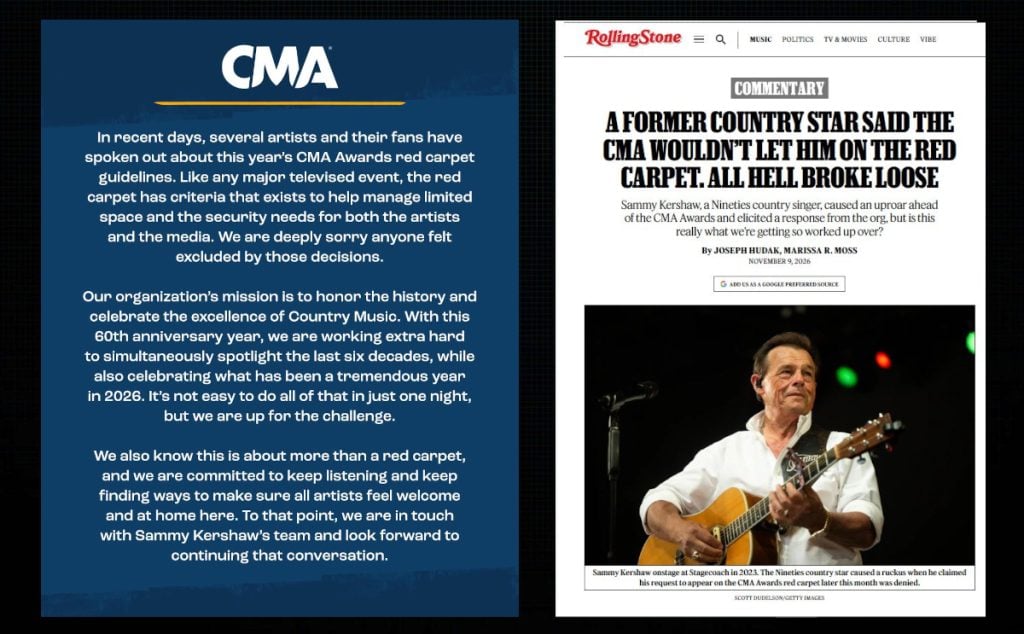
In recent days, several artists and their fans have spoken out about this year’s CMA Awards red carpet guidelines. Like any major televised event, the red carpet has criteria that exists to help manage limited space and the security needs for both the artists and the media. We are deeply sorry anyone felt excluded by those decisions.
Our organization’s mission is to honor the history and celebrate the excellence of Country Music. With this 60th anniversary year, we are working extra hard to simultaneously spotlight the last six decades, while also celebrating what has been a tremendous year in 2026. It’s not easy to do all of that in just one night, but we are up for the challenge.
We also know this is about more than a red carpet, and we are committed to keep listening and keep finding ways to make sure all artists feel welcome and at home here. To that point, we are in touch with Sammy Kershaw’s team and look forward to continuing that conversation.
As country artist Jake Owen said in response, “This is a lot of words saying nothing… “our mission is to preserve the history and celebrate the excellence of country music How about, sorry Sammy.. we messed up,..our words don’t match our actions. Instead, you waited 4 days to craft this?!?”
At this point, it’s uncertain if the CMAs were even intending to release a statement on Monday until they felt like their hand was inexorably forced, they had no choice. Saving Country Music published an article at around 10:15 am Monday titled, It’s Not About The Red Carpet. It’s About Respect after an assumed 10:00 am statement from the CMAs never came. When they concluded their statement album 2 1/2 hours later with “We know this is about more than a red carpet,” it feels like they had drafted the statement within the hour, and four days after they should have already worked to resolve the matter.
Meanwhile, Tim Rushlow of Little Texas and The Frontmen has also weighed in, saying,
This is as lame as it looks and sounds! A couple years ago, Larry Stewart (Restless Heart), Richie McDonald (Lonestar). and myself as The Frontmen Live were gonna attend the show and it was gonna be $4,000 plus no guarantee of any red carpet or press at all, just seats and that’s without wives!”
Add to the fact that every time we play CMA Fest, we have to pay our band and our crew and we play for free, yet they charge thousands of dollars per ticket and make hundreds of millions of dollars each year while the artists actually have to pay their own people just to play there, pretty nuts!! Not a fan of the hypocrisy at all.”
Little if anything unites Americans these days, or country music fans specifically. The culture war divide runs right down the middle of country music like a grizzly heart bypass scar. But this Sammy Kershaw situation has created a massive unifying effect. Irrespective of how anyone feels about Sammy or his music, the situation is a stand-in for how country fans feel their interests are not being met by the institutions charged to represent them, and instead entities like the CMA are beholden to corporate overloads and sponsors.
For the 2026 CMA Awards, they’ve just announced that the rock band Halestrom will be performing. Sure, singer Lzzy Hale has collaborated with country artist in the past. But why are we platforming an established rock band on a country show when the whole underlying red carpet controversy is about not having enough time for country performers?
Leave it to Rolling Stone Country to figure out how to leverage this situation not to speak to the anger and frustration millions of country fans who are venting their frustrations through the Sammy Kershaw situation, but to hector them about how all their energy and anger is misplaced, and their perspective is uncultured. It also came even later than the CMA statement.
Starting with the title of the article itself, you see the down-looking, generally disinterested, and systemically uniformed nature of this outlet and its perspective. “A Former Country Star Said the CMA Wouldn’t Let Him on the Red Carpet.”
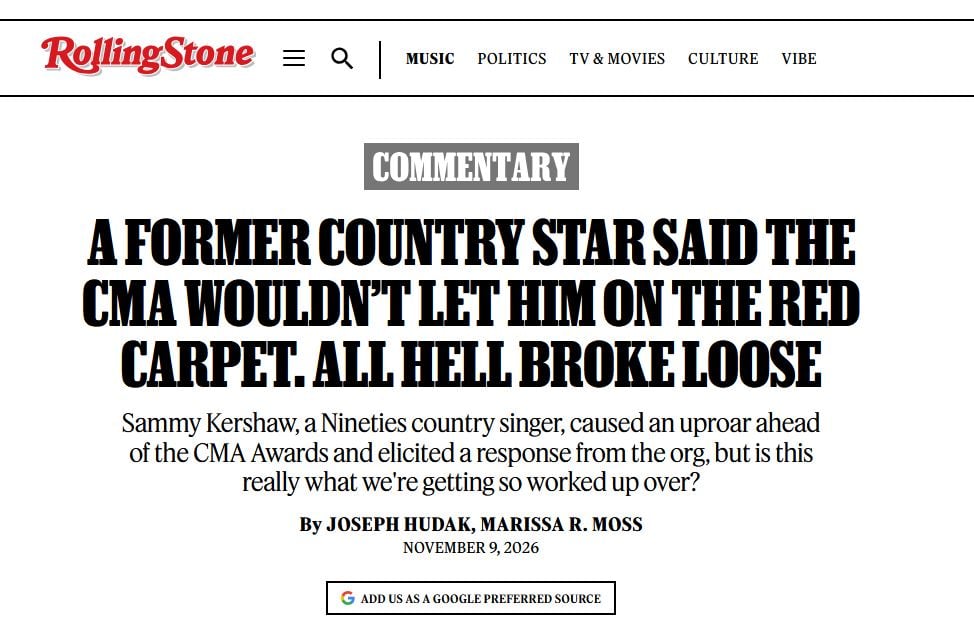
First, Sammy Kershaw can’t be dignified by having his name mentioned in the title. He’s not important enough apparently. They tell you that when they instead label him as a “former country star,” which again, is meant to demean, discount, and present him Kershaw as irrelevant—the same type of insulting is disrespectful behavior the CMAs participated in to instigate this whole matter.
Then in the subheading when they say, “Sammy Kershaw, a Nineties country singer…” they’re not just hectoring the reader—assuming they have no idea who Sammy Kershaw is and must explain it—they’re also revealing that they barely know who he is themselves, so in their reality bubble, people need this explained to them. This is all very similar to the recent case of Rolling Stone causing an uproar by calling Ian Noe an “obscure” artist while also leaving his name out of the title.
The truth is that the authors of the article, Joseph Hudak and Marissa R. Moss, think that country fans are all regressive uneducated cousin fuckers who deserve to be talked down to, and are simply a refraction point for them to virtue signal and morally preen to their upper crust elitist friends to gain cultural clout they can then use to paper over their own cultural indiscretions and bigoted attitudes towards others.
Hudak and Moss are also political apparatchiks who have no loyalty to country music or the fans that it’s their job to inform. They see country fans simply as unwitting pawns in their political game that they can mind meld through slanted coverage to do their bidding. This comes into sharp focus as the article unfolds.
The Rolling Stone article starts by hand waving away the whole situation in total, saying that Kershaw, “stirred up controversy — mostly benign, as these things go — when he took the org to task for allegedly not allowing him and his wife access to the media red carpet before the show. (He is still able to attend the awards as a ticketed guest, as all non-nominated artists are.)”
But of course, they leave out how Kershaw was going to be charged $800 each for his tickets, and even then would not be guaranteed to be seated in the artist section. They also left out the communication with Kershaw’s manager, and the fact that the CMA’s strung him out for two months.
The one good piece of reporting we do get from Rolling Stone is the specific criteria from the CMA for who gets to walk the red carpet, which apparently is what disqualified Kershaw. The requirements state that for someone to walk the red carpet…
They are a previous CMA Entertainer of the Year; they have had a Top 20 single on a Billboard or Country Aircheck Country singles or songs chart during the past three years; they have had a Top 10 album on the Billboard Top Country Albums chart during the past five years; they are a member of the Country Music Hall of Fame; they are a reigning 2024 (sic) CMA Awards winner; they have participated in CMA Foundation or CMA Industry Relation/Membership initiatives.
The Rolling Stone article does make sure to say, “Should the CMA just let him walk when the carpet opens in the early afternoon on Wednesday and call it a day? Certainly.” But otherwise, the article completely ignores the PR aspect of this entire thing, which ultimately is where the bigger controversy has presented itself. So when it laments that the issue is distracting from “the scores of artists in awards contention, including the women making huge waves this year,” it’s putting the onus for this on country fans instead of the CMAs who continue to fumble this situation, and should have nipped it in the bud four days ago.
Then Rolling Stone goes in, “This year’s 2026 CMA Awards do not boast one single Black artist nominee. There’s been little outrage over that … We’ve also yet to see such a vocal segment of the industry organizing boycotts on behalf of nonwhite artists who are repeatedly excluded from contention.”
Okay, but where was Rolling Stone writing dedicated articles, or calling for boycotts due to no Black artists being nominated when the CMA nominations were first announced? Where is their advocacy for the Black artists they believe should have been nominated? Who are the Black artists, or the albums or songs from Black performers that deserved to be nominated in 2026? They don’t name them.
Instead, Rolling Stone only levels ambiguous notions of racism against the CMA when BigXthatPlug was one of the featured performers in 2025, and Saboozey’s new album The Outlaw Cherie Lee was outside of the eligibility window, or it otherwise very well might have been nominated.
Instead of actually advocating for Black artists in country, it’s articles like this from Rolling Stone that get in the way of that advocacy work, and make it feel decidedly uncool. This is the 2016-era Woke 1.0 approach that has been rejected by the public en masse. As Rolling Stone and writer Matt Bai said perfectly in an article published on November 5th after the recent Midterm elections, “Democrats Stopped Lecturing America — And Won Big.
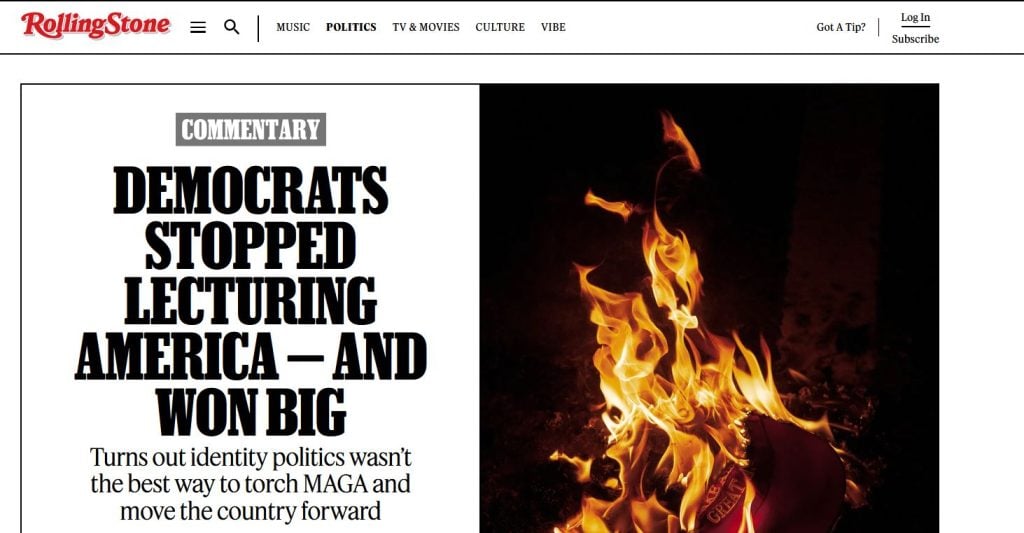
“Turns out identity politics wasn’t the best way to torch MAGA and move the country forward,” the article concludes, yet that’s exactly what Joseph Hudak and Marissa R. Moss are trying to do here. This is not to say that the CMA doesn’t need to be criticized for its lack of inclusion. But to act like ageism is a “benign” issue, but racism is the one worth getting outraged over confounds the issue, and again, doesn’t address the PR blunder which is where this situation was really sent into the stratosphere.
What Rolling Stone really misses here is the opportunity to make common cause with actual country music fans about the exclusionary nature of all country music institutions. Instead of speaking down to them, they could use this moment to illustrate how the same mechanisms that exclude aging artists are often is the same mechanisms that affect independent artists, and Black and Brown artists. But by discounting the efficacy of the Sammy Kershaw concern as “mostly benign,” they squander that opportunity.
And by the way, where was Rolling Stone‘s outrage and coverage when it was revealed Jelly Roll said the N-word three times on camera years after the Morgan Wallen controversy? Why were they part of the concerted media effort to sweep that under the rug? Where was Rolling Stone when Mickey Guyton penned an op-ed in Billboard about being disinvited from the Highwomen video shoot? Where were other Rolling Stone stories involving race when it didn’t fit their preconceived narrative? And if all these matters are so culturally important, why do they continue to put their coverage behind a paywall?
Ultimately, Rolling Stone‘s country arm is just like the CMAs—-staffed with people who aren’t of the country, aren’t even really country fans, and have been ensconced in positions due to resume points as opposed to real-world experience. They’re not in the trenches with their finger on the pulse of who country music fans are, how they feel, and why they have agency. And often, these people are outright repulsed by country fans, and see them as an epiphenominal distraction as opposed to who they are charged to represent and give voice to.
Country music is music of the people of the country. It’s the job of media institutions, award shows, and broadcast media to represent their interests. But they do not. Sammy Kershaw’s snub verified this. It’s not 2024 anymore. Everywhere you turn, institutions are being torn down, systems are breaking down, and people are speaking up more than ever. Instead of hand waving away the concerns of country fans by labeling their heroes “former stars,” and their outrage as “mostly benign,” perhaps listen to them.
– – – – – – –
On late Tuesday afternoon (11-10), Sammy Kershaw released a new statement.
First, I want to sincerely say THANK YOU to the thousands of fans, fellow artists, friends, and people throughout the country music community who have spoken up over the past several days. I am truly humbled beyond words. The outpouring of love and support has been overwhelming, and touched my heart in ways I will never forget.
When I first shared my disappointment about being denied the opportunity to walk the red carpet at this year’s CMA Awards, I wasn’t trying to start a controversy or looking for attention. I simply spoke from my heart because I was hurt. I never imagined the response would reach so many people across America and around the world.But, something happened that I never expected. As this story continued to unfold, it became clear from many thousands of people that this wasn’t just about me. It was for those who came before me, the men and women who gave us their hearts, their voices, their lives to country music. The ones who rode those highways long before there were tour buses. The ones who played the honky-tonks and sacrificed time away from their families. This is about something much bigger than me or any one artist. Those artists didn’t just give country music its sound. They gave it its soul.
This was never about the red carpet. It was about recognizing and respecting those who dedicated their lives to this music and preserving the history and legacy that makes country music so special.”
Over the past several days, we have been in talks with CMA leadership in hopes of finding a positive resolution.While I was disappointed with the time it took for the CMA to publicly respond, and felt their statement fell short of addressing the heart of the issue, I also believe in giving people the opportunity to make things right.
I’m pleased to share that we’ve since had a sincere and meaningful private conversation with CMA leadership. They have acknowledged how this situation was handled and extended a sincere, heartfelt apology, which I have personally accepted.The CMA has also extended an invitation for my wife, Mendy, and me to walk the red carpet and attend this year’s awards alongside our fellow artists. I am grateful for that invitation and appreciate their willingness to listen, acknowledge our concerns, and work toward a positive outcome.
But, perhaps the most important thing to come from all of this is the conversation we’ve started about the importance of recognizing the generations of artists who helped make country music what it is today, whether their name is still in the headlines or their songs are simply living on in the hearts of the people who grew up listening to them.You cannot celebrate 60 years of country music without celebrating the artists who helped build those 60 years.
Country music has always been about honoring where we’ve come from while embracing where we’re going. I have nothing but respect for the incredible talent carrying country music into the future. Every generation of artists deserves its moment to shine, and I believe there’s room to celebrate all of them.
My sincere hope is that the conversations we’ve begun with the CMA will lead to lasting change and an even greater appreciation and recognition of our industry’s legacy artists for many years to come.
Because the spotlight may move on, the charts may change, and the years may pass. But the people who built country music should never be forgotten.
To every fan who stood up and made their voices heard, every artist who spoke up, and supported not only me but the many artists who have dedicated their lives to this music, I want to thank you from the bottom of my heart. You were heard, and you reminded me that country music is still more than an industry. It’s a family. God bless you all.
So the specific issue of Sammy Kershaw being denied red carpet access is resolved. The underlying systemic reasons it happened in the first place still remain, as does the concern of how this issue was handled, how long it took to address, and the now nearly dozen or so other performers who’ve come forward to say they’ve felt disenfranchised by the CMA.
This doesn’t feel like the end of the story, but where it should begin. Perhaps as current CMA CEO Sarah Trahern retires at the end of the year and new CEO Brittany Schaffer comes in, this conversation can evolve into significant chance in how the CMA does business.
Whether the whole imbroglio becomes a major distraction for the 2027 CMA Awards on Wednesday, November 18th remains to be seen.
– – – – – – – – – – –
If you found this article valuable, consider leaving Saving Country Music A TIP.
November 10, 2026 @ 4:50 pm
This is what I was wondering. So, as it turns out, Sammy Kershaw helped rescue the CMA’s image. But that alone won’t solve the bigger problem, unless the rest of Sammy’s message is actually taken to heart. And while I hope it will, I am also realistic. I’m not necessarily saying that Sammy did the wrong thing. I’m saying that Sammy’s decision to go helps the CMA more than it helps him.
November 10, 2026 @ 5:16 pm
Sammy threw the CMAs a lifeline for sure. And without that, the CMAs would have been riddled with controversy and distraction at every turn. At the same time, I think Sammy kept his dignity in tact, and also didn’t make all the energy and effort over the last few days feel like it was in vain.
For the record, I wrote the majority of this article before Sammy Kershaw released his statement. Because I feel like it was vitally important to put on paper some of the criticisms the CMA and Rolling Stone had coming. But it also feels good that the matter has some sort of resolution to conclude on, even if there’s still a lot of artists out there that still won’t receive an invitation, and arguably deserve one.
November 10, 2026 @ 5:13 pm
I’m glad Sammy and his wife are going to be able to walk the carpet. I’m especially glad someone over at the CMA’s woke up and realized just how poorly this had been handled. By reason, or by force? I’m still not sure.
There is a lot of trash over there that needs to be cleaned up. AI bots handling the red carpet carpet invites probably should be 1st on the list.
November 10, 2026 @ 5:27 pm
“But why are we platforming an established rock band on a country show when the whole underlying red carpet controversy is about not having enough time for country performers?”
Sorry to go off on such an insignificant detail to the article as a whole, but most of the “country” music that come out of Nashville these days is a southern draw away from being called bad rock music. Even on the independent side of things, much of your “Texas music” are red dirt is rock in all form and function. Furthermore (and there is some poetic irony to this), “country music” is sonically in its early 2000’s rock phase, where it’s almost lost its form, but is just hanging on to its sonic identity by the slightest thread.
The crux of this whole rant is this question: what’s the issue with a rock artist performing at the CMA’s if their music sounds almost exactly the same as a “country” music? I know I’m largely ignoring the main point of the article, and am sure that I’m somehow completely wrong or something, but we’re talking about “country music” here, not “traditional country music” or any other sub-category of country music. Why Whisky Myers, Jason Aldean, and so many others are called “country” artists while [insert MOR rock band] isn’t is just something I just can’t wrap my head around.
November 10, 2026 @ 5:50 pm
Halestorm is nothing like the modern country artists you mention. They belong on the CMA Awards about as much as someone like Drake does.
November 10, 2026 @ 5:53 pm
Hey James,
So there’s multiple layers to this question.
First, Treaty Oak Revival, Dexter and the Moonrocks, even Koe Wetzel and Southall to an extent, these are all rock bands from Texas that people are pushing through country channels because it’s convenient, and I’m more opposed to that than I am having Halestrom on the CMA Awards. But two wrongs don’t make a right. If you are going to put a rock band on stage, why not make it one that’s country adjacent? Whiskey Myers is having a massive moment with their song “Broken Window Serenade.” What is the cultural tie-in with Halestrom?
Rock, hip-hop, and pop rarely turn their stages and opportunities over to country acts, and they shouldn’t feel the need to. But country suffers from an inferiority complex, and always feels like it needs to reach out to other genres to be “cool.” I try to be pragmatic about putting non-country acts on the CMA Awards, but (initially) refusing Sammy Kershaw underscores how when you invite them on, that’s one less slot for a country performer, even if it’s just on the red carpet.
I have no issue with Halestrom or Lzzy Hale. But to be frank, it feels like we’ve seen this episode before. She appeared with Eric Church at CMA Fest over a decade ago. She also performed on the CMT Awards. It sounds like she’s going to be singing a Brooks & Dunn song. Why not have one of these promising neotraditionalists like Mack Geiger or Jake Worthington do it instead?
This Sammy Kershaw red carpet situation amplifies all of these concerns. Otherwise, it probably wouldn’t be as big of a deal to have Halestrom on.
November 10, 2026 @ 6:02 pm
I remember when RollingStone was cool. As far as I can tell, it’s nothing more than a political rag masking as a music and culture magazine these days (actually, it’s been that way for a very long time).
“They are a previous CMA Entertainer of the Year; they have had a Top 20 single on a Billboard or Country Aircheck Country singles or songs chart during the past three years; they have had a Top 10 album on the Billboard Top Country Albums chart during the past five years; they are a member of the Country Music Hall of Fame; they are a reigning 2024 (sic) CMA Awards winner; they have participated in CMA Foundation or CMA Industry Relation/Membership initiatives.”
If this is the case, why are hip-hop and rock acts allowed to attend and walk the red carpet? Also, why are so-called influencers and actors put before country artists?
November 10, 2026 @ 6:21 pm
If it’s written by Rolling Stone and/or Marissa R. Moss, you might as well throw it away. It’s incredible to see Sammy graciously pull the CMAs out of the PR nightmare of their own creation. Also, if the CMAs would have just listed the red carpet requirements from the start and made those clear to Sammy Kershaw and others at the time of inquiry, there would have been no confusion. However, it feels more like the “red carpet requirements” were mere suggestions with a lot of wiggle room based on who you know, which is probably where Sammy got strung along by them. One thing is for certain: This will be the most-watched red carpet the CMAs has ever had.