

Once Again, Country Goes Under-Represented in the Grammy Telecast
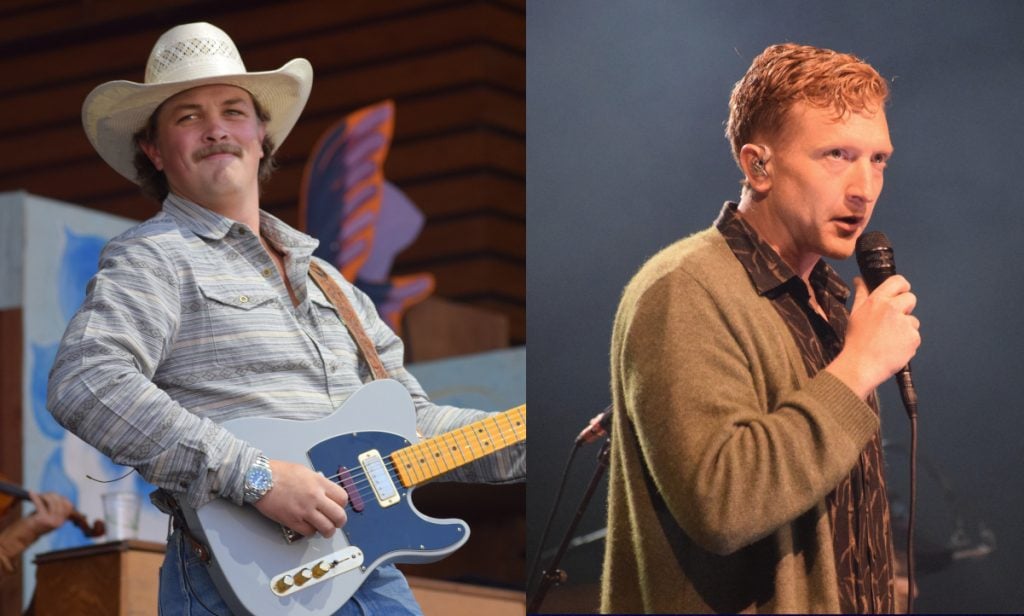
The Grammy Awards were handed out on Sunday (2-1), with Zach Top, Jelly Roll, and Tyler Childers being some of the big winners in country, and Billy Strings, Mavis Staples, and I’m With Her the big winners in the American Roots categories (bluegrass, folk, Americana). But for the second year in a row, country and roots music went virtually unrepresented in the televised presentation of the awards. Instead, it was a constant parade of pop and hip-hop performances, even as country remains a very popular genre.
A lot has already been made already about how not a single artist, song, or album from country or roots competed in the Grammy’s big all-genre categories in 2026, namely Album of the Year, Song of the Year, Record of the Year, and New Artist of the Year. A recent breakdown of the Grammy voting population exposes a dramatically under-represented bloc where the country and roots voters should be that results in such outcomes.
“Only 7% of Grammy voters come from the country genre, according to the Recording Academy (compared to 24% for pop and 16% for jazz),” the report says, while “only 1% of this year’s new voting members identified as being most aligned with the country genre.“
But while voting and Grammy membership is not entirely in the Grammy’s control, the performances are. In 2025, aside from Brad Paisley appearing in a multi-genre opening segment with Dawes centered around the L.A. fires, Lainey Wilson appearing in tribute to Quincy Jones, and a quick appearance by Shaboozey, country music was nowhere to be seen. Similarly, rock music also was absent from the presentation.
In 2026, the sum total of country’s participation in the 3 1/2 hour show was the 4 minute, 44 second performance by Reba McEntire, Brandy Clark, and Lukas Nelson of Reba’s “Trailblazer” as part of an In Memoriam segment, which quickly was forgotten when Post Malone and a bunch of A-list rock guys came out in tribute to Ozzy Osbourne—which was the sum total of the rock featured on the presentation. In other words, aside for In Memoriam time, country and rock were once again shut out.
Grammy member, music historian, performer, and author John Lomax III has let it be known that he found the Grammy’s curation of the performances unacceptable in a letter he sent to the Nashville Recording Academy’s Executive Director.
“There were no country, bluegrass, folk, jazz, blues, gospel or classical music performances so, ‘Music’s Biggest Night’ was confined to rap, hip-hop, pop, alt-rock and K-pop,” Lomax wrote. “Last year at least we had a Herbie Hancock jazz segment. My conclusion is that the Recording Academy does not consider American roots music performers worthy of national exposure. As a long-time member of the Academy I find this very disturbing.”
Some have also pointed out a pretty glaring omission during the Grammy’s In Memoriam segment. Generally speaking, the Grammys do a great job with honoring fallen music greats, and a much better job than country’s CMAs and ACMs do. Songwriter Brett James, Jeannie Seely, Todd Snider, Joe Ely, Raul Malo of The Mavericks, even Roger Sovine, the son of Red Sovine and a song rights executive were honored.
But the Grammys forgot to mention one of the biggest losses in country music in 2025, Johnny Rodriguez. For an organization that prides itself in representing diversity, this was an especially unfortunate omission. Johnny Rodriguez was instrumental to integrating country for Hispanic performers and fans.
On Tuesday (2-2), Billboard published an article asking, “When Did The Grammys and VMAs Swap Places?” with the subhead reading, “MTV’s marquee event used to be the the hipper, younger alternative to Music’s Biggest Night, but Sunday night’s Grammys showed how it’s become the more urgent awards show.”
The article goes on to point out how it used to be the VMAs where “the pop, rock and hip-hop stars built their iconic legacies with performances, acceptance speeches and red carpet moments, where the music defining the era’s youth culture was ably represented by the artists on stage and in the audience.” Now that’s the Grammys, while the VMAs are focused more on paying tribute to legacy acts—something the Grammys used to do more of.
This underscores the culture shift happening at the Grammys from being the non-profit Record Academy of Recording Arts and Sciences, to chasing the cultural zeitgeist and those shocking moments that used to be resigned to the VMAs.
This shift is what has locked out many actual musicians, actual musical performances as opposed to lip-synced presentations with choreographed dance routines, and left more organic performances from all genres on the outside looking in. At the least, one of the nominees from Best Contemporary Country Album could have performed. Jelly Roll might not be that country according to a lot of actual country fans. But being the big winner of the night, at least he could have performed.
At one point during the introduction, host Trevor Noah said that hip-hop was no longer just a genre of music, but a lifestyle, and cultural movement. But that was an anecdote that would have been more relevant to issue in 2014 when even country was adopting hip-hop via Bro-Country.
Today it’s country music that’s dominating American culture with artists like Beyonce, Post Malone, and others donning cowboys hats and making supposed “country” records. But for some reason, the Grammys are not paying attention to that cultural shift in their performances. And that shift won’t be around forever. These things ebb and flow. But while they’re flowing, they Grammys should be working to represent country equitably on their stage and televised presentation.
In 2017 when Sturgill Simpson won Best Country Album for A Sailor’s Guide to Earth, they moved the handing out of Best Country Album to the pre-telecast “Premier Ceremony.” During his speech, Sturgill said, “I guess the revolution won’t be televised.” That remains the case for the rising popularity of country when it comes to the Grammys.
– – – – – – – – – – –
If you found this article valuable, consider leaving Saving Country Music A TIP.
February 4, 2026 @ 9:19 am
NARAS doesn’t care about country music or its fans and it won’t change.
Seriously though, do country fans care about the Grammy Awards anymore? There’s no more male and female artist categories and traditionally minded people don’t go for the genderless, new age rubbish they’re getting handed. Awards shows aren’t what they used to be anyways as a drawing card.
February 4, 2026 @ 9:24 am
The Gammy Awards represented country better when it wasn’t so popular than they do now in the performances. I do think this is making the Grammy’s less relevant to country fans, and that’s why I’m speaking out. Just like with the Super Bowl, we’re not asking for half the presentation to be country. But how about one country artist performing one of their original songs in a 3 1/2-hour presentation? How about one country artist perform since it’s been 32 years. These don’t come across like huge asks. Just give country and roots a little love.
February 4, 2026 @ 9:50 am
It would be good to see more country and roots music on there. I don’t think they like country and roots fans and don’t care to engage with us. They’re trying to engage young people who aren’t into what we like. However…
This is from a conservative news site I won’t identify:
“For the second year in a row, the Grammy Awards took a dive in the ratings, primarily due to a collapse in younger viewers.
On Sunday, only 14.4 million people tuned into a show that regularly drew somewhere between 25 and 40 million viewers from 2016 to 2019.”
The Bad Bunny and Billie Eilish fans aren’t tuning in when they’re the ones the organizers are trying to engage. The older, more traditional minded folks who have tuned in in the past aren’t being served and the kids they want to serve don’t care.
Maybe they’ll learn and listen to what you and Alan Lomax III are saying. I won’t bet on it. They want to be the cool kids and hype the viral acts. People like us are expendable. People tune in to the Super Bowl because it’s bigger than life even when Country acts are shut out from halftime. The Grammies are not a big deal.
The Grammies organizers used to think it was a service to highlight jazz, country, blues, classical and other less commercial genres. On the second year that best Jazz Fusion recording was awarded, Manhattan Transfer and Chuck Mangione performed, and Al Jarreau and Woody Herman handed out the award. I love it!
Now the public service is promoting left-wing political stances and lapel pins. Zach Top or Stephen Wilson, Jr. need not apply even though they can put out 4 minutes of great performing and open eyes to something new.
February 4, 2026 @ 9:49 am
The grammy awards are just a pat on the back from major labels to themselves for successfully narrowing the airwaves and big streams to feature only their globally homogenized product. The genre awards – which inherently have a lot more independent artists – aren’t broadcast, because majors don’t care about genres since genres (country, rock, soul, rnb, jazz, folk, etc) don’t scale globally. It doesn’t even have anything to do with youth culture at this point – it’s purely business aimed at optimizing input costs. Corrupt isn’t exactly the word for it, but to pretend it has anything to do with actual music is naive.
February 4, 2026 @ 10:13 am
Good points made. The mono-genre is real.
The business is about pushing the big streamers (formerly big sellers) and the thought that highlighting the roots-oriented genres is quaint. Apparently, ratings for the show don’t matter anymore.
February 4, 2026 @ 9:50 am
Yeah, not acknowledging Johnny Rodriguez is a head scratcher — especially in light of some of the other acknowledgements. He crossed over not only genres, but languages. You would have thought they would have been all over that opportunity to virtue signal on diversity and inclusion. Then again, recognizing that Latinos (and Blacks, for that matter) have historically found success among and appreciation from country music fans doesn’t exactly fit the narrative about rural whites being the greatest threat to mankind.
Finally, I don’t want to diminish Rodriguez by bringing in the diversity and inclusion context. He deserved to be recognized in his own right. It was an egregious oversight, whatever the reason.
February 4, 2026 @ 10:00 am
…it gets pretty difficult to stage country music appropriately at the grammys, if its arguably biggest draws – morgan wallen and zach bryan – can’t be bothered to submit their works. the only genre behaving so stupidly is unfortunately country music.
this is not a situation to raise complains – this is a situation to pass some blame. but of course, when the people sounding country (one way or another) are cultivating their disgust for appropriate manners and behaviour in the most egocentric fashion, one mustn’t wonder.
i did not hear any complaints from sabrina carpenter, who could have had some reason for disapointment being in the spotlight there left, right and center and not winning anything. the young woman didn’t lower herself to take it like a country man. good for civilisation – embarassing for country.
February 4, 2026 @ 10:22 am
Think were approaching a big C little C situation here with Country Music. little c country music is getting more exposure as musicians continue to push boundaries and blend genres. Big C Country, which seeks control over the genre no doubt hates that, so the producers of shows like the Grammys are gonna go where they think the viewers are and not defer to the genre associations to dictate that.
Thats all Ill say on this, because frankly, everyone hates the Grammy, everyone always has, the elders of every genre thinks that the Grammys do them dirty and music critics often agree. Its timeless and its not really going to improve