

The Spiking New Property Taxes on Nashville’s Lower Broadway Explained
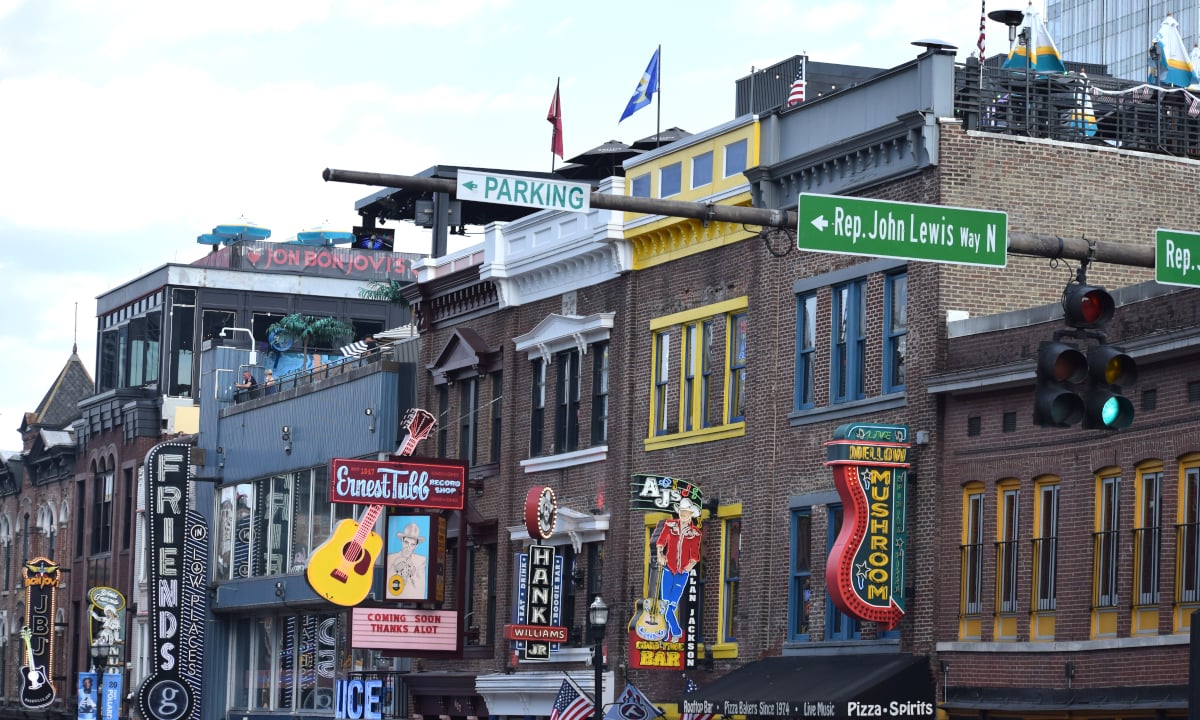
The few independently-owned businesses left in Nashville’s popular Lower Broadway district that don’t just appeal to tipsy out-of-towners are facing an existential crisis as a massive spike in property taxes is coming due at the end of February.
It was previously reported how independently-owned music venue and restaurant Acme Feed and Seed is facing closure due to their property taxes spiking from $129,000 last year to $589,000 this year—an increase of 356%. That’s more than our rent and net profit combined. We can’t pay it. It’s punitive,” says owner and local preservationist Tom Morales.
But that’s just where the concerns begin. Layla’s is another one of Lower Broadway’s few spots that caters to traditional country artists, original music, and a more authentic experience. Owner Layla Vartanian said recently to The District Nashville, a nonprofit that works to preserve Nashville’s historic core,
“I’ve never seen an increase of any kind of property tax or any kind of tax in such a short period of time. We’re having an increase of 300-400% on these buildings down here, on our commercial buildings. Even on our personal properties, residential properties, the increase is 300% and 400%.”
According to The Tennessee Star, other Lower Broadway businesses are seeing a massive spike as well. Some of the numbers they accrued were in line with Acme Feed and Seed, and Layla’s.
Honky Tonk Central – $81,000 (2024) – $348,000 (2025)
Honky Tonk South (Kid Rock’s bar) $209,000 (2024) – $765,000 (2025)
Friends in Lowe Places (Garth Brooks’ bar) $397,000 (2024) – $839,000 (2025)
Though these properties represent some of the biggest, and perhaps some of the most stable businesses on Lower Broadway, they illustrate the dramatic spike in property taxes that will disproportionately affect the smaller, more independently-owned businesses that often attract more local patrons, more distinguishing country fans, and often book more original music as opposed to party bands—places like Layla’s and Acme Feed and Seed.
What is the cause for this massive, year over year spike?
According to metro Councilmember Jacob Kupin, new property tax assessments were done in the summer of 2024. Those bills were then sent out in October of 2025, and are due at the end of February of 2026. This is the reason Acme Feed and Seed is facing such a steep bill due right now.
Many businesses in downtown Nashville and Lower Broadway have what are called “triple net leases,” which means even though they don’t own the physical building themselves, they are responsible for the property taxes. So when these property taxes go up, there isn’t a landlord to share that burden with.
But another big factor appears to be that the last time property tax assessments were done on Lower Broadway was in 2021 during the COVID-19 pandemic. Due to the depressed nature of the economy and tourism over that time—including some businesses that closed for long periods—the property valuations came in uncharacteristically low. In some cases, property taxes when down for landlords and businesses.
At the time, the lower property evaluations were seen as an inadvertent relief for businesses that rely on large crowds to be able to pay the high overhead of doing business on Lower Broadway. But now that business is booming better than ever on Lower Broadway, those tax assessments are spiking.
Councilmember Jacob Kupin also underscores that the property values are not based off of actual revenue or profits these businesses make, but are “on paper” assessments, often tied to square footage, location, and comparable properties. Due to the nature of business on Lower Broadway, calculating property tax can be quite complicated. Some businesses are only one story, while others are four or five. Some are museums or retail, while others serve food and drinks.
There is an appeals process. But the current way the appeals process works is business and property owners are expected to pay the original property tax bill in full, and then wait for the appeals process to transpire to see if they might be discounted and reimbursed. The city has until September of 2026 to make those decisions.
Nashville Mayor Freddie O’Connell drew a strong negative response when he was asked about the situation, and the quote shared from him was, “It’s not up to me whether he keeps that business open. The market evolves. New businesses start even as beloved old businesses close.”
But unreported by many news outlets was a “fact check” by the mayor’s office where the full context of his exchange with a local FOX reporter was recorded.
The more full quote from Mayor O’Connell reads,
“Well, I mean, I think the hard part for all of us in moments like this, I’m happy to invite the assessor up because, you know, this is a combination of how these things work, but we’ve had the Comptroller review these valuations, and the Comptroller has determined that downtown’s valuations are reflecting market value at this point. It’s an incredibly valuable piece of property. My understanding is Tom has already entertained some significant offers recognizing that value. So, it’s not up to me whether he is going to keep that business open. It’s up to him as a property owner to determine how to capture the value that’s inherent in the property.
To read the full interaction, CLICK HERE.
Nonetheless, Councilmember Jacob Kupin is not impressed, saying he’s “appalled” by the Mayor’s response. “It’s contrary to what my district believes It was really a disappointing message from the mayor. Our job is not to say, ‘too bad, so sad.’ Our job is to protect these businesses.”
If these massive property tax spikes stand, it could radically transform Lower Broadway, and not for the better, forcing every square inch of every business to leverage maximum revenue, likely meaning dramatically higher prices for patrons, and squeezing pay and benefits from local employees.
– – – – – – – –
If you found this article valuable, consider leaving Saving Country Music A TIP.
February 19, 2026 @ 7:27 pm
Notice that no one suggests bringing down the tax rates in order to not drive the businesses away.
February 20, 2026 @ 6:26 am
The “issue” with that is that means cutting services and/or department budgets. And then you get that crowd out whining. And politicians hate that just as much as property tax bitching.
This is happening in other parts of the country, mostly because cities got fat and happy on COVID-era dollars from the Feds.
Now that that money is gone, you have the whiplash effect where department budgets that grew with those Federal funds either need to be slashed back down or local taxpayers assume the bill.
I don’t have insight into Nashville specifically, but this is why as someone with local government experience, I advocated for only one-time investments with the COVID dollars. Build fiber broadband. Fix roads. Upgrade IT equipment.
But just giving raises to employees or writing the PD a blank check or undertaking some new social program was always a ticking time bomb once that money was tapped out.
February 19, 2026 @ 9:02 pm
The city officials obviously want that land area to be razed clean to the ground and re-developed into something that will provide the local government with greater annual property tax revenues. Like most self-serving politicians they don’t care about historical buildings or country music other than as a tourist draw. Truly pathetic…
February 19, 2026 @ 10:15 pm
Due to the historic designations of the vast majority of the buildings on Lower Broadway, many of the buildings can’t be razed or even seriously altered without approval. But I do believe the mayor’s rather callous tact to this issue is due to wanting to leverage as much revenue from the region as humanly possible, and if that means bankrupting cool businesses, they don’t care. They want the property tax revenue for the new stadium, public transit projects, and other pet initiatives. Most folks local to Nashville look at Lower Broadway as a scourge. What they don’t understand is this public policy will make it even more of a scourge, and completely unappealing and so overpriced it will implode under its own volition like was Las Vegas is presently doing, ultimately undercutting the corridor as a tourist destination, and an economic engine for the city.
February 20, 2026 @ 6:13 am
Double vodka and redbull was $21 last time ibwas at laylas …they cant raise prices anymore next will be cover charges ..it is impossible to drink and eat in lower broadway and not spend $200 a night ..its fuckin bullshit …whats next roberts western world is expanding and the mayor does nothing about these problems if roberts and laylas leave downtown ther will be no reason to go for any locals to go and bring riends and celebrate the culture they have spent 30 years building from where it was in the 90’s..luckily i have a place in east nashville to go i rarely go downtown anymore ..cost me $60 to park down behind acme when i went to roberts street party last 2 years ..its rediculous …the shitty theme bats with $ 20 burgers and now the kane fuckin brown bar is comin
February 20, 2026 @ 12:58 pm
Don’t ever park there lol. Park underneath the Batman building or at Music City Center then it’s around 15-20 for a few hours. Parking at Music City Center is great because when you leave you are not fighting the worst traffic.
February 19, 2026 @ 9:25 pm
Layla Vartanian said residential properties are going up 300-400%, too. If that’s true, why isn’t everyone in Nashville screaming?
February 19, 2026 @ 10:01 pm
I believe what Layla is talking about here is the residential properties within the downtown area, and there are some of these, and some of the old-school business owners down there live nearby. But I’m not 100% sure. I attempted to contact and speak to Layla for this story, but couldn’t connect.
February 20, 2026 @ 12:41 pm
I moved from Nashville to 40 mins south in 2020. The small house I was renting most likely costs double now and is twice my mortgage. Unless someone is earning 6 figures and up…they have roommates.
February 19, 2026 @ 10:37 pm
Cut spending? Look for unnecessary bureaucracy? Heck no, the solution is always raise taxes. Raise them and keep raising them until the politicians get what they want.
February 19, 2026 @ 11:25 pm
So during COVID they lost all of the revenue from tourists and bars because they chose to completely shut the town down – that year they implemented a 32% property tax increase for residential homeowners…I sold my house the next year. Complete bullish%t…this is the Nashville leaders trying to pad their coffers and showing they do not care about anything except money as long as they are in office…I moved to Nashville in 1994 – you could have bought a building on Broadway for $75,000…now they say they are worth $50 Million?
February 20, 2026 @ 4:00 am
“Triple net leases”…Can we say “360 deal”, anybody?
February 20, 2026 @ 5:32 am
Unfair to the business owner? Yes.
Should the business owner have entered into a lease contract with the property owner under triple net terms? Absolutely not.
February 20, 2026 @ 7:51 am
The problem for a business owner is they can’t anticipated any expense going up by 350% year over year, especially something as big as property taxes. The triple net issue is downstream from the fact that property taxes are being raised so egregiously, the triple net deals are being exposed. If property tax goes up annually 10% to 20% at the most as it normally does in most locations, we’re not even talking about triple net leases.
February 20, 2026 @ 9:46 am
Yes. Forget the lease structure. No business can afford property tax quadrupling, be they a landlord or a restaurateur. Even if the landlords had been stuck with the tax bill, what are they going to do? Pay it out of the kindness of their hearts? They are going to pass the cost on to their tenants by qunitupling rent. Or they are going to not pay and sell the building with a tax debt and then the tenant gets a new landlord who wants a return on his investment and sextuples the rent.
February 20, 2026 @ 6:19 am
All they want is some new bar with a collage of pictures of roberts ,laylas,and acme or a fuckin mural painted in wall while they tear it down for more $700 a night hotels and apartment that rent for $30,000 a month ….pathetic
February 20, 2026 @ 6:33 am
Simply put, if the establishment owner cannot afford the property tax, given the amount of business that walks in the door each day, then the tax rate is prohibitively high. A 3rd grader could understand this concept. Why can’t these Nashville beaurocrats get that?
So if as the esteemed Mayor suggests, Tom sell his beloved building, what’s the guy behind him who buys the building gonna do? How will his investment team make a profit? What would they do save raise drink prices to the moon?
The amount of stupidity and greed here is obscene. Way to go Nashville. Destroy your own golden goose.
February 20, 2026 @ 7:54 am
Exactly.
February 20, 2026 @ 7:19 am
I’m all for supporting local business and it’s a shame these smaller places might be lost but this is an inevitable part of Nashville becoming what it has. There’s huge money in tourism and these smaller places don’t draw the crowds/dollars the larger ones do. Property taxes aren’t pulled out of thin air either, they are based on the value of the land and obviously the land here is a gold mine……. because of the tourism dollar potential. So have to pick a lane – you can’t have small local businesses with limited income potential and also maintain/grow your huge tourism industry. The market has evidently spoken here and Nashville is choosing tourism. Also these property owners can always sell and make a killing – I’m sure they won’t complain at that time.
February 20, 2026 @ 11:18 am
If you go into Layla’s, Robert’s Western World, Acme Feed and Seed, they’re almost always packed to the gills whenever the rest of the Lower Broadway bars are. This is not about not enough people frequenting these locations. Also, since all the buildings on Lower Broadway are protected by historic designations, there’s only so much any location can do to maximize the profit per square foot. You can shut businesses down all day. That doesn’t mean another more profitable business will take its place. Maybe it will, but that’s not guaranteed.
What happened in downtown Austin is you had entire city blocks on 6th Street (Lower Broadway equivalent) go abandoned, and they’ve been that way now for 15 years. Where Emo’s used to be located there and moved away for more space and cheaper taxes, and now that block has been vacant since 2011, with the other storefronts also boarded up. Guess how much revenue the city is making there now? And nobody wants to move there because they can’t make the economics work, even though it’s right in what is supposed to be the entertainment district.
February 20, 2026 @ 9:35 pm
So to expand on your point. It appears that the assessed values of these establishments is largely influenced by the multiple of location x lot size x potential for rebuilding on that lot.
If, however, the building on a lot is protected in some historical way that would kill the rebuilding potential part of the equation.
IF this is true I would say that those owners would have a very good case to present upon appeal.
February 20, 2026 @ 9:04 am
Taxation is theft. Especially property taxes. You never own your land; you are merely leasing from the government.
We revolted over a small tax on tea.
This country has gone soft.
February 20, 2026 @ 10:17 am
100% agree. I think it’s way past time to spill the tea. In Nashville and everywhere.
February 20, 2026 @ 6:39 pm
“Taxation is theft” Am I correct to assume that you believe there should be no taxes of any kind? Zero taxes?
February 22, 2026 @ 11:02 am
None whatsoever. Good people who preach about helping others will do the right thing and donate to programs. Isn’t that what people preach? The collective that willingly wants to fund government for the greater good will.
February 23, 2026 @ 1:39 pm
Ideally, yes.
But I am fine with a small sales tax. No property or income taxes.
America’s economy did fine without the income tax.
February 24, 2026 @ 7:15 am
We pay a lot of taxes on the air that we breathe too, indirectly.
The air should be pure as a virgin nun if it helped just a bit.
February 20, 2026 @ 9:11 am
The spike in taxes reported above is staggering. It seems to me that Nashville is being short sighted, much like the UK government. Raise taxes but if businesses cannot afford them, they go under. Once that happens, there is even less tax revenue, fewer jobs and less venues and less reason to visit with the result that Nashville will not have as much money in its budget to spend. Here in the UK taxes are up and so is unemployment. Lower taxes so often means more jobs.
February 20, 2026 @ 10:16 am
Property taxes are unconstitutional and should be abolished everywhere.
February 20, 2026 @ 11:24 am
Reasonable property taxes to help pay for schools, city services, civic improvements, etc. should be something we all should be willing to pay. I take greater umbrage with income taxes for low and middle income people. Nobody has to own property, and property ownership often comes from wealth. Everyone has to work.
But this story really emphasizes how egregious taxation destroys community, and undercuts civic responsibility. Nobody’s getting rich running Acme Feed and Seed. They do it to offer a more healthy alternative on Lower Broadway, and hopefully turn a little profit for their time.
February 20, 2026 @ 11:52 am
Considering how poorly mismanaged our schools, services, and civic improvements are, that is hardly a good argument. Our public schools barely teach the bare minimum while fat cat union administrators soak up massive salaries.
The income tax amendment was the start of America’s downfall. 1913 was a terrible year.
I am glad you wrote this article, Trigger.
February 20, 2026 @ 12:38 pm
“Reasonable property taxes to help pay for schools, city services, civic improvements, etc. should be something we all should be willing to pay.”
This is the problem. Most voters are so willing to be slaves for the government they convince themselves they are doing their part while greedy politicians get fat and rich and piss their tax dollars away on mostly dumb shit.
The people who decide what is reasonable more often than not couldn’t manage a McDonald’s let alone a city like Nashville. Yet folks keep voting for their own poverty and demise. You get what you elect.
Also, this idea that no one should own property is complete horseshit. It’s always the people who can’t afford something who think those who busted their ass building their wealth shouldn’t be able to own the those same things.
February 23, 2026 @ 1:38 pm
Well said, Jimmy.
February 22, 2026 @ 11:06 am
Nah, taxes in goods, food etc can pay for all that. Spread it among the collective. Property owners should not carry the burden for it.
February 22, 2026 @ 11:25 am
People have to work, and people have to eat. Taxes should be the most minimal, if not non-existent on these things, until they rise into the realm of luxury experiences and major wealth acquisition. I agree that property taxes should be minimal as well. All taxes should be as minimal as they can be. But property ownership defines those who are more wealthy in America. It is the seat of the American Dream. The median age for a first time homeowner right now is 39, WAY up from previous eras. You have a lot of older Americans sitting on large sums of equity as the youth of America are very quickly seeing the American dream evaporating. These wealthy Americans then turning around and acting like they shouldn’t have to pay for taxes is undercutting the very fabric of America. The rich get richer, the poor get poorer because they’re still paying taxes on income and essentials, and the homelessness rates spikes, like we’re seeing as well.
Appreciate this is an article about the egregious taxes being levied on independent business in Nashville, and advocating against it. Private homeowners who act like they shouldn’t have to pay ANY property taxes is just as an egregious of an assertion. Of course property taxes are too high everywhere. But I’d rather see food and income taxes abolished first.
February 20, 2026 @ 12:53 pm
I don’t understand how growing tourist revenue is costing the city 600% more in costs. The property tax rates should be a percentage of the business revenue; otherwise venues will have to cater to the lowest common denominator.
February 20, 2026 @ 1:47 pm
Sounds like the result of a lazy or understaffed assessors office. These properties have not been assessed since Covid. Had they been assessed on a yearly basis, the increase would have been more gradual.
February 22, 2026 @ 9:55 am
*since lockdowns. Covid had no effect.
February 20, 2026 @ 11:40 pm
And now The Valentine is becoming a Kane Brown bar. Hilarious!
February 22, 2026 @ 1:07 am
Who even wants that? I’ve yet to meet a Kane Brown fan in real life.
February 22, 2026 @ 9:54 am
Number one goal of local government is to generate revenue. Any way possible.