

One of the Unspoken Reasons for “Blue Dot Fever”
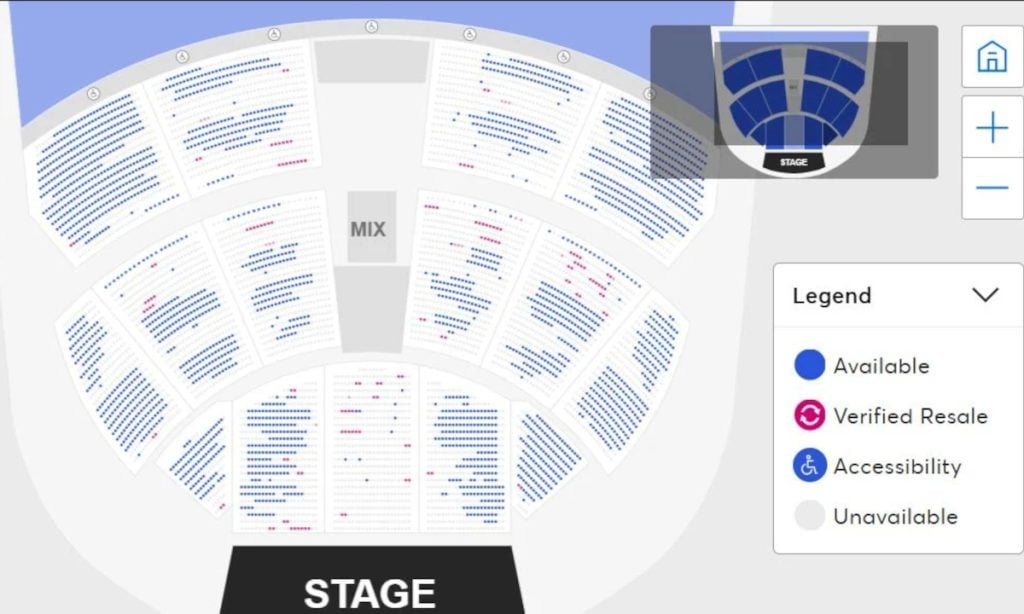
In 2026, one of the big narratives in music has been what’s coined as “Blue Dot Fever” from the rash of undersold tours and events for artists and venues big and small, resulting in postponed tour dates, cancelled festivals, and sometimes entire tours being 86’d due to lack of demand. The “blue dot” nickname comes from the demarcation of available seats on Ticketmaster seating charts.
Everyone seems to have a theory of what’s happening whenever an event, tour, or artist gets hit with blue dot fever. Some blame politics with either “go woke go broke!” or “they’re Trump-aligned!” theories bandied about. Others blame the economy that despite the wealthy doing very well, continues to affect the rank and file significantly, with inflation eating away at expendable income, and young people being affected disproportionately, who also happen to make up the population of frequent concert goers.
Some blame the exorbitant prices for tickets these days and skyrocketing fees on low attendance, which is certainly affecting some events, though even small-time artists touring on $10 door deals are dealing with the phenomenon.
In reality, it’s likely a combination of all of these factors that are affecting the prospects of music tours, along with an overall draw down in live event demand in the aftermath of the pandemic that had consumers wanting to get out more and experience life.
But among all the other excuses and explanations, there is one factor few if anyone is citing for the lack of fans showing up to support what often are very worthy artists touring through town: the media.
It’s probably not the primary factor. It might not even be a major factor. But the days of picking up your town’s alternative newsweekly to excitedly thumb through to the calendar section and see who’s playing a show in the coming weeks, or perusing the local newspaper for recommendations of the best shows that weekend, they’re virtually over.
Now tour announcements are posted by the artists themselves on social media, and face an uphill battle in the algorithms to be seen in a sea of AI slop and political shitposting to the point where a cavernous disconnect has formed between artists and their fans. Sometimes the issue is not that fans don’t want to do or don’t have the money to attend a show. Sometimes they don’t know a show they want to see is happening right down the road from them at all.
Beyond the communication breakdown, there’s also just something invaluable about 3rd party validation when it comes to some fans deciding who to see live, or whose new album to listen to. Sure, music has never been more accessible and easy to peruse yourself. But there’s also never been more of it to have to sift through to find what might appeal to you. There was a time when most any active music fan had their favorite critics, whether they were on the local or national level, and used this professional insight to decide who to go see on a given Friday or Saturday night.
So much of that is gone now and lost in the endless social media scroll. Tour publicists have been replaced by social media ads that an artist’s own followers might or might not see. Even if a local or national outlet publishes something about a tour or a festival, there’s no guarantee people will read it. In the previous era, picking up the copy of Creative Loafing, The Austin Chronicle, The Dallas Observer, or The Nashville Scene and thumbing through it was a weekly ritual.
Hypothetically, technology and apps could make all of this easier, more efficient, and more fool-proof since the info could be edited and updated in real time. But you would be surprised how many artists don’t even update their own calendars, and how many venues don’t either. Most rely on Instagram posts which are becoming increasingly buried.
What is the soultion? That’s much harder to conclude than diagnosing the problem. Local journalism has been absolutely decimated, especially in the arts and entertainment space in lieu of political coverage, while paywalls have become commonplace, which keeps many at arm’s length from their local outlets. Though companies like Bandsintown have platforms designed to connect artists, fans, and venues, their tech has always been short on solutions. An outlet like Saving Country Music should be able to populate a calendar by simply selecting recommended artists whose dates automatically go into it. But we’ve been waiting for 15 years and counting for that function.
Though they’re facing challenges with dwindling resources, the media can still be effective at affecting turnout to live events. But as opposed to thinking conventional website articles and print stories will still move the needle significantly, they also need to be leveraging social media to help put butts in seats and spread the word about live performers. But increasingly, events and venues are restricting or outright eliminating media access.
Willie Nelson’s 4th of July Picnic happened last weekend in Austin. Though it transpired only four miles from Saving Country Music headquarters, word came down that the media wasn’t being hosted by the event at all. The event was also affected by blue dot fever, though according to attendees, the event filled out decently last minute due to giveaways and deep discounts. It was far from the sellout it should have been though with Billy Strings as a co-headliner.
Ahead of this year’s event, there could have been features and interviews with performers like Margo Price and Rodney Crowell who both just released new albums, or profiles on up-and-comers like Stephen Wilson Jr. or Lily Meloa to help stimulate some buzz. Radio stations and local DJs can also play a role in this, but similar to the media, they have been significantly downsized for nationally-focused programming—another potential reason for blue dot fever.
But there was none of that dedicated media coverage for Willie’s Picnic, even though if you were a local country fan, you couldn’t scroll through social media without seeing an ad for it. The media was iced out of the entire event, just like much of the media has been from the event now for multiple years now. It’s not just a lack of media to cover such events, it’s the restrictive nature certain venues and artists are approaching the media these days that make it worse. Instead they rely on their own social media campaigns, which once again, don’t carry that 3rd party recognition that can be important to consumers, and can get lost in the algorithm.
Would it have made a significant difference if the media had been activated for Willie’s 4th of July Picnic? It very well might have. It certainly couldn’t hurt. They call media coverage you don’t have to pay for “earned media.” This is the often pro bono third-party recognition that can make a significant difference for an artist, venue, or event. The influencer network is also a way to reach potential concert goers, but doesn’t come with the same honest, critical, and trusted assessment the conventional media can.
It goes without saying that music media and the media in general is a rapidly diminishing resource for artists and the public, especially in the arts sector. But that doesn’t mean it can’t still play an important role, even if it’s only on the margins. The media (or what’s left of it) might have to play a significant role if we want to see the trend of under-supported events and tours turn around.
– – – – – – – –
If you found this article valuable, consider leaving Saving Country Music A TIP.
July 6, 2026 @ 8:42 am
I totally agree and I’ve been saying this for a while. Back in the analog days every town had a weekly or bi-weekly alternative or entertainment paper or the daily had a weekend entertainment section where you could see what was around and clubs, promotors and venues had display ad touting events coming up even further down the road. Now I follow probably 60 or 70 venues in 8 or so cities and more bands than I want to just in case someone I want to see will be anywhere near me. And someone will still sneak by in some out of the way venue or town I hadn’t anticipated.
July 6, 2026 @ 8:49 am
Also Willie Nelson is like 100. You can be appreciative of him, recognize his career and contributions to the music and the culture without seeing what’s left of him perform live.
Somebody should consider taking his metaphorical keys away. It’s the loving thing to do
July 6, 2026 @ 9:03 am
Any show with Billy Strings, Wilco, Stephen Wilson Jr., Sheryl Crow (despite being quite spare), Rodney Crowell, and Margo Price should sell out a 14,000 capacity venue. In fact, Billy String sold out a 15,000-capacity venue in the same market last year. Twice on consecutive nights.
We all know Willie is at limited capacity these days. The reason this event didn’t sell through is because the Germania Amphitheater sucks in the dead of summer, they charge WAY too much for concessions, prices for tickets were ridiculous, and they have pissed off the media for many years now so they weren’t on board at all to help promote the event. Willie’s age was inconsequential. People still love seeing him because you never know when it’s going to be the last time.
July 6, 2026 @ 8:52 am
I’m sure there’s a plethora of other reasons but it’s at least 80% economical. Even a $10 show turns into over $100 when you factor in eating, parking, concessions, etc. it’s about $200-250 for a night if you have kids that need a sitter. With average ticket prices, you have to budget at least $500 for a concert for 2. Even a solid paying job right now rarely affords the luxury of doing this more than 2-3 times a year without major sacrifices elsewhere in the budget.
The biggest shows are fine because there’s enough well off people that can afford those shows but these aren’t the same people that are embedded into different music scenes to attend the $10-50 shows.
July 6, 2026 @ 11:25 am
Jeff, I think you’re exaggerating a bit here. Let’s take your $10 ticket example. There is a transportation cost, no debate there. But the cost of transportation can be adjusted. Rideshare is probably the most expensive option, let’s say like $30 each way. But I can almost always find parking for around $10 if I’m willing to walk a few blocks (the closer to the venue, the more expensive). And public transit would be even cheaper. Everything else, eating, concessions, merchandise, etc. is an optional expense. Most shows I have one beer and don’t eat out before/after. So your $10 ticket may result in a $100 evening, but mine is going to be somewhere in the $30-40 range, because I’m willing to forgo some optional niceties so I can stretch my concert dollar further.
July 13, 2026 @ 10:41 pm
I learned a new word recently – “funflation”.
July 6, 2026 @ 9:01 am
I received notice that Zach Top and Alison Krauss were both playing near me this month, If I want to see either performer and not just watch them on a screen, I’m laying out $105-$131 for tickets. I usually go to concerts with my son-in-law, so double that.
We’re seeing Jamey Johnson on Friday night. Those tickets were close to $100 each if I recall. Travis Tritt in September is a bit less at $86. I’m not sure if any of those prices include the Ticketmaster Hold You Hostage fees.
I realize that musicians need to eat too (just a tiny bit of sarcasm) but those prices are getting up there. Then add to it that the way I used to hear about concerts (in addition to the entertainment section as noted above) was through country radio. Of the four artists listed, only Zach Top gets airplay on most stations. I don’t think that helps either.
July 6, 2026 @ 9:03 am
“It’s the economy, stupid!” But seriously, the problem I see is all the money it takes to go to a substantial concert. The gas to get somewhere, hotels, food, parking, concert tickets, venue alcohol, ridiculously expensive merch… it all adds up. The young professionals can’t afford multiple concerts in a year these days.
July 6, 2026 @ 9:08 am
I’m grateful this site exists cause it pretty much is my source for new music and info about tours of artists I want to see
July 6, 2026 @ 9:09 am
I think it’s 3 main things with #3 being the biggest.
1) lack of Radio listeners- big and mid sized shows were always known by everyone because ads on the radio, interviews with artists, and dj’s talking about it. I’m pretty in touch and I still get suprised with local shows I had no idea about.
2) price – i prefer the 1000 person or less venues and they are still fairly reasonably priced, but prices for shows at an amp, arena, or stadium are beyond out of control.
3) The overload of artists – I think this is the biggest reason. The number of shows to choose from has become so significant that people are forced to pick and choose. Artists from the 60’s, 70’s, 80’s 90’s, 00’s, 10’s, and 20’s are all still touring. That’s 7 decades!
July 6, 2026 @ 9:26 am
Radio used to play a HUGE roll in selling tickets. Now, it’s an afterthought. Few listen to it, most morning shows are nationally syndicated, and though there’s still some local shows out there trying to do it right, they’re fighting an uphill battle.
July 6, 2026 @ 11:41 am
How many people get music via terrestrial radio today compared to streamers? I would never go to a show again if shows were only advertised on radio. Meanwhile, thanks to Bands in Town, artist mailing lists, artist social media, I’m aware of far more shows than I was in the 90s and 00s and often end up having to pick between artists. I don’t think radio falling away or reduced media spending is a very large part of this phenomenon.
The economy is the suggested factor that has changed the most in the last year, and nobody was talking about blue dot fever last summer. I’m going with that as the biggest single cause.
July 6, 2026 @ 12:05 pm
I think the answer to your question likely depends on the genre and artist(s) in question. Nobody is getting Joshua Ray Walker updated from the radio. But I suspect it still drives a good chunk of mainstream Country listenership. Streaming certainly is massive, but radio in the mainstream Country genre isn’t entirely irrelvant either.
July 6, 2026 @ 12:38 pm
One benefit to radio was that it’s a discovery mechanism. You can follow all of your favorite bands on BandInTown, but what about the band that you’d love that you never heard about because you don’t listen to the radio, and you don’t have them on your playlist?
Radio has done a great job making itself obsolete. But it still holds some benefit other mediums don’t.
July 6, 2026 @ 2:15 pm
I regularly forget I even have Bandsintown on my phone. After reading this article, I opened it up, and yup, disappointed as usual. It was a great app when it first came out, but then it needed to make money, and so it’s now just a bunch of sponsored suggestions of shows that I have absolutely no interest in seeing.
July 6, 2026 @ 9:21 am
I try to forward every concert announcement in my area, whether or not it is an act that I am interested in, and I STILL get comments along the lines of “ I didn’t know they were going to be there!” when I post a picture of the show.
July 6, 2026 @ 9:27 am
Part of the problem is that Instagram almost immediately identifies these concert postings at attempts at free advertisement, and buries them in the algorithm. If you pay for them as ads as an artist, this helps. But even then, there’s no guarantee that your own followers, meaning the people that followed you to see your content, will see the posts.
July 6, 2026 @ 12:14 pm
I will never understand why artists – especially independent ones – are not more aggressive in promoting shows and their content across social media platforms. It seems every artists just posts stuff to Instagram and TikTok and that is it.
I’m a bit of a broken clock on this – but artists really should be trying to promote their stuff everywhere. Be it TikTok, Bluesky, Threads, Facebook, X (Twitter), hell even YouTube & Mastodon.
I know it is more work, but the social media landscape really has fractured in recent years. If all you are posting to is Instagram and TikTok you are reaching a massive audience, but you are also leaving out folks who have sworn off those platforms AND you are entirely at the mercy of each platforms blackbox algorithm on if people see it or not.
July 6, 2026 @ 12:41 pm
Something I almost broached in this article but it probably deserves its own post is how so many younger artists are avoiding Facebook entirely. I think this is a mistake. Yes, Facebook is for old people. But guess who also have the time and expendable income to go to shows: old people. Guess who will buy the vinyl and the hoodie and support your GoFundMe campaign: old people.
Artists need to be on all platforms, even if they primarily focus on the ones they’re best at—funny quips = X/Threads/Bluesky. videos – TikTok and Instagram.
July 6, 2026 @ 3:07 pm
I actually agree on Facebook. And I say that as someone who loathes Meta so much I have their domains blocked at a network level at home.
I would toss in YouTube as a video platform as well. Shorts hasn’t taken off despite Google’s jamming it down everyone’s throats, but it is a massive platform and I see no reason for artists not cross-posting as much as possible.
It has always seemed odd to me that artists aren’t willing to post on a bunch of different platforms at a time that social media is as fragmented as it is. And posting on a bunch of different platforms also allows you to roll the dice a bit when it comes to engagement (which is what they are all after).
July 6, 2026 @ 10:02 pm
Come to Reddit and post about your stuff at r/countrymusic, r/ameripolitan, etc. were also an outpost of independent country content.
July 7, 2026 @ 9:41 am
Reddit is tough because it’s not really built to facilitate “promotion” like the other social media platforms are. YouTube is easy to do that, post a video, host a live stream, etc. Same for Facebook, Twitter, Threads, hell even Mastodon and Bluesky.
Reddit is more “let me post something to start a conversation”. I do think artists/bands should do AMA’s if they are asked. Easy win to give fans a chance to interact with you while also promoting your stuff to the general public who might just be “lurking”.
July 6, 2026 @ 9:23 am
I tend to think it’s the ever rising ticket prices. The entertainment at our county fair this year is Gary Allan, tickets seem to be selling well. You can still buy general admission bleacher tickets for $20. Last time I looked the $45 track seating was pretty well sold out.
July 6, 2026 @ 9:24 am
just sayin… I saw Jimi Hendrix $4 … $4.50 day of show. Same prices when I saw Led Zepplin with Jethro Tull as opener. I know things have drastically changed, but seriously?
July 6, 2026 @ 9:57 am
In 1968 (assuming that’s when you saw Hendrix) the median U.S. annual salary was $7700. So, you have to adjust those $4 ticket prices for inflation.
July 6, 2026 @ 11:34 am
so 40 bucks? I’ll still take it.
July 6, 2026 @ 11:35 am
If I may…
The median salary has nothing to do with the need to adjust for inflation. A $4 ticket in 1968 would cost about $38.52 in 2026 adjusted for inflation using the US Government CPI data.
However, what you might be getting at is the relative difference of a $4 ticket in 1968 when median income was $7700 vs the price of a ticket today when the median income is $89,000 (estimated). An estimate of the average price for a “top-tier touring act” in 2026 is around $135.
In 1968 a $4 ticket was .00052% of the median household income. In 2026 a $135 ticket was .0015% of the median household income.
So, a concert ticket is not only more expensive than would be expected based on inflation alone, but it makes up a larger portion of the US median family income.
BTW, $7700 in 1968 is equivalent to $74,150 today.
July 6, 2026 @ 9:31 am
Don’t feel bad. River Snook’s only media coverage of her new album and tour are so-called “earned media” stories about how two of her shows were supposedly cancelled due to poor ticket sales, nothing about her record or performances.
When social media stories become a pity party about endemic scene failure due to the “economy,” they become a sort of passive political shitpoasting largely aimed at the White House. Underlying it all, of course, is a silent cultural boycott in lieu of a tax payer funded Get Out the Vote campaigns tied to the biggest acts with “crossover” potential..
July 6, 2026 @ 9:50 am
What a stupid comment, and it verifies your weird obsession with River Shook because the topic allows your to veer into the rage politics your really want to talk about in these comment sections.
The article you’re referring to wasn’t about River Shook. It was about Bailey Zimmerman’s arrest in which one paragraph of the 20 mentions River Shook.
https://savingcountrymusic.com/this-is-the-worst-part-of-these-bailey-zimmerman-felony-charges/
River Shook isn’t even mentioned here at all.
Sorry Big Jilm, but River Shook is married. Find someone else to obsess over.
And this idea that you can’t criticize the economy because it’s a stand-in for political criticism of the President goes both ways. There are most certainly people claiming the economy is great despite the overwhelming indicators it isn’t as an element of political signaling.
July 6, 2026 @ 10:32 am
Look. I am not going to have a political debate with you.
I wasn’t referring to your Bailly Zimmerman article. Nor do I consider you to be media, per se. There are three or four articles in other media outlets making a story about River Snooks instagram poast that began ” I am not going to bullshit you…”
Whisky Riff was one of them that picked up the non story. You, yourself circuitously tied it into your opinion piece on Zimmerman’s show cancellations in some odd conflatory fashion, but River Snook, granted, wasn’t your headline. I never said it was.
Face it, though. When low ticket sales are the main story, either the culture is in severe decline amidst a stochastic boycott or we are heading into an election year.and Willie Nelson is the two hundred pound gorilla in the room nobody wants to talk about.
July 6, 2026 @ 12:42 pm
Whiskey Riff ran a non story? Well choke my chicken.
July 7, 2026 @ 9:38 am
i gotta see this guy’s browser history. his obsession with river is something.
July 6, 2026 @ 9:31 am
Bottom line is people are BROKE!
July 6, 2026 @ 11:55 am
Yes, and I fear the day they put shitpoasting behind a paywall.
July 6, 2026 @ 2:51 pm
It’s interesting that unlike in the US, there is no industry-wide slump in ticket sales in Europe (i.e. Germany, France, Scandinavia, Benelux, Ireland, UK). There’s no grappling with cancellations, declining attendance, and sharp price drops like in the US. The European live music sector has a stable demand, despite general inflation and rising artist fees. The phenomenon of the loss of local media (newspaper, magazines, radio) that announced concerts and introduced artists occurred here just as it did in the US.
July 6, 2026 @ 9:38 am
I think public trust is just generally decaying in all facets, which is creating a misanthropic culture all across the country. Unfortunately, the music industry usually leads the charge in culture shifts both good and bad.
Removal of A&R that used to filter the good artists from the bad, no cohesive media arm to filter events that might interest the public, scams and frauds like the whole Geese situation that discredit “popularity”, and terrible perception around ticketing thanks to ticketmaster. These are just some of the things that compile into a stew of poor public perception around new music in general. At a certain point I believe people just give up, then creating this “opt out” culture, and then translating to low ticket sales across the board. Plus, who has the bandwidth to filter through all the current noise to actually follow a band or a venue they like. It almost feels like doing homework, when it should be leisure.
It certainly doesn’t help that it’s impossible for artists to reach people that want to see their shows now that algorithms have disregarded followers. Also, even the best self promotion (promotion by the venue or artist themselves) doesn’t carry half the weight that a 3rd party promotion carries – like you stated. BUT no one trusts or reads local journals because that local journal lost trust 10 years ago lol.
The only thing I see working – particularly for smaller artists – are festivals built and branded around a niche genres or events. They seem to gain public trust by making the fest not entirely about the lineup – so to speak. Example: town chili fest w/ touring artist lineup or mountain summer bluegrass fest w/ 15 bluegrass bands and camping spots. Food for thought that artist name is losing luster, and live music seems to only attract when the artist(s) are part of a broader theme or event.
I actually think the economic argument is overstated – people have enough money to go to shows, but no trust in what they are buying.
July 6, 2026 @ 10:36 am
Good thoughts. I especially agree about festivals that can build trust with ticket buyers irrespective of the lineup, though those fests are more few and far between these days.
I broached the concern of eroding trust in the public and specifically when it comes to concerts in an article last month. I think this play a big role.
https://savingcountrymusic.com/this-is-the-worst-part-of-these-bailey-zimmerman-felony-charges/
But I also think the economy is a big issue to. I think one of the reasons there’s such a big disconnect here is the gulf between the have’s and the Have not’s is becoming so pronounced, we’re losing touch with the realities of each other.
July 6, 2026 @ 1:39 pm
Thanks! Just read that Bailey Zimmerman Article and agree with your public trust synopsis.
In regard to the economics of ticket prices I have a few counter arguments based on my youthful perspective. Sorry for the length of this:
I’m a young corporate professional/ permanent underclass lol, or a person of which these promoters try to bring in. Sure older generations are generally the “haves” in terms of being able to afford $200 tickets, but I doubt that Billy Strings & team wants his shows to turn into the same crowd that goes to Eagles Tribute bands. Also, older crowds tend to lean on what’s old and familiar anyways, rarely giving the time of day to newer artists.
So, I argue that my generation and surrounding generations view tickets for their utility. It’s not so much that we don’t have $120 to see so and so, it’s that we have to gauge the utility of the show and determine if it would be worth it.
Example with Willie’s 4th of July. I, and many others my age are huge Willie fans, BUT, the only utility to his show is to say “I saw willie”. We know it’s going to be old, slow, sloppy etc.. “Oh but we have Billy Strings and Stephen Wilson” – which is cool, but the utility stops there.
Why would I not wait to see Billy in 4 months or see Stephen in a theater where the crowd/ venue etc is better/ younger/ more fun. Then the issue becomes I don’t know when Stephen is playing at a local theater because the promoter there stopped trying in 2004 & there is no cohesive media arm promoting local shows.
So I think the bad news for larger venues, artists, and promoters, is that the customer is thinking about the show way too much before they buy tickets. Part of this is the cost – true – but I think a bigger part of it is a lack of fundamental public trust. Will this be a good show? Not sure. Is the venue fun? probably not. Will others go that are similar to me? (popularity factor) who knows. Is there something better to do with my $120 and my Saturday night? most likely.
I see it as just a near insurmountable trust loss. The only point where artists can command $120+ for GA AND have those that go be under 60 years old is when they are super hot/trendy/ had 9 figure marketing budgets like zach top, ella langely, OR are already established like Stapleton and Combs.
So then what price for an average level new show will bring in young couples, families or just normal Americans making ever- diminishing wages? Honestly probably no more than $25. I would take a chance on a band and venue if tickets were $25. Which is completely out of scope of rising costs for artists. Unfortunately at that level, the risk is that the band is horrendous because the music industry didn’t filter them out like they used to in the old days.
So could they solve blue dot fever by lowering prices? yes, but they would probably have to drop 60+% on most shows for younger people to give their time to it – which is totally unfeasible.
Therefore, I don’t think economics are that big of an issue. Even if willies 4th of july prices were cut in half, it’d still be hard to convince younger people that it’s going to be worth your time.
Just my youthful perspective, and from seeing good bands play empty rooms (even for cheap tix) I hope I am wrong and I hope that venues, promoters and artists can find a way to lessen ticket prices and that is what solves the general lack of turnout for music. I just think there is a lot more to why it’s so hard to get butts in seats today.
It’s interesting now to see the general lack of interest in new music start to reach reach big shows and “mainstream” artists which is why there is a panic now. But you have been talking about small cap venue troubles for a while which I appreciate as well.
Thanks again,
July 6, 2026 @ 1:06 pm
I think you hit on a lot of good points here. The comment that it feels like homework finding informaiton on an artist or venue really hit home with me. I spend enough time in front of a screen for a job I dislike. I don’t want to have to “work” in my off time to find something. I’ve tried to find new artist via Spotify, Quboz and other streaming platforms, but I’ve given up on that. It’s the same poorly curated playlist that doesn’t showcase anything other than what I’m sure are paid slots.
While I do feel that music lovers have discretionary funds they are willing to spend I think the majority of fence sitters are being much more protective of how they spend their money. Cost are up on everything while income remains flat.
To me it is a combination of many things affecting ticket sells and of course the additional fees aren’t helping either.
July 6, 2026 @ 1:15 pm
I want to add to the doing homework comment. I know many people are also getting frustrated with the process of buying tickets. The pre-sales. Complaints about buying tickets when they 1st go on sale and then seeing tickets next to the ones they bought much cheaper a few days later. The ever changing inventories and prices on Ticketmaster. Then you have a resell market. All this makes many not confident they got a fair price. Also lately, it’s difficult to actually get into the AXS site to buy tickets (if you have any other website or software open it denies you entry) and goes through multiple verifications. None of this is hard to learn but it does become a hassle for someone who just wants to log in and buy tickets at a fair price for a show they want to see.
July 6, 2026 @ 10:19 am
For reasons I won’t go into, rates of inflation are a topic of interest for me. In short, most of the things we purchase are amazingly consistent with what they cost in the 1960’s or the 1970’s, adjusted for inflation. There are certainly variables, but there is a through line.
However, entertainment is often at 200% or more of the rate of inflation. Concerts, ball games, theme parks, you name it. This is a consideration in this conversation.
July 6, 2026 @ 10:43 am
I paid $24.00 to get into the Willie Nelson Picnic in 2013, and could get within 20 yards of the stage. In 2026, the cheapest ticket was $80.00 for a seat in the lawn.
Part of what is also driving ticket inflation is the supersizing nature of events. It used to be you got a bench seat in a municipal park. Now with all the pyrotechnics and production of live events, they skyrocket the overhead, which then they pass to the consumer, but also use to boost the profit margin.
July 6, 2026 @ 11:39 am
Sincere question; is it because of the decreasing attention span?
I belong to the so-called MTV-generation, I believe, and I grew up during a time when the shows really started loading up on pyrotechnics and other crap.
My generation’s offsprings added “the screen” – computer games, smartphones, streaming – further distracting the mind.
I find it hard to believe that the majority of those 40 year olds and younger could sit through a 2-3 hour show with just a few guys picking, singing and telling stories up on the stage.
July 6, 2026 @ 12:43 pm
I do think competing with the cell phone is the reason performers feel they need to have big production behind their music as opposed to just playing in front of a big stage banner. At this point, it’s almost required for bigger shows, which means higher costs.
July 7, 2026 @ 9:41 pm
This is a phenomenom that is true across all industries. The product improves and becomes more sophisticated as time goes on, bringing with it higher production costs. This is true for the price of living in general, which goes up along with a general increase in quality of life from years past.
One problem is that those changes and improvements are often forgotten. We aren’t comparing apples with apples if we are comparing the price of a stripped down concert to the production we see today.
The other problem is that in this particular industry, the objective ‘improvements’ don’t necessarilly match up with what the consumer subjectively might want. If it’s true that many music fans would be happy to hear their favorite singer from a park bench, but all that is being offered is a high production concert, then the product that they actually want isn’t being sold. It’s like if someone wants to buy a cheap basic oven with no high-tech features, which you can’t by new anymore.
The answer is hopefully that the lack of sales encourages artists to rethink.
July 6, 2026 @ 10:43 am
Correct, Hoss. And the now exceedingly low music streaming royalty rate means artists have to earn at shows, sending ticket and concession prices into the stratosphere.
July 6, 2026 @ 11:16 am
“In short, most of the things we purchase are amazingly consistent with what they cost in the 1960’s or the 1970’s, adjusted for inflation.”
What a shock. Could be because the inflation rate is DEFINED as the rate of increase in prices of “most of the things we purchase.”
July 6, 2026 @ 10:46 am
I think this is a great thing to bring up because I loved and fondly remember the days of the free alt weekly — in NYC I could pick up the Village Voice, the “L” Magazine and even The Onion (originally from Wisconsin!) had local show listings and recommendations. In Asheville there was (is?) Mountain Express and Richmond had Style Weekly, which is still around but not the same.
I don’t know what they had a big impact back then and they mostly don’t exist, at least physically, anymore. I reckon it would have to be a labor of love to put one out now, but something doesn’t have to make money to be worthwhile! Tip of the cap to SCM and sites like RVAmag.com (which I don’t read but serves a similar function in Richmond) for keeping the fire burning.
July 6, 2026 @ 11:02 am
I think its a combination of location, costs, and is it someone you really want to see.
My wife and I love concerts but I am real careful to pick ones I know she would enjoy. Last week, our son gave us tickets to see Paul Simon at Bank of NH Pavilion in Gilford, NH. We stopped going there in the last few years even though its a beautiful venue, because at our ages ( mid 60’s) we really don’t need to watch artist shooting beers onstage or bad crowd behavior. Besides a young lady behind us talking through the whole show, it was worth it to see Paul Simon.
We like smaller venues now, our favorite being Stone Mountain Arts Center in Brownfield, Maine (about 250 people). “SMAC” in the middle of nowhere, but a great place to her live music-tickets are higher because that pays the artists and the venue makes money on the excellent meals theyserve. No video/ photos allowed and the crowd is usually serious music fans. We’ve seen excellent shows by Ricky Skaggs, Asleep At The Wheel, Kathy Mattea, The Quebe Sisters, The War And Treaty, Marty Stuart, Mo Pitney, etc.
The other thing that limits our concert attendance is sadly the fact that some of our favorite groups/artists are dying off. A lot of groups we loved from the 70’s are either gone or only one original member left. If its not the originsl lead singer, I tend to skip it.
We used to go a lot to the Flying Monkey in Plymouth, NH, another great small intimate venue where we’ve seen Michael Martin Murphey, Ricky Skaggs, Nitty Gritty Dirt Band, Pure Prairie League, Justin Hayward, Asleep at the Wheel, Brennen Leigh,etc. However they book less original groups and tend to do mostly cover bands ( not interested) and comedians now (which someone told me comedians are a better value to book for venues).
Its just a changing landscape for music and sometimes you do have to hunt around to find what you want.
July 6, 2026 @ 11:56 am
As I have aged(70 ain’t far away all of a sudden) I find that I just don’t like people very much. Not enough to be surrounded by ’em. Last show I remember attending was Whitey Morgan in a local bar in my hometown, some fella named Cody Jinks opened.
July 6, 2026 @ 3:36 pm
IF THIS IS MY OLE PARD SCOTT I JUST WANT TO SAY HELLO AND I HOPE YOURE DOING GOOD OLD BUD GOD BLESS
July 6, 2026 @ 1:09 pm
The other thing Ticketmaster/LiveNation can do is de-facto dynamic pricing. Now they can overprice the tickets for the diehard fans who will buy pre-sale or day 1. Then they can discount to a price that they might have had from the start. Extract more money from the fans that would pay the most, then reduce prices to collect from the more price sensitive consumers.
I guess it’s really just reversing the order on the demand that the secondary market used to exploit. And more of the money is going to Ticketmaster/LiveNation instead of scalpers. Maybe this financial benefit gets passed on to the artists, but then again it’s Ticketmaster/LiveNation so probably not.
Using made up numbers to illustrate the point:
If they could sell half of the 4th of July Picnic floor tickets at $300, they’re better off than selling all of them for $100 (concessions notwithstanding). Then they can reduce tickets closer to the show and sell the remaining tickets for $100.
July 6, 2026 @ 1:35 pm
My wife and I are in our 70s now and frankly, we find that big events at big venues no longer appeal to us anymore. This issue is compounded by the fact that many of the artists we’d like to see simply pass us by here in northeast Florida for Orlando, Tampa and Miami.
So we rely on smaller venues. There are three great ones in this region in downtown Jacksonville (Daily’s Place) and nearby St. John’s County (Ponte Vedra Concert Hall and the St. Augustine Amphitheater). The latter two are a private-public partnership and all three make use of a very effective promotional tool – email.
We get a constant flow of email from all three (Daily’s is currently closed due to a massive renovation taking place at Everbank Stadium, to which it’s attached). The acts are varied (many of the country music-related acts play down in St. Augustine as it’s a larger venue). But the folks running the operations work pretty hard to make sure the word gets out about all their shows. Frankly, the local media sucks pretty badly, so we realized that if you want any regular current information about coming shows, you have to try to be proactive and seek things out. Fortunately, all three of these venues try very hard to keep people informed.
But I do miss the days back home in New York, waiting for the Village Voice to hit the stands so we could search through the pages of concert and club show announcements.
July 6, 2026 @ 2:01 pm
Live music is going down the same road professional sports went down 20 years ago. The only people buying tickets are either wealthy enough to afford it or stupid enough to not understand how interest on a credit card works. Between tickets, parking, beer and maybe a room for the night you can easily spend over a thousand dollars for one night out. If you’ve been going to concerts for a while and remember what things cost 10 years ago it’s even harder to justify spending that much. Maybe it’s not the only reason? Or even the main one? But it certainly isn’t helping and since the extra cost isn’t even going to the artists in most cases I hope this blue dot thing is enough to make live nation or whoever rethink their price strategy. Doubtful I know, but if Willie Nelson can’t sell out a show in Texas that’s not a good sign of things to come.
July 6, 2026 @ 3:14 pm
The ticket brokers and their shady bull shit and adjusting prices are the reasons for blue dot fever. I honestly don’t even care about mid and large size venues. They’re never worth it, never have the small venue intimacy. So unless I’m tagging along, I’ll stick to Knuckleheads in Kansas City and other small venues.
July 7, 2026 @ 10:17 am
$30 parking, $45 T shirts, $16 beers, $5 water. And you still have to watch someone watch their phone. Add in a hotel for the night and it’s just too pricey.
July 6, 2026 @ 5:22 pm
Good piece, Trig.
I lived in Baltimore for 15 years and the alt weekly had a great rundown of local concerts. From venue ads to calendars to writeups, you could see what was coming up regularly and quickly.
July 6, 2026 @ 6:36 pm
About a month ago, my wife and I attended an outdoor “House” Concert in Maryland featuring Whitey Morgan and 78’s + Piedmont Boys. I’ve been attending live music events of all sizes for over 30 years and this might have been my favorite. Tickets were about $70 each, BYOB and food, free parking, our lawn chairs, friendly staff, great sound, and better people. Cost us about $200 for tickets, some merch, our own food and drinks, and over 4 hours of top shelf music.
Would love to see more shows pop up like this. Such a great alternative.
July 7, 2026 @ 6:39 am
The other thing for me that I don’t see addressed much is that so many concerts are now giant productions. This drives up costs for the involved artists and ticket prices as a result.
One of my favorite things about seeing Charley Crockett was how simple his stage setup was. Classic & classy. He sounded like a live act, too.
I mostly see shows by small acts at this point because I’m going for the music – not a big “production” that’s got the audio processed, smashed, auto-tuned, and whatever else. There’s that, too.
July 7, 2026 @ 7:20 am
this is true. I’ve missed a few show recently that I would have gladly attended, but had no idea it was even happening. I was able to see Ward Davis a couple of weeks ago at the world famous Eddies Attic, and the only reason I knew to buy tickets was because I just happen to find out that the Droptines were playing there the week prior. The information for Ward’s show had not shown up anywhere on my news feed whatsoever.
July 7, 2026 @ 8:29 am
I rarely go see live music these days. And I love live music. But the experience is just so miserable. I have a job and need to work. But I am supposed to stay out until midnight or later on a Tuesday? Then get up at 5am for work? And I had to stand all night, drink expensive beer, and constantly get stepped on by drunk morons, while straining to hear the music over all the people talking? No thanks.
The media thing is also very true. I live in a relatively small town that doesn’t get too much live music, but have had some of my favorite artists come through town and almost miss them because I had no idea they were playing. And I follow these bands on social media.
July 7, 2026 @ 9:42 am
I used to go to shows all the time. But I was young, they were $10 or less, I had better hearing, I didn’t mind long periods standing, I heard about them in a convenient one or two places, and nobody was standing in front of me with cells phones held high. None of this is true anymore. I just find nothing enjoyable about the experience. All these factors make it suck. Add to that streaming makes all music readily available, and effectively free in a lot of cases. I think ultimately, concerts are for the uber-dedicated, or the unfazed rich, or the young who never knew things to be any other way. When they get older, a whole new set of annoyances will be added to the list, and they will gripe too.
July 7, 2026 @ 9:46 am
My comment ended up in a reply thread by mistake, so I try it again:
It’s interesting that unlike in the US, there is no industry-wide slump in ticket sales in Europe (i.e. Germany, France, Scandinavia, Benelux, Ireland, UK). There’s no grappling with cancellations, declining attendance, and sharp price drops like in the US. The European live music sector has a stable demand, despite general inflation and rising artist fees. The phenomenon of the loss of local media (newspaper, magazines, radio) that announced concerts and introduced artists occurred here just as it did in the US.
July 7, 2026 @ 11:56 am
Tickets have been overpriced for years. Buyers are finally wising up and not purchasing.
July 7, 2026 @ 5:17 pm
Radio DJ here. My station is located less than an hour away from a major arena and several theaters. Majority are Live Nation shows. We are playing all the acts that are doing concerts in the area. Live Nation will only reach out to our particular station 10 days or less before a show to arrange promotions. These shows have been on sale for months, and have been discounted or have upper sections closed at this point. We are not involved in announcing the on-sale date, hyping the show months in advance, etc. Instead we promote it one week before the show and occasionally have issues giving away tickets because listeners can’t commit with that late of a notice.
July 8, 2026 @ 4:48 am
This “article” is missing the number 1 reason ……..and it’s “grandkids” …… who are poisoned by the W(O)KE MIND VIRUS who now REFUES to spend time with us …..just because they think REAL AMERICAN with “REAL” AMERICAN VALUES are evil…….I pray every night..our rightful GOD CHOSEN “President Trump” throws ALL these “horrible people” in JAIL. ……I don’t have a racist bone in my body… but these days “anyone” who doesn’t mindlessly parott BARAKK HUSEIN OBAMA is worse than HITLER to them!!!!
July 9, 2026 @ 6:54 am
The only show in my area, which has a brand new amphitheater, that sold out was Sierra Ferrell and that was all through her marketing and pre-sales to her fans online. Brandi Carlile is asking $225 – $300 per ticket to sit in the first 25 rows and there are WAAAAAY more blue dots than purchased seats. She wants $113 to sit near the back of the seating area in front of the lawn. Tim McGraw and Hank Williams Jr, lower prices, but more blue dots. People complain that a day at Disneyland is $150 a ticket, but people are charging $150 a ticket for a two hour concert. Disneyland is a steal.
July 9, 2026 @ 11:17 am
Last year I caught a Cole Chaney show. Literally 20 people including me showed up. Felt terrible about it because I knew it meant he likely won’t come back to town again. Sadly I think many peoples attentions spans are too short for even live music.
July 13, 2026 @ 1:51 am
Thanks for this article. I miss the good old ads days. We need a platform to help us fans plan a sustainable schedule to see shows.