

One of the Unspoken Reasons for “Blue Dot Fever”
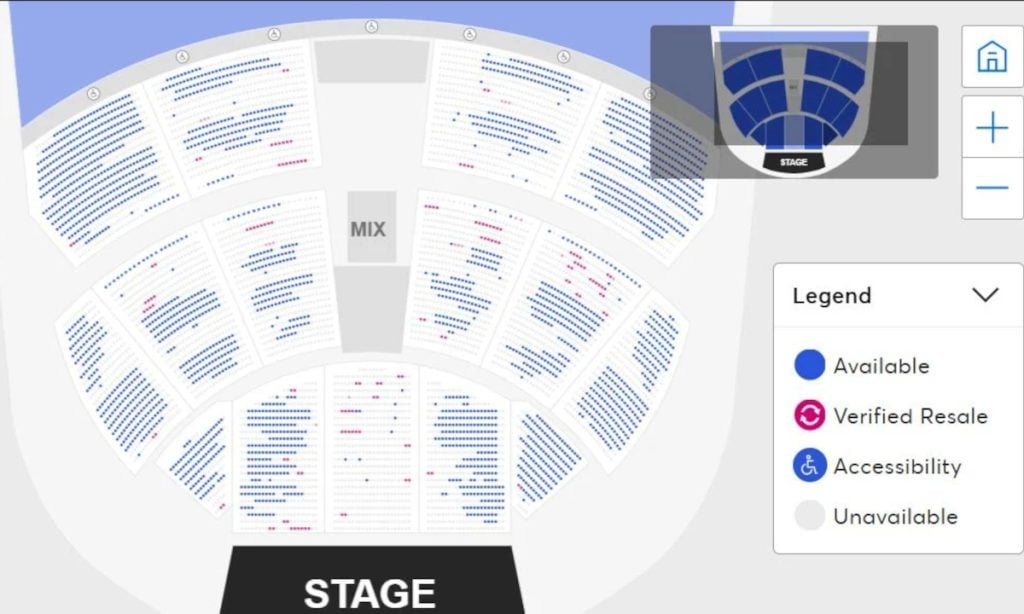
In 2026, one of the big narratives in music has been what’s coined as “Blue Dot Fever” from the rash of undersold tours and events for artists and venues big and small, resulting in postponed tour dates, cancelled festivals, and sometimes entire tours being 86’d due to lack of demand. The “blue dot” nickname comes from the demarcation of available seats on Ticketmaster seating charts.
Everyone seems to have a theory of what’s happening whenever an event, tour, or artist gets hit with blue dot fever. Some blame politics with either “go woke go broke!” or “they’re Trump-aligned!” theories bandied about. Others blame the economy that despite the wealthy doing very well, continues to affect the rank and file significantly, with inflation eating away at expendable income, and young people being affected disproportionately, who also happen to make up the population of frequent concert goers.
Some blame the exorbitant prices for tickets these days and skyrocketing fees on low attendance, which is certainly affecting some events, though even small-time artists touring on $10 door deals are dealing with the phenomenon.
In reality, it’s likely a combination of all of these factors that are affecting the prospects of music tours, along with an overall draw down in live event demand in the aftermath of the pandemic that had consumers wanting to get out more and experience life.
But among all the other excuses and explanations, there is one factor few if anyone is citing for the lack of fans showing up to support what often are very worthy artists touring through town: the media.
It’s probably not the primary factor. It might not even be a major factor. But the days of picking up your town’s alternative newsweekly to excitedly thumb through to the calendar section and see who’s playing a show in the coming weeks, or perusing the local newspaper for recommendations of the best shows that weekend, they’re virtually over.
Now tour announcements are posted by the artists themselves on social media, and face an uphill battle in the algorithms to be seen in a sea of AI slop and political shitposting to the point where a cavernous disconnect has formed between artists and their fans. Sometimes the issue is not that fans don’t want to do or don’t have the money to attend a show. Sometimes they don’t know a show they want to see is happening right down the road from them at all.
Beyond the communication breakdown, there’s also just something invaluable about 3rd party validation when it comes to some fans deciding who to see live, or whose new album to listen to. Sure, music has never been more accessible and easy to peruse yourself. But there’s also never been more of it to have to sift through to find what might appeal to you. There was a time when most any active music fan had their favorite critics, whether they were on the local or national level, and used this professional insight to decide who to go see on a given Friday or Saturday night.
So much of that is gone now and lost in the endless social media scroll. Tour publicists have been replaced by social media ads that an artist’s own followers might or might not see. Even if a local or national outlet publishes something about a tour or a festival, there’s no guarantee people will read it. In the previous era, picking up the copy of Creative Loafing, The Austin Chronicle, The Dallas Observer, or The Nashville Scene and thumbing through it was a weekly ritual.
Hypothetically, technology and apps could make all of this easier, more efficient, and more fool-proof since the info could be edited and updated in real time. But you would be surprised how many artists don’t even update their own calendars, and how many venues don’t either. Most rely on Instagram posts which are becoming increasingly buried.
What is the soultion? That’s much harder to conclude than diagnosing the problem. Local journalism has been absolutely decimated, especially in the arts and entertainment space in lieu of political coverage, while paywalls have become commonplace, which keeps many at arm’s length from their local outlets. Though companies like Bandsintown have platforms designed to connect artists, fans, and venues, their tech has always been short on solutions. An outlet like Saving Country Music should be able to populate a calendar by simply selecting recommended artists whose dates automatically go into it. But we’ve been waiting for 15 years and counting for that function.
Though they’re facing challenges with dwindling resources, the media can still be effective at affecting turnout to live events. But as opposed to thinking conventional website articles and print stories will still move the needle significantly, they also need to be leveraging social media to help put butts in seats and spread the word about live performers. But increasingly, events and venues are restricting or outright eliminating media access.
Willie Nelson’s 4th of July Picnic happened last weekend in Austin. Though it transpired only four miles from Saving Country Music headquarters, word came down that the media wasn’t being hosted by the event at all. The event was also affected by blue dot fever, though according to attendees, the event filled out decently last minute due to giveaways and deep discounts. It was far from the sellout it should have been though with Billy Strings as a co-headliner.
Ahead of this year’s event, there could have been features and interviews with performers like Margo Price and Rodney Crowell who both just released new albums, or profiles on up-and-comers like Stephen Wilson Jr. or Lily Meloa to help stimulate some buzz. Radio stations and local DJs can also play a role in this, but similar to the media, they have been significantly downsized for nationally-focused programming—another potential reason for blue dot fever.
But there was none of that dedicated media coverage for Willie’s Picnic, even though if you were a local country fan, you couldn’t scroll through social media without seeing an ad for it. The media was iced out of the entire event, just like much of the media has been from the event now for multiple years now. It’s not just a lack of media to cover such events, it’s the restrictive nature certain venues and artists are approaching the media these days that make it worse. Instead they rely on their own social media campaigns, which once again, don’t carry that 3rd party recognition that can be important to consumers, and can get lost in the algorithm.
Would it have made a significant difference if the media had been activated for Willie’s 4th of July Picnic? It very well might have. It certainly couldn’t hurt. They call media coverage you don’t have to pay for “earned media.” This is the often pro bono third-party recognition that can make a significant difference for an artist, venue, or event. The influencer network is also a way to reach potential concert goers, but doesn’t come with the same honest, critical, and trusted assessment the conventional media can.
It goes without saying that music media and the media in general is a rapidly diminishing resource for artists and the public, especially in the arts sector. But that doesn’t mean it can’t still play an important role, even if it’s only on the margins. The media (or what’s left of it) might have to play a significant role if we want to see the trend of under-supported events and tours turn around.
– – – – – – – –
If you found this article valuable, consider leaving Saving Country Music A TIP.
July 6, 2026 @ 8:42 am
I totally agree and I’ve been saying this for a while. Back in the analog days every town had a weekly or bi-weekly alternative or entertainment paper or the daily had a weekend entertainment section where you could see what was around and clubs, promotors and venues had display ad touting events coming up even further down the road. Now I follow probably 60 or 70 venues in 8 or so cities and more bands than I want to just in case someone I want to see will be anywhere near me. And someone will still sneak by in some out of the way venue or town I hadn’t anticipated.
July 6, 2026 @ 8:49 am
Also Willie Nelson is like 100. You can be appreciative of him, recognize his career and contributions to the music and the culture without seeing what’s left of him perform live.
Somebody should consider taking his metaphorical keys away. It’s the loving thing to do
July 6, 2026 @ 9:03 am
Any show with Billy Strings, Wilco, Stephen Wilson Jr., Sheryl Crow (despite being quite spare), Rodney Crowell, and Margo Price should sell out a 14,000 capacity venue. In fact, Billy String sold out a 15,000-capacity venue in the same market last year. Twice on consecutive nights.
We all know Willie is at limited capacity these days. The reason this event didn’t sell through is because the Germania Amphitheater sucks in the dead of summer, they charge WAY too much for concessions, prices for tickets were ridiculous, and they have pissed off the media for many years now so they weren’t on board at all to help promote the event. Willie’s age was inconsequential. People still love seeing him because you never know when it’s going to be the last time.
July 6, 2026 @ 8:52 am
I’m sure there’s a plethora of other reasons but it’s at least 80% economical. Even a $10 show turns into over $100 when you factor in eating, parking, concessions, etc. it’s about $200-250 for a night if you have kids that need a sitter. With average ticket prices, you have to budget at least $500 for a concert for 2. Even a solid paying job right now rarely affords the luxury of doing this more than 2-3 times a year without major sacrifices elsewhere in the budget.
The biggest shows are fine because there’s enough well off people that can afford those shows but these aren’t the same people that are embedded into different music scenes to attend the $10-50 shows.
July 6, 2026 @ 9:01 am
I received notice that Zach Top and Alison Krauss were both playing near me this month, If I want to see either performer and not just watch them on a screen, I’m laying out $105-$131 for tickets. I usually go to concerts with my son-in-law, so double that.
We’re seeing Jamey Johnson on Friday night. Those tickets were close to $100 each if I recall. Travis Tritt in September is a bit less at $86. I’m not sure if any of those prices include the Ticketmaster Hold You Hostage fees.
I realize that musicians need to eat too (just a tiny bit of sarcasm) but those prices are getting up there. Then add to it that the way I used to hear about concerts (in addition to the entertainment section as noted above) was through country radio. Of the four artists listed, only Zach Top gets airplay on most stations. I don’t think that helps either.
July 6, 2026 @ 9:03 am
“It’s the economy, stupid!” But seriously, the problem I see is all the money it takes to go to a substantial concert. The gas to get somewhere, hotels, food, parking, concert tickets, venue alcohol, ridiculously expensive merch… it all adds up. The young professionals can’t afford multiple concerts in a year these days.
July 6, 2026 @ 9:08 am
I’m grateful this site exists cause it pretty much is my source for new music and info about tours of artists I want to see
July 6, 2026 @ 9:09 am
I think it’s 3 main things with #3 being the biggest.
1) lack of Radio listeners- big and mid sized shows were always known by everyone because ads on the radio, interviews with artists, and dj’s talking about it. I’m pretty in touch and I still get suprised with local shows I had no idea about.
2) price – i prefer the 1000 person or less venues and they are still fairly reasonably priced, but prices for shows at an amp, arena, or stadium are beyond out of control.
3) The overload of artists – I think this is the biggest reason. The number of shows to choose from has become so significant that people are forced to pick and choose. Artists from the 60’s, 70’s, 80’s 90’s, 00’s, 10’s, and 20’s are all still touring. That’s 7 decades!
July 6, 2026 @ 9:26 am
Radio used to play a HUGE roll in selling tickets. Now, it’s an afterthought. Few listen to it, most morning shows are nationally syndicated, and though there’s still some local shows out there trying to do it right, they’re fighting an uphill battle.
July 6, 2026 @ 9:21 am
I try to forward every concert announcement in my area, whether or not it is an act that I am interested in, and I STILL get comments along the lines of “ I didn’t know they were going to be there!” when I post a picture of the show.
July 6, 2026 @ 9:27 am
Part of the problem is that Instagram almost immediately identifies these concert postings at attempts at free advertisement, and buries them in the algorithm. If you pay for them as ads as an artist, this helps. But even then, there’s no guarantee that your own followers, meaning the people that followed you to see your content, will see the posts.
July 6, 2026 @ 9:23 am
I tend to think it’s the ever rising ticket prices. The entertainment at our county fair this year is Gary Allan, tickets seem to be selling well. You can still buy general admission bleacher tickets for $20. Last time I looked the $45 track seating was pretty well sold out.
July 6, 2026 @ 9:24 am
just sayin… I saw Jimi Hendrix $4 … $4.50 day of show. Same prices when I saw Led Zepplin with Jethro Tull as opener. I know things have drastically changed, but seriously?
July 6, 2026 @ 9:57 am
In 1968 (assuming that’s when you saw Hendrix) the median U.S. annual salary was $7700. So, you have to adjust those $4 ticket prices for inflation.
July 6, 2026 @ 9:31 am
Don’t feel bad. River Snook’s only media coverage of her new album and tour are so-called “earned media” stories about how two of her shows were supposedly cancelled due to poor ticket sales, nothing about her record or performances.
When social media stories become a pity party about endemic scene failure due to the “economy,” they become a sort of passive political shitpoasting largely aimed at the White House. Underlying it all, of course, is a silent cultural boycott in lieu of a tax payer funded Get Out the Vote campaigns tied to the biggest acts with “crossover” potential..
July 6, 2026 @ 9:50 am
What a stupid comment, and it verifies your weird obsession with River Shook because the topic allows your to veer into the rage politics your really want to talk about in these comment sections.
The article you’re referring to wasn’t about River Shook. It was about Bailey Zimmerman’s arrest in which one paragraph of the 20 mentions River Shook.
https://savingcountrymusic.com/this-is-the-worst-part-of-these-bailey-zimmerman-felony-charges/
River Shook isn’t even mentioned here at all.
Sorry Big Jilm, but River Shook is married. Find someone else to obsess over.
And this idea that you can’t criticize the economy because it’s a stand-in for political criticism of the President goes both ways. There are most certainly people claiming the economy is great despite the overwhelming indicators it isn’t as an element of political signaling.
July 6, 2026 @ 9:31 am
Bottom line is people are BROKE!
July 6, 2026 @ 9:38 am
I think public trust is just generally decaying in all facets, which is creating a misanthropic culture all across the country. Unfortunately, the music industry usually leads the charge in culture shifts both good and bad.
Removal of A&R that used to filter the good artists from the bad, no cohesive media arm to filter events that might interest the public, scams and frauds like the whole Geese situation that discredit “popularity”, and terrible perception around ticketing thanks to ticketmaster. These are just some of the things that compile into a stew of poor public perception around new music in general. At a certain point I believe people just give up, then creating this “opt out” culture, and then translating to low ticket sales across the board. Plus, who has the bandwidth to filter through all the current noise to actually follow a band or a venue they like. It almost feels like doing homework, when it should be leisure.
It certainly doesn’t help that it’s impossible for artists to reach people that want to see their shows now that algorithms have disregarded followers. Also, even the best self promotion (promotion by the venue or artist themselves) doesn’t carry half the weight that a 3rd party promotion carries – like you stated. BUT no one trusts or reads local journals because that local journal lost trust 10 years ago lol.
The only thing I see working – particularly for smaller artists – are festivals built and branded around a niche genres or events. They seem to gain public trust by making the fest not entirely about the lineup – so to speak. Example: town chili fest w/ touring artist lineup or mountain summer bluegrass fest w/ 15 bluegrass bands and camping spots. Food for thought that artist name is losing luster, and live music seems to only attract when the artist(s) are part of a broader theme or event.
I actually think the economic argument is overstated – people have enough money to go to shows, but no trust in what they are buying.