

Are You Checking the Ingredients of Your Music?
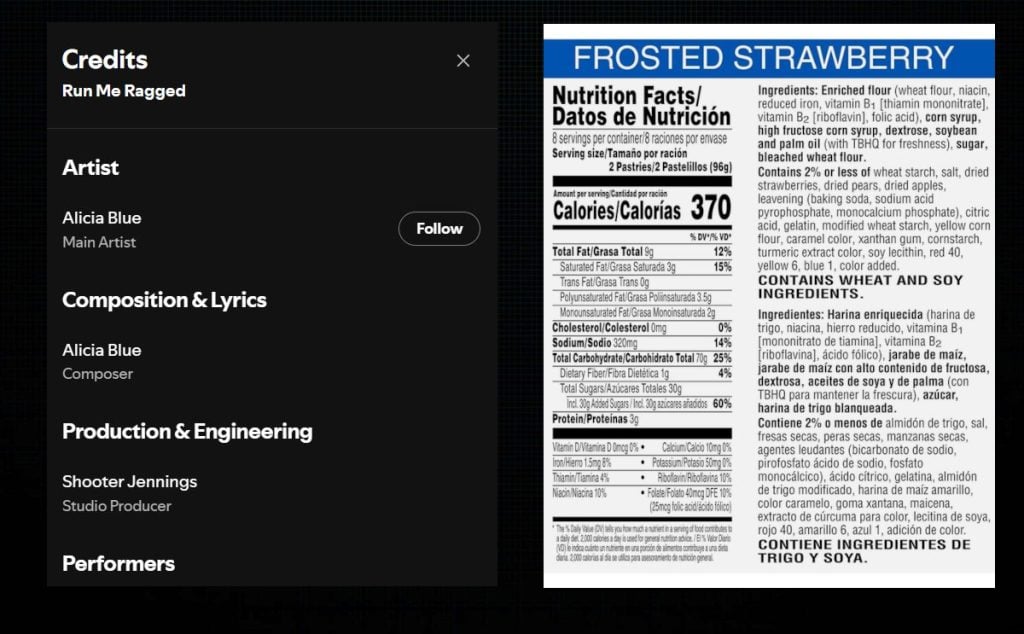
At some point, we got tired of fast food and TV dinners as a society, and all the artificial flavors and chemical preservatives they contain. That doesn’t mean they still don’t have their place when you’re on the run, on the road, or just want a little sinful indulgence every once in a while. But these days, fast food isn’t even that cheap, or that good. And you end up paying even more for it in the long run.
What you feed your brain and your soul is just as important, if not more. Just like with food, more and more people are choosing the slow music experience over the fast one. That is why we’re seeing a massive resurgence in vinyl sales, and listeners moving on from the passive experience of corporate radio to find more fulfilling programming in independent, regional, and underground scenes to the point where some of these scenes and artists have become quite popular themselves.
Now as AI slop, songwriting by committee, samples and six producers on tracks, and music curated to algorithms instead of the human heart are flooding streaming services, it’s becoming more important than ever to be a conscientious consumer and check the credits of songs and albums no different than the health conscious consumer consults the ingredients and nutrition facts label on food. And now that Spotify and other streaming services are making it easier to find the credits for a song, you’re running out of excuses not to.
Here’s some reasons to consult the credits of the music you’re consuming, and what to look for.
The Less Ingredients, The Better
No matter what the ingredients are, one good rule of thumb is that if you look at the list of ingredients on the package of some food item and it’s a mile long with a lot of unrecognizable names, chances are there’s stuff in there that’s not particularly good for you, and is probably repurposed from other places.
Same goes for music. Often, the less songwriters and producers, the better. Even better if it’s the performer themselves that’s in one or both of these roles. Songwriting by committee is often when you get inferior results as the germ of an idea gets run through the sausage press, or diluted down to create mass appeal. When you see multiple people credited as “producers” or for “programming,” that often means they were behind a laptop, putting extra layers onto something, often burying the soul and original expression from the performer.
Sampling or interpolation of a track immediately means the songwriters from the previous work must be added to the new one, doubling up on the credits to where it’s not uncommon these days to see a dozen names or more on a given track just in the form of “songwriters” and producers.
If there’s a lot of instrumentalists on an album, that’s fine, especially if there’s a horn section, string section, harmony singers, or a backup chorus. It’s always a better choice to add layers of arrangement from human contributors in lieu of samples or synthesizers attempting to give body or ambiance to a song or album.
More Natural Ingredients Instead of Artificial Ones
Of course, the more natural human involvement in a song, the better. This is how you secure the intimate human connection with the audience. It doesn’t mean that in the arena of EDM, hip-hop, and pop where electronic programming often prevails, you still can’t find some good songs or genuine expressions. Of course you can. But when the sounds you hear in a song come from human fingers pressed upon wire and wood, or someone singing a melody devoid of filters or Auto-tune, or an actual human banging away behind a drum set, it often creates that deeper connection that only the best music can.
On of the reasons AI is starting to significantly encroach into the music market is because it not as much of a technological leap from sampling and the 808 drums beats that have already been employed in music for multiple decades, at least compared to organic instrumentation recorded in analog or even digital settings.
If there’s one saving grace preceding the AI onslaught that’s invariably coming for music (and already here in certain sectors), it’s that there’s nearing a universal consensus that any AI-generated music needs to be disclosed, by streaming services, on charts, to awards and sales certification organizations like the RIAA. Consumers should pay attention to these disclosures as they become move prevalent, and feel free to flag or call out artificial music when they see it.
Ironically, if Suno or some other generative AI company created a track, it’s unlikely to have a huge list of contributors or collaborators (see rule 1). It could just be some loser in a basement behind a laptop. But even though the credits might only list a couple of names, in truth the contributors are in the millions since AI music companies like Suno scrape the copyrighted material of your favorite human artists to train their models and compose the music in unauthorized activity.
What you consume really does matter. The more attention you give to human made music, the more it will thrive. The more people passively consume AI stuff just because it’s convenient, catchy, or trendy, the quicker the human element in music will evaporate, and leave little actual new music for humans to consume, or ironically, for AI to train itself on.
Look for Trusted Names and Brands
When you become a conscientious and informed consumer, it starts to become natural to consult the liner notes, just like you do the ingredients to food, and to know what those ingredients mean. It might come to a point where simply looking at who is involved in a song or album will give you a good indication if you will like it or not. It might be certain record labels that you know can be trusted sources, or it might be a list of producers. It could even be a certain guitar player that you know would never sign off on working on anything without integrity behind it.
Soon, just like a health nut, you will know what is most optimized for you, and you will get the most out of your listening experience. And just like bad food can make you feel sluggish, bloaty, or even result in disease, the music you consume will instead boost your mood, enhance your concentration and focus, stimulate your brain power, and perhaps, even make you a better person.
– – – – – – – – – – –
If you found this article valuable, consider leaving Saving Country Music A TIP.
October 20, 2026 @ 8:55 am
Great analogy, music is similar to food, a good friend of mine always said to shop around the perimeter of the grocery store and avoid the middle which has all the processed foods with tons of additives preservatives and ingredients. Buy the fresh simple things, it’s actually cheaper to but you have to put in the time. But like music that is always best .
In my home we play music and cook, bake , whatever and it always tastes better, same with great organic music!
October 20, 2026 @ 9:47 am
The discovery of new artists now comes with significant apprehension. I really hate this climate.
October 20, 2026 @ 9:54 am
Me too. I hate to admit this, but I no longer search out new artists on my own. I pretty much stick to what’s recommended here and to my tried and true favorites. You know things are bad when you have to work to do research before trying new music.