

Are You Checking the Ingredients of Your Music?
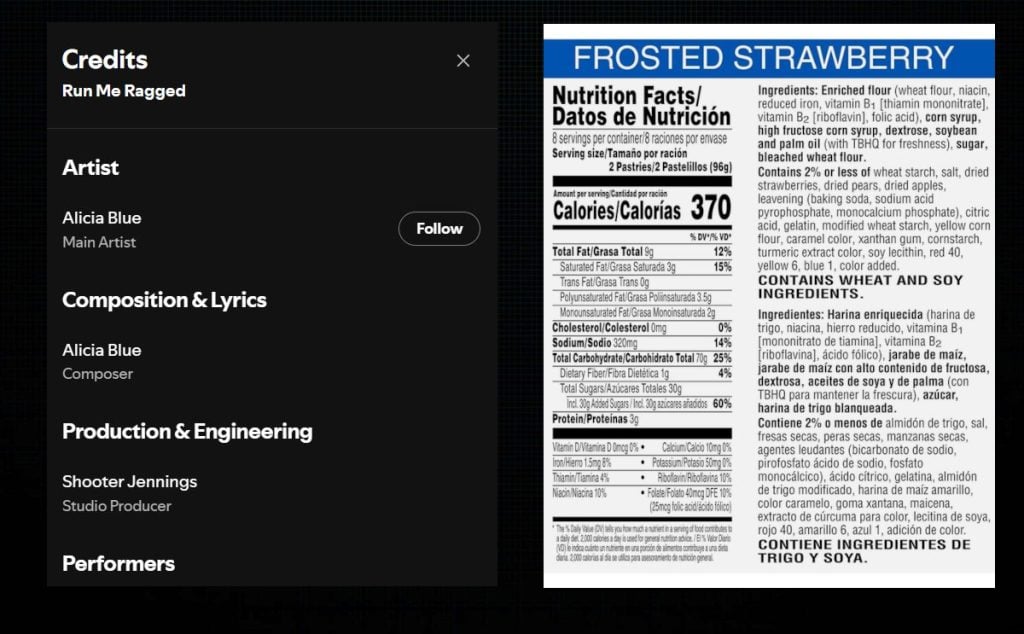
At some point, we got tired of fast food and TV dinners as a society, and all the artificial flavors and chemical preservatives they contain. That doesn’t mean they still don’t have their place when you’re on the run, on the road, or just want a little sinful indulgence every once in a while. But these days, fast food isn’t even that cheap, or that good. And you end up paying even more for it in the long run.
What you feed your brain and your soul is just as important, if not more. Just like with food, more and more people are choosing the slow music experience over the fast one. That is why we’re seeing a massive resurgence in vinyl sales, and listeners moving on from the passive experience of corporate radio to find more fulfilling programming in independent, regional, and underground scenes to the point where some of these scenes and artists have become quite popular themselves.
Now as AI slop, songwriting by committee, samples and six producers on tracks, and music curated to algorithms instead of the human heart are flooding streaming services, it’s becoming more important than ever to be a conscientious consumer and check the credits of songs and albums no different than the health conscious consumer consults the ingredients and nutrition facts label on food. And now that Spotify and other streaming services are making it easier to find the credits for a song, you’re running out of excuses not to.
Here’s some reasons to consult the credits of the music you’re consuming, and what to look for.
The Less Ingredients, The Better
No matter what the ingredients are, one good rule of thumb is that if you look at the list of ingredients on the package of some food item and it’s a mile long with a lot of unrecognizable names, chances are there’s stuff in there that’s not particularly good for you, and is probably repurposed from other places.
Same goes for music. Often, the less songwriters and producers, the better. Even better if it’s the performer themselves that’s in one or both of these roles. Songwriting by committee is often when you get inferior results as the germ of an idea gets run through the sausage press, or diluted down to create mass appeal. When you see multiple people credited as “producers” or for “programming,” that often means they were behind a laptop, putting extra layers onto something, often burying the soul and original expression from the performer.
Sampling or interpolation of a track immediately means the songwriters from the previous work must be added to the new one, doubling up on the credits to where it’s not uncommon these days to see a dozen names or more on a given track just in the form of “songwriters” and producers.
If there’s a lot of instrumentalists on an album, that’s fine, especially if there’s a horn section, string section, harmony singers, or a backup chorus. It’s always a better choice to add layers of arrangement from human contributors in lieu of samples or synthesizers attempting to give body or ambiance to a song or album.
More Natural Ingredients Instead of Artificial Ones
Of course, the more natural human involvement in a song, the better. This is how you secure the intimate human connection with the audience. It doesn’t mean that in the arena of EDM, hip-hop, and pop where electronic programming often prevails, you still can’t find some good songs or genuine expressions. Of course you can. But when the sounds you hear in a song come from human fingers pressed upon wire and wood, or someone singing a melody devoid of filters or Auto-tune, or an actual human banging away behind a drum set, it often creates that deeper connection that only the best music can.
On of the reasons AI is starting to significantly encroach into the music market is because it not as much of a technological leap from sampling and the 808 drums beats that have already been employed in music for multiple decades, at least compared to organic instrumentation recorded in analog or even digital settings.
If there’s one saving grace preceding the AI onslaught that’s invariably coming for music (and already here in certain sectors), it’s that there’s nearing a universal consensus that any AI-generated music needs to be disclosed, by streaming services, on charts, to awards and sales certification organizations like the RIAA. Consumers should pay attention to these disclosures as they become move prevalent, and feel free to flag or call out artificial music when they see it.
Ironically, if Suno or some other generative AI company created a track, it’s unlikely to have a huge list of contributors or collaborators (see rule 1). It could just be some loser in a basement behind a laptop. But even though the credits might only list a couple of names, in truth the contributors are in the millions since AI music companies like Suno scrape the copyrighted material of your favorite human artists to train their models and compose the music in unauthorized activity.
What you consume really does matter. The more attention you give to human made music, the more it will thrive. The more people passively consume AI stuff just because it’s convenient, catchy, or trendy, the quicker the human element in music will evaporate, and leave little actual new music for humans to consume, or ironically, for AI to train itself on.
Look for Trusted Names and Brands
When you become a conscientious and informed consumer, it starts to become natural to consult the liner notes, just like you do the ingredients to food, and to know what those ingredients mean. It might come to a point where simply looking at who is involved in a song or album will give you a good indication if you will like it or not. It might be certain record labels that you know can be trusted sources, or it might be a list of producers. It could even be a certain guitar player that you know would never sign off on working on anything without integrity behind it.
Soon, just like a health nut, you will know what is most optimized for you, and you will get the most out of your listening experience. And just like bad food can make you feel sluggish, bloaty, or even result in disease, the music you consume will instead boost your mood, enhance your concentration and focus, stimulate your brain power, and perhaps, even make you a better person.
– – – – – – – – – – –
If you found this article valuable, consider leaving Saving Country Music A TIP.
October 20, 2026 @ 8:55 am
Great analogy, music is similar to food, a good friend of mine always said to shop around the perimeter of the grocery store and avoid the middle which has all the processed foods with tons of additives preservatives and ingredients. Buy the fresh simple things, it’s actually cheaper to but you have to put in the time. But like music that is always best .
In my home we play music and cook, bake , whatever and it always tastes better, same with great organic music!
October 21, 2026 @ 11:15 am
My feeling is that for groceries, we at least have options for where to get them.
Most people consume music, and decide what they like, by way of one single streaming service owned by a billionaire who does not give a shit about music (spotify’s founder was just looking for a platform for selling ads and he said as much in the past- he thought music was free because of piracy at the time when he founded Spotify, and it’s still cheap and easy for them to take financial advantage of artists because society still thinks that artists are privileged to have that job despite the work they put into that job).
In the past at least you could say that streaming services were a good experience for the user.
At this point their suggestion algorithms are a shitshow, and obviously they broke the entire industry.
Keep in mind that there are still places to find human curated music online:
Mixcloud is a platform for DJ’s and some terrestrial radio stations use it as an archive
Most radio stations have a website with an archive and real-time streaming of their shows.
Some people put their radio shows up on soundcloud and stuff like that
You can find DJ’s that do “good” country music through things like that Ameripolitan Awards articles here – go through the archive and look for who all the nominees were, then look them up. If you find them on mixcloud you will also see who they follow which will give you a bunch of weird random collectors with “radio” shows.
Another good idea is to follow the artist you like on band camp, then see who has bought their music and see what else they have bought. There’s kind of a “social” element to Bandcamp if you dig around. Bandcamp covers indie music of all kinds so when they do one of those “best country music on Bandcamp” articles on their blog, it can be a little heavy on indie folk, but a pretty high percentage of the artists that saving country music covers, also have their stuff for sale on band camp. I believe that they don’t get paid if you are only using it as a streaming service but it’s also a good way to “tip” artists (for example if you don’t want to listen to mp3s, you can at least buy a digital song or two if you want to the artist a few bucks)
SiriusXM has several shows that cover all the good stuff and a subscription there is cheaper than spotify. You stream it on your phone and access the shows in an archive afterwards.
October 20, 2026 @ 9:47 am
The discovery of new artists now comes with significant apprehension. I really hate this climate.
October 20, 2026 @ 9:54 am
Me too. I hate to admit this, but I no longer search out new artists on my own. I pretty much stick to what’s recommended here and to my tried and true favorites. You know things are bad when you have to work to do research before trying new music.
October 20, 2026 @ 12:49 pm
After having Spotify recommend AI music to me, I now treat every song from an artist I haven’t heard of with skepticism and that sucks. The first minute of a new song gets ruined because I’m listening for AI “tells” rather than enjoying the music.
I feel like Chris Farley after finding out he’s been drinking Decaf Columbian Coffee Crystals.
October 21, 2026 @ 11:19 am
I think at least one other streaming service tries to remove AI music and devotes significant resources to it. Deezer does that, and I think maybe tidal if I’m not mistaken?
Since the Spotify algorithm sucks, why stick with Spotify at this point? The same exact music gets uploaded every single streaming service because they all are forced to use the same distributors. You don’t need to give Spotify your money
There are lots of services that will transfer your playlists to a different streaming service. I think to my playlist is the one I’ve used and I believe they also transfer over what artists you are subscribed to from Spotify to another service of your choice.
You are not actually locked into a shitty streaming service if you don’t want to be.
October 20, 2026 @ 5:49 pm
I find most my new artists from this site or from BJ Barham’s/American Aquarium patreon site. Occasionally a friend might recommend new music. Almost never go wrong.
October 21, 2026 @ 11:20 am
This is a really good point- patreon is also a really great platform for discovering other artists and interacting with them. The people who run patreon are actually fairly decent and they have a weird attempt at a social media type feed. I’m not sure that excited about yet another feed in my life but I do follow a few artists there.
Rachel Brooke runs a chat (outside of her regular posts and comments on patreon) and people regularly recommend music to each other over there. I’m sure it’s like that in other artists patreon accounts.
People on patreon structure their stuff differently- but plenty of them have a free tier that gives you some idea of what their content is going to be on patreon.
October 20, 2026 @ 10:16 am
I burn up Spotify’s “View Song Credits” on every song when I’m listening to a new album at home. It’s a really cool feature on the new(er) catalogs.
You see some really interesting stuff on albums that leverage a lot of studio musicians. Just this year, Ian’s new one had Jack Lawrence from The Raconteurs, and Brandon Flowers’ album had Laur Joamets (Sturgill), and John R Miller had John Fullbright all over The Great Unknowing.
October 20, 2026 @ 12:05 pm
I do as well and have been for a long time, it’s interesting to sometimes see the writer’s full real name for royalty purposes as well as producers, engineers, musicians etc….many folks don’t know the credits are even there.
October 20, 2026 @ 11:08 am
Yeah, I’ve always been a liner note junkie, if you saw Larry Carlton on guitar, Jim Gordon on drums, Leland Sklar on bass and other greats you knew it was gonna big good music.
Do your homework
October 20, 2026 @ 12:18 pm
I agree with you. But are we who care the minority in this matter? People prioritize the small matters and desires. They see the Constitution and respond, “TLDR.” Give them an AI slopfest of virtual Waylon, Tupac, Elvis and Armstrong for half price, and they will buy it.
October 20, 2026 @ 12:38 pm
Most people here probably are “the minority in this matter.” Like the food analogy, though, there is definitely an alternative culture building that likes the way things used to be. I see beef tallow all over supermarket shelves now while canola oil is on clearance. Similarly, more people are getting into country music led by steel or fiddle versus the 2010s electric-guitar-heavy craze.
October 20, 2026 @ 12:41 pm
It might still be a minority that care about this stuff. But the percentage of the population that cares is growing and is very active and involved in music. The only thing that has helped keep a lid on AI music is consumer sentiment and the pushback against it, especially from younger listeners because they see AI as existential. The government is feckless, and the corporations will do whatever makes them the most money. Strangely, it’s the consumers who are putting up the stop signs on AI, spending more on vinyl, and calling out artists who use AI in their artwork, not just their music.
October 20, 2026 @ 1:12 pm
Great article Trigger. Thank you.
October 20, 2026 @ 6:14 pm
I second that! Thank you Trig. I’ve been using the food analogy with my kids for over a decade, and it seems to be working. It’s nice to see it so well articulated in writing.
October 20, 2026 @ 1:25 pm
My wife recently came across a new “artist” that Google’s AI summary response was “independent country and alt-country singer-songwriter and digital/AI-assisted virtual artist”. 1st time I read that line it came off as AI related to the virtual aspect, thinking Damon Albarn with Gorillaz. The more I revisit that line I am realizing “virtual” is the play on words instead of the over inflation.
AI within Music will be almost impossible to place a label on for “buyer beware”. Its definitely going to be more disruptive than drum machines and synthesizers since AI offers more than a tone.
We may have to endure a full cycle moment for AI to be recognized by the masses for music creative before it has an embarrassing moment and finds its place within the Industry. Using the Innovation Adoption Curve as a general guide this topic feels like it has found the early adopters and will soon transition to the early majority and late majority phases in the coming year+ where the larger news will happen.
True music connoisseurs will adapt to finding true musicians to support. Barring a lawsuit being successful like the one against Suno AI coming early we need to brace for the storm this is bringing in. If we had middle aged business men putting together boy bands in the late 90s for $$$ we definitely have a few business minded people that see a short road to $$$. The 16-30 year-old crowd with how they adapt and consume content is the great unknown and the targets for what’s coming to get more than the foot in the door.
Leetokzz was the record label that released 3 albums from this artist that I am choosing to refrain from adding here.
October 20, 2026 @ 2:32 pm
The entertainment industry loves to put all kinds of restrictions on everything they release so at some point they need to say this song is AI or fake, buyer beware, because they want their royalties and Pay.
Just like the food industry especially the organic food industry needs to do, there are several types of organic food, much is not organic at all, it’s pretty much a load of $hit, but lets hope it gets sorted out. Otherwise I will listen to the music I’m fairly certain is real!
October 20, 2026 @ 2:39 pm
I thought you were supposed to be doing that for us big bro What the hell?
October 20, 2026 @ 3:29 pm
My release radar on Spotify has recently decided I would like a couple new releases by Whiskeytown. Yeah, 5 seconds in and it’s crystal clear it ain’t that Whiskeytown. AI garbage.
Someone needs to invent an app that automatically flags AI either before or seconds into a song and prevents it from playing. My wife uses an app at the grocery store to “score” the food she buys. Much to my dismay Zebra Cakes have been eliminated from the weekly haul so now I have to buy them at the gas station when she’s not around. We need an app like that for music.
October 23, 2026 @ 7:04 pm
What somebody could easily vibe code would be an app orbbriwsert extension that checks your Spotify selection against something like Deezer (which devotes its own software resources to ferreting out AI music from their streaming platform), does an automatic Google search to see if there’s a real web presence that looks like a real human is on it.
Most AI music fails these two tests.
October 20, 2026 @ 3:35 pm
I’m not so much worried about AI music itself. It’s when an artist I like and respect gets caught or spills the beans about how they wrote a song with AI assistance. “Man, I’m just stuck on this one line, let me see what ChatGPT can do…”
Weeding out the completely generated AI stuff is easy. Right now I’m listening to Ian Noe’s album for like the hundredth time. Think he had help? I’d prefer to think he didn’t but there’s no way to know.
October 20, 2026 @ 4:06 pm
“As for me, give me live music, or give me death!” Well, at least that’s what he should’ve said! Before the “Mothers Against Live Music” got it all shut down in the early 1990’s, you could go hear and dance to large Country bands at your local smoke-filled honkytonk seven nights a week in Anytown, USA. Was there, done that! Back then, there were no dating apps. You had to wash your face, comb your hair, and actually leave your house to meet and mingle with people!
October 20, 2026 @ 5:16 pm
If you use Spotify, one way to make sure AI-generated music doesn’t show up is to search for an artist you know is actually human, and go to the Artist Radio for that artist. Whenever I do that, Spotify never plays AI-generated music.
October 20, 2026 @ 9:05 pm
<blockquoteThat is why we’re seeing a massive resurgence in vinyl sales</<blockquote
Vinyl had no business ever replacing CD’s; this was bought about by internet-based influencers talking unscientific bullshit about how CD’s are inferior to vinyl when it isn’t even true, as this article will tell you (especially this partabout CD’s.)
Whoever pushed this should be set to the Phantom Zone, and after that, everything they ever said about CD’s being inferior to vinyl should have everything they wrote purged from the Internet.
October 21, 2026 @ 8:58 am
Though I would agree with you that CDs have gotten a bad reputation, I do think there is still something about the slowness of vinyl that appeals to many people. You put on a vinyl record like to start a fire in your fireplace. Is it an efficient way to heat your home? Probably not. Does it create a cozy environment? Yes it does, and in a way a CD can’t. Consumers also buy vinyl expressly for the large format profile of the medium, and because it supports the artist in a more significant way.
All that said, I think artist that forgo releasing CDs are making a mistake, especially with how easier they are to manufacture compared to vinyl.
October 21, 2026 @ 9:17 am
I think music is too accessible today and with the NET, attention spans are so short.
Back in the seventies you saved up the $4.76 (5 dollars even with Tax) and took a gamble at the local record store, you played it side after side and I always found that the song I liked best was not the one on the radio. Today every listens to a song for 10 seconds and if it doesn’t trigger a response they’re on to the next one.
Plus album art and liner notes were also integral in the experience, so I don’t buy vinyl these days since I have a few thousand of them and even more Cd’s , but I still have them and treasure each one. Kind of a history of your life, and trigger’s a harkening back to that particular time period.
Man, I used the word trigger a few too many times, (insert smile)
October 20, 2026 @ 10:07 pm
Thanks for the great article and analogy. Like the food ingredients, I apply the same basic rule to cocktails. If I read a cocktail menu and the drink has more than four ingredients, it’s a no thank you – disqualified from consideration. This definitely holds true for song writers with a two to three person limit, particularly if the credited writers are not singing or playing an instrument in the band. I generally end up tossing the cocktails menu aside and going with straight tequila, mezcal, or whiskey on the rocks – seems my music tastes are aligned with this tendency for singular contributors. Go figure.
October 21, 2026 @ 6:31 am
I think this is a good analogy trig, my pushback is the six writer thing. Just like the FDA makes labels spell out certain ingredients in their chemical form that otherwise would have been listed as one ingredient in the 70s, the nature of how song credits and royalties work means that the exact same song credited to one artist in the 70s would have 4 or 5 artists in the 2020s. Case in point – Paul Simons Graceland, which, primarily through a fight with Los Lobos has a lot more artist credits on Spotify now than it did after original release.
But otherwise a good analogy
October 21, 2026 @ 9:59 am
Tradition radio (e.g. WNRN in Virginia) and/or Sirius XM (Outlaw Country in particular) are excellent for putting a fella onto new music b/c the DJs and/or staff already put in the legwork to stay abreast of new releases, emerging artists, etc., which means they throw out the AI slop. Plus Trigger’s lists are invaluable, too.
October 21, 2026 @ 6:16 pm
WNRN….I believe that I’m a bit old for their demographic, AJ, but I listen sometimes. Sometimes I have no idea what they’re playing, but it’s a pretty good station.
October 21, 2026 @ 10:20 am
Regarding artists that aren’t using AI (as far as I can tell) – Trig, any chance you’ve come across Cash Muretta? Listening to his first album for the first time, that came out about a month ago. Pretty good stuff, albeit a bit uneven in approach. Came across him in the depths of spotify so don’t know what his social media presence is like.
October 21, 2026 @ 2:08 pm
The stuff I like, what I listen to, what it comes to is a singer songwriter with a guitar.
October 30, 2026 @ 10:00 pm
I like this farm-to-table analogy for how to increase your chances of finding the best of new country music.
As others have also said in these comments, Spotify’s recently expanded credits section, which now often includes musicians and engineers, not just songwriters and producers, is very welcome and comes closer to the level of detail that I used to enjoy reading in printed liner notes.
November 1, 2026 @ 7:17 pm
The food-label analogy works well, especially your point that a Suno track may credit only one or two names while its real “contributors” number in the millions through training data. That means short credits can no longer be read as a purity signal on their own. Disclosure from streaming services, charts and the RIAA will help, but only if it sits right next to the credits, where listeners already look.