

As Jelly Roll’s ‘N’ Words Remain Ignored, ‘Jesus’ Draws Ire
Jelly Roll is finally starting to experience the widespread scrutiny his life, career, and music has deserved for a few years now. But it’s coming in a very unusual, and frankly, misguided manner.
Those who are frequent readers of Saving Country Music know that for the last six months or so, SCM has been reporting on the continued wholesale ignoring of Jelly Roll being captured using the N word three times on video. In footage taken on January 23rd, 2023 at the Ghost Ranch of fellow country rapper Ryan Upchurch (also referred to as simply “Upchurch”), Jelly Roll is heard using the N-word in conversation multiple times, two years after the Morgan Wallen incident of a similar nature.
To read more about the Jelly Roll N-word incident, CLICK HERE.
It was Morgan Wallen being caught on a Ring doorbell camera using the N-word on January 31st, 2021 that set off an incredible firestorm in country music and beyond that in certain circles is still raging to this day. It was arguably the biggest moment in country music in the last 25 years, similar in stature to the cancellation of the Dixie Chicks.
But strangely, there has still not been one single media report on the Jelly Roll matter whatsoever. When the video came out, members of the country rap community felt confident it would end Jelly Roll’s career. But the same media that has been showering Jelly Roll with praise and peddling his redemption story continues to ignore the incident. Furthermore, not one prominent music artist has spoken out about Jelly Roll’s N word use whatsoever, unlike with the Morgan Wallen incident. For whatever reason, mum is the word.
Those who are frequent readers of Saving Country Music also don’t need to be reminded how critical of Jelly Roll this site has been, and of the media coverage of the singer that refuses to probe the holes in his supposed rehabilitation and sobriety story, while continuing to push favorable think pieces and human interest stories that have built Jelly Roll into this magnanimous character of American culture above reproach.
But all of this has started to change after Jelly Roll won multiple Grammy Awards on February 1st, including the Grammy for Best Contemporary Country Album, which was handed out during the televised portion of the presentation.
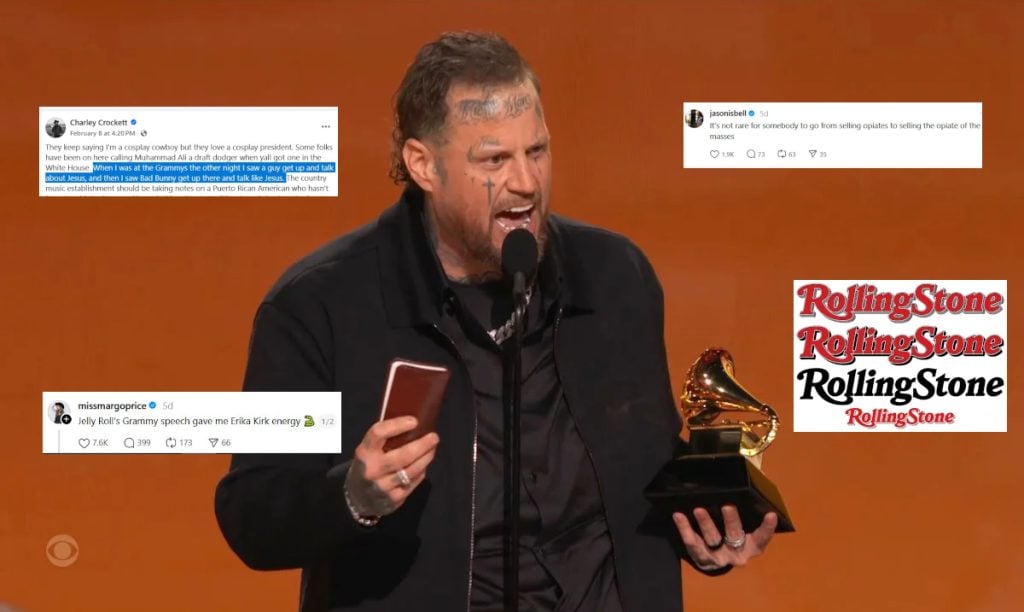
“There was a moment in my life where all I had was a (pocket) Bible this big and a radio the same size in a six-by-eight-foot cell,” Jelly Roll said during his signature fiery acceptance speech.“I believed that those two things could change my life. I believed that music had the power to change my life, and God had the power to change my life. I want to tell you all right now that Jesus is for everybody. Jesus is not owned by one political party. Jesus is not owned by one music label. Jesus is Jesus and anybody can have a relationship with him. I love you Lord.”
It wasn’t Jelly Roll’s N-words caught on camera, but Jelly Rolls J-words that have now set off an incredible firestorm of controversy, with his fellow music artists roundly criticizing him for it, and the media beginning to use it and his non-committal to a political affiliation to undercut his character. “Jesus” all of a sudden is way more offensive to these people than the N word.
After the Grammy Awards, Margo Price took to social media (Threads) to issue numerous criticisms of Jelly Roll, saying “Jelly Roll’s Grammy speech gave me Erika Kirk energy,” and followed it up with, “Plus, the music ain’t good.” Price later shared a photo of herself with Shaboozey saying, “You know who gave a great Grammy’s acceptance speech?”
Shaboozey’s speech made reference to how he is the son of immigrants, and how important immigrants are to the United States. Shaboozey issued the speech during the Grammy’s Premier Ceremony before the televised presentation when he won Best Country Duo/Group Performance, somewhat ironically with Jelly Roll for their song “Amen.”
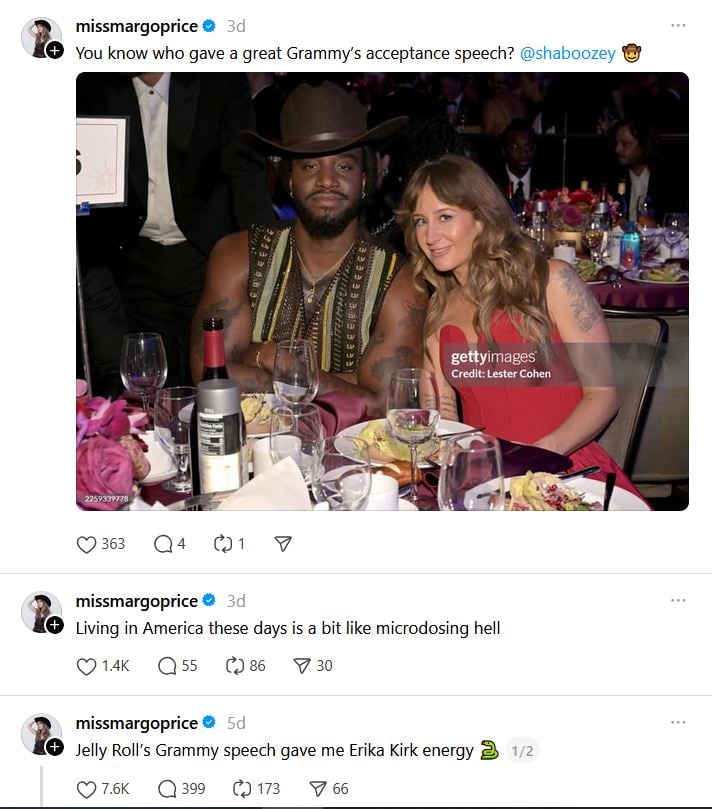
Margo Price was nominated for Best Traditional Country Album, which is why she was at the 2026 Grammy Awards. She was the only woman nominated in the category. Though her criticisms of Jelly Roll were rather pointed, they are also pretty par for the course for Margo.
The comments of Jason Isbell took it to another level, with Isbell stating, “It’s not rare for somebody to go from selling opiates to selling the opiate of the masses.”
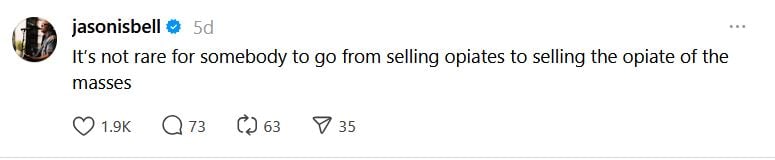
Jason Isbell didn’t name any names in his Threads post. Maybe he was talking about Paul Cauthen, who worked in the drug trade, comes from a strong Christian background, says he could have become a preacher, and currently counts himself as a devout Christian. Adeem The Artist and Waylon Payne both pursued working as preachers before deciding to pursue music.
But of course Jason Isbell was talking about Jelly Roll. His reference to the “opiate of the masses” comes very directly from the father of communism, Karl Marx who said “Religion is the opium of the people.” Communism of course strictly forbids the practice of religion, and is against the freedom of speech, while the First Amendment of the United States resoundingly protects these rights.
Then right before the Super Bowl was about to ensue on Sunday, February 8th with the contentious Super Bowl Halftime show embroglio, Charley Crockett decided that would be the perfect time to go on a political tirade against a host of individuals, including President Trump, Elon Musk … and Jelly Roll, specifically for his references to Jesus.
“When I was at the Grammys the other night I saw a guy get up and talk about Jesus, and then I saw Bad Bunny get up there and talk like Jesus,” Crockett said.
By the way, notice that the only one with the balls to refer to Jelly Roll by name was Margo Price.
Charley Crockett’s missive wasn’t only about Jelly Roll, and Jesus. He made a very salient point when he said about Bad Bunny, “The country music establishment should be taking notes on a Puerto Rican American who hasn’t forgotten his heritage and brought his culture’s traditional music back to the front, showing the world something new with it.”
This is similar to what Saving Country Music said assessing Bad Bunny’s Grammy-winning album.
Crockett also said, “The President is a grifter who bankrupted 6 casinos. That’s pretty extraordinary considering it’s a rigged business in favor of the house. The only thing he’s good at is filing lawsuits and portraying a successful business man as a reality TV actor. Last time I checked Elon Musk was an immigrant from South Africa but there he is standing in the White House buying our elections.”
These statements will now make Charley Crockett one of those artist where no matter what he does, half of country music fans will roundly attack and reject it, just like we see with Jason Isbell, Margo Price, Tyler Childers, and others. Charley Crockett’s career is now cast in that political frame, and will be that way forever. He is officially a politically polarizing artist.
The words from Crockett, Jason Isbell, and Margo Price have been the more high profile callouts of Jelly Roll’s Jesus comments, but social media was riddled with them after the Grammy Awards with people calling Jelly Roll a performative Christian, and that they were getting “MAGA vibes” off of him. This was in part due to Jelly Roll being ambushed by a reporter from Rolling Stone named Nancy Dillon at the Grammy Awards who asked the singer if he was “willing to comment on what’s going on in the country.”
Jelly Roll responded, “So this is the truth, and I’m glad somebody asked, because I love talking about this stuff, and people care to hear my opinion, but so I can tell you that people shouldn’t care to hear my opinion. You know, I’m a dumb redneck, like, I haven’t watched enough … I didn’t have a phone for 18 months. I grew up in a house of, like, insane pandemonium. I didn’t even know politics were f—ing real until I was in my mid-20s in jail.”
Jelly Roll continued, “Like, that’s how disconnected [you are] when you grew up in a drug-addict household. You think we, like, had common calls about what’s happening in rural politics? Like, we’re just trying to find a way to survive, man, you know?”
Jelly Roll did go on to say that he had a lot to say about the “political climate,” and “I’m going through it the next week, and everybody’s going to hear exactly what I have to say about it in the most loud and clear way I’ve ever spoke in my life. So I look forward to it on the Internet.”
But the big narrative was that Jelly Roll had chickened out of an opportunity to speak out politically at the Grammys. Also, it’s been a week since Jelly Roll said he would speak out. He hasn’t so far. It’s a pretty common political ploy to say you will speak on something in the future to get a microphone/camera out of your face, but then never address it at all.
But that only tells part of the story of what happened with Jelly Roll at the Grammy Awards.
After Jelly Roll was accosted by the reporter to speak out politically, he in turn accosted the reporter, following them into a press area. According to another Rolling Stone reporter, Tomás Mier who appeared recently on the Plus One Show with Jess Lucero,
“Nobody’s talked about this, because it happened in the press room and only certain people saw, but this is something that happened and I think we should talk about it,” Mier says. “After Jelly Roll did walk off stage…he came back to speak to Nancy in a not-happy tone about a Rolling Stone article that had been published before, where they associated him with MAGA stuff. And it was a very tense moment, because it was Jelly Roll speaking from a platform down to a reporter who was just doing her job…Everybody in the room just froze. At one point, somebody on his team just came and just told Jelly, like, ‘Jelly, we have to go, like, let’s go’.”
You can see the full interview exchange here:
The article in question was not written by Tomás Mier or Nancy Dillon who asked Jelly Roll the initial question. It was written by Rolling Stone reporter Jonathan Bernstein, who covers country music upon occasion, and just published a biography of Justin Townes Earle.
The article in question was called How Nashville’s Music Row Went MAGA in 2025 (Paywalled). Generally speaking, the article was well-written and refreshingly objective from Rolling Stone. The assertion of the article is also correct.
Basically since after the pandemic, country music has been veering to the right politically, after remaining decidedly non-political ever since the cancellation of the Dixie Chicks in 2003. In large part, this political moratorium was due to a mandate from many record labels and managers to artists to not speak out politically on either side. It would only divide an artist’s fan base.
But there were a couple of important points that the article Rolling Stone article missed on. The first is it said nothing about the role the media and Rolling Stone itself—and specifically Senior Country Editor Joseph Hudak and writer Marissa R. Moss—had played in goading country artists to speak out politically. As Saving Country Music warned at the time, the idea these artists were going to speak out for the left-leaning causes Hudak and Moss were advocating for was absolute hubris.
Goading country performers into political speech, and admonishing them publicly for advocating for right-leaning causes would only result in a backlash, and a break in the moratorium on political speech in country music, which was the best scenario left-leaning journalists could ever hope to achieve.
The situation reached a fevered pitch when the wife of Jason Aldean was regularly attacked in the media for Instagram posts. This was the type of behavior that had Aldean and others break their moratorium on political speech, and started advocating for right-leaning causes. Subsequently, Jason Aldean has become friends with Donald Trump.
The other problem with the Jonathan Bernstein article in Rolling Stone that Jelly Roll questioned was how it unilaterally assigned political alignments to certain performers who had not proclaimed such affiliations, which obviously in the current contentious political climate, can be catastrophic to a performer’s career.
The article states, “When the [Grand Ole Opry] invited Jelly Roll to become its latest member, it did so not within the sacred confines of the Opry House but in a segment during Jelly’s appearance on Joe Rogan’s podcast, which, despite having guests that range from Bernie Sanders to Trump, has become closely associated with the cultural ascendance of MAGA.”
But saying that a performer appearing on the Joe Rogan Experience immediately makes them MAGA is beyond irresponsible. Jesse Welles has appeared on the Joe Rogan Experience. So has Charley Crockett who has now come out with left-leaning perspectives multiple times. Zach Bryan appeared with Joe Rogan. Assuming Jelly Roll is “MAGA” simply because he went on the Joe Rogan podcast was a completely irresponsible assertion by Rolling Stone, unnecessarily politicizing Jelly Roll and his career.
Then the Christian and Jesus role also came into play in the Rolling Stone article.
“It’s not a coincidence that Christian music has been surging in popularity on Music Row at the same time MAGA has captured the culture. Artists like Anne Wilson, Gabby Barrett, and Jelly Roll, all with label homes in Nashville, have actively courted and won over both country and Contemporary Christian Music audiences,” the Rolling Stone article states.
If Jelly Roll was confrontational or aggressive with a reporter, that’s not acceptable behavior from him. He should apologize, and the Grammys should look into it. But Rolling Stone assigning a political alignment to him is just as aggressive and irresponsible, and the ultimate reason for the confrontation to begin with, especially after he was asked a politically pointed question by a Rolling Stone reporter, which has since been used to attack Jelly Roll and discredit him further since he didn’t answer.
Rolling Stone has a bad track record of imposing political affiliations upon artists and others, including, if not especially, country artists and other country reporters. We saw this happen with Eric Church in 2018 when a Rolling Stone cover implied he was a Bernie Sanders supporter who was against the 2nd Amendment—a canard you continue to see brought up whenever Eric Church’s name is mentioned even today. Rolling Stone also published a fictitious story about Toby Keith attacking Kris Kristofferson over politics.
The context for the tense political moment at the Grammy Awards was the recent killing of Alex Pretti by ICE officers, which Rolling Stone then used to call out the hypocrisy of country stars for not standing up for Pretti’s 2nd Amendment rights in a piece written by Marissa R. Moss, as if admonishing them publicly would result in public pronouncements from country stars—a political media theory that has so roundly been proven to not only be ineffective, but very directly counter-productive since 2020.
Central to the debate around Alex Pretti though was the 1st Amendment, which enshrines people’s freedom of speech, or freedom to not speak, along with the right to protest. It also protects the freedom of religion.
By making the criticisms of Jelly Roll about his religious faith, they’re picking the wrong fight. And assigning Jelly Roll political affiliations is outright irresponsible. The reason Jelly Roll is being politically obtuse is likely because he knows if he becomes a politically polarizing artist, it will undermine his career. You also can’t just hand wave off his insistence he’s not informed enough to have an opinion, or it’s not his place to share his political opinions as a performer.
None of this is to say that Jelly Roll doesn’t deserve scrutiny. But going after him for mentioning Jesus, or Assigning “MAGA” affiliations to him because of his religion is patently irresponsible.
The public has clearly started to sour on Jelly Roll’s sermon-like acceptance speeches at award shows when they used to be lauded, and his redemption story was useful to the press who saw Jelly Roll as a subversive force inside country music that they hoped could be useful to their political causes. That’s likely why the press and high profile artists gave him a pass for the N-word incident. They wanted to keep open the opportunity to be able use Jelly Roll as vessel in the culture war.
But as soon as Jelly Roll doubled on his non-political affiliation and dropped the J word, he’s become persona non grata. You must speak out about political causes or the media will turn on you, or even further, say you’re “MAGA” when you have never verified that affiliation. That is why you see artists like Charley Crockett and others feel the need to broadcast their political affiliations, often to the great detriment of their careers.
This also speaks to the elitist “club” mentality that can exist around such things as the Grammy Awards. Either you’re in that club, or you’re not. Clearly, Jelly Roll isn’t, especially how his explanation of how coming from a broken household is the reason he doesn’t think about things in political terms was so summarily brushed away as diversion.
All of these compelled political elements placed upon music artists only works to overly-politicize the musical space, often leading to less political capital for performers to wield through their music itself. It parses fans bases, polarizes performer’s names to where whatever they say is summarily discounted by half the electorate, and makes consensus building nearly impossible behind any cause.
There are plenty of things to criticize about Jelly Roll, and to scrutinize about his past and present. But going after the religious faith he’s used to rehabilitate himself doesn’t just feel like a low blow. It feels deeply un-American, and anti-1st Amendment, especially when you’re quoting Marxist ideology in the process. Jason Isbell was once susceptible to substance abuse. Margo Price has also been sober since 2021. You would think they would have some grace for Jelly Roll using religion to overcome addiction.
Even while strongly criticizing Jelly Roll’s Grammy win for Best Contemporary Country Album, Saving Country Music made it a point to say,
“Unquestionably, Jelly Roll has pulled himself up from his bootstraps, turned his life around, and ascended to the mountaintop of popular society through discipline, self-understanding, admitting to his past sins, and by submitting to the belief in a higher power … [He’s] gone from the gutter and dregs of society to become one of the most popular and applauded artists in all of music, including now being named a Grammy winner. It’s a distinctly American story.”
If Morgan Wallen deserved to be criticized and widely admonished for using the N word, so does Jelly Roll. It’s not just the use of the word, it’s the double standard the media and high profile artists have illustrated by not saying anything about the Jelly Roll incident. Now deciding that “Jesus” is the word that is verboten, and deserving of admonishment takes the hypocrisy to an entirely new level.
Jelly Roll deserves to be forgiven for all his past sins, no different than Morgan Wallen, or Jason Isbell, or anyone else. Even if you’re not a believer, that’s what the teachings of most all formal religions, philosophies, and certainly left-leaning political ideologies tell us.
– – – – – – – – – – –
If you found this article valuable, consider leaving Saving Country Music A TIP.
February 10, 2026 @ 11:50 am
Jelly Roll walked right behind that stage after taking those Grammys and started dropping f-bombs in the interview, 30 seconds after trying to tell people about Jesus. No different than claiming recovery while telling people he can drink and still be in recovery. They guy wants a little of everything. That’s not what it means to follow Jesus.
He’s using Jesus.
February 10, 2026 @ 12:13 pm
How is saying the f-word contradictory to being a Christian? Jesus called people harlots and broods of vipers, things that people would off you for calling them in biblical times.
February 10, 2026 @ 3:03 pm
This topic has come up before on the SCM comments.
I believe if you are a Christian, you would try to refrain from using foul language. Would you use it in Jesus’s presence?
It is very easy in today’s culture to throw around the f word like it is an everyday word.
But I believe if you talked to a pastor, rabbi, spiritual leader, or looked in the Bible, it wouldn’t be acceptable.
And as a retired teacher, I personally don’t think children need to hear or learn this word.
If you are a believer in Jesus, I don’t think you would want to use that word.
Just one man’s opinion….
February 10, 2026 @ 5:11 pm
You aren’t understanding my point.
Jesus said foul language himself. Language so offensive that could have gotten him offed back in biblical times. No one is going to off you today for saying the f-word. Christians who think its so terrible to say “bad” words to me seem like they think they’re above Jesus in a way.
What makes language foul is entirely subjective to the culture. The word goose was seen as a swear word in Colonial times, would you think it bad that children learn the word goose?
The Bible gives prescriptions on language that is blasphemous, not culturally relevant “bad” words.
February 10, 2026 @ 6:45 pm
Bob,
What do you reckon this means?
Colossians 3:8: But now ye also put off all these; anger, wrath, malice, blasphemy, filthy communication out of your mouth.
February 10, 2026 @ 10:03 pm
Contextually it means speech that is scandalous to others, and speech used in an abusive, hurtful manner. Not simply “the f-word in any context”.
What determines whether words/speech is bad is context.
If a husband said to his wife “I love you so f-ing much”. Would you think that “filthy”? It’s obviously not to any honest person.
This is shown in the Bible, when Jesus calls people harlots, a brood of vipers, and “raca” which is a biblical word meaning “rtarded” basically.
So how can this “filthy speech” be condemned, but at the same time used by Christ himself?
It’s contextual, and the condemned speech refers to communication that seeks to harm others or blaspheme God.
February 11, 2026 @ 6:16 am
And “Contextually” in the United States the f-word is considered Profanity. It is restricted by the FCC. Broadcast television and radio cannot air that word. So contextually, in the USA, he uses filthy communication.
February 11, 2026 @ 10:51 am
So you get your morality from lawmakers is what you’re saying?
Again, the word “goose” used to be considered profane in the US. Is it “un Christian” to say goose?
February 11, 2026 @ 2:01 pm
No, i just think its foolish to try and identify loopholes to justify behavior that is clearly against scripture if you profess to follow scripture.
I tell my kids “No Running” and they say “I’m jogging.” You’re trying that with the guy who ordered all the plagues of Egypt. The kids know what i mean and there isnt a reality where Jesus wants you swearing just because you like to speak in profane communication.
Do I get my morality from lawmakers? Do you specifically need Jesus to say Identity Theft is wrong to believe it to be immoral?
February 12, 2026 @ 9:52 am
People have serious lack of reading comprehension and are unable to understand context. Reread my comments very slowly, maybe a few times, then get back to me.
February 12, 2026 @ 9:55 am
The Bible doesn’t say “do not say no-no words”, it says “do not use language that harms or seeks to harm others”. It’s completely different to say “f you”, and “this is f-ing awesome”. COMPLETELY different meanings and contexts for the same word.
But you probably won’t understand this because you’re a boomer Protestant who doesn’t understand logic or much of anything outside of the boomer bubble
February 11, 2026 @ 6:57 am
Who cares it is a WORD? Sticks and stones may break my bones but words will never hurt me!! Remember that phrase?
February 11, 2026 @ 10:07 am
“Who cares” is certainly a reply to a conversation about those who proclaim Jesus yet violate Christian tenets.
February 11, 2026 @ 10:14 am
Calling people harlots is a lot different than dropping f bombs
February 11, 2026 @ 10:48 am
Right, calling people harlots in the culturally relevant day and age would have gotten you killed and the meaning behind the word is a lot worse
February 10, 2026 @ 1:27 pm
As someone who has been heavily critical of Jelly Roll’s sobriety narrative and the way he’s used it to market himself, I have never questioned the sincerity of his faith, and have no reason to do that now. Is the whole “Jesus” thing part of his marketing? Absolutely. But in this instance, it dramatically backfired on him. He might have been embraced by portions of Nashville for it, but LA and Grammy class inside of roots repudiated him for it, with three of his fellow Grammy nominees using his faith as the basis for their criticism of him.
February 10, 2026 @ 2:02 pm
Invoking “faith” and “Jesus” is a ‘get-out-of-criticism-free card.’ That’s what I find annoying about it.
February 10, 2026 @ 2:39 pm
Amen
February 10, 2026 @ 6:45 pm
What criticism is he trying to get out of?
February 10, 2026 @ 7:56 pm
How his whole image is around his redemption story and why all of his songs are some shitty variation of his first hit ‘Save Me’
His wife admitting on camera that she sleeps with other men.
The fact that all of his music is objective crap without the whole ‘redemption backstory’ to wrap it in.
February 11, 2026 @ 7:44 pm
Yall are just crybabys
February 10, 2026 @ 6:42 pm
You are correct, Rick. Thank you for saying it.
February 11, 2026 @ 7:34 am
So dropping the f bomb means you’re not following Jesus? Is persecuting others for how they follow Jesus the way.
February 11, 2026 @ 9:25 am
Jelly roll is correct in what he did. He didn’t affiliate with people that caused ice to shoot them. He didn’t affiliate with ice or maga yet rolling stone tried to affiliate him with them. No different than a representative of rolling stone trying to say well I didn’t write that. You have affiliated yourself with them. So if your going to do it to him, you should expect nothing less than the same to be done to you.
February 11, 2026 @ 2:34 pm
Anyone that hasn’t cleaned up their potty mouth is a hypocrite, that’s not the way the real Jesus talks.
February 13, 2026 @ 12:22 pm
Without sin, first stone and all that rot.
Should he try to clean up his language? Absolutely. Is it your place to question his walk? Absolutely not. Take care of that mess in your own eye.
February 13, 2026 @ 12:28 pm
He’s not perfect. Are you? Asking for a friend.
And those three idiots bashing him? They are exactly the reason I listen to my mp3s instead current radio.
FWIW? I don’t even know anything Jelly Roll sings tbh (bc I don’t listen to radio these days). But there are a lot of self righteous assholes (sue me) and I’ve heard a lot worse coming out of the mouths of leftist singers who hold themselves out to be better than. So just like many modern so called artists, the holier than thous can miss me, too.
February 24, 2026 @ 7:33 am
Should we ask most every rapper about the language they use and condemn them for said language? N word. F word. Rape and every other profanity used and you all are ok with their music? What he does or does not say is not for you to decide if it’s good or bad. Leave those things to the lord and not mere mortals. Judge not less ye be judged. Or for the simple minded…those who live in glass houses shouldn’t throw stones.
February 10, 2026 @ 11:56 am
“It’s not a coincidence that Christian music has been surging in popularity on Music Row”
If Rolling Stone thinks Christian music has been surging in Country music today, they may not want to listen to country music from it’s origins right up into the late 1970’s.
Even this century, “Jesus Take The Wheel” was the biggest song of the year when it was released
February 10, 2026 @ 2:01 pm
Christian music has always been a massive industry for decades – and it’s also out of Nashville. There have been some crossover hits from Amy Grant and Bob Carlisle (Butterfly Kisses) in the 90’s or “I Can Only Imagine” in the 00’s, but largely it’s been it’s own seperate industry that sold millions of records. It’s always been in Nashville and I don’t see how that’s seperate from Music Row.
February 10, 2026 @ 2:09 pm
Rolling Stone (aslo Margo Price and others) are trying to associate Christianity with being conservative or right wing in a direct attack on People’s faith. It’s honestly pretty unsettling.
February 10, 2026 @ 12:11 pm
I was confused by Charley Crockett’s comment. Does he have a problem with people speaking publicly about Jesus? I follow him on social media and he went on one of his giant tirades and I really didn’t know what he meant about someone talking about Jesus and someone talking like Jesus.. it is getting a little old with him. Dude does nothing but whine and complain.
February 10, 2026 @ 12:26 pm
He has a problem with people using Jesus’ name to make themselves seem devout when they don’t actually live by His message. As a Christian, I have a problem with it, too.
February 10, 2026 @ 1:32 pm
I think it’s pretty safe to say that both Jelly Roll or Bad Bunny “don’t actually live by His message.” And if anything, Jelly Roll is likely farther on the right side of that equation than the wrong one compared to Bad Bunny. Though I think the pearl clutching over Bad Bunny’s lyrics has been a little ludicrous, a comparison of Bad Bunny’s recent lyrics and Jelly Roll’s recent lyrics would be a the most night and day comparison you could perhaps possibly make in all of popular music.
February 10, 2026 @ 1:37 pm
Gotcha. I do too… however, none of us are anywhere near perfect and all have sin in our lives that we could work harder on removing. Jelly Roll’s faith seems important to him. Obviously I don’t personally know the guy or really follow him, but from what I’ve seen, he seems to praise Jesus a lot lately and I’m always grateful for that.
February 10, 2026 @ 1:00 pm
I think it’s a bad look to question anyone’s faith. As far as I know a seminal part of the whole Christian experience is accepting that we’re all imperfect when apart from God.
As a side note, I think “opiate of the masses” has sort of entered the general lexicon, so it may be a leap to ascribe Marxist motivations to someone who uses the phrase. I’m sure there’s a bazillion examples of decidedly non-Marxist usage.
February 10, 2026 @ 1:23 pm
I don’t disagree with you, and I don’t know if this applies to Jelly Roll but theres a difference between being a Christian and being a Christian nationalist and hiding behind one while advocating the other is problematic. We saw a lot of that this weekend.
February 10, 2026 @ 1:35 pm
“I think it’s a bad look to question anyone’s faith.”
I agree.
I respectfully disagree that Isbell’s quote can be disentangled from its Communist origins. Though I agree that saying “opiate of the masses” as a general phrase doesn’t necessarily mean it’s tied to a Marxist perspective, Isbell was clearly making reference to Jelly Roll’s Jesus speech, and thus referring to the Marx saying about religion.
February 10, 2026 @ 2:04 pm
I think you might be missing Moses’ point, Trigger, though I’m happy to have him tell me I’m wrong. Isbell could be using the phrase “opiate of the masses” directly in reference to Jelly Roll’s Jesus speech and still not mean it in any Marxist sense. When a phrase like that has entered the general lexicon, it means that people don’t necessarily associate it with its original meaning. I’ve heard people use the phrase dozens of time in reference to religion when I know for certain (because I’ve asked) that they had no idea about the phrase’s origins.
February 10, 2026 @ 2:29 pm
I understand what Moses is saying, and I understand that phrase can be used more colloquially without the Marxist connotations. If you’re talking about bland pop music being the “opiate of the masses” or “high fructose corn syrup” or “Ozempic” or something, I get it. Isbell’s reference was very directly citing religion. That was the context Marx used it in. That was the context Isbell used it in.
February 10, 2026 @ 2:04 pm
Isbell criticizes Jelly Roll for “selling” the opiate of the masses. That’s pretty clearly a criticism of JR using Christianity as a tool to promote himself, not a Marxist decree to abolish all religion.
Like I said, personally I think it’s best to accept everyone’s proclaimed faith at face value, but we’ve all been succumbing to a bit of hyperbole lately and making that out to be an explicitly Marxist statement feels like falling further into that same hole.
February 10, 2026 @ 2:34 pm
I understand what you’re saying, and I agree we shouldn’t get hyperbolic about it. I don’t think that Jason Isbell wants to abolish the 1st Amendment. But it is a Marxist quote, and I just don’t feel like that was a fair criticism to go after Jelly Roll with, basically attacking his sobriety and his religion, especially coming from someone who’s sober.
February 10, 2026 @ 3:35 pm
Yeah I agree that Isbell is being too cynical here. I suspect he found the turn of phrase to be clever moreso than seeing an opportunity to advance Marxism.
Of course Marx’s metaphor was about opium. Comparatively opiates and especially opioids haven’t really pacified the masses so much as sewn chaos and destruction.
February 10, 2026 @ 6:56 pm
Trig,
I assure you that Isbell would want to abolish the 1st amendment with regard to anything that he finds hateful or offensive.
He might not openly frame it as abolishing the 1st amendment, but he would effectively support abolishing it.
He’s an outer-school Communist. Meaning that he’s a Communist by virtue of the tenets of his worldview, regardless of what he calls himself. In other words, his beliefs help to advance Communism.
February 10, 2026 @ 11:03 pm
Was it Jesus or Marx who suggested you get rid of your possessions? “If thou wilt be perfect, go and sell what thou hast and give to the poor, and thou shalt have treasure in Heaven; and come and follow Me.”
And stop conflating Marxism and Communism. Two different things. And it was a great line by Isbell. Religion is nothing but a human institution. Like every human institution, it is utter bullshit. Ireligion has now transformed to the sword and the shield. It can be used to attack others because you are better than them, but it also used as a cop out because it it isn’t your fault that your religion commands your twat behavior.
Some pious fuck preaching about Jesus gets questioned about the morality about the current state of affairs in this country isn’t about setting a trap. It is about calling out said bullshit.
“For I was hungry and you gave me something to eat, I was thirsty and you gave me something to drink, I was a stranger and you invited me in”
Same with misunderstandinfg the 1st amendment. It is about restricting government action and not allowing the establishment of of a state religion, while allowing people to worship or mock as they want.
We live in a world where Sam Darnold is a Super Bowl winning QB. A world where a pill can make a lazy, fat fuck lose an amazing amount of weight and extend his life. Anything is possible. Can’t wait for a pill that can make said lazy, fat fuck be able to sing on key and maybe write a good song. Another pill that makes him keep his pious bullshit to himself would great too.
February 10, 2026 @ 6:52 pm
“I think it’s a bad look to question anyone’s faith. As far as I know a seminal part of the whole Christian experience is accepting that we’re all imperfect when apart from God.”
No, it’s an obedient-to-God look. Questioning your own faith and the faith of others is intrinsic to Christianity. One cannot become born again without knowing for certain he needs to be.
This idea that Christianity is nothing more than vague niceness is modern, western trash.
February 10, 2026 @ 9:19 pm
I think this misunderstands my point. This isn’t Jelly Roll’s pastor mentoring him to be a better Christian. It’s people saying he’s not really a believer and that he’s just cynically crafting an identity, etc… And he may be, but I think it’s bullshit to assume we know what’s in other people’s hearts. Especially people you don’t know in real life.
February 10, 2026 @ 9:26 pm
Exactly.
February 14, 2026 @ 11:09 am
The Bible provides very clear standards by which people can make righteous judgments about who is and is not a Christian. And contrary to what people say when they twist the concept of judgment, Jesus tells us to judge. He says don’t make hypocritical judgements.
Someone who claims to be a Christian yet continues to practice sin shamelessly is not a Christian.
If a Christian is just someone who believes in Jesus, then Satan is a Christian.
But hey, Di Harris agrees with you, so you’re probably right.
February 10, 2026 @ 10:15 pm
Funny how you say this, but based on your reply to me, you’re a bad word/tone policer. Surely you’ve never said a bad word in your life Honky
February 11, 2026 @ 9:49 am
I think KHOC’s quote (ultimately) explains everything: “No, it’s an obedient-to-God look. Questioning your own faith and the faith of others is intrinsic to Christianity. One cannot become born again without knowing for certain he needs to be.”
As a lifelong Lutheran, aka the religion that started the Reformation 500+ years ago, everything in my faith tradition opposes KHOC’s above statement. It’s not blind-obedience – it’s discernment. It’s about grace and presuming good intent, not calling out others for their so-called “lack of faith.” One doesn’t need to be born again, because people are saved by “Grace Alone.”
I can go on and on. The point is that KHOC is shouting about Christian fundamentalism/evangelicalism/nationalism, and I’m sharing actual Christianity.
“Christian” fundamentalism has much more in common with “Jewish/Muslim” fundamentalism than actual Christianity. A literal interpretation of a faith document written 2000 to 6000+ years ago, rejection of science, intolerance, hatred of the other/explicit racism, tolerance of slavery, lack of charity/grace, subjugation of women, hatred of homosexuality, I can go on and on…
In Matthew 23 in the Bible, Jesus spends a lot of time insulting so-called Christians who do evil, supposedly in “His Name,” and he’s talking about fundamentalists.
Ultimately though, Christianity is not what you say you believe, but how you act. So let’s pull it back to country music and America 2026. By the way they act, who is more of a Christian:
Dolly Parton, Willie Nelson, Loretta Lynn, Johnny Cash vs. Jason Aldean, Morgan Wallen, Donald Trump, J.D. Vance, Kid Rock.
Obviously it’s not even close in the kidness and grace they display towards others.
However Christian fundamentalism is rooted in the Deep South & Appalachia, aka the birthplace/hotbed of Country music, and the creative/tortured tension between Heaven & Hell/Salvation & Damnation has always been a key component of both the Blues and what I would consider real Country music (aka the “White Man’s Blues, aka Hank Williams, George Jones, Bill Monroe (all of who were major assholes)…
My take on Charley Crockett was that he was calling out so-called “Christian” fundamentalists, as indicated by Charley’s focus on the hypocrisy between their actual deeds vs. their so-called “beliefs.” With regards to Jelly Roll, his music sucks but he seems a sincere Christian, so to quote Pope Francis quoting Jesus in th e book of Luke, “Who am I to judge?” And who cares, his music sucks.
Finally, there’s a reason the more fundamentalist Country musicians tend to suck. They tend to be less open-minded, less artistically fearless, and bluntly, less creative since they’re not really that good at integrating and synthesizing new ideas. There are a couple exceptions, who created great music by burrowing deeper into the tradition (Ralph Stanley, Larry Sparks, George Jones and Whitey Morgan come to mind), but we love Bill Monroe & Hank Williams & Lefty Frizzell & Merle Haggard and Willie and Waylon because they were innovators in their times. As they all have ably demonstrated, you can still respect the tradition of Country music while pushing it forward, which is what I would argue the best Country musicians are doing nowadays: Sturgill Simpson, Tyler Childers, Colter Wall, Vincent Neil Emerson, Sierra Ferrell, Del McCoury, Billy Strings, Charley Crockett, Dwight Yoakam, to name a few..
Not Jason Aldean or Jellyroll or Luke Bryan or Morgan Wallen, who rehash tired cliches and just plain out suck…
February 10, 2026 @ 1:01 pm
Sorry Brad I meant that as a general reply to the post not a specific reply to you.
February 10, 2026 @ 1:32 pm
It’s all good, sir!
February 10, 2026 @ 5:14 pm
He also seems to have problems discerning who speaks like Jesus, because Bad Bunny sure as hell doesn’t.
Quite frankly, that’s far too high a compliment to give to anyone currently walking the earth.
February 10, 2026 @ 11:28 pm
Are you insinuating Jesys didnt ralk alot about the size of his shlong or eating a** ? How racist and MAGA of you.
February 10, 2026 @ 12:17 pm
The hicklibs are insufferable. https://countrymusicpride.com/on-the-hick-libs/
February 11, 2026 @ 9:33 am
The hicklibs are the updated version of scalawags. Selling out their culture for societal acceptance.
February 10, 2026 @ 12:22 pm
“Jelly Roll’s Grammy speech gave me Erika Kirk energy,”
We get it Margo you hate Christian’s
February 10, 2026 @ 2:39 pm
As someone who knew Margo in her pre-success days, Margo ALWAYS thinks she’s the smartest person in the room. She’s not. Ever. A dog or a goldfish or a well watered houseplant could out debate her.
February 10, 2026 @ 5:27 pm
Quite frankly, it’s more insulting to be told you give off Margo Price vibes than Erika Kirk vibes.
However you feel about politics, Erika Kirk is in the public eye regardless of what she wants (I recognize she may want to be a public figure, but even if she didn’t she would still be stuck) because a nutjob murdered her husband publicly, in front of thousands at the time and millions more subsequently through recordings. To use her name as an insult not even 6 months later is a horrible thing to do and Margo should be ashamed of herself. Erika Kirk is grieving and also walking two toddlers through grief they can’t understand.
BuT ShE AnD hEr LaTe HuSbAnD dOn’T 100% SuPpOrT aBoRtIoN oR tRaNs IdEoLoGy, So I gEt To CaLl ThEm HaTeFuL, aNd ThEy DeSeRvE WhAtEvEr HaPpEnS tO tHeM!
Welcome to the United States in 2026, folks
February 10, 2026 @ 6:25 pm
“BuT ShE AnD hEr LaTe HuSbAnD dOn’T 100% SuPpOrT aBoRtIoN oR tRaNs IdEoLoGy, So I gEt To CaLl ThEm HaTeFuL, aNd ThEy DeSeRvE WhAtEvEr HaPpEnS tO tHeM!”
This does not depict Most of the people in the United States, at all.
Not by a long shot.
I understand where you are coming from North Woods, but the truth is this.
Most people in the U.S. understand the hatred that is doled out by the people who are given a platform, are being instructed, and told what to say. By their recording labels, for instance.
It is not nearly a 50/50 equation that a lot of publications, online, or otherwise, falsely report.
Ahem.
February 10, 2026 @ 6:45 pm
“are being instructed, and told what to say. By their recording labels, for instance.”
There is not a single record label on the planet that is instructing artists what to say. On the contrary, the record labels are instructing artists what NOT to say.
February 11, 2026 @ 11:08 am
The record labels that manufacture “bands” like Linkin Park, 98degrees, O-Town, N-Sync, Backstreet Boys, etc. tell their artists what to say, eat, dress, and sing. It is an industry. There is content that is wholly produced by that industry. Not everyone is an indie or outsider.
February 10, 2026 @ 12:27 pm
Not a Christian, but I have a whole lot of sympathy and empathy for the fallible but yet, trying, Jelly Roll, even though he’s not old school country. I give him the benefit of the doubt in things.
Wallen on the other hand, I find to be smug.
February 10, 2026 @ 12:37 pm
I know that music has always reflected and even influenced our sociopolitical landscape, but I really miss the days before literally every single word and and gesture had to be used as further ammunition for our tiresome, never-ending “culture wars.” (Spoiler alert: these wars have no ultimate winner!)
I’m 51 and am clinging to the hope that music can be a unifying force again in my lifetime, at which point Trig can utilize his stellar writing skills to deeply delve into songs and country music trends without having to constantly dwell on how irrevocably divided we are. I come here to escape from the relentless political hostility, not to be reminded of it 🙂
February 10, 2026 @ 2:56 pm
Here here, 100%
February 10, 2026 @ 12:50 pm
This article is… a lot… but my only 2 (okay 3) thoughts (one of which is a theme on here)-
1) nobody who “hates writing about politics” seems to do as much of it as trigger. Certainly this 10000 word deep dive doesnt come from someone who hates that politics and country music are intertwined.
2) In anticipation of “I cant believe Zach Bryan/Charley Charley Crockett/xxx has GONE WOKE” comments on here, have you possibly considered that these artists come from a place of political neutrality but the actions of this administration have been so chaotic and outside the bounds of acceptable behavior that it has forced these artists to speak out when in they otherwise woukdnt have in even a normal conservative leadership cycle?
And 3) im very happy to have started really enjoying Charley Crocketts music this year, and it is easier to support someone who speaks to causes I care about (although the opposite is fine too, I still like Marcus King even if I disagree with his politics, I find Oliver Anthony cringe but would still want to listen to him over someone who hides their beliefs in meaningless platitudes.
And beyond that I guess the best way to not be affected by Jelly Roll is to have no interest in his music, or his story arc, which is where Im at.
February 10, 2026 @ 2:14 pm
So first off, this article is 3,300 words long, not 10,000. I know that numbers matter to you Mike, so I just wanted to clarify 🙂 .
Also just to explain how this article became so long: I had basically drafted it after seeing Jason Isbell’s and Margo Price’s reactions to Jelly Roll’s Grammy wins, along with all the other viral online reaction. THEN Charley Crockett came out with his statement. THEN the info came out about the incident with the Rolling Stone reporter at the Grammy Awards, which really is essential to this story, and verifies how disruptive and irresponsible this politicizing of the music space can be.
I’ve been trying to explain this for 18 years, and frankly, am frustrated why some people don’t seem to get it. I believe that music is more powerful than politics. Some people say music is inherently political, but in my opinion, music transcends political power. However, politics can and does undermine music’s power to shape hearts and minds. So whenever I broach politics, it’s never to advocate for one side or another, unless it’s a cause affecting artists that happens to have apolitical quotient. My advocacy is that music should be insulated from political polarization so that it can have the power to broaden people’s perspectives, bring people together, create consensus, and if necessary, speak truth to power.
Very commonly in this pursuit, I have found Rolling Stone undermining this power, and have been publishing articles against it for years. The fact that you had Jelly Roll confronting a Rolling Stone reporter (though the wrong one) about being politically mischaracterized after they had just tried to goad him into making some sort of political statement that no matter what he said would have likely undermined his best interest and not moved the needle of public opinion anyway very directly illustrates what I’m talking about.
This type of demand for political speech is destructive to careers and music communities, and is being pushed under a completely discredited philosophy that in every redneck country singer is a Marxist just looking to speak out, and if they do, the American rural electorate will remarkably change from red to blue.
Country music used to be a mostly political free zone after the Dixie Chicks debacle and the loss of popularity of Toby Keith. Now it’s back. And though there are many reasons for that, Rolling Stone and their political apparatchiks larping as journalists played a role in that. And we ALL lose as country fans.
“have you possibly considered that these artists come from a place of political neutrality but the actions of this administration have been so chaotic and outside the bounds of acceptable behavior that it has forced these artists to speak out …?
I definitely think some of this is what is going on, and I think people on the American right need to understand this. The Trump Administration understands this. Its supporters should too.
February 10, 2026 @ 2:56 pm
*Some people say music is inherently political, but in my opinion, music transcends political power.*
You and I have completely different mindsets on that one, having grown up on Rage against the Machine and System of a Down and Green Day, and listening to my parents protest music from the 1960s and 1970s, I find Music plays an important role in shaping political movements, and providing the landscape to social political movements at the time, like Countries two cousin genres – Folk and Blues – have been doing for decades. I did not know or appreciate growing up the inherent political nature of Willie Nelsons, Music, or Johnny Cash’s Music, or Loretta Lynn’s music, or that Okie from Muskogee was meant to be satirical, partly out of my own ignorance, but partly because the Nashville controlled narrative doesn’t want that to be the story. I do believe this (this being the last 10 or so years) is one of those moments in American history of significant political upheaval that demands music shine light on that upheaval, not placate it, and am appreciative of musicians who are willing to tell the stories, often interconnected to the politics of the time that make Nashville and their captive audience, uncomfortable, and are willing to speak out to meet the moment in a way country music as a whole has never been able to do before.
Either way, based upon the amount you write about this, I would think you at least recognize that socially conscious writing is an inherent part of country music (or at least outlaw country) now, and isn’t going away, and maybe you would even acknowledge that artists who are willing to speak on taboo subjects, and write about things that arent just Trucks and Honkey Tonks and Jesus and the “Back in My day” nostalgia that’s often as a social weapon to demand conformity, is one of the reasons Country Music is popular in ways that it never was before (but its still no bad bunny, sorry), and that you wouldn’t merely bemoan artists (mostly Jason Isbell) for bringing politics into a space you don’t think belongs.
The TL:DR is if you didn’t have country artists willing to meet the moment of society, then you would lose a lot of interest from people that respect those artists for doing that.
February 10, 2026 @ 3:20 pm
“You and I have completely different mindsets on that one, having grown up on Rage against the Machine and System of a Down and Green Day, and listening to my parents protest music from the 1960s and 1970s, I find Music plays an important role in shaping political movements.”
I think you completely misunderstood what I said. I absolutely think music can play an important role in political movements. But if you blow your social capital on randomly calling Trump a draft dodger in a Facebook post right before the Super Bowl, or if you’re a reporter and you mischaracterize the political alignment of a musician because you need another big name to bolster the validity of your think piece, you undermine that power, and unnecessarily.
February 10, 2026 @ 8:09 pm
I just wanna say one reason I like when musicians talk about politics in their music is it’s authentic. People have opinions about politics. People talk about politics. People participate in political movements, people vote, people protest. Politics are as real as love or work death or any other topic covered in music. It’s not really important to me when a musicians broaches politics in their music that the message be “effective” at accomplishing a specific goal. Rather I often find it artistically meaningful and rewarding.
And yeah it was an incredible moment last weekend to sing the world is on fire with a group of people at an American aquarium concert. It’s real life.
February 10, 2026 @ 3:40 pm
“… if you didn’t have country artists willing to meet the moment of society, …”
And, herein lies the problem.
The vast majority of people will always take the easy way out, and go along with the crowd. They think it provides them with a certain cache.
Quite the opposite. It shows cowardice. A glaring lack of integrity.
February 10, 2026 @ 12:55 pm
Jelly Roll’s primary problem seems to be that he is clearly full of $#!t and everyone knows it. You can only pull that off if you are a cult leader. And he’s not.
February 10, 2026 @ 1:16 pm
This is a very long article dedicated to one person. Usually, someone talking that much flak is right over the target.
I really don’t care when people are reported to have used the “n-word.” It’s like a free pass to cancel them and everything they’ve accomplished in their life. Context matters and your a stubborn fool if you say it doesn’t. We’ve all listen to and enjoyed music dishing out the n-word like playing cards. Some people say it, others are entertained by it and the rest are hypocrites.
Lastly, an acknowledged sinner trying to make his life right through Jesus Christ will continue to be a sinner, but shouting some bad words at a reporter for writing a defaming article about you doesn’t qualify for a trip to Hell. Would Jesus have handled it better? Yes. He’s Jesus, free from sin. We’re talking about a convict who turned his life around and lost 300 lbs to make himself a better person. Gotta be a silver lining somewhere in that.
February 10, 2026 @ 2:26 pm
People need to stop thinking about how the N Word aspect of this story is all about pearl clutching and cancellation. Jelly Roll is not going to be cancelled any more than Morgan Wallen was.
The reason it’s so important is because it’s the key to unlocking the entire grift behind the Jelly Roll narrative, and the insane hypocrisy by the media. So there were thousands upon thousands of news reports about Morgan Wallen and it became a national scandal, but only one measly new outlet reported on it about Jelly Roll? There were two dozen stories when Jason Isbell called out the Grand Ole Opry for allowing Morgan Wallen back on stage, but Jason Isbell can’t even bring himself to comment on Jelly Roll’s N word use … yet he take issue with him mentioning Jesus in his Grammy speech?
What is going on here?
What’s going on is all these people saw Jelly Roll as a potentially useful political tool. But when he refused to speak out at the Grammy Awards, he was thrown to the wolves.
February 10, 2026 @ 7:59 pm
They tried to cancel Morgan Wallen though – even you were giddy about how you didn’t expect his level of fame to be where it was after the incident. Why does everyone deny what happened at the height of cancel culture and covid?
February 10, 2026 @ 8:02 pm
“This latest incident and ‘N’ bomb will hopefully and rightfully knock him down to the notch where he belongs,”
https://savingcountrymusic.com/morgan-wallens-n-word-proves-hes-unworthy-of-praise-prominence/
February 10, 2026 @ 8:11 pm
Yeah Strait, you’re being EXTREMELY selective with what you’re choosing to recall of my coverage of the Morgan Wallen situation. I wrote probably a dozen articles about it, and selecting the first one right after the incident I think is disingenuous. That said, I 100% stand behind the quote you offer here. It didn’t happen, but I don’t want Morgan Wallen being the top artist in country music. It’s an embarrassment.
Here’s what I wrote a few weeks after:
https://savingcountrymusic.com/morgan-wallen-backlash-not-just-ineffective-its-counter-productive/
February 10, 2026 @ 8:26 pm
How in the world is that disingenuous? It was your initial stance and the way I described it was accurate. Yeah ok you obviously softened your stance after the fact but your initial stance matched that of other people who wanted him cancelled. You still wanted him cancelled initially along with many others – that’s my entire damn point. I don’t have time now to dissect the articles that followed to see if you changed your stance when time revealed he was getting more popular and being heavily defended – or if you had a change of heart on how serious his offenses were. I believe it was the former.
I’m still not sure why you want the media to correct it’s hypocrisy in the single direction of calling out Jelly Roll’s N-word usage. Do you want Jelly Roll to apologize? I realize that you get super irritated when I disagree with your entire premise for an article but what you expect the media to do sounds a lot like you want them to try and do some soft-cancelling of Jelly Roll.
February 10, 2026 @ 8:39 pm
I never said that I wanted Morgan Wallen “cancelled.” I said he didn’t deserve to represent the country genre as its biggest star, either through his music, or his personal behavior, and I stand behind that today and would still say the same thing.
By not reporting the Jelly Roll N word incident whatsoever, the media is verifying that there is a a clear, present, and extremely pronounced bias in coverage. And for whatever reason, that bias has demonstrably favored Jelly Roll. My theory on that is so many outlets and journalists were on the record lauding him, and they though he could be useful to their ulterior political projects pushed through their country music coverage, they have actively chosen to look the other way. I actually wouldn’t be surprised if we see a story about this soon now that they have decided he’s not useful to them.
If a new video came out of Morgan Wallen using the N word, it would be the biggest story in all of America. It would knock the Epstein Files to Page 2.
February 11, 2026 @ 9:56 am
Now it’s a semantics argument on what cancelling even means or meant then. Louis CK and Michael Richards were cancelled. They weren’t completely blocked from making money but took a big career/financial hit which is what cancelling effectively is. I maintain that rooting for someone to take a career hit still falls under cancelling.
Of course there is obvious bias. Rolling Stone Magazine went from being the biggest outlet that was critical of the Bush Admin to carrying water for the Obama admin to the point of hero worship.
Kid Rock and TPUSA knocked the Epstein files back to page 2 for a few days. The political divide is so severe that nothing substantial is likely going to happen because that would meaning joining forces with Q-Anon adjacent Republicans and “conspiracy theorists” who were talking about the Podesta leaked emails with the same PDF code words. the Franklin scandal, hell even Frazzledrip may be real based on the latest Epstein dock releases with him having bought 55 gallon drums of sulfuric acid – people aren’t fully ready for the depth of evil in those files and the economic fallout from full justice.
Anyway I don’t have a good theory on why outlets are giving Jelly Roll a pass other than they don’t really take him seriously as an artist and he is just this formely blobbish entity that everyone pretended was this great new thing because they believed it could benefit themselves to align with him. Idk I find it confusing how he got embraced by the mainstream because I’ve always considered his music similar to Rehab’s ‘Bartender Song’ – the kind of crap that comes on at 1am in a dive bar. Rolling Stone and others were behind trying to cancel Matt Healey of the rock band The 1975 for some supposed racist remarks, and he was no conservative and made objectively good music. That didn’t work either. White rappers get a pass for saying the N-word. No one went after Eminem (outspoken Liberal), Bill Maher escaped cancelling for his hard R use of it on air – maybe because he has comedic liberty but that’s why I find the whole thing wrong with trying to cancel Wallen and criticize JR for it because why would it be ok in a comedic or film context (which would implicate liberal comedians and actors who used the word) but not regular white people in a conversational setting?
February 11, 2026 @ 10:13 am
I believe that Rolling Stone and other liberal outlets think it is more effective to draw the moral line as a political line because it doesn’t implicate people they don’t want implicated. My guess is there is a subconscious fear that in the smartphone era it’s too unpredictable to be hardline in cancelling people over saying the N-word (or anything believed to be racist speech) because if it’s recorded, and there are no clear statute of limitations on when it was recorded, then a lot more people could be implicated and there will be hardline Twitter leftists who will eat their own – even when Rolling Stone and NPR may not want all of their favorite artists at risk. So it’s easier to draw this line at “Do you support Trump or not” because that’s what they tried to get out of JR at the Grammy’s and I believe that is why they felt emboldened to take down MW for his N-word incident.
February 12, 2026 @ 11:10 pm
Louis CK and Michael Richards were canceled. One jerked off habitually in front of women and the other called a black person a n-word. They got dinged. They still make money. That is called consequences.
You right winger pussies always trot out canceled as your mantra when someone has to suffer consequences for their behavior. I always ask who has been canceled? Always the answer is someone still making money or more even.
The most canceled person of my lifetime has been Sinead O’Connor. A singular voice, artist and talent. She correctly protested the systematic abuse of the Catholic Church and became a pariah. Scorned by liberals and conservatives alike. And she was dead on fucking right.
Of course she wasn’t a white guy, which is what this is almost always about. And she was talented and a true artist. Not that Louis CK isn’t, but Wallen, Jelly Roll (fucking clown name befits the person) and Michael Richards aren’t.
February 10, 2026 @ 8:11 pm
Would be nice if it made Morgan wallen less popular. Certainly would be a better world if someone else was carrying the banner for country music
February 10, 2026 @ 1:28 pm
Oh look, the asses made asses of themselves again.
Jelly Roll is a world class grifter, but what’s worse, being a world class grifter or a world class asshole? I’m not entirely sure at this point.
Did Charley Crockett just expose himself as both grifter and asshole?
February 10, 2026 @ 1:54 pm
Charley Crockett seems to be using up what liberty he has as a legit Country performer to engage in drama with his contemporaries in hopes of boosting his fanbase. The liberty he has that excuses his very limited vocal talent comes in part from him not having been a drama queen. He’s drifted into drama queen territory.
February 11, 2026 @ 9:31 am
Crockett has always played a character. I saw him open for Turnpike in 2017 and it was a sitcom.
February 11, 2026 @ 10:29 am
I see nothing wrong in playing a character on stage and adopting that persona into the music. The line is fabricating a backstory and off-stage passing it off as historical fact and then throwing jabs at other artists for their “inauthenticity.”
February 10, 2026 @ 1:34 pm
I’m just glad jelly roll has reached a level of popularity to where his words can now be used to smear all of country music and not just the white trash hillbilly rap community he came from. That’s what’s going to happen when this story inevitably takes off one day.
February 10, 2026 @ 2:43 pm
This comment is EVERYTHING. This is the entire ballgame right here.
Morgan Wallen wasn’t injured whatsoever by the N word scandal. If anything, he benefited from it.
Who got hurt? “Country music,” presented as a monolith by the media. That’s who took it in the teeth, and had all kinds of canards and misnomers launched about it. And that’s exactly what will happen when someone at the New York Times or wherever gets a hold of this story, and say that country music embraced a racist. That’s why I want to be on record about this, and furthermore, calling the people out in the press who have been running interference for Jelly Roll, and who are now turning their poison pens against him since he won’t do their political bidding.
February 10, 2026 @ 8:12 pm
Sadly I think also the turning point concert is the same thing. “Country music” as both right wing and also as kid rock and Brantley Gilbert as far as the average American is concerned
February 10, 2026 @ 1:47 pm
I can’t stand Jelly Roll’s music, his fake ass persona and his constant crying, but no artist or anyone for that matter should be pushed to identify their political leanings. I won’t go as far to say I respect him choosing to dodge the question because everything about him is fake and he is a snake oil salesman – but I completely disagree with forcing someone to pick a side politcally.
Artists have the liberty to speak about their politics – they don’t have the right to force people to agree with their views or listen to their music, so it’s their choice to decide if they want to espose views or express them in a way that may alienate some of their fans.
February 10, 2026 @ 2:05 pm
Just wait until someone use both the n-word and the j-word…
February 10, 2026 @ 2:13 pm
“The article states, “When the [Grand Ole Opry] invited Jelly Roll to become its latest member, it did so not within the sacred confines of the Opry House but in a segment during Jelly’s appearance on Joe Rogan’s podcast, which, despite having guests that range from Bernie Sanders to Trump, has become closely associated with the cultural ascendance of MAGA.”
But saying that a performer appearing on the Joe Rogan Experience immediately makes them MAGA is beyond irresponsible.”
I haven’t read the full Rolling Stone article (don’t have an account), so I’m basing this just off the quote you’ve used here, Trigger. You accuse RS of being “beyond irresponsible” for calling Jelly Roll MAGA, but the quote that you offer as evidence doesn’t do that at all. The quote you shared calls Joe Rogan’s podcast “closely associated with the cultural ascendance of MAGA.” Nowhere in the quote does the author proclaim to know Jelly Roll’s politics or call him a MAGA figure.
Do they call Jelly Roll MAGA somewhere else in the article? If not, I think you need to clarify this, especially given that you’re accusing them of being “beyond irresponsible.” It frankly seems like you’re the irresponsible party in this case, at least based on the quote you offered as evidence of your claim.
February 10, 2026 @ 2:48 pm
The article is titled “How Nashville’s Music Row Went MAGA in 2025.” Jelly is referenced in the article THREE times, with three different things implying that he’s MAGA, including his religious affiliation. Does it directly state, “Jelly Roll is MAGA?” No it doesn’t, because it doesn’t need to.
But the most important element to this is the account of Jelly Roll very directly accosting a Rolling Stone reporter about the mischaracterization at the Grammy Awards. Now I’m not here to excuse the behavior of anyone not respecting the press and their boundaries. But clearly Jelly Roll took issue with how he was characterized.
Why didn’t Rolling Stone reach out to Jelly Roll to ask if he was MAGA?
February 10, 2026 @ 3:07 pm
If the article doesn’t directly say Jelly Roll’s MAGA, I don’t see how you can credibly call the author “beyond irresponsible” for saying he’s MAGA. If the article really does imply that, then why did you only provide evidence that does no such thing? I think you’re really, and uncharacteristically, off on this one. You’re asking us to take your word on what the article says, but the only quote from the article that you include doesn’t support your claim.
As for why Rolling Stone didn’t reach out to Jelly Roll to ask if he was MAGA, I have no idea. Based on your description of the article, they 100% should have, and it certainly seems irresponsible if they didn’t.
Did you reach out to Isbell or Crockett for this article before making assumptions about who they were referring to or for clarification on what they meant? I know that sounds like a “gotcha” question, but I don’t mean it as one. I’m genuinely asking; just don’t know how to phrase it without coming across like an asshole in text!
February 10, 2026 @ 3:31 pm
Man, we’re just going to have to disagree on this one Pat C. If you publish an article about how country music went MAGA, name an artist THREE TIMES and give three separate reasons they should be considered MAGA, you’re basically saying he’s MAGA. Did the article come out and expressly state, “Jelly Roll is MAGA.” Gee, I guess not. But it’s not like it was an article about a random topic, and they just happened to imply Jelly Roll was right wing in passing.
Jelly Roll took it as a proclamation he was MAGA. The public took it as a proclamation he was MAGA. You can make a mealy-mouthed semantic argument here, but the curse was cast by this article.
February 10, 2026 @ 3:44 pm
Trigger,
Happy to agree to disagree, but pretty disappointing that you’re going personal and saying I’m being “mealy-mouthed.” Not sure how that’s warranted, and I thought you were better than that. But hey, maybe I’m wrong twice here.
You keep referring to the Rolling Stone article, but my critiques here have been directly about your Saving Country Music article. The RS article may well do what you say it does. I don’t know, since I can’t access it. But the SCM article that you wrote offers exactly ZERO evidence for your claim, while calling the RS author irresponsible. That’s bad journalism. Nothing mealy-mouthed about what I’m writing here; I’m being very direct and asking you to do better.
And back to my question above on the topic of responsible journalism: Did you reach out to Isbell or Crockett for comment before publishing this article?
February 10, 2026 @ 3:59 pm
Pat C.,
I apologize for saying “Mealy mouthed.” I definitely didn’t mean it personally. I just meant to underscore that this to me feels like a ludicrous discussion and I’d rather gouge my eyeballs out before continuing it. In no portion of my brain can I fathom how an article about country going MAGA that mentions an artist three times, and three times asserts they’re MAGA because of things they done is not ACTUALLY calling them MAGA because it didn’t directly say it.
As for reaching out to Charley Crockett and Jason Isbell, no I didn’t, because I am using their words and quoting them directly from statements they made publicly online instead of taking implications and inferences and assigning a political ideology to them irresponsibly that at a later date they will refute. If either reaches out and says they weren’t talking about Jelly Roll, I will update this article. Then I will eat my hat.
February 10, 2026 @ 4:09 pm
Trigger,
I appreciate the apology, and I appreciate you and all you do! You’ve made your points; I’ve made mine. Time for a beer. Cheers!
February 10, 2026 @ 2:35 pm
I’m fine with crocketts overall message. But saying things like “34 felonies” just makes him sound ignorant. Trump is no angel but that whole case was complete bullshit and even leftist talking heads agreed.
February 10, 2026 @ 3:02 pm
Margo’s new nose and Isbell’s new teeth are infecting their brains.
February 10, 2026 @ 3:38 pm
The most powerful aspect of Christianity is the redemption arc. I sense that Rolling Stone, Margo Price, Isbell, and others who have hardline Leftist beliefs and who are also non-believers, have unknowingly put political dogma in the place of Jesus and Christianity or other religious beliefs. They view conforming to the belief structures they believe in as the path to “redemption.”
February 10, 2026 @ 5:30 pm
Oh they’re all very religious, but don’t realize it. We are inclined to worship God. If we refuse to worship him, we’ll unknowingly worship something created.
February 10, 2026 @ 5:22 pm
Understanding that saying opinions as they are fact is so far from accurate and destroys credibility, what evidence do we have that Jelly Roll is a grifter? Seriously….
Obviously he needs a bit of theological advancement and maturity, but I cannot find anywhere where it is clear that he is a grifter specially as it pertains to this.
Setting aside your beef with his face tattoos, his past, his curse words (which I do not condone), and the other things that the great Kristofferson may have included in “most of us hate anything that we don’t understand”, is there really that strong of a reason for all of this hate?
He seems to actually be trying to unify us. I would rather hear a siren and a baby crying than his music, but dad gum guys…some strong hate here. So many folks on these SCM forums love to drink urine in their coffee each morning and then spit it in the face of Everton around their digital zone of reach.
Go be mean to that Gavin dude or countless others that are trying to separate us.
February 10, 2026 @ 5:23 pm
This is hard… I don’t like jelly roll music but I agree with what he talks about. Childers and Crocket are both in my top 3 but it’s hard listening to them when by the way they talk I assume they would hate me as i’m more of a conservative Christian than jelly roll. I don’t know what to do?
February 11, 2026 @ 2:40 pm
Just be yourself.
Good post, Frosty.
February 10, 2026 @ 6:36 pm
I have always thought Margo Price was a bit insufferable at best, music be damned. Before this incident, around the time Todd Snider passed away, she accused George Jones of ripping off ”Beer Run,” and I was just like, ”George Jones didn’t even write that song, and I wouldn’t have been surprised if he had not even heard the Todd Snider song of the same name when Garth Brooks asked him to record.”
February 10, 2026 @ 7:03 pm
I’m so tired of finding out that yet another white performer is so rap-brained that they use black lingo like it’s second nature to them. How shameful.
And then to make it even more embarrassing, the Boomer dorks like Trig start sperging out on behalf of blacks because they’ve been taught to react that way from birth, even though the only demographic who is deeply offended by “n****r is affluent urban whites.
February 10, 2026 @ 8:13 pm
Don’t misdate me, Honky.
I’m squarely Gen X.
February 10, 2026 @ 7:14 pm
I feel like the reality of our country has become just like the movie Idiocracy.
It is very comical to me that our culture looks up to and takes very seriously the opinions of entertainers (who are a bunch of idiots). Who cares what they have to say? The only thing I am worried about them doing is, well, entertaining me.
Lastly, who cares if Jelly Roll or anyone else says the “n” word? Do we not live in the USA where freedom of speech reins supreme? Or is that just another false promise?
Besides, do black folks realize that the “n” word is offensive when they are saying it?
February 10, 2026 @ 7:55 pm
The person who wrote this just hates anything that points towards Jesus. People are allowed to make mistakes and are allowed to be redeemed. Just like this article. Write a new one and redeem yourself from this trash.
February 10, 2026 @ 8:12 pm
Did you actually read the article. Just not sure where you came up with that ideal.
February 10, 2026 @ 8:12 pm
I don’t know. I just reread it and it sounds like whoever wrote this was saying it’s not fair for artists to attack Jelly Roll due to his faith and professing his love for Jesus.
February 10, 2026 @ 7:56 pm
The n word incident and the drama around it was a big joke. I dont know the context of jellys use of it but i care the same about it as i did wallens. I dont care at all. But i do see the hypocrisy in people pointing out one while not even mentioning the other. Which is what trigger has been saying. Far as the religious aspects. While lots of people use it for their own purposes, liberals tend to be all over the dial with it. They use Jesus a lot to benefit their message but tend to forget God. Far as what these entertainers say, doesnt matter. They arent any smarter than the guy giving out value meals at mcdonalds. Ill listen to their music, but their social commentary, i just ignore.
February 10, 2026 @ 11:08 pm
Would like to say this, concerning Margo, & Jeremy.
They have been through enormous pain, having lost their child. I cannot imagine.
My heart goes out to them
February 10, 2026 @ 11:17 pm
My god, is there a more miserable and stereotypical dry drunk than Jason Isbell?
February 11, 2026 @ 2:10 am
In relation to this whole left-right discussion, which is also being held bitterly here: Reba McIntyre, who demonstratively hugs Bad Bunny at the Grammys. Kacey Musgraves and Tucker Wetmore, who explicitly praise Bad Bunny’s halftime show.
Willie Nelson and Lukas Nelson, who criticize Trump’s inhumane language and refugee policy. Dolly Parton, whose clear positioning for Ukraine, which is tormented by Russian terror, deviates significantly from the current government’s defamatory statements about Ukraine and who is clearly supports LGBTQ rights.
Garth Brooks, who performed at the inaugurations of Obama and Biden but declined to perform at the inauguration of Trump and who also supports LGBTQ rights.
Zach Bryan, Sturgill Simpson, Tyler Childers, Jason Isbell, Charley Crockett, Benjamin Tod, Jesse Welles, some of whom comment very drastically on the policies of the current US government. Sierra Ferrell, who will donate $1 from every ticket sold on her North American tour to the National Immigration Law Center, an organization that advocates for the rights of low-income immigrants.
Some package the criticism more subtly: Flatland Cavalry posed in front of the Mexican flag in Instagram stories and sang Spanish-language songs after Trump once again made derogatory comments towards Latinos and Mexicans. Shane Smith & the Saints named their 2025 European tour “Transtlantic Reunion” after JD Vance made grossly offensive attacks against Europe at the Munich Security Conference. They also clearly criticized Trump’s “Gulf of Mexico” quirk at concerts.
That’s an impressive number of well-known artists who clearly understand a “greater America” as something different than the current government and its supporters.
February 11, 2026 @ 8:40 am
Reba McEntire of course. – Autocorrect was playing tricks.🙄
February 11, 2026 @ 9:28 am
Most singers are clueless about the real world.
February 11, 2026 @ 3:45 am
GOD BLESS THE U.S.A.!!!!
February 11, 2026 @ 5:17 am
The author completely misrepresent the Marx quote. It’s Hilarious.
February 11, 2026 @ 8:20 am
How so?
February 11, 2026 @ 6:20 am
Speaking of filthy language… has anybody bothered translating Bad Bunny’s lyrics? Definitely not speaking like Jesus.
February 11, 2026 @ 8:22 am
Yeah, there’s reams of articles about it post the Super Bowl.
February 11, 2026 @ 7:11 am
Seems like what you are saying is that as a country music artist if you dare criticize or critique Trump you are killing your career, or at least cutting your fan base in half. At what point do you think it’s ok to speak out against what you see as corruption? The general consensus among the maga folks is that if you dare say anything about Trump that doesn’t glorify the man you are automatically a leftist who hates America. That attitude is absolute bullshit and how a cult of personality operates. Some people need to take off their blinders and think more independently. Not everything is left vs right.
February 11, 2026 @ 8:51 am
I am not a “shut up and sing” guy. Artists should be able to say whatever they wish publicly. They also should understand there are consequences to these actions. Those consequences affect me here trying to do my job of pushing good country music to the masses. Now any time I mention Charley Crockett till kingdom come, have of the comments will be political, and will roundly reject whatever he releases. The cosplay cowboy accusation will only increase due to this.
To me, Charley Crockett specifically squandered an opportunity to otherwise make a great point about the music of Bad Bunny. As “Mike Annoys Trigger” said in another comment, some of what the Trump Administration has been doing recently is pretty universally condemned, even by people on the right, like the killing of Alex Pretti. Be smart on how you broach these political subjects if you feel you must so you can be effective.
Attacking Donald Trump in 2026 on Facebook for being a draft dodger, or for his failed casinos, or for the 32 felonies that everyone feels was just a political hit job over an accounting scandal is just not the ground to fight on. Bring up the Epstein Files. Bring up the specific issues that are affecting everyday Americans. Even better, stop posting ineffective social media screeds, and synthesize your experiences as an American into song in a way that can actually reach people’s hearts and minds you want to persuade. THAT is using the power of music to change the world.
February 11, 2026 @ 7:21 am
I would hate to hear this so-called journalist’s opinion of Willie, Waylon, and the boys. Country music was created by outlaws that weren’t afraid to drop some bad words while claiming to love Jesus. Jelly Roll’s lifestyle is more country than any of this new garbage classified as country music. To hell with any celebrity that feels like anyone gives a rat’s ass about their political opinions.
February 11, 2026 @ 8:55 am
Country music was not created by Outlaws. It was created by preservationists wanting to pay forward the songs of their ancestors. The founding principles of this website come very directly from the country music Outlaws of the ’70s. So obviously, they’re considered fondly here.
This so-called journalist’s opinion on Jelly Roll’s bad words mixed with Jesus is I have none. That’s why I haven’t chimed into that discussion. I think it’s a distraction from much bigger issues, but people are free to have it here if they wish. I personally did not criticize Jelly Roll for his foul language. The N word is only brought up in the context of the hypocrisy of how the media has handled it, though I don’t think anyone should be using that word, Black or White, in 2026.
February 11, 2026 @ 7:27 am
So if no one is reporting on Jelly Roll saying the N-word then why the fuck are you. Because you’re trying to “save country music” because you don’t believe Jelly Roll should be apart of country music? Stfu. Country music of old has been fucking gone. Have you heard Jelly Rolls early trap music? You don’t think he gets pass from that community because of his early music? They loved his rap. There is a huge difference in Morgan Wallen saying the N-word and Jelly Roll. The fact that you don’t get the reason why, shows you are ignorant. Upchurch released that video thinking it would destroy Jelly Roll. It clearly did not. So now you and that cry baby are screaming “why”. Yall stfu and go save something worth saving. Stupid fucks
February 11, 2026 @ 9:00 am
“So if no one is reporting on Jelly Roll saying the N-word then why the fuck are you.”
This makes no sense. The media should report on newsworthy events. The whole scandal here is not even that Jelly Roll said the N word on camera at this point. It’s that the media refuses to report on it when it became a national scandal with Morgan Wallen.
“The fact that you don’t get the reason why, shows you are ignorant.”
…except I explained why in this article, and it illustrates the corruption and hypocrisy inside the media.
“Country music of old has been fucking gone. Have you heard Jelly Rolls early trap music?”
Have you heard the #1 song in all of music right now, Not just country music, but in ALL of popular music? It’s a traditional country song.
February 11, 2026 @ 7:29 am
“His reference to the “opiate of the masses” comes very directly from the father of communism, Karl Marx who said “Religion is the opium of the people.” Communism of course strictly forbids the practice of religion, and is against the freedom of speech, while the First Amendment of the United States resoundingly protects these rights.”
This is such a cheap shot, it might as well be a parody of a Fox News article. Isbell’s obvious intent is to take a shot at Jelly Roll’s huckster style, not to promote Communism. Isbell is glib and uncharitable online, more at 11.
“Communism” does not strictly forbid the practice of religion. Marx meant that religion numbs the working class to a system that abuses them. If they were not being abused, would they need the drug? There are 5 modern Communist states: China, North Korea, Cuba, Vietnam, and Laos. All have significant religious populations, although granted religious expression is not generally “free”. There are many countries in the world, Communist and not, that limit religious expression.
“Communism” is also not against freedom of speech. Not to bring up Cold War-era rhetoric, especially during the Winter Olympics, but what good are the “resounding” protections of the First Amendment when the news is owned by billionaires and protesters are murdered in the streets by the state?
It’s a shame this is the best site I’ve found for discovering new music. The constant middle school political asides detract from the experience. “Why are they criticizing Jelly Roll for Erika Kirking at the Grammys, when the could be criticizing him for using the n-word? Here’s why it’s wrong to criticize him for both” is weak, mealy-mouth discourse. Did he deserve the Grammy? Can’t there be many things to criticize about Jelly Roll and the awards shows? Why nitpick other’s criticism?
February 11, 2026 @ 9:10 am
Hey Richard,
I find it extremely strange that Jason Isbell took such umbrage with Morgan Wallen’s use of the N word and spoke out about it multiple times, donated his proceeds from Wallen’s cover of “Cover Me Up” to the NAACP, and when Wallen appeared on the Opry, Isbell directly called the Opry out. He wouldn’t let it go, just like many. But when it comes to Jelly Roll, the issue he takes is he mentioned Jesus in his Grammy acceptance speech, while he continues to ignore the N word situation?
As I said in another thread in this comments section, I don’t want to come across as hyperbolic about Isbell’s quote. But it is a direct reference from Karl Marx. It is unfortunate that Isbell would pass such judgment upon another performer in recovery, use that performer’s recovery and rehabilitation as an attack vector, along with their religion. Yes, it’s glib and uncharitable, and Jason Isbell should be better.
February 11, 2026 @ 9:47 am
It’s because Isbell chases/supports “the current thing.”
The only thing consistent with his ilk is inconsistency.
February 11, 2026 @ 11:52 am
Thank you for the response. It just seems like there’s a vendetta here:
– Why are you so sure Isbell is ignoring that Jelly Roll said the n-word, rather than just unaware of it?
– The criticism is not for “mentioning Jesus”, which surely more than one or two award recipients have done without getting mean-tweeted. As your piece begins, the wide criticism seems pretty squarely on Jelly Roll using Jesus’ name to further his career.
– Had Isbell ignored the Grammy speech and instead called out Jelly Roll for his use of the n-word, would that not be red meat content for another “Forgiveness for Me but not Thee” piece for the John Waynes around here?
– If the media was covering up Jelly Roll’s profanity, but his subversiveness is no longer useful for the mainstream coverage of country music, shouldn’t we have gotten the Jelly Roll n-word expose from Rolling Stone by now?
February 11, 2026 @ 2:06 pm
Hey Richard,
Let’s take a step back here for a second.
This article is not about Jason Isbell. He was one of three artists mentioned as examples of criticizing Jelly Roll for his use of “Jesus,” and like the other two, was mentioned because he was a Grammy nominee this year with Jelly Roll. Furthermore, this article is about a much broader systemic issue with how country music is reported on.
To answer your first question, Isbell might not know about Jelly Roll’s N word tape, because it’s not been reported out. That’s the whole problem. There is a distinctly venal way how country music is reported on by political actors to shield certain individuals, and smear others. And often the way these people are smeared is by labeling them “MAGA.” Jason Isbell once said I was a Trump supporter who was too cowardly to admit it. Multiple Rolling Stone reporters have also said I’m MAGA.
Meanwhile, I’m not only the only one who has reported out Jelly Roll’s N word situation, I was the only outlet that reported on Mickey Guyton being disinvited from a Highwomen video shoot, which stimulated Guyton to write an op-ed about her experience for Billboard. She didn’t name names. I did, and nobody else picked up that story except Billboard, who basically had to at that point. Jason Isbell and Brandi Carlile claimed they wrote the “first gay country song” for The Highwomen project, which is a ludicrous claim. Again, “MAGA” Saving Country Music was the only outlet to refute that assertion, which was made unchallenged in Rolling Stone in a puff piece written by Marissa R. Moss.
I think at this point, Rolling Stone and others are unwilling to report about Jelly Roll’s N word tape because there would be too much egg on their face for being in arrears of this story. It also probably doesn’t help that they would probably have to give credit to Saving Country Music for breaking the story. If the Jelly Roll N word tape is mentioned anywhere in the media, it will likely be in the New York Times, or somewhere else outside of country media. The story has been officially squashed at this point. The damage is done. If Jelly Roll’s Grammy win didn’t result in the reporting of it, nothing might.
I don’t have a vandetta against Jason Isbell. Anyone who asked me who the greatest songwriter of our generation is at the moment, I wouldn’t hesitate mentioning Jason Isbell’s name. I have also backed that up in my coverage of his music for over a decade. His social media presence undermines the important work he does as an artist. It’s unfortunate.
February 11, 2026 @ 7:46 am
I’ve gotta read the the Bible today,because I’m sure Jesus,like Wallen and Roll often said the “N” word,but Charley Crockett is SPOT-ON about America’s Grifter-In-THIEF !!!!!!!!!!!!
February 11, 2026 @ 9:04 am
I completely agree with your assessment of Marx’s opium quote, Trigger.
My family suffered very real for the Christian faith under a very real communist regime behind the Iron Curtain. People who never had to suffer under Marxist-Leninist communism have no idea what they are saying when they artificially separate “Marxism” from “communism”.
If Jason Isbell uses this Marx quote seriously, it is extremely thoughtless regarding the millions of people who were deported, imprisoned, forced into forced labor, tortured or murdered under communism solely because of their faith. People whose lives were completely destroyed, who were not allowed to learn the professions they wanted, who were forbidden to attend secondary schools, who were given very poor housing – solely because of their faith.
February 11, 2026 @ 9:27 am
Isbell doesn’t care. He thinks Communism hasn’t been “correctly” tried and the persecution was OK.
February 11, 2026 @ 9:24 am
Every single person cited in this article is completely unlikeable.
Isbell, Jelly Roll, Price, and Crockett are all the same flavor.
February 11, 2026 @ 9:26 am
That being said, I am not surprised by the Rolling Stone article. Christianity is the most persecuted religion in the world. We aren’t a Christian nation or a theocracy as some dopes like to claim. A theocracy would never allow the story to be published.
February 11, 2026 @ 9:26 am
Charley Crockett’s Instagram post following Bad Bunnyʼs Super Bowl halftime show:
“They keep saying I’m a cosplay cowboy but they love a cosplay president. Some folks have been on here calling Muhammad Ali a draft dodger when yall got one in the White House. When I was at the Grammys the other night I saw a guy get up and talk about Jesus, and then I saw Bad Bunny get up there and talk like Jesus. The country music establishment should be taking notes on a Puerto Rican American who hasn’t forgotten his heritage and brought his culture’s traditional music back to the front, showing the world something new with it. The President is a grifter who bankrupted 6 casinos. That’s pretty extraordinary considering it’s a rigged business in favor of the house. The only thing he’s good at is filing lawsuits and portraying a successful business man as a reality TV actor. Last time I checked Elon Musk was an immigrant from South Africa but there he is standing in the White House buying our elections. Let’s deport his ass and send Peter Thiel back with him since they both openly believe in a post democratic society where men of their class are above the law. Forgive me if I have a problem with a 34 time convicted felon running this country when I lost the right to vote or own a weapon for years over marijuana. As long as you’re hating the oppressed and loving your oppressor you’ll never know why our generation is poorer than our parents and grandparents. As a great man once said it’s welfare for the rich and rugged individualism for the poor. If you can sleep at night licking their boots that’s between you and yours, but that type of thinking isn’t freedom. It’s mental slavery. Every single right we have as a people wasn’t handed to us. We had to fight and take it. Judge a man by how he treats the poor and those who he views as being able to do nothing for him. Don’t forget why Muhammad Ali said ‘I am America.’ Remember the coal miners of Harlan County, Kentucky. I believe in what we can be. Ride on.”
February 11, 2026 @ 9:37 am
Bad Bunny’s show included an asinine skit that the USA was part of Latin America and then he led a caravan right to the end zone. Aka accept illegal immigrants.
During America’s 250th anniversary.
Crockett should stick to his cosplay music.
February 11, 2026 @ 11:15 am
Crockett and Isbell are being stupid and wrong, but I will probably get over that.
Price’s comments, however, are revolting in the sense that they give me a sick feeling in the pit of my stomach. Whatever Charlie Kirk was to you or me or Margo Price, to Erica Kirk he was her husband. He was murdered (just five months ago!) in Technicolor 4K for the whole world to see in front of Erica and their children.
Erica Kirk has chosen to be a public figure so I don’t think she’s above critique for her public statements. But for Price to drag her into a dispute that she wants to start with Jelly Roll? That’s just revolting.
If Margo doesn’t feel that then I don’t know what anybody can do for her. Certainly I’ll stop listening to her music. I doubt that’ll help her any, but it’ll at least make me feel better.
February 11, 2026 @ 4:23 pm
Price’s comments, however, are revolting in the sense that they give me a sick feeling in the pit of my stomach. Whatever Charlie Kirk was to you or me or Margo Price, to Erica Kirk he was her husband. He was murdered (just five months ago!) in Technicolor 4K for the whole world to see in front of Erica and their children.
Erica Kirk has chosen to be a public figure so I don’t think she’s above critique for her public statements. But for Price to drag her into a dispute that she wants to start with Jelly Roll? That’s just revolting.
Yes. This. All of this. That mention of Erika Kirk was just some next-level shitheelery. Absolutely despicable.
February 11, 2026 @ 11:23 am
This is so much more entertaining than anything I deserve… lmao twixxer “Spook the grifter” idk man that’s getting titty-fucked by a circus clown level of funny but sad… still yeah, dance with the one that brought ya.
Also Caitlyn Smiths new single rings my bell, try it.
February 12, 2026 @ 8:55 am
Hmmmmm……
February 12, 2026 @ 12:03 pm
It seemed to me that Jelly Roll was positioned as a kind of Trojan horse — a way to introduce more hip-hop influence into country music and gradually reshape a genre that many critics view as historically too white. Now that he’s openly talking about finding faith and emphasizing personal redemption, some in the activist-leaning media appear to be far less supportive. The shift in tone from praise to criticism is pretty obvious.
February 17, 2026 @ 9:38 am
What I like about your writing is how it can’t tell whether it’s self-congratulatory or aggrieved but has definitely decided those are its only two modes.