

Billboard Must Address AI on the Charts NOW
Everywhere you turn at the moment, systems of society are breaking down in a slowly devolving post-Capitalist apocalypse. This is true throughout the Western world, but in music specifically.
There’s perhaps no better example of this happening in music than what’s happening at Billboard, which has been publishing industry-leading charts keeping up with the consumption and distribution of music since 1940. Earlier in December right as we entered the Holiday season, the publication gutted its editorial staff. Executive editor Frank DiGiacomo, editors at large Robert Levine and Steve Knopper, senior director of live music and touring Dave Brooks, and lead analyst Glenn Peoples were all let go.
The cuts were part of greater cuts across the board at other Penske Media-owned publications. The company also owns Rolling Stone, who let go writers Andre Gee, Brittany Spanos, and others. Spanos had been at the publication for 11 years. The fact that the same company owns arguably two of the biggest legacy media brands in music is one of the many, fundamental problems in music media. If one segment of one business experiences a downturn, all businesses can be affected.
Variety is also owned by Penske Media, and they also let go senior entertainment writer Adam B. Vary and associate news editor J. Kim Murphy. All of these cuts come after other cuts at Rolling Stone back in September, including the outlet’s executive digital director Lisa Tozzi, and TV critic Alan Sepinwall. Penske also owns The Hollywood Reporter, Deadline, Vibe, and a host of other entertainment publications.
The Penske Media cuts are part of the continued contraction in the music and entertainment media space. They speak to sharply declining ad revenue in print/online media, and how short form video via social media is taking over the American mind.
But there are much bigger problems for Billboard as they hemorrhage cultural relevancy. After placing their charts behind paywalls, they’ve made these landmark conversation pieces for music fans simply a tool for the industry, rendering Billboard just another music publication.
As Saving Country Music pointed out recently using Billboard‘s rock charts as an example, their utter lack of backbone in categorizing music on the charts has also made Billboard virtually irrelevant in the industry as well. When a year-old Billie Eilish album is named the #1 rock album in 2025, you know the sauce is off, the the chart managers are asleep at the switch.
Gripped by the fear of being labeled “gatekeepers,” Billboard refuses to make any strong decisions that might create any blow back in the public from very loud yet very few voices, while undercutting their business model and the critical role the publication plays in the music ecosystem as they do so.
Recently, YouTube decided they will no longer be sharing their data with Billboard since the chart company measures free listens on their charts less than paid-for streams. Billboard was already doing this at a ratio that measured three ad-supported/free streams for every one paid-for stream. Billboard actually announced they were going to change the formula from 1:3 to 1:2.5 in January 2026, meaning weighing free spins even more in their metrics. But for YouTube, the change isn’t enough.
Irrespective of how anyone feels about a stream should be weighed in the charts, completely eliminating YouTube activity from the charts will significantly alter the charts in a way that will make them less representative of the public’s consumption habits behind songs. This will in turn make Billboard‘s charts even less relevant than they are now. YouTube could also just be the first of many companies choosing to pull out of Billboard charting.
But as much as some independent music fans might want celebrate the demise of Billboard and other legacy music media institutions, these companies offer critical infrastructure that the integrity of an increasingly corrupt and paid-for music industry depends on. This could be especially imperative as AI continues increase its market share, and threatens to flood and dominate the music space in 2026.
Afraid of “gatekeeping” accusations, Billboard seems content with AI encroaching onto its charts without the company in any way addressing it directly at the moment. Billboard could disallow AI songs and albums from being eligible on the charts. They could put AI music on separate charts that measure AI music consumption specifically. Or at the least, they could make sure AI songs are clearly disclosed on the chart as being AI-generated—a policy it seems unclear if they’re committed to at the moment.
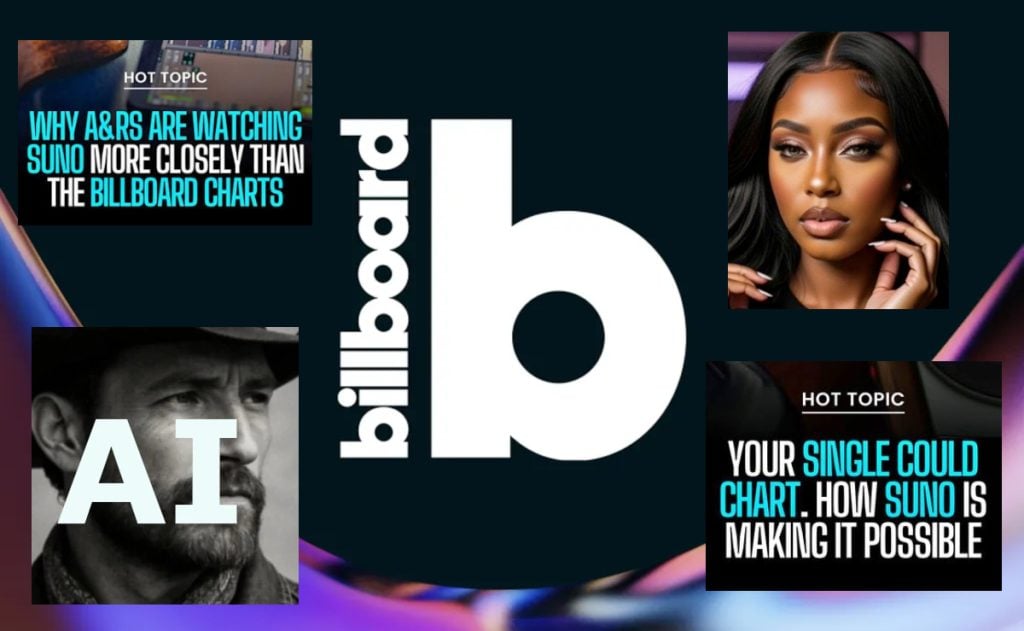
The AI music company Suno that is at the heart of the explosion of AI songs. It is currently advertising that you could make a song, and it could end up on the charts, while at the same time advertising that A&R reps at labels are watching Suno activity more than the Billboard charts. Suno seems to be understanding the importance (or lack thereof) of Billboard‘s charts more than Billboard does. Suno is basically calling the media company out, while also leveraging Billboard‘s clout to promote themselves.
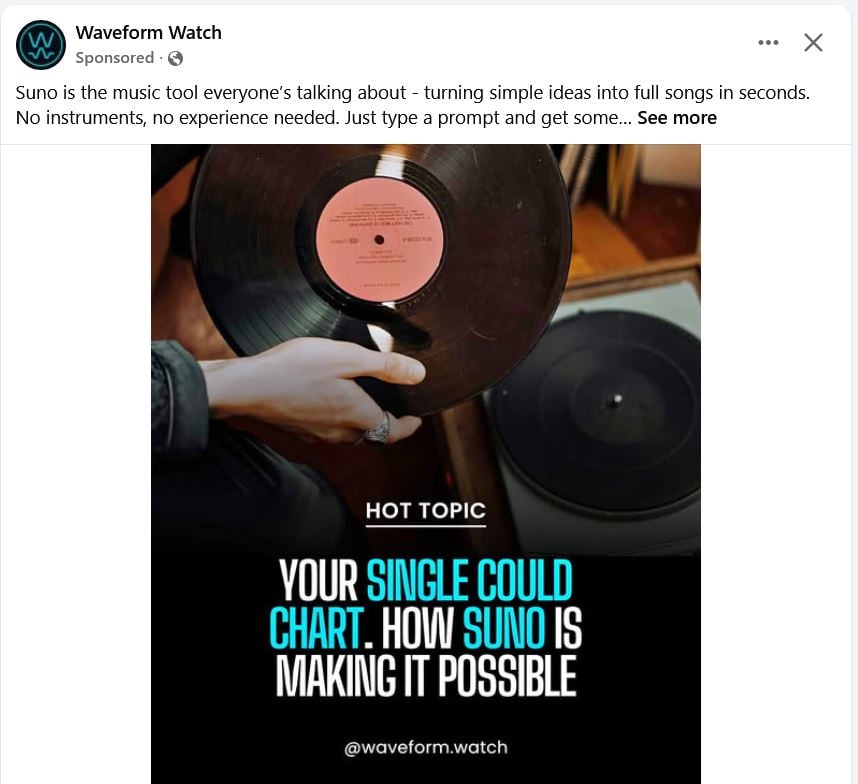
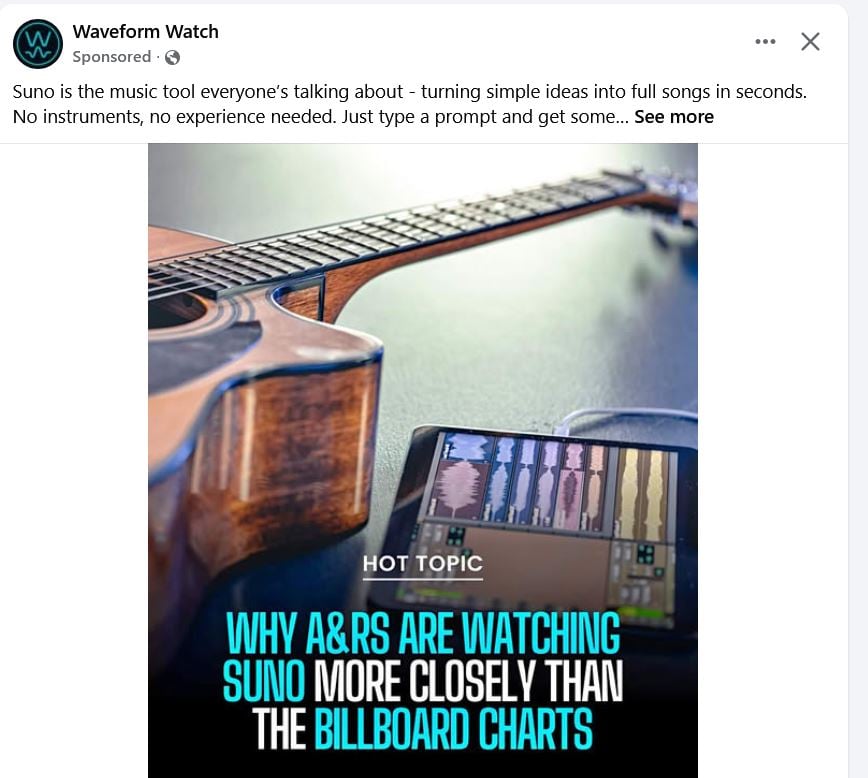
Meanwhile, instead of meeting this crisis head on, Billboard seems content to simply “discuss” the matter of AI songs charting on their charts, and paying lip service to accountability, and protecting human creators. Recently the publication released a 25-minute discussion asking “Are AI Artists Taking Chart Spots From Human Creators?”
The answer to that question is empirically “yes.” There is no other way to answer that question that isn’t false. The only reason Billboard frames this matter as a question is because they’re not willing to acknowledge the only correct answer. We saw this when an AI-generated song topped Billboard‘s Country Digital Song Sales chart.
Billboard‘s discussion involved Willie “Prophet” Stiggers, who is the president and CEO of the Black Music Action Coalition (BMAC) who was advocating for human creators. It also involved Romel Murphy, who is the founder of Daidream, and manages the AI artist Xania Monet who uses Suno to create her music, and recently signed a multi-million-dollar label deal.
Similar to what Saving Country Music has been saying since the beginning of AI music entering the commercial marketplace, Willie Stiggers of the BMAC strongly advocated for proper labeling of AI tracks if nothing else.
“I don’t feel that AI-generated artists should be on the same charts as human beings. I think that very similar to the way you put Parental Advisory stickers on albums … the same sort of transparency should be taking place as it relates to AI-generated artists. I think a lot of people don’t even know that they’re listening to [AI] … We have to take care of the creative community that’s taken care of us since the inception of time.”
Xania Monet’s manager Romel Murphy cited how iHeartMedia made a decision to not include any AI-generated music on their radio stations and podcasts as a form of discrimination against AI music.
“You’re gatekeeping,” Murphy accused. “She’s got 1.6 million fans listening to that song a week, and you made the decision, because you’re at the top of the food chain of your company, you made the decision to shut it down. So now you’re gatekeeping the fans.”
But fans are still able to consume whatever they wish, just as radio stations or networks should be allowed to play whatever they wish. If anyone is a victim of “gatekeeping” in this scenario, it’s human creators who are being overshadowed on charts by AI songs and “artists.”
Similar to the claims that Beyoncé was the victim of “gatekeeping” in country music as her albums and songs appeared at the top of all of Billboard‘s country charts and she made millions of dollars, Xania Monet is being couched as a victim as she signs multi-million-dollar label deals, and makes tons of revenue off of AI-generated music. Beyoncé is a billionaire, but somehow is a victim as many independent country artists can’t even make enough money to sustain a career.
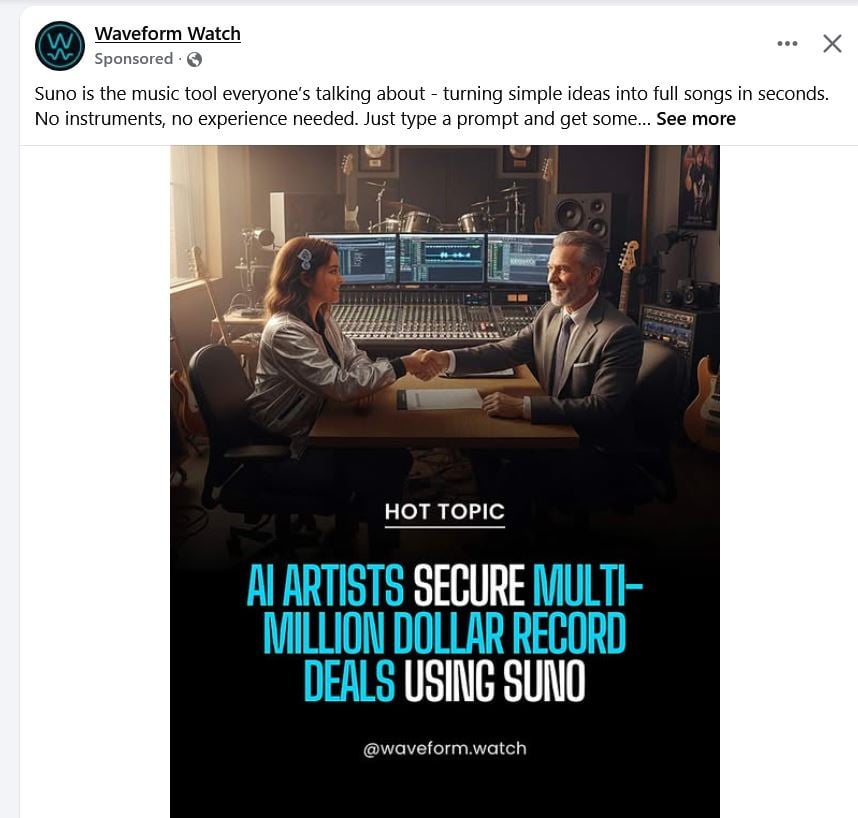
Once again, Suno is advertising how you could use their service to sign multi-million-dollar recording contracts when so many human creators out there who’ve spent years or decades perfecting their craft are left on the outside looking in.
As Willie Stiggers of the BMAC went on to say, “The creative community, especially the Black creative community have given so much to society from the inception of time, and have received so little in terms of compensation, it terms of ownership. And for me, I’m always out to protect that. And we have to fix that. And we as a people should never get so far away from the human connection. And when you have non-humans competing in charts with humans, we are furthering that disconnect between humanity.”
For Billboard and other entities, the music calendar ends in November, and December/early January is the time to retool for the next year. This is the time when Billboard is changing their ratio for how ad-supported songs are weighted in the charts, and when YouTube is pulling out of reporting to Billboard.
This should also be the time for Billboard to take a very hard and close assessment to how it handles AI songs on the charts moving forward. At the absolute least, the company should make sure all songs with 50% or more participation via AI are disclosed, or that human-certified tracks are highlighted. Deezer’s AI Detection Tool could be used to assist with this. But for now, AI songs should populate their own charts, at least until we can determine just how disruptive or catastrophic this AI phenomenon might or might not be to music.
It’s not AI creators who will be the victims of “gatekeeping.” It will be the human creators who’ve spent their entire lives perfecting their craft, honing their skills, and dreaming of making it in music since they were little kids. They will be the ones who are summarily locked out as commercially-driven and talent-bereft opportunists with AI prompts infiltrate and eventually dominate the music charts, and music in general.
It won’t just be human musicians who are severely hurt in this situation. It will be Billboard as others who continue to lose public trust and cultural relevancy as they increasingly struggle to offer the clarity and transparency the music industry needs to remain credible in the minds of an increasingly skeptical public.
– – – – – – –
If you found this article valuable, consider leaving Saving Country Music A TIP.
December 26, 2025 @ 8:51 am
The “gatekeeping” argument made by Murphy is mind numbingly stupid. An adult should be embarrassed to make that argument on the record and in the public eye, but sadly society is all too content to listen to grifters and con artists in 2025.
Also interesting that Murphy said “fans” and not “people”. Hmmm….
December 26, 2025 @ 9:06 am
“Gatekeeping” is just one of these thought-ending cliches that is issued in the vacuum of actual, salient arguments for or against something. It’s simply meant to instill a fear in being labeled as such to result in the outcome the issuer wants, in this case for AI “artists” to be dealt with no different than human creators. Unfortunately, the “gatekeeping” accusation is very effective. It’s ironic that it was being used to make an arguments against a representative from the Black Music Action Coalition, which has used that accusation often in the past as well. But even the BMAC can see how existential AI will be on human creators.
Sometimes as an individual, entity, institution, etc., you have to make strong decision in the face of criticism. At some point in the future, Billboard could go back and re-evaluate how they deal with AI on their charts. But for the time being when these decisions feel so existential, they should take the most prudent route when it comes to AI music, which is to keep it separate from the music made by humans, accusations of “gatekeeping” be damned.
December 26, 2025 @ 9:59 am
Billboard, like many others, is putting their eggs in the Ai basket in order to survive the coming Ai Armageddon for creatives. It might save them in the short term, but their days are numbered. Ai is mostly for lazy people with no talent.
December 26, 2025 @ 10:11 am
“Billboard, like many others, is putting their eggs in the Ai basket in order to survive the coming Ai Armageddon for creatives.”
I think this is a very smart assessment. There’s an “If you can’t beat ’em, join ’em” calculation going on right now at places like Billboard, The Recording Academy, the RIAA, and other places where they see the deleterious nature of all of this, but don’t want to be on the wrong side of the paradigm as tectonic actions start happening in entertainment. Yes, AI is here and there’s no putting that genie back in the bottle. But that doesn’t mean you can’t make smart and prudent decisions right now that could dramatically shape how all of this unfolds, and ensures that human creators don’t have at least a fighting chance to survive.
December 26, 2025 @ 12:44 pm
Their days are numbered just as many media entities are numbered — the great advertising drought just keeps getting deeper. As corporations consolidate, there’s less of a need to advertise as there used to be, and legacy media like print, radio and TV are suffering the most. That’s what will kill Billboard, not the death of creative.
December 26, 2025 @ 11:24 am
AI songs solely exist because every song ever has been hovered up into 1s and 0s, then AI can take all that and use it to makes its own songs. Without the underlying real music, there couldn’t be AI music.
And billboard…they can go screw with their continued poor decisions that make themselves irrelevant by the day. Someone bold could take the lead on this alas they will just play passenger.
December 26, 2025 @ 11:37 am
Who is “gatekeeping” human creators from having their intellectual property stolen by companies like Suno, and major labels selling them out by giving permission to Suno to do so—something they never signed a contract authorizing?
December 26, 2025 @ 12:20 pm
AI “creators” who complain about gatekeeping are complete and utter morons. I love baseball – is MLB gatekeeping being my schlubby ass would be winded just walking up to home plate? I appreciate the arts – but is it “gatekeeping” if I take my finger painting down to a museum and they refuse to put them next to Van Gogh?
AI music “creators” possess no skill or talent. They are good at entering the correct AI prompts, but a damn monkey could do the same if given enough time and opportunities. The complaint that Billboard just giving AI music it’s own chart is somehow “gatekeeping” them is proof that our education system sucks because these folks are complete morons. In a proper society these morons would be shunted off to a corner and forced to wear the dunce cap they so deserve. Sadly it seems husks of institutions like Billboard instead are like “you know, that guy makes some points!”.
December 27, 2025 @ 2:47 am
I await the day AI has scavenged all it can from actual human creatives, so all AI has left to Hoover up and re-process are the 1s and 0s of previous AI “creations.” Music will become an AI feedback loop. I bet *that* will be some memorable music. We will miss the gatekeeping.
December 26, 2025 @ 12:19 pm
Unfortunately, by this time next year – this won’t even be a discussion anymore. Most of what we consume will be AI and it will just be the way it is…for worse, or even worse.
The whole “Let’s force labeling” thing will be a quick blip in the timeline that will come and be gone over the course of a few weeks.
Within 2 years all music on the charts will come from UMGs own in-house AI music generators. There will be a rotating staff of underpaid musicians to tour the songs and it will all just be considered normal. Just like autotune or digital recording.
Welcome to hell.
December 26, 2025 @ 12:32 pm
I don’t know about that. We might very well eventually get to that point – but I also think it needs to be pointed out that a LOT of people loathe AI and the slop it allows to be pushed as well as the economic impacts it currently is having (energy/utility prices and Big Tech trampling over property owner rights). McDonalds floated an AI Christmas ad 2 weeks ago and the result was significant push back with the ad widely being reviled. It isn’t clear to me that people even like the current AI songs out there vs. people gaming the charts system and people listening because it is a “new” technology.
Hell, Congress has been pushed by White House to include AI law preemption at a local level throughout the year and couldn’t get it done because folks on both sides of the political spectrum – Steve Bannon to Bernie Sanders – hated the very idea of giving even an inch to the AI companies. Which forced the currently (illegal) executive order issues earlier this month by the White House.
There will always be a sad amount of people content to hoover up their AI slop fed to them by corporations. But I also think that audience is nowhere near as big as the labels and AI companies think it is. I could see AI displacing certain genres of music – think children’s music firstly – and teen pop being the most obvious “low hanging fruit” for this. But I also think there are going to be genres where it is going to be a lot harder to gain significant ground in. And that also assumes that the technology is going to continue to get better (unclear to say the least) AND that consumer interest is more than “novelty” as it currently seems to be.
December 26, 2025 @ 1:28 pm
I think it will happen faster than you think, because the LOVE IT and the HATE IT people are a pretty small combined percentage. The completely indifferent one way or another people make up the biggest percentage – and that’s all they need. They know the majority just doesn’t really care – and they’re betting on it. It’s pretty rare that big company greed doesn’t win in the end.
December 26, 2025 @ 5:42 pm
I’m under no illusions Big Tech is going away, but keep in mind these are the same companies that told everyone that the Metaverse was gonna make in-person meetings obsolete. These are the same companies who said shoving a Chromebook or iPad in front of every kid was gonna boost math and reading scores to new heights. Hell, remember when 3-D TV’s were supposed to be the next big thing?
I think AI is absolutely going to change a lot of things about society, but I remain unconvinced that half the threats and promises both sides of the AI argument make are gonna come to fruition. Only time will tell, but Big Tech has a lot more “losses” in the column lately than wins when it comes to technologies and platforms they promise are world changing and that actually occurring.
December 26, 2025 @ 1:16 pm
Though I agree the future looks dire, that doesn’t mean we can’t make decisions right here, right now that can affect or delay how all of this will transpire, even if only on the margins. Even if we can only protect some human creators, even if we can stave off the AI onslaught by months or years, these won’t be insignificant accomplishments. And the sooner rules and good practices are adopted, the more likely the catastrophic impact of AI can be controlled or compartmentalized to some extend that will protect actual musicians. The consequences here are too dire to not at least try to put up a fight.
December 26, 2025 @ 1:30 pm
Totally agree on that. Just because you know you’re going to get your ass kicked – that’s never a reason to quit throwing as many punches as you can.
December 26, 2025 @ 7:50 pm
Yeah, there is something to be said for “fighting the good fight”, hopeless as it may be.
Humans, or at least the human experience, is in terminal condition. We know we are going to die soon. The choice is whether to do everything you can to extend your life 6 months, a year, maybe two. It’s more precious time to soak it all in and who knows maybe a miracle happens in the meantime.
December 26, 2025 @ 1:29 pm
My engineer texted me today and said he just ran sound at a wedding where the walk in and walk out songs were both AI generated, and no one seemed to notice or care. I think the fact that we have these kinds of AI songs charting and in wide circulation is a symptom of a much deeper societal problem, and not the problem itself.
On a personal artistic level, my audience is so niche anyway that I don’t really get concerned about losing in come to AI. People who like Conrad Fisher are not going to particularly enjoy AI slop, so I don’t feel like I’ve lost any steam to it. So far it has not affected me or my income. In the studio, I’ve had a few clients say that they are now using Suno to create tracks, but they always end up coming back after a month or two. As an artist, you have to take a good hard look at your definition of success, because it is changing. Chart success used to be the way to make it as a songwriter or artist, but that’s simply not the case anymore, and if you can be ok with that, you’ll be a lot happier.
I had a conversation after one of my gigs about a year and a half ago with a guy who worked for Nvidia. I asked him what the future looked like for creatives like myself, and he said, “As long as you can stand up there and capture people’s attention with wood and wire, you’ll have a job.”
This may make me sound really pompous, but in my observation, a lot of creatives (outside of session players, those folks are taking a beating) who are losing work to AI weren’t especially creative in the first place.
December 26, 2025 @ 5:34 pm
In fairness, even if people were aware or focused on the music at a wedding, they likely aren’t going to say anything anyway out of politeness alone.
But I agree with the rest of your point – the artists most at risk of being impacted by AI are those are were producing mindless, thoughtless, background music. The people producing thoughtful content for people to really intently listen to – those are the one’s that I think will be more insulated than not.
Dan & Shay are screwed. Singer songwriters with actual talent? Not so much.
I have heard similar things from friends who work in the tech field. The folks who only knew enough about coding to build simple apps for small businesses are screwed. AI coding will wipe them away. The folks tasked with combing through said software code to determine why the app broke and how to fix it will be fine.
For all the hand-wringing about AI, lost in a lot of the conversation is much of the software is….just not good. Big Tech hasn’t built anything new and actually good in a long, long time. I’m not convinced that trend is gonna change significantly based on CoPilot being unable to sum an Excel column correctly or Gemini telling folks to put glue on pizza.
December 26, 2025 @ 2:02 pm
“Manager of AI Artist “. Let that one sink in. Even implying that an AI song is ” by an artist” is insulting to say the least, but then you have a ” Manager”? What?! You mean a freeloading, money grubbing, opportunist con-man? This whole thing is rotten, and I do hope musicians and consumers will realize what is happening. Art is one of the hallmarks of HUMAN civilization, it serves as a showcase of human creativity and accomplishment. Art should NEVER under any circumstance be created by machine and then touted as anywhere near an equivalency to what a human being creates. You wanna have a music service labeled clearly as AI? Even that is a compromise because losers like AI Manager Romel Murphy will clamor “gatekeeping” if their “songs” aren’t dominating every chart as they wish. People like Romel are soulless, conscience devoid imbeciles who care not that they are destroying our very civilization and reducing the human experience to virtually nothing but brain-dead consumers who do nothing of value, merit or worth. Thanks tech billionaires, thanks a lot. You genuinely suck.
I know some human artists are sadly using AI to write songs and that is tragic. To me the whole craft of songwriting is officially over as we knew it at least. Simply put, there is no longer going to be a need for writers of any kind. We can see what is happening clearly, and how do any of us stop it?
December 26, 2025 @ 8:13 pm
We can only hope Rolling Stone will disappear into oblivion.
December 28, 2025 @ 6:21 am
Does Billboard have any real relevance anymore? Do the charts mean much anymore? Does Rolling Stone have any credibility left?
January 3, 2026 @ 5:07 pm
For me, beyond the destructive implications of AI’s incursion into the music world, my main concern is, why do we need any AI-created music in the first place?
I’m all for AI being introduced where humans could actually use some help–in finding a cure for cancer, for example–but when it comes to music, there’s a whole history, present and future of wonderful human-created music that we’ll never have enough time to listen through, so any additional AI-created music is not only destructive but entirely unnecessary.
The creative arts are, by definition, an expression of *human* skill, intellect and emotion, which should disqualify the participation of AI.