

Death Threats and Defections: 2026’s Rock The Country Fest
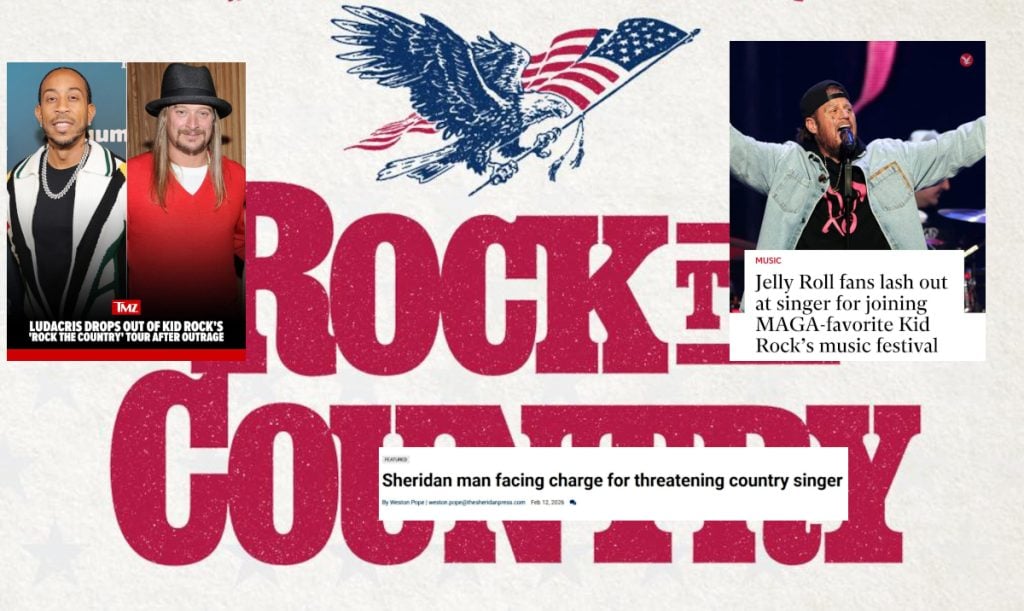
In late 2023, Kid Rock and Jason Aldean announced they were co-headlining what became known as the 2024 Rock The Country festival. It was part festival, part tour, with multiple dates in multiple locations throughout the South and Midwest, and a different lineup in each location depending on the city. It’s a similar model to the original Lollapalooza or Lilith Fair festivals from the ’90s.
Miranda Lambert, Hank Williams Jr., Lynyrd Skynyrd, Koe Wetzel, Brantley Gilbert, Travis Tritt, Lee Brice, Big & Rich, and Gretchen Wilson were some of the other big names involved in the tour, with an even deeper undercard of developing talent.
The big, unspoken theme behind the festival seemed to be that it was basically a big traveling political rally promoted during a Presidential election year, and coded toward the American right. This was never expressly stated on the posters or in any of the promotional copy for the traveling festival. But watching a documentary on the 2024 Rock The Country confirms the political tie-in, with Tucker Carlson and Donald Trump leading invocations, and fans touting their MAGA bonafides.
The Rock The Country festival/tour also took place in 2025, with Kid Rock and Nickelback being the two big names leading lineups in eleven different cities. By all indications, Rock The Country has turned into a strong and successful touring franchise that can be expected to happen each year.
Announced on January 12th, the 2026 Rock The Country Festival would travel to eight different locations, and feature the reunification of Kid Rock and Jason Aldean, along with top names like Blake Shelton, Jelly Roll, Creed, Brooks & Dunn, Miranda Lambert, Riley Green, Hank Williams Jr., Lynyrd Skynyrd, Shinedown, Jon Pardi, Ella Langley, Brantley Gilbert, Treaty Oak Revival, Gavin Adcock, Ludacris, Nelly, and a large undercard depending on the city.
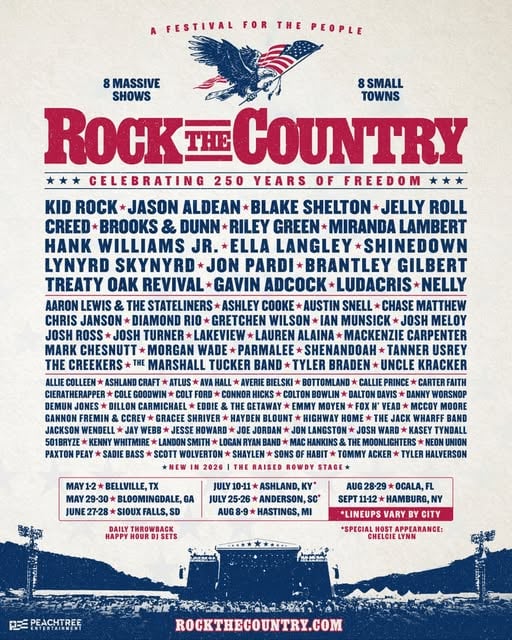
But where in previous years the Rock The Country announcements came with excitement by many, and eye rolls and grumbles from folks that were unlikely to attend anyway, the January 12th announcement was proceeded by widespread rebuke and condemnation of the performers whose names were associated with the event.
It seemed that the “vibe shift” that preceded the last Presidential election had started to shift back, and a passive resignation by some music fans to the politicization of the music turned into active pressure campaigns to shame artists to drop out of the events, or face supposed “cancellation” like it was 2020 all over again.
The first to capitulate was rapper Ludacris, who just like Nelly, has appeared on multiple “country” festival billings before. As opposed to owning up though, the Ludacris camp played dumb, saying appearing on the lineup was “a mix-up. Lines got crossed, and he wasn’t supposed to be on there.” Maybe that’s the case. But artists must confirm poster placements for events like this, and Ludacris has made a concerted effort to open the country market to his music. It’s more likely public pressure was the culprit.
Shortly after the Ludacris departure, two openers from the country world in Morgan Wade and Carter Faith also dropped off the lineup. In the face of public pressure being put on all the performers, the drummer for rock band Shinedown, Barry Kerch, called out Ludacris for being a coward for dropping out, though also acknowledged the band didn’t know about the political notions of the festival. He said in late January,
I had no idea this was Kid Rock’s thing. It was just, ‘Hey, here’s an offer. It looks like a cool lineup, and it’s a mix of country and rock. Okay, we’ll play it.’ We took the offer and played it, and then all of a sudden we find out, ‘Oh, this has got some political leaning to it.’
I don’t care. I’m just gonna go play a show. I really, really don’t care. You can keep your politics to yourself. I have no opinion one way or the other on Kid Rock. I love his music. This is about music. Ludacris wasn’t tough… I mean, it’s not like he needs the money, Jeez. If he’s not tough enough to stick it out, that’s just silly. That’s him being a coward, in my opinion.
But where the pressure really began to mount is after Kid Rock’s involvement was revealed in TPUSA’s alternative halftime to the Super Bowl. Two days before the Super Bowl (Feb. 6th) Shinedown decided to pull out, saying in a statement,
Shinedown is everyone’s band. We feel that we have been given a platform to bring all people together through the power of music and song. We have one BOSS, and it is everyone in the audience. Our band’s purpose is to unite, not divide. With that in mind, we have made the decision that we will not be playing the Rock The Country Festival.”
We know this decision will create differences of opinion. But we do not want to participate in something we believe will create further division. And to our fans, thank you for supporting and believing in us. We love and appreciate you always.
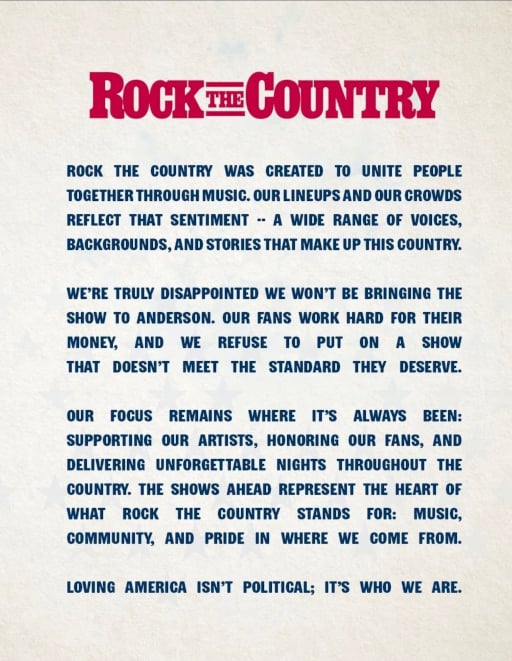
The defections from the festival ultimately doomed two of the dates scheduled for Anderson, South Carolina, on July 25th and 26th, which were canceled.
But as the Super Bowl Halftime performance became the culture war du jour, people seemed to move on from the Rock The Country outrage, and public pressure died down on the performers, even if high-profile performers like Blake Shelton and Jelly Roll who previously were not considered through a political lens are now considered “MAGA.”
But it wasn’t just public pressure and backlash some Rock The Country performers have been facing. A 46-year-old man named Baptiste W. Brafford from Sheridan, Wyoming allegedly sent Rock The Country performer Tanner Usrey from Texas numerous death threats directly tied to a show he was scheduled to play in Rapid City, South Dakota on February 6th.
Saving Country Music has been able to confirm that the threats Usrey received were directly tied to his involvement in Rock The Country.
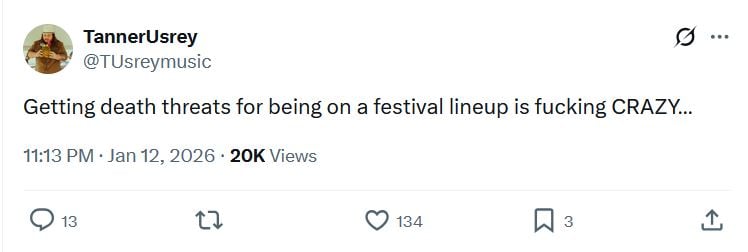
On January 12th—Rock The Country lineup was originally released—Tanner Usrey posted on X/Twitter, “Getting death threats for being on a festival lineup is f-cking CRAZY…”
Baptiste W. Brafford allegedly sent in Facebook messages, “Don’t come to Rapid City, you could end up ‘Charlie Kirk’ spreading that same hate. It be an arrow though … Hey a 30-06 (thirty-ought-six) would blow your head off. That’s what killed Charlie Queen yet didn’t blow his head off. You think it was a 06 (ought-six) but any good ole boy knows that was a .223 at best.”
Rapid City police were contacted about the threats, who then reached out to Sheridan, Wyoming police who arrested Brafford. The man told officers that he remembered sending Facebook messages to Usrey approximately one month previous and stated that he was drunk when he sent them. Brafford said he later deleted the conversation.
Brafford was taken into custody Feb. 4 for telephonic threats for communicating with Usrey electronically and threatening to inflict death. He pleaded not guilty to the misdemeanor charge during arraignment Feb. 5, and later posted a $5,000 bond.
What the narratives, news stories, and now criminal charges stemming from the 2026 Rock The Country festival underscore is how political acrimony has now officially permeated every crevice of American culture, to the curation of many music events, to how those events are received by the public. Where you perform, who you perform with, what tour you choose to join, what music you perform or listen to is all being whittled down to a political decision, not one of personal taste.
Despite the proclamations of Rock The Country in their statement after the cancellations, they are dividing America, as are the fans an activists shaming the performers for participating in Rock The Country.
Now that negative rhetoric has even rose to the level of death threats, it’s not hard to imagine how it could manifest into physical violence. It did for Charlie Kirk like the alleged death threat author mentioned. It also did for the 60 people killed, and over 400 wounded in 2017 at the Route 91 country music festival in Las Vegas—the deadliest mass shooting in modern history, and one where a motive has never been concluded upon.
All of this is a catastrophic prognosis for the music community, and the ability of music to unite people. It’s all a symptom of the societal decay in a crumbling empire and late-stage Capitalist era that it now feels somewhat fruitless to rage against, and impossible to game a solution to, especially since so many are poised to personally benefit from this rabid polarization, at least in the short-term, feeding off of it for attention, social clout—and for those in the political class themselves, power.
But if for no other reason than for personal safety, everyone should work to turn the temperature down, show more grace and understanding than judgement, and work to restore music’s unique ability to unite people beyond the political binary, even if such a statement in itself seems blind and innocent to the realities of American society today.
– – – – – – – –
If you found this article valuable, consider leaving Saving Country Music A TIP.
February 18, 2026 @ 9:06 am
“Late-stage capitalist”. C’mon, man, you can do better. The division is sown by the violent and feeble-minded, not the artists or promoters.
February 18, 2026 @ 9:11 am
I think even if you’re a dyed-in-the-wool Kid Rock fan, you have to be aware that he’s divisive. I think that’s why many people like him, because he’s outspoken and divisive, and expresses their values. To not recognize the divisivness of Kid Rock—and to a perhaps smaller extent, Jason Aldean—is to feign feeble mindedness.
February 18, 2026 @ 9:28 am
So are we gonna call Jason Isbell, Kacey Musgraves and others who speak from the other side divisive.
February 18, 2026 @ 9:32 am
Have you read anything trigger has ever written lol
February 18, 2026 @ 9:43 am
Forgiveness For Me But Not For Thee: On Jason Isbell & George Jones
https://savingcountrymusic.com/forgiveness-for-me-but-not-for-thee-on-jason-isbell-george-jones/
The Confounding Dichotomy of Jason Isbell
https://savingcountrymusic.com/the-confounding-dichotomy-of-jason-isbell/
Jason Isbell Says There Aren’t Great Conservative Songwriters
https://savingcountrymusic.com/jason-isbell-says-there-are-no-great-conservative-songwriters/
Houston Venue Refutes Jason Isbell’s Claim It Refused Covid Policy
https://savingcountrymusic.com/houston-venue-refutes-jason-isbells-claim-it-refused-covid-policy/
– – – – – –
Someday, people will finally come to the conclusion that what I’ve been saying for many, many years is true: I don’t not bring a political alignment to my reporting. My allegiance is to trying to keep political acrimony and irrationality out of the music space so it can do its job of unifying people across the ideological strata.
February 18, 2026 @ 4:36 pm
Almost everyone has a political alignment which reveals itself in the lexicon they naturally use and the ideas through which they interpret, understand and describe the world.
You are no exception to this. Your casual use of a phrase such as ‘late stage capitalism’ and your tacit assumption that women and blacks have been shunted (“oppressed”) in country music simply because they’re a woman/black demonstrates that you veer leftward politically.
You are not a neutral or objective commentator. Such a belief, in itself, situates you within a certain set of governing ideas, particularly post-enlightenment liberal notions concerning reason. You operate within a particular epistemology.
From what I’ve read here over the years I would describe your politics as that of a ‘non-commital centrist dad’. For the most part you remain explicitly politically neutral, however linguistically and methodologically you code leftward.
For a conservative reader it’s evident you work from liberal axioms; for the liberal reader you probably don’t go far enough. You are not a Comrade, therefore the suspicion is you’re probably a Nazi.
Thankfully, because you’re not an activist type who wears country music a skin suit, you mostly stick to discussing the music.
February 19, 2026 @ 12:10 am
Ha, you got me all figured out. Don’t you, 🙂
So I don’t know why folks are taking the “late stage capitalism” phrase as a political signal. I think irrespective of your political alignment, we can all recognize the massive wealth gap that’s only getting more pronounced by the day, how a wealthy oligarchy is really who is running the country as homelessness skyrockets, the American dream becomes unaffordable for young adults, and kids are facing a reality where they will never have it as good as their parents.
As for my tacit assumption on women and blacks, I always find this fascinating, because there are people with PhDs speaking to college classes citing my writings on Beyonce as proof of the intrinsic racism pervasive throughout country music because I had the audacity to take Beyonce at her word that she didn’t make a country album. To the academic/journalist cohort, there isn’t a more racist and misogynist character in country music than myself, aside from maybe Morgan Wallen.
“From what I’ve read here over the years I would describe your politics as that of a ‘non-commital centrist dad’.”
Well, first off, I’m not a father. Second off, people take my objectivity of politics as centerism often. But really how they should regard it as radical. I’m not a centerist. I am for the utter expulsion of the entire political system that has utterly destroyed this country by fooling people into thinking that politics can be a soultion to anything, and doesn’t enact more problems than it solves.
February 18, 2026 @ 6:19 pm
GM Slack, I am a staunch conservative/liberty loving capitalist. But I recognize that this country is in the midst of “late stage capitalism.” We are on the road to socialism, whether we like it or not. My only consolation is that I won’t see it achieved due to my advanced age. My point is, I think Trigger is intelligent enough to see what is happening. Whether he likes it or not, I cannot discern from his writing. In my opinion, that’s what makes him a good writer.
February 19, 2026 @ 8:13 am
Your prickly hyperbole aside, yes I have discerned your general political orientation; Viz, naive liberalism. Liberal because, inter alia, your operating assumptions appear to be universalism, blank slatism, utilitarianism, the autonomy of the rational individual etc. Naive, because you also appear to be unaware that they are your operating assumptions.
Note I say Liberal, not socialist. Within academia you are considered insufficiently radical. This is true of anyone who refuses to conform with the latest moral fashions of the neo-marxists. Take for example J.K Rowling, who in most respects is a Liberal. However her dissent on a single issue, ‘trans’, has her marked by the academic-media complex as, at best, ‘problematic’ and more typically ‘fascist’.
‘Late stage capitalism’ is both interpretation and prediction. It draws on Marx’s ideas concerning the trajectory and final ‘crisis point’ of capitalist systems. Other understandings are available. Personally I believe the hybrid socialist-capitalist model predicted and described by Belloc in his ‘The Servile State’ to be more accurate.
To have the politics of a centrist dad doesn’t necessitate being an actual father. Perhaps the phrase has not reached you Americans. In a nut shell a ‘centrist dad’ is yester-year’s liberal, he is stereotyped as middle aged, middle-class, male. He’s a progressive, yet not quite up to date nor sufficiently zealous. He considers his views as ‘sensible’, ‘moderate’, ‘rational’ and ‘objective’.
Which gets me to the point you can’t seem to grasp. You appear to have operative premises that correlate with the governing axioms of the liberal paradigm, more specifically that of the ‘centrist dad’ type. You, like everyone else, work from a particular point of view and that’s why I see your claims to objectivity and neutrality as risible and ridiculous.
February 19, 2026 @ 8:16 pm
Yeah…GM Slack’s lengthy, pathetic rant is deeply illustrative of where we are.
As long as you view human beings whom GM Slack’s social media feed has told him (we all know it’s a him, and that social media is the closest it’ll ever get to interacting with a woman) are “other” as human beings, you’ll never win with people like it.
It blames its social and sexual isolation on liberalism and the woke media, instead of its utter failure to have ever provided any value in any social interaction over the course of its sad, lonely life.
Which is why it valorizes men who describe middle school girls with phrases like “if there’s grass on the field, play ball.”
There’s a deep despair that defines the GM Slacks of the world…which would be sad, if they weren’t desperate gobbling Aryan Nations without coercion.
As is…it’s pretty funny.
February 20, 2026 @ 5:57 am
Cool Lester smooth, can you show me on the doll where the hateful nazi incel touched you?
Also lay off the estrogen pills.
February 18, 2026 @ 12:40 pm
Can’t just admit that Kid Rock and Aldean are divisive. Gotta be a “yOu gUyS aRe DiViSiVe 2!!” argument.
February 18, 2026 @ 9:51 pm
So there was a Kid Rock and Nickleback tour/festival? And people proudly went to it? We need a rea plague.
February 18, 2026 @ 10:36 pm
Has less to do with “capitalism” than with whose pernicious voice is the loudest; and those who follow are the ones electing to participate in the division. And it’s human nature to make decisions based on what you belive. Period.
February 19, 2026 @ 4:47 am
Funny that only artists on the right are considered “divisive”. Artists on the left can say any damn thing they want, and they get smothered in kisses.
February 19, 2026 @ 7:14 am
I don’t remember seeing an artist on the left shooting Bud Light cans with an AR-15 because they couldn’t cope that Budweiser put an LGBTQ on a six pack (and didn’t put them on shelves nationwide).
I don’t remember artists on the left using the N word.
I’m also pretty sure Isbell has received backlash, probably just not enough in your eyes.
It’s all good, Michelle. Being a victim is currency these days…keep up the good work, you’re doing great.
February 19, 2026 @ 8:33 am
That’s aggressively untrue. I personally have labeled Sturgill Simpson, Jason Isbell, Margo Price, Tyler Childers, and others as “divisive,” and very specifically for them taking strong political stances.
February 19, 2026 @ 2:56 pm
You are confusing Public Opinion and Freedom of Speech.
Cheers!
February 19, 2026 @ 6:54 am
Yep – these people love Kid Rock for values like “If there’s grass on the field, play ball.”
Shows up in how they vote, too.
February 21, 2026 @ 8:31 am
More political BS from the so called non political website. Typical BS from far left leaning Trigger.
February 21, 2026 @ 8:56 am
Lol, okay so now I’m “far left”? Give me a break man. Go read the articles I posted about Jason Isbell I linked to above and get back with me.
And yes, every time Saving Country Music broaches politics, it’s to advocate for the removal of polarizing politics from the creative space. If people can’t go through the two-part thought process of understanding you can’t broach political divisiveness and how it’s hurting the country music community without broaching politics itself, that’s not my problem. I have been extremely, extremely consistent on my stand of politics and country music: it is caustic to the ability of music to actually change hearts and minds, and should be avoided.
February 19, 2026 @ 6:50 am
Seriously – if a masked collection of violent, feeble-minded diddlers and wife-beaters weren’t roaming the streets murdering and kidnapping American citizens, there would be a lot less division!
But hey – at least inflation’s skyrocketing as the dollar tanks!
February 18, 2026 @ 9:25 am
Once again- well stated, we’ll balanced, we’ll said. I dont know how you do it. Thanks for doing it anyway. Much appreciated.
February 18, 2026 @ 9:25 am
I am a bit unsure about the reference to the Las Vegas shooting which is presented like it’s intended to suggest a political motive to the shooting when as far as I’m aware there’s no reason to think that. I understand it’s all a bit murky but what I’ve read suggests the shooting was motivated by the shooters personal grudge against the casino he fired the shots from. Happy to be corrected
February 18, 2026 @ 9:36 am
This is what the article states about the Las Vegas shooting:
” It also did for the 60 people killed, and over 400 wounded in 2017 at the Route 91 country music festival in Las Vegas—the deadliest mass shooting in modern history, and one where a motive has never been concluded upon.”
There has been a lot of speculation about motive, but it appears the killer very intentionally covered his tracks in a way that would trip up investigators and leave them with more questions than answers, knowing motive would be something they would be focused on.
I don’t want to be hyperbolic here. I also don’t want to diminish the possibility of political violence becoming part of the equation here. The biggest mass shooting in modern history happened at a country music festival.
February 18, 2026 @ 9:46 am
That reference stuck out to me as well. Otherwise a good article
February 18, 2026 @ 12:03 pm
Allow me to don my tin foil hat and suggest the Las Vegas mass shooting may well have been politically motivated. It just had nothing to do with US politics, however.
February 18, 2026 @ 9:42 am
Despite my already stated disagreement that the goal of socially conscious music isnt meant to “unify” ill not flare up political discourse in all of this and ask question ive generally been curious about:
– Where the heck has Uncle Kracker been in all of this? Seriously, not a peep.
As far as Kid Rock, Ill merely say hes found a schtick to keep his name in the news and presumably the checks flowing in. Good for him I guess… I guess it is a burden that country music must address that a washed up artist like Kid Rock just needs to hug a flag and don a red cap and select the country music button to make a payday with out offering anything new or noteworthy musically, but thats a burden for another day.
February 18, 2026 @ 2:28 pm
Not all music needs to “unify” necessarily. But if you’re an activist artist, it’s your job to “convince” people of whatever you’re advocating for. You can’t do that through the venting of anger and alienation, which is often how music activism takes shape, though not always.
February 18, 2026 @ 9:44 am
Also not mentioned here Trigger but the death threats definitely take me back to when this exact thing happened with the Dixie Chicks, which weve all established was not country musics proudest moment
February 18, 2026 @ 9:56 am
When rabid politicization permeated country music in the early 2000s resulting in the expulsion of the Dixie Chicks from the genre, it wasn’t just the Dixie Chicks that were injured.The entire credibility of country music suffered, resulting in not just the loss of cultural cachet for the genre, but lowered economic activity as people didn’t want to be associated with it. This is the reason labels, managers, etc. all enacted a moratorium against artists taking strong political stances, which was a regime that lasted up until about 2024.
Now that moratorium is completely gone, and even labels and managers are actively using politics to attempt to leverage political demographics for popularity. Though this may result in a short-term goosing of popularity or a strengthening of a fan base, it also runs the risk of a massive backlash as the political winds shift like we are already seeing.
February 18, 2026 @ 10:46 pm
The Dixie Chick’s affair was decades ago. This country is different. And I don’t think artists and management care about backlash anymore, as they can always rely on their core to support them. I honestly think artistscabd management teams have shifted in the srnse that “mass appeal” is no longer their ultimate goal, just limited expectations of selling to their core – and being content with that. Super-duper stars like Taylor Swift are the rarity now, not the norm. (And the “mono-genre” arguement needs a revisit, since the creativity and sounds will focus to specific groups, woth less focus on style other that to push the messaging.
February 18, 2026 @ 9:48 am
Well said. I am really disappointed in Shinedown. If they truly want to be a uniter they could of just said they didn’t understand the political nature of the event but made a commitment and welcome all sides to listen to their music and did the show. Especially since they were a headliner and many got tickets just for them. It is a shame because many of their lyrics could be inspiring to anybody and would guess a good portion of their fanbase leans right (good portion leans left too). Who knows what the percentages are but no doubt they angered up to 50% of their fanbase with this decision. The drummer sure looks bad too.
February 18, 2026 @ 10:01 am
Give credit to the Rock The Country organizers for at least trying to put together lineups that cut across ideological lines. As much as it drives me nuts that these country festivals book rap acts like Nelly and Ludacris as opposed to supporting actual Black artists within country, they did that on purpose. They were trying to appeal and represent a wider audience. They also didn’t book an act like Morgan Wade on accident. And by people shaming these artists off the lineup, it does made these events more politically and socially concentrated and ideological.
February 18, 2026 @ 10:27 am
You dont think some of this is on kid rock? I mean hes the face of the festival, and has dived right into the current political and cultural wars head first for what (cynically) seems to be his own financial reasons.
February 18, 2026 @ 10:32 am
https://savingcountrymusic.com/death-threats-and-defections-2026s-rock-the-country-fest/comment-page-1/#comment-1740402
“I think even if you’re a dyed-in-the-wool Kid Rock fan, you have to be aware that he’s divisive. I think that’s why many people like him, because he’s outspoken and divisive, and expresses their values. To not recognize the divisivness of Kid Rock—and to a perhaps smaller extent, Jason Aldean—is to feign feeble mindedness.
February 18, 2026 @ 10:41 am
Maybe I wasnt paying attention but up until the last 18 months or so, I hardly thought about Kid Rock, and didnt see him as much divisive as I did a washed up 90s rocker who tried a poor mans Darius Rucker genre switch but to shrug results.
I guess that’s the point. In past years people kind of shrugged off Kid Rock, even if they knew he was political, not too many people thought of him all that much. Now hes plastered everywhere, presumably to his financial benefit but those tied to him are going to get questions from a generic public that wss previously uncaring
February 18, 2026 @ 2:34 pm
Though I’m sure it would not appeal to you, the documentary on Kid Rock and the 2024 Rock The Country tour gives some very excellent insight into the rabid fan base and grassroots support Kid Rock enjoys. That’s why when he was announced for the Super Bowl halftime alternative and people laughed, I pushed back. The guy has a very big, loyal following.
https://youtu.be/ASW-GVkO6O0?si=Urba2ZmHGDsv7Ogu
February 18, 2026 @ 5:58 pm
All music interests me. Ill add it to the queue. Thanks!
February 18, 2026 @ 10:48 am
It’s mostly about Kid Rock even though my post was about Shinedown and while Kid Rock is the organizer of the concept he wasn’t scheduled to perform at that one. The left can’t stand the fact they can’t make him go away. I will also say I don’t think Kid Rock makes any decision solely based on money. The one thing many people don’t understand about Kid Rock is that his fan base goes beyond music and MAGA, he is beloved by many in Detroit and in Michigan along with the large military community for the time, money and resources he has provided. Plus, there has always been an attraction for someone who really doesn’t care what anyone things about him. Fyi, I’m not necessarily a fan and no doubt he brings some of this on himself.
February 18, 2026 @ 10:15 am
Sad to see music artists get death threats.
February 18, 2026 @ 10:38 am
All that talk about “Love > Hate” from the left… yet CSIS and other stats show left-wing attacks and plots leading the charts lately. I agree it would be nice to calm things down, but so many celebrated when Kirk died that I don’t see how that could happen.
February 18, 2026 @ 10:58 am
It’s a sign of a fucked up nation. Everything and anything ends in trench wars.
Whatever used to unite us isn’t an option anymore. Soon enough they will sell bags of M&M’s without the red and blue ones, in case it might offend said party lackeys.
Oh well. We’ll all speak chinese in 50 years or so.
February 18, 2026 @ 11:10 am
Don’t listen to an artist you hate. Problem solved.
Sadly, the social media took the place of the pubs, bars and cafè’s. Whatever we slurred to ourselves or a few friends over a beer or a coffee, now lives on forever online.
Of course, that’s a wanted evolution. Now we’re too afraid to vent our frustration overall, leaving that space to the mentally unstable.
(Yeah, we’re probably a bunch of borderline freaks here too, but as far as I have read in the comments, we’re not throwing death threats around. Unless it’s “Death to Country Pop”. Exaggeration, bad jokes, harmless bantering and silly name-calling should pass. We’re adults, after all (he said with a snicker)).
February 18, 2026 @ 11:27 am
Apropos to nothing besides Kid Rock…Like 20 years ago my uncle was in it bad with the cocaine. Not in a good place. Borrowed against the farm, was a mess, all that. Anyhow, one Christmas he gave all of his nephews ages like 8-22 a Kid Rock CD. Looking at Kid’s discography it was either Rock and Roll Jesus or the self titled album I think, one of the more country ones none the less. I was like 22 so I sorta knew what was going on, but the younger cousins and the rest of the family were fairly confused and disappointed about the choice in presents. And my uncle was going on about how the music was “spiritual” and other shit in that vein. And we were all just like “yeah, yeah, yeah, whatever”. After dinner my brother and I went out to the shop to get high and shoot hoops and we were both just like “so Uncle____ is pretty fucked up huh”. Like two weeks later the elders of the family held an intervention. Him borrowing against the farm, rolling the 4020 over, calling my grandpa cause he thought his house was bugged… my family could look past all that, but the Kid Rock gifts caused the intervention. Uncle’s doing good now, sober. Just the other day I asked him if he would watch the Kid Rock halftime show and the family laughed and laughed and laughed.
February 18, 2026 @ 11:50 am
Man, you gotta be a complete and utter moron to post a threat to anyone on a public forum while living in our current surveillance state. Which this administration has happily kept the throttle down on from previous admins.
The DOJ is mass requesting information about anyone posting negative things about ICE on Facebook, Instagram, Reddit, Discord, etc.
Palantir is building a database – likely with the assist of data collected during DOGE.
I’m not defending the threat and condemn them myself, but talk about hitting every stupid branch on the tree of life if you post that stuff on a public forum in 2026.
February 18, 2026 @ 12:48 pm
These crazies are stuck inside the self-made blur of fantasy and reality.
February 18, 2026 @ 11:52 am
Activists — or what I would call Marxist-style “color revolutionaries” — continue to direct outrage and pressure toward certain events while ignoring others. The real question is whether festivals like Coachella, Lollapalooza, Bonnaroo, or Austin City Limits would face the same level of scrutiny or even threats of disruption. Let me answer that directly: no, they would not.
Let’s be clear about what’s happening here. Threats of cancellation, intimidation, and the use of pressure campaigns have increasingly become political tools associated with the left, not the right. If the goal is truly to “lower the temperature” in public discourse, then that reality needs to be acknowledged openly and honestly. Calls for civility ring hollow when one side continues to use outrage and coercion as leverage while simultaneously demanding restraint from others. God bless Robert Ritchey, I hope this is a successful tour.
February 18, 2026 @ 12:09 pm
I don’t think the single drunk guy who DMed a threat to whoever should be described as a “marxist style color revolutionary”. The right uses plenty of “cancelation” and “intimidation” themselves, it’s just on the right it is state sponsored, which is quite a bit different than a drunk guy DMing some artist. With that said, threatening the life of a musician is ridicules and that person should be punished and prosecuted to the furthest extent of the law.
February 18, 2026 @ 12:34 pm
I hear what you’re saying, and I agree that threatening a musician’s life is completely unacceptable and should be prosecuted to the fullest extent of the law — no argument there.
My broader point, though, isn’t about one drunk individual sending a message. It’s about the larger culture of organized pressure campaigns, public outrage, and attempts to shut down events or artists based on politics. That kind of coordinated pressure tends to be applied selectively, and that inconsistency is what I’m criticizing.
You’re right that political pressure and attempts to silence opponents can exist on both sides — I don’t think anyone should defend that behavior, whether it comes from private individuals, institutions, or government actors. If we actually want to lower tensions, the standard should be consistent across the board.
At the end of the day, people should be free to perform, speak, or attend events without intimidation or threats. That’s why I wish the best for Kid Rock (Robert Ritchie) and hope the tour is successful, just as I’d support that same freedom for any artist.
February 18, 2026 @ 1:53 pm
Right, like that Bud Light boycott over the trans influencer, or Colin Kaepernick never playing another down of football, or cancelling anyone who pointed out that Charlie Kirk did a lot of jerky things, or creating a whole separate halftime show because of being mad about the headlining act, or threatening boycotts saying “go woke, go broke”, etc etc.
I dunno, maybe it’s something that everyone does.
February 18, 2026 @ 3:11 pm
Disagree. The attempts to “cancel” individuals in the aftermath of Charlie kirks murder was almost entirely based around people who were going on social media and mocking his murder, and saying he deserved it. That goes way beyond free speech. Many of these individuals were teachers, nurses and doctors so that also played a part, you can’t be a public facing figure like these people were and not get called out by concerned citizens who felt maybe their daughters preschool teacher shouldn’t be employed if she was going on tiktok to dance and cheer when hearing about Charlie’s murder. Those who contacted employers about those alarming instances are heroes and even Rudy Giuliani was calling employers to get people fired. I applaud his and everyone’s efforts.
The comments and actions in the moments after Charlie’s murder and continuing on for a few weeks, went well beyond just diagreeing with his beliefs. You aren’t owed or guaranteed a job if you go on social media in the aftermath of a murder and cheer it and I sure as fuck don’t want my kids to be anywhere near a teacher that would celebrate stuff like that (aren’t we supposed to be opposed to school shootings?). Not hard to do to say killing him was 1000% wrong. Additionally any patient or a nurse or doctor who saw their doctor cheer on the assassination also has every right to leave that doctor but also more so to the point those patients have the right to complain to the hospital and the medical board to get the doctor fired and have their medical liscense revoked.
I engaged in calling employers myself and saw several of the places I called later on say they fired the offender as a result.
Anyone in any job if it was found out by your boss that you had gone on social media to not only mock an assasssination, but to ENCOURAGE and cheer it on, as many did, you’d be shitcanned within minutes of your boss finding out.
I support Charlie and I support TPUSA. Now and forever.
February 18, 2026 @ 4:12 pm
The President’s statement after Rob Reiner was murdered was basically cheering it on, did you call his boss too?
February 18, 2026 @ 5:12 pm
Claiming that certain speech that you dont like goes “way beyond free speech” for no other reason than it is disparaging or villianizing of someone you admired, is, of course, ridiculous… especially since it comes from someone who regularly uses this space exercise their free speech rights to go on complete tangents ans villainize people you don’t like in equally stark terminology…
February 18, 2026 @ 7:53 pm
Celebrating Charlie Kirk’s death was pretty vile. But I also have a hard time understanding someone who pats themself on the back by playing a part in getting someone fired simply because they were offended.
Charlie was a victim. Doesn’t mean you’ve gotta be one, too.
February 18, 2026 @ 2:37 pm
Hey Kross,
Though I would generally agree that the concerted efforts to banish people out of society generally come more from the left than the right, as Matt points out below, you do have instances like Bud Light, like Garth Brooks playing the Biden Inauguration, where there have definitely been cancellation attempts.
That said, I think folks on the left really do themselves a disservice by trying to “end” people’s careers and shame them into submission as opposed to trying to convince them of whatever they believe.
February 19, 2026 @ 7:29 am
I’ve already said that this kind of behavior can come from both sides, and I don’t support cancel culture in any form. That said, how much sympathy am I supposed to have for a multibillion-dollar corporation that was clearly trying to normalize something much of middle America didn’t agree with?
As for Garth, he didn’t deserve the backlash — at least not for that. He was simply performing for a newly elected president, and I didn’t hold it against him personally. When you step back, it starts to feel like a chicken-and-egg situation: which came first — efforts from the left to silence opposing voices, or similar reactions from the right? From my perspective, the left opened this Pandora’s box.
February 19, 2026 @ 8:46 am
It certainly can, and does, come from both sides. As a liberal, the illiberalism on the left drives me nuts, and I regularly call it out when I see it from those I’m ideologically aligned with. It’s wrong, and it’s demonstrably hurting our cause. I think Trigger and you are wrong that it comes more from the left, though, and I’d be curious to see anything to defend that claim.
In terms of where it all began, however, I think there’s no question that the conservatives opened Pandora’s Box in post-War America via McCarthyism. Those cancellation efforts were, I believe, the first of their type and are the direct predecessors of subsequent cancellation drives. What should be most troubling for all of us, and especially for principled freedom-loving, small-government conservatives, was how McCarthy then and Trump now utilize the government in their cancellation efforts. Liberal cancellation efforts are largely indefensible too (I say “largely” because campaigns like divesting from apartheid South Africa had clear moral merit), but they’ve primarily come from private actors and entities. Liberals use the free market power of cancellation. Conservative cancellation on the other hand, and painfully ironically, has come via government action and force. We should all be deeply troubled by that.
February 19, 2026 @ 1:14 pm
I appreciate that you’re willing to call out illiberalism on your own side, although I don’t think real liberals engage in cancel culture. The old school liberals I know, agree with freedom of speech—
Where I’d push back is on the idea that conservatives uniquely “opened Pandora’s Box” with McCarthyism. What we call cancellation or political suppression didn’t begin in the 1950s — you can point to earlier examples like wartime censorship, progressive-era speech restrictions, or other periods where dissenting views were punished. McCarthyism was real and troubling, but it was also widely condemned and ultimately curtailed by American institutions themselves, including many conservatives.
I also think the distinction between government cancellation and “private” cancellation is less clear than it sounds. When major cultural institutions — universities, media, large corporations, and tech platforms — all move in the same ideological direction, the pressure they exert can be just as coercive, even if it’s not formal state action. And conservatives would argue that in recent years we’ve seen increasing overlap between government actors and private platforms in shaping what speech is permitted.
From my perspective, the concern today isn’t just government force but the broader culture of ideological enforcement that makes open disagreement costly in many areas of public life (Charlie Kirk) That’s why many conservatives feel the current imbalance is more pronounced on the left — not because conservatives are uniquely virtuous, but because the institutions with the most cultural influence today tend to lean one way.
February 18, 2026 @ 12:09 pm
We’ve managed to devolve ourselves into a tribal society. How long before we have a Hutus and Tutsis situation? Stay tuned.
February 18, 2026 @ 12:12 pm
Real threats don’t make threats.
February 18, 2026 @ 1:39 pm
This is just a flat out lie. Charlie kirks assassin was all over discord and social media and proclaiming to his own family ahead of the Utah valley tour stop that he planned to take out Charlie. That woke coward let a ton of people know what his plans were prior to the event.
I also believe the troon who shot students at that catholic school in Nashville also made comments online and in person about plans to do evil deeds.
February 18, 2026 @ 1:47 pm
This just reinforces my reasons for hating music festivals in general. 99% of the time I like very few of the bands/artists included in these exhaustive lineups. If I like a band, I’d rather my money go more directly to them at a show with fewer acts. Reading through the list, I legitimately said “Holy shit! Danny Worsnop!” That truly caught me off guard. It’s truly a “Who the fuck are these people?” situation aside from a very few notable acts.
February 18, 2026 @ 6:35 pm
There was a time in my 20s I loved a good festival. Alas now I’m lucky if I have time for 3-5 shows a year
February 18, 2026 @ 6:43 pm
“Cancellation” in this context is just the free market at work. If artists want to align themselves with things I don’t agree with, they don’t get my support, nor should they. Disappointed with some of the names on this list. Fortunately there’s lots of other music out there.
February 18, 2026 @ 7:02 pm
I don’t like Kid Rock. I don’t like Kid Rock’s music.
But, I admire his ability to survive and rebrand himself. He’s got a huge devoted following that I’m not even sure listens to his music, but will forever make him viable in entertainment.
Kid Rock charted everywhere with the re-worked cover of Cody Johnson’s “‘Til I Can’t” debuted on the Turning Point Alternate Halftime show, but most notably #1 on the Faith Based Charts. His first charting song since 2015.
On the Top 100 charts, Kid’s version of “‘Til I Can’t” debuted at 69 (ironically one spot ahead of Cody Johnson’s cover of “Travelin’ Soldier”).
The weeks prior to the SB, the MAGA brand was in damage control. The ICE homicides (that’s how the AD classified them) in Minnesota, Epstein files, and the Obama ape video tweet were causing artists to drop out of the MAGA friendly Rock the Country tour and forced one cancellation.
The alternative halftime show could have been an embarrassment. I was already throwing dirt on Kid Rock’s grave and the remaining dates on the Rock the Country tour. But, 9.1 million live views later (6.1 million YouTube, 3 million Rumble:TPTV & DailyWire+) and a charting hit song later, everything appears to be back on track for the Rock the Country Tour.
Also, those two South Carolina dates that were canceled were weak ass lineups. Creed was the Saturday night headliner, Shinedown was the Sunday headliner (Ludacris the undercard). They probably weren’t selling well before the defections and it apparently wasn’t worth Kid Rock or Jason Aldean’s time to fly in and save them by inserting themselves as headliners.
February 18, 2026 @ 9:25 pm
I honestly think had he decided to dedicate more of his career away from his Kid Rock moniker and to just being Robert Ritchie say………….twelve-to-fifteen years ago or so…………….I’m absolutely convinced he would be regarded substantially more as a recording artist today.
I absolutely think his cover of Cody Johnson’s “Til’ You Can’t” was the highlight of that alternative half-time show (still think it was counterintuitive choosing to perform “Bawitdaba” under his Kid Rock moniker when “Born Free”, “Amen”, “Roll On” and even “American Bad Ass” would have been far more effective choices given the lyrics of “Bawitdaba”). And even though his past several studio albums have just felt tired to me……………..flashes of his broader potential as a singer/songwriter have long been speckled across his catalog on deeper cuts.
The problem is aside from the “Born Free” era……………..he just leaned too heavily on the histrionics and pizazz of his image and persona to the effect it overshadowed any strides at artistic growth and evolution. And given how alienating he is to many for the better part of a decade now: I concede it’s just too little too late for him to really be taken seriously as an esteemed singer/songwriter at a broader scale even if his cover of “Til’ You Can’t” was an admirable attempt at showing there’s more to him than his persona.
February 18, 2026 @ 8:57 pm
As all of this is happening: to make a comparison across another aspect of pop culture for a second here…………….I’ve also noticed actor/comedian Kevin James has been garnering a lot of heat following a late-night television interview where he kept tight-lipped in response to political questions: saying that his job is “to make people have fun, have hope and get a nice escape in their day.” And many have been going at him and insisting he’s MAGA just because he’s not more engaged and/or direct of his political beliefs in this current climate.
I don’t have a problem with what James said whatsoever. Much like Trigger has correctly repeatedly emphasized that music is and should continue to be one of the finest things meant to bring people together from all walks of life, other aspects of entertainment ought to do so as well in serving as a temporary retreat from the everyday stresses of life…………….and how James is being treated is most counterproductive.
Now going back to Shinedown here: I think what makes their situation a bit unique…………….is that even though they’ve regularly emphasized that they’re not a political band: their most recent studio album “Planet Zero” had a few tracks on it that raised some eyebrows at the time in attempting to unpack and acknowledge topics like cancel culture, wokeness and the effects of social media on mental health (most notably on the title track and “America Burning”)………….that overall could definitely be interpreted as being more right-coded in their messaging and framing. So considering that: it isn’t at all surprising to see many of Shinedown’s right-leaning fans ideologically feeling confused or even betrayed by their decision to pull out of Rock The Country’s lineup: because many of them who heard “Planet Zero” on modern rock airwaves often during the early stages of the COVID_19 pandemic identified heavily with the sentiments of that song and some of the rest of its parent album and felt their personal and political beliefs validated by them as well………………..and so to now see them make a decision that seems at odds with that is deeply upsetting and cathartic to them.
Another point to consider…………is that frontman Brent Smith’s mother passed away late last month. I have to imagine that devastating loss of his undoubtedly played a part in their decision as well: a decision not even having to do with politics and personal beliefs and Smith simply needing more time to reflect, heal and decompress.
Anyway I just wanted to provide this additional context because I think this serves as a cautionary tale of sorts as to why many other names in music are choosing to be more like Kevin James: because Shinedown ultimately rattled BOTH some of their left AND right-leaning fans and probably left neither feeling particularly happy.
February 19, 2026 @ 2:50 pm
All I can say is the USA is going to hell, the only sane people are the original inhabitants, us native Americans. Hey kid rock you’re on stolen land fool
February 19, 2026 @ 5:37 pm
Late-stage Capitalist is not so far off. But I would go with Early Post-Democracy or Mid-Fascism.
Trump has destroyed the USA, with help from his fascist cohorts.
February 21, 2026 @ 10:10 am
Since this has turned into a political thread all I will Say the orange Jesus is an arsehole. that’s all.