

Dissecting ‘The New York Times’ Top 100 Songwriters Poll
Attempting to name the 30 Greatest Living American Songwriters couldn’t have gone any worse for The New York Times when they published their list in April. It wasn’t just who they picked, but frankly, the entire methodology of their approach that was flawed from the very beginning. Though they bragged about consulting more than 250 experts and meticulously curating their results, it was doomed if for no other reason than cutting the list off at 30 left it scandalously incomplete.
“Look, we only had 30 slots to play with,” says Wesley Morris, one of the list’s authors on an episode of the Cannonball podcast where he and the other authors smugly tried to defend themselves. But why only 30? Who made that decision? Was it decreed from God on stone tablets carried down the mountain by Moses? You could have as many slots as you wanted.
Wesley Morris also cites the “Impossible task we faced.” But the only reason it was impossible is because you made it that way for yourselves. Sure, any list is going to be polarizing, torn apart, scrutinized, and sized up and down. But you screwed yourselves by stopping it at 30. That wasn’t the only mistake they made though.
Ultimately, the list and their attempted cleanup afterwards was a catastrophe, and counter-productive to the effort to promote The New York Times as an authority on music because it exposed how publications like The New York Times are not always here to objectively report. They’re often here to impose their ideology upon the people from on high, and make you accept it.
The publication’s pop reporter who participated in the “30 Living Songwriters” piece is Jon Caramanica, who incidentally, has openly and smugly criticized Saving Country Music many times in the past after being called out for his poor reporting on country music.
“I feel like everybody in that room was willing to think expansively about what songwriting is,” Caramanica said in the damage control podcast after the publication of the list. “And songwriting is such a peculiar thing. It has so much baggage. It comes with attachment to certain communities, certain subgenres, and engaged fans who have an extremely fixed idea of what constitutes songcraft.”
Notice how in this sentence, he figures out how to substitute “songwriting” for “songcraft.”
Caramanica continues, “I think it’s a heroic white man with a guitar struggling through his emotions, sitting in a room, no collaborators, no contact with the outside world, perhaps alcohol, perhaps drugs, accessing some kind of pure emotional truth, and putting it in a rock, country, or otherwise roots affiliated genre. To me, as much as I enjoy some of that music, I do not mistake that for the totality of American song, and I do not mistake that for the best examples of songcraft.”
But when Jon Caramanica replaces “songwriting” with “songcraft,” he’s allowing that term to incorporate things that would generally be considered “production,” meaning the making of beats and rhythms, sampling, sequencing, etc., which isn’t necessarily inherently evil in music, but is also not “songwriting.” Songwriting is melody and lyrical composition. The list was not titled the “30 Great Living American Songcrafters.”
What Jon Caramanica basically came out and said is that anyone who fits his stereotype of what a “songwriter” is was discounted on the list, and anyone who didn’t fit that stereotype was emphasized on the list, because that was the ideological slant he chose to impose on the list as opposed to a more objective perspective that gave equal weight to all songwriters.
Respected music producer and YouTube commentator Rick Beato had a pretty good take on the matter in a video he titled “Watch This NYT “Music Critic” Embarass Himself … AGAIN.” For the record, The New York Times damage control podcast only received some 90,000 views, while Rick Beato’s takedown of it received 1.5 million.
“So songwriting is not the best example of songwriting,” Beato chided Jon Caramanica. “Who are these people?”
Beato then went to explain how everyone involved in the original article was an Ivy League graduate except for one from NYU, including a Harvard alum, two from Yale, and one from Princeton. None of them were actual musicians or songwriters, or had music degrees.
“Here’s four Ivy League educated people … that are the most pretentious, cork-sniffing, smug people, that are all music critics with no background in music … exactly what you would expect from a New York Times music critic,” Beato says. “Now I shouldn’t rag on these people because of their education … [but] these people’s takes are absurd.”
And the sad thing is, this doesn’t just relate to The New York Times and so much of their music coverage, but Rolling Stone, and the recent horrifically-uninformed NY Mag/Vulture piece about politics and country music that got so much wrong—and just like the 30 Greatest Songwriters List, had people from both the right and left universally calling foul.
But The New York Times did do something last week to help address the continuing controversy, and it became an excellent illustration of the deeper cultural rot at the heart of elite music media coverage.
“As soon as we decided to make a list of the 30 greatest living American songwriters, we could guess how readers would respond to the results: with a combination of enthusiasm and outrage, quickly letting us know which of their favorites we had unconscionably forgotten,” NYT said. “We didn’t want all that passion to go undocumented. So we invited readers to assemble their own list in a formal poll.”
More than 25,000 ballots were cast, producing nearly 12,000 distinct choices, which were then culled down to the top 100 songwriters, according to New York Times readers. Below are the results, and some thoughts from Saving Country Music.
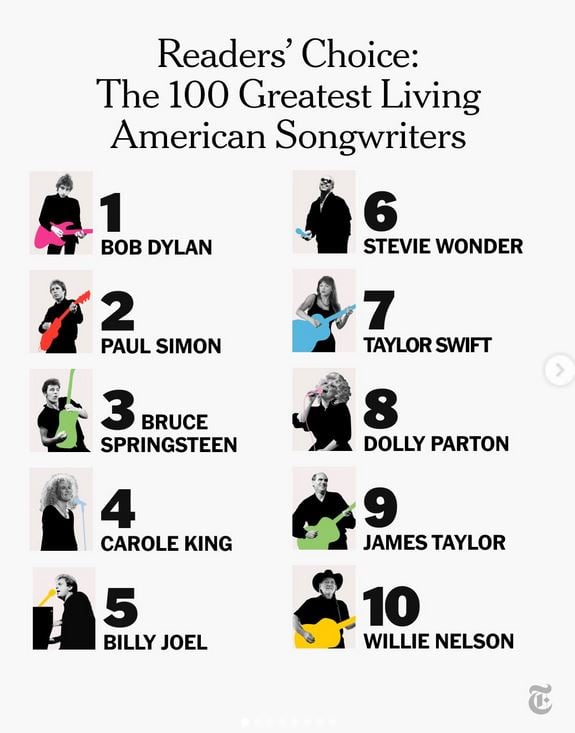
This feels like a pretty fair assessment, and one that fairly represents most all American genres, demographics, interests, regions, and socioeconomic statuses. It’s incredible when you take ideology out of the equation, how much the average consensus makes way more sense than what’s decreed from on high from elites.
The only quibble might be that Taylor Swift is so high. Does she really have a catalog that’s better than Willie Nelson or Dolly Parton? Of course not. Recency bias is prevalent throughout this list. But Swift has done tremendous work exposing the discipline of songwriting to the masses, and writing very personal songs. So it’s not completely offensive she’s in the Top 10 conversation.
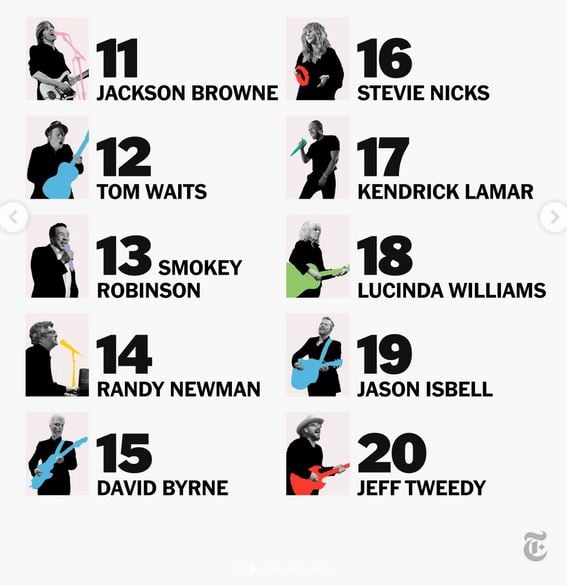
Tom Waits, Jason Isbell, and Randy Newman who were glaring omissions from the NYT’s original list, but all made it in the Top 20, proving how flimsy the original 30 were. Yes, this isn’t a survey of the wide population, but of New York Times readers, so songwriters who lean left like Isbell and Tweedy are probably weighted extra heavily here. But they’re also two excellent, landmark songwriters of this generation, and made it in before more performative picks. So we’ll take it.
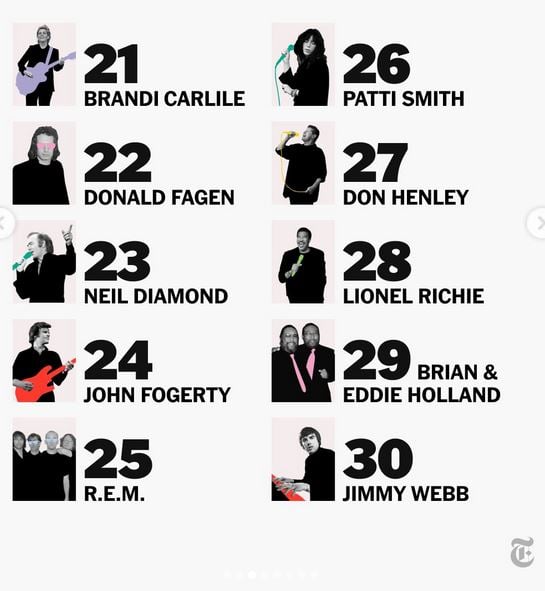
Again, John Fogerty who wrote some of the most iconic songs for the American songbook was left out of the original NYT list, and his inclusion here again is validation of his importance, and the foolishness of the original picks. Ditto for Jimmy Webb. Is Brandi Carlile really a better, more important songwriter than Neil Diamond? That’s a hard case to make, even if it’s an easy one that she should be included here somewhere.
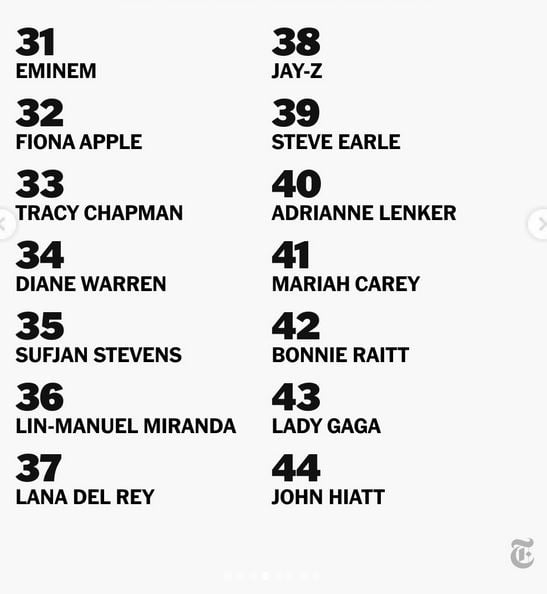
No major complaints here, and it’s good to see hip-hop stars beginning to be represented for the lyricism they bring to the table. It’s not that hip-hop music is an anathema to songwriting. It’s that it usually puts beats, production, and sampling first. But don’t discount Eminen or Jay-Z as lyricists. From the country/roots world, Steve Earle and John Hiatt are coming in very strong here.
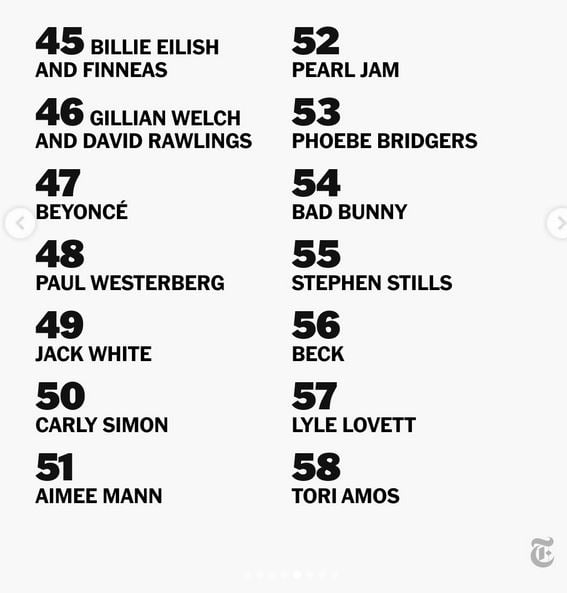
Again, no complaints here. In a just world, Gillian Welch and David Rawlings should come in before Beyoncé, but you knew Mrs. Knowles would be weighted heavily here. This conversation would not be complete without Lyle Lovett, so it’s good to see him.
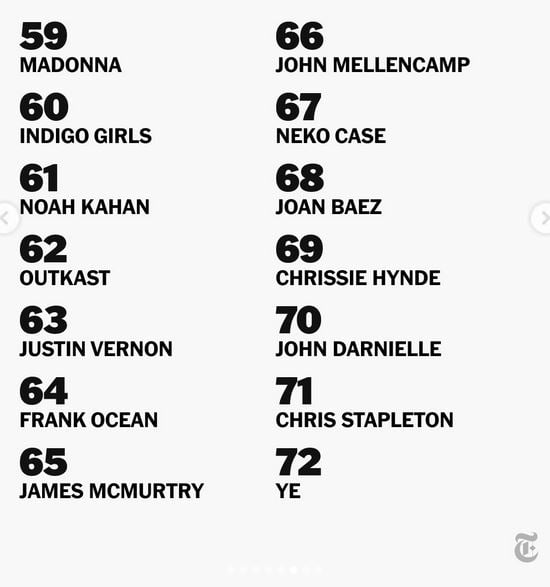
James McMurtry was one of the biggest omissions from the original NYT Top 30, and they got called for the mat for it. Sure, his appeal and name recognition is niche, but it still feels like a slight to put him at 65. Purely based on compositional prowess, a compelling argument could be made that McMurtry deserves to be in the Top 20, or at the least the Top 30.
The other misstep here that speaks to a recency bias is Noah Kahan at 61. His career is just too early to consider over some more serious heavy hitters, and his inclusion here was probably helped by having the #1 album in the US when this poll was conducted. Also, you have Noah Kahan at 61, but don’t have Zach Bryan at all? Arguably there is no Noah Kahan, or at least not an appetite for his music without Zach Bryan seeding it. This feels like one of the poll’s biggest missteps.
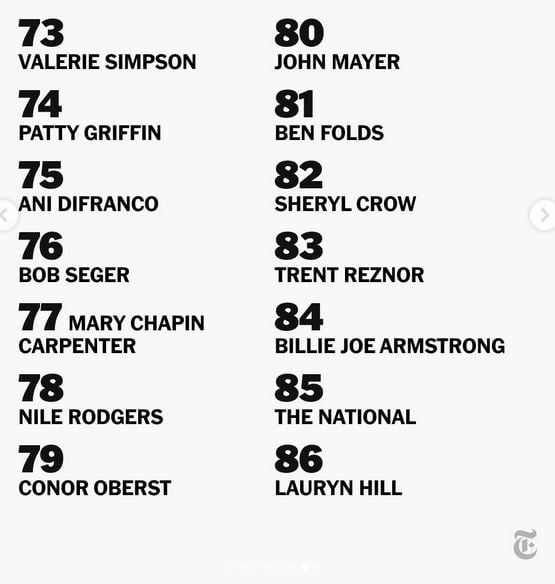
Cool to see both Trent Reznor, and Billie Joe Armstrong from Green Day getting some deserved love, even though they might not conventionally be though of as great “songwriters.” Patty Griffin and Mary Chapin Carpenter could also have been overlooked, but luckily weren’t.
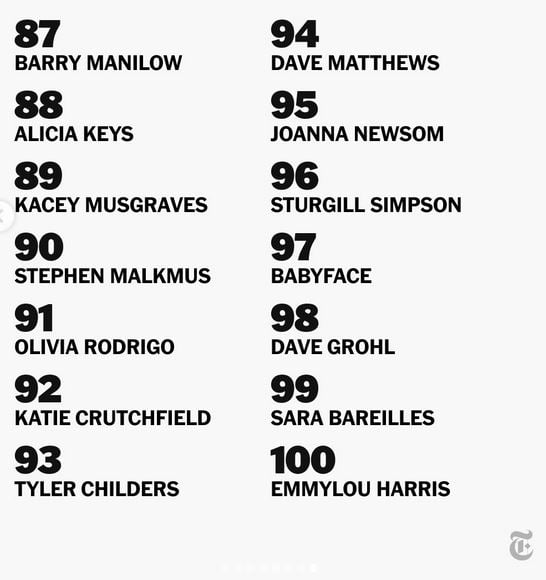
A lot of really cool names from the country world make it into the final slide, and probably deservedly so. The songwriting of Tyler Childers might have slid from his earlier career, but his early career was so rich, he deserves this. Much of Sturgill Simpson’s impact has been through his iconoclastic approach and guitar playing. Sure, he’s got some great songs too, but there might have been some more worthy names, where Simpson might have been better suited for the 100-150 slots.
Emmylou Harris is nothing short of a goddess walking among us, and a certifiable country legend. She also has no business being on a list of songwriters, any more that George Strait does. Did she write some songs? Sure. She’s not a songwriter though.
– – – – – – – –
Who was not included from the country/roots world? The dumb cobbling together of Josh Osborne, Brandy Clark, and Shane McAnally that made it onto the original NYT Top 30 list, but luckily got excluded by readers. It would make more sense to put any three of these names on the Top 100 list individually. But the people spoke, and they’re not on there at all. In some respects, they’re represented by the inclusion of Kacey Musgraves. For sure, performing songwriters were weighted heavily by readers.
Who from the country/roots/folk/ Americana world is a glaring omission? First and foremost, Jesse Welles. Forget that he should be on this list somewhere, he very well could have supplanted multiple names in the Top 20. He is the Bob Dylan of our time. But the fact that he is willing to criticize both sides of the political spectrum, go on the Joe Rogan podcast, engage in cross-ideological dialog has made him strangely hated by the very type of New York Times reader who would overvalue others.
Though you hate to de-ligitimize any list because one name is not on it, the exclusion of Jesse Welles does feel pretty disqualifying.
The other name that you know would not even be close to consideration but deserves to be is Alan Jackson. He is an American superstar, and one that wrote many of his own songs, and by himself.
But overall, what even the biased population of New York Times readers proved is that the public tends to be more knowledgeable, reasonable, informed, and open-minded than the elitists in the media who attempt to serve us our information from on high. Engaged music fans know good songwriters, and know what good songwriting is. They don’t need to be told by The New York Times or anyone else. That’s what this readers poll proves.
– – – – – – – – – – –
If you found this article valuable, consider leaving Saving Country Music A TIP.
June 11, 2026 @ 11:29 am
Jon Caramanica sounds like an insufferable douchecanoe.
June 11, 2026 @ 11:49 am
Where is Tom Russell??
June 11, 2026 @ 12:10 pm
My personal favorite. No one can tell a story like he can
June 15, 2026 @ 10:00 am
I’ve got a bunch of favorite Tom Russell songs, but Gallo Del Cielo qualifies as one of the best story songs ever written. And speaking of best story songs ever written, where’s Robert Earl Keen? Thanks, Trigger, for highlighting James McMurtry’s right to be on the list.
June 11, 2026 @ 3:50 pm
Tom Russell and also Dave Alvin. But I think neither of those guys is high on most people’s radar. Dave Alvin did win a Grammy but still flies low in public recognition sadly.
June 12, 2026 @ 12:29 pm
I’m not on anybody’s radar either and I could’ve made this list, Thank you Lord Jesus for my talent.
June 11, 2026 @ 5:24 pm
I check in about once a year using Google to see when Tom Russel will tour again. Looks like he’s about done. I sure would like to see him once.
June 12, 2026 @ 9:34 am
Not to mention Jim Croce, perhaps the most tragic loss in songwriting history.
June 12, 2026 @ 9:37 am
Ah, living ones, it is.
Explains the hilarious picks.
June 11, 2026 @ 11:53 am
The Eilish siblings? Noah Kahan? Come on, NYT.
June 11, 2026 @ 11:58 am
Nice to see Jason Isbell up there , people love the political messages in his songs Id guess. Keep up the great work.
June 11, 2026 @ 12:01 pm
No Zach Bryan anywhere is absolutely shocking to me. The only explanation is that NYT readers are not in the age bracket of your typical ZB fan. I presume Noah Kahan spans the 20-something’s on up to gray hairs which is why he made it over Zach.
During college graduation weekend for my daughter we took in several garage band backyard performances. It was all Creedence, Skynnard, The Mac, Pearl Jam, Petty, etc… except for Zach Bryan songs. He’s all they’ve got as current if you consider what their cover bands are playing.
June 11, 2026 @ 12:37 pm
Yes i saw Beatos amazing response and came to conclude that NYT had no business doing a list given who they tasked. Horrid opinions.
Though I still dislike the readers list, it’s better than the previous one. Admittedly as fun as lists are, they are fundamentally impossible to get mass consensus on. And no one will ever agree on order of rank even if you could find agreement on who’s listed.
A few i think could/ should be on the list
Hank Jr
Clint Black
Ray Wylie Hubbard
Evan Felker
Bill Anderson
Jamey Johnson
Chris Isaak
Dean Dillon
But hey, that’s my take and im sure most would disagree and that’s OK.
June 11, 2026 @ 1:36 pm
This list makes it look like country songs write themselves.
June 11, 2026 @ 2:03 pm
Good call on most of these.
June 11, 2026 @ 3:19 pm
Garth is a much more prominent songwriter than most give him credit for. Even how he basically fed himself before he was a known artist. In “platinum cowboy” by Edward morris I think it covered until 1993 he had 49 cuts by himself or others. Maybe he was criticized for it later but some of his full albums he had a part of writing everything.
Going off current living how can you not include dean dillon.
June 12, 2026 @ 9:39 am
Garth is more like Elvis and Buck.
Put my name on it, and I’ll record it..
June 11, 2026 @ 3:52 pm
They obviously made inclusions based on popular appeal. That being said Hank Jr, Merle Haggard, Dean Dillon should all have been included.
June 12, 2026 @ 9:41 am
I did that, too, complained because I didn’t see Jim Croce.
Then I remembered that it says “living songwriters”.
June 15, 2026 @ 10:09 am
Amazing Jamey Johnson isn’t on the list.
June 11, 2026 @ 12:59 pm
Zach Bryan not being listed is probably my favorite part of this list. Not because I have any particular disdain for him, personally, but because the hype is significantly greater than the actual talent.
June 11, 2026 @ 1:11 pm
Zach Bryan recently signed the biggest music rights deal in history. He holds the record for the most attended music event in North American history. Love or hate his music, he’s perhaps the most influential songwriter of the last decade. And like Taylor Swift, he opened up the knowledge of what songwriting is to millions.
His songwriting has been messy at times, and so has his personal life. Just like Dylan. Zach Bryan most certainly deserves to be mentioned.
June 11, 2026 @ 12:14 pm
I know as country and western fans we’re all going to be upset at who’s not there with a list a mile long, but really? No Townes Van Zandt?
If you polled all the Americana stars on this list, they’d all point to TVZ.
June 11, 2026 @ 12:20 pm
This list is specifically living songwriters, so Townes was not eligible.
June 11, 2026 @ 1:04 pm
Ok, thank God it’s for living because with no Merle Haggard or Kris Kristofferson I was getting more and more upset the more I read. I guess I can’t read either!
June 11, 2026 @ 12:20 pm
Wait it says living. I just can’t read apparently.
June 12, 2026 @ 9:43 am
We expect the NYT to suck anyway, so our mistake are justified.
June 11, 2026 @ 1:20 pm
Country and Western! Love it, Billy!
June 11, 2026 @ 9:09 pm
@billy–And if I polled most hard-core country music fans–heck if I polled just the people who up-vote TVZ–I’d wager that not 1-in-5 could name four Townes songs that they like or that they know.
June 11, 2026 @ 12:15 pm
Where the hell is Bob Seger?!
June 11, 2026 @ 1:32 pm
“Where the hell is Bob Seger?!”
The likely thought his rhyming skills were meager
June 11, 2026 @ 1:46 pm
#76. Bob Seger is at #76.
June 11, 2026 @ 12:29 pm
The omission of Josh Osborne, Brandy Clark, and Shane McAnally probably has more to do with the fact that the readers choice option emphasizes the performers who wrote their own songs, rather than songwriters in their own right.
Diane Warren, Holland Brothers, Jimmy Webb included I guess, but it seems like there might be some better songwriters who are less known because they only exist in the liner notes.
June 11, 2026 @ 12:41 pm
I agree with the overall purpose of the article and thought Beato’s video was great in the way he ripped them. Though the article brings up something I’ve been confused about since i became an avid reader of this site. When the term “songwriting” is used it seems to me you are mostly referring to the lyrics and not the whole song. My confusion stems from the “Rock World” where many songs begin with a riff and the lyrics come later. Many great bands wrote songs this way, writing the instrumental parts 1st, then adding lyrics. Are the riffs/instrumental parts not considered songwriting? Or is it different terminology for different genres?
June 11, 2026 @ 12:56 pm
BP
Excellent point. Why are lyricists for rock groups not considered singer- songwriters? How about Dave Grohl of Foo Fighters or David Lee Roth of Van Halen or Sammy Hagars Van Halen material? Bono and The Edge from U2. Beautiful songwriters each and every one, all stylistically different from each other but they have all written some of the most played and sung popular music of all time. Don Henley anyone? He ought to be there too.
June 11, 2026 @ 1:13 pm
Don Henley is at #27, Kevin.
June 11, 2026 @ 3:42 pm
Yep…I missed that Henley and Dave Grohl is on their list as well. Good. As it should be. I will throw Anthony Kiedis from The Red Hot Chili Peppers as one that’s overlooked on the list.
June 11, 2026 @ 3:57 pm
I was Pearl Jam as an entry and that isn’t a person. I immediately thought of Van Halen. Based on their other inclusions of songwriters who wrote many popular but “dumb” songs David Lee Roth should absolutely be in this list. There was no “songwriting by committee” with Van Halen. EVH came up with the riffs and music and DLR would come up with the lyrics, many on the spot in the studio.
June 11, 2026 @ 5:54 pm
Eddie Vedder is a great songwriter. Definitely should be on a list of great ones. Pearl Jam is a killer band with amazing songs. As for VH, I know David Lee isn’t known for deep songs but his hooks and melodies are amazing. Not all songwriting needs to be deeply philosophical, but writing something so insanely catchy that becomes a standard is a huge talent.
June 12, 2026 @ 2:22 pm
“Eddie Vedder is a great songwriter.”
On a list of pure and classic songwriters, Vedder, and a lot of other folks on this joke of list wouldn’t even be in the top 1000.
June 11, 2026 @ 1:14 pm
Musical and instrumental composition is most definitely part of songwriting, as can be programming beats to put lyrics on top of. But the primary element to songwriting is the WRITING. Lyricism is paramount.
June 11, 2026 @ 3:45 pm
And so many of the great bands of rock had stellar lyricists. But for various reasons people often dont consider them in the sacred realm of songwriting. A pity.
June 11, 2026 @ 4:21 pm
Neil Peart of Rush is a great example of this, and he’s on nobody’s radar as a songwriter, even if he’s on everyone’s list as one of the greatest drummers. RIP so he didn’t qualify here. But still.
June 11, 2026 @ 11:14 pm
Also Canadian (tho I think he DID get citizenship late in life iirc)
June 11, 2026 @ 12:43 pm
I tried to read as much of this as possible, but when you got to the point that the entire methodology behind the list was racist, that’s when I got angry and couldn’t continue. But none of this should come as a surprise from the woke rag that is the NYT.
June 11, 2026 @ 12:51 pm
WHAT!? Young Thug didn’t crack the Top 100 of the readers poll!? Can’t believe tastemakers with their whole fist on the scale got that one wrong.
This list is much easier to appreciate.
Of the SCM world, I think you nailed it with Jackson’s omission. We all know Felker belongs on there too. If it were Hank’s list, Ian Noe, John R Miller, John Moreland, Gabe Lee, and BJ Barham would be on there as well.
My biggest gripes are some of the kids on the list and entire genres being discounted. Olivia Rodrigo and Dave f’kin Matthews being in over Mike Ness, Tim Armstrong, or even Gwen Stefani is a joke. Billie Ellish and her brother should be in the 90s, at best. Noah Kahan might crack a Top 200, but visibly ranking him just ahead of OutKast is offensive to anyone who isn’t a 22 year old girl. Seger is way too low. Ye is too low. Billie Joe Armstrong is too low.
I was glad to see both McMurtry and John Darnielle soundly in there though. Both are woefully underrated.
June 11, 2026 @ 12:56 pm
This list, like the NYT, is a joke. Taylor Swift at 7. 😂 This is a list of people’s favorite artists. A lot of the folks on here wouldn’t make top 1000 list. Lab created music, which most pop music (and even mainstream Nashville music) is, does not belong on these lists.
June 11, 2026 @ 1:19 pm
Neil Young? Canadians not allowed?
June 11, 2026 @ 1:21 pm
OK, now I see it’s American songwriters.
June 13, 2026 @ 7:28 am
Neil now has dual citizenship and should have been included IMHO.
June 15, 2026 @ 12:38 pm
We can make a special rule just to make sure Neil Young isn’t allowed.
June 11, 2026 @ 1:24 pm
LMAO at the Indigo Girls.
June 11, 2026 @ 3:02 pm
Meanwhile, I was thrilled to see the Indigo Girls. Go listen to their music and you’ll realize why. So many of their songs are breathtaking.
June 12, 2026 @ 2:25 pm
I agree. They wouldn’t even make the top 1000, but you know it’s the NYT, so they have to add some wokeness to the list.
June 11, 2026 @ 1:28 pm
It is a bit odd to me turnpike apparently don’t penetrate the consciousness of folks responding to this poll like their peer Childers, sturgill, Isbell do. Even Felker is a better songwriter than any of them and should be here. But for whether reason turnpike just don’t quite have the breakthrough.
And obviously I disagree with trigger about this and don’t need to argue or anything but glad to see no Jesse Welles. I think he’s a fraud getting by on affectations of being Bob Dylan while totally lacking substance.
Also very happy Mary Chaplin carpenter is here. Adore her
June 11, 2026 @ 2:01 pm
It really is frustrating that Turnpike hasn’t acheived that breakthrough exposure they deserve. We also saw this with the Grammy Awards last year and their snub. I just wouldn’t expect to see Evan Felker on something like this, even though he deserves to be. All I know to do is to just keep beating the drum. Reigning Artist/Album/Song of the Year winner here at Saving Country Music.
June 11, 2026 @ 5:30 pm
I don’t like the political arguing on this sub and don’t aim to start or engage in it. I don’t know Felkner’s politics, and glad that I don’t. But if he were on Twitter trashing MAGA or saying weird things about race, he’d be an NPR/NYTimes darling.
McMurtry is one of my favorites, but he doesn’t make this list without that anti-Bush anthem “We Can’t Make It Here.”
June 12, 2026 @ 5:17 am
I am a Turnpike fan, D&G would be #2 on my favorite album of the 21st century list and GNS would be in the 8 to 12 range. I agree Felker deserves to be on this list. I know I’m risking getting my head bit off here but I’m not surprised they are struggling to breakthrough. Here’s why. Despite it’s critical acclaim and winning AOTY on this site, I don’t think Price of Admission added many new fans to their fanbase. I also think the songwriter emphasis and sleepy production made a small but significant percentage of their existing fanbase disinterested. Even if the disinterested percentage is 10% to 15%, it still outnumbers the new fans kind of leaving them running in place. Also, Turnpike falls in the same category of bands (from a ticket buying perspective) that get rave reviews for their live shows like Jinks, Whiskey Myers, Red Clay Strays etc. and Turnpike live doesn’t rate well against those. They did the Outlaw festival last year and got overshadowed by the RCS, a lost opportunity to add fans. Also, Turnpike is an acquired taste, it’s an unique sound, and one that doesn’t do well at 1st listen, at least that’s my experience when trying to expose them. Turnpike has gone from a rollicking up tempo band with great lyrics to an artist emphasizing songwriting. Neither is better but one narrows the potential fanbase.
June 11, 2026 @ 2:49 pm
Their last two albums haven’t been as good as their first four classics.
June 11, 2026 @ 1:54 pm
Serious question: Has anyone ever covered a Jesse Welles song? He’s been releasing music since 2012–14 years. By this point in Dylan’s career (1976) he had had multiple huge artists have huge hits with his songs.
I don’t think that necessarily means Welles shouldn’t be on this list, but there are some pretty remarkable differences between Welles and Bob Dylan.
June 11, 2026 @ 2:06 pm
The comparisons of Jesse Welles and Bob Dylan are stylistic. Obviously, Bob Dylan is one of the most influential and covered songwriters in history. But let’s not act like the world knew about Jesse Welles for 14 years. He released his first solo “Hells Welles” album less than two years ago, and that’s around the time he really started blowing up. Quite a few artists have covered his songs though.
June 11, 2026 @ 2:07 pm
When I went to a songwriter’s camp hosted by Billy Edd Wheeler in 1989, there were a couple of people there who had studied with Sheila Davis in New York City, and they talked about how she had discussed “well-crafted tunes”. Maybe that’s what the guy meant when he said “songcraft”.
June 11, 2026 @ 2:46 pm
Tom Petty should be on the list, somewhere in the Top 100.
June 11, 2026 @ 3:21 pm
Sadly Tom can’t be on the list as he’s no longer with us. Man I miss hearing new music from him. Really hoping there’s a massive vault of unreleased stuff. Keep a Little Soul was released well after his passing and it’s as good as you’d expect a Petty song to be.
June 12, 2026 @ 2:20 pm
I vote for the 1979 “No Nukes” shows. They issued Springsteen’s footage a few years back, so you know it still exists. And in ’79, Tom was still hungry, so it would be a banger of a show.
June 11, 2026 @ 2:50 pm
Fan voting doesn’t work for the Pro Bowl and it doesn’t work here. Swift at #7 is a farce.
June 11, 2026 @ 3:31 pm
Todd Snider is another great songwriter who sadly has passed on.
June 11, 2026 @ 5:38 pm
This is much better than the initial list. I’d quibble with Emmylou and Joan Baez. Both tremendous performers, but neither are prolific writers. I’d also note that Outkast, R.E.M., and The National are not the names of any songwriters I’m aware of. The individual members may be songwriters and may belong here, but these are musical groups.
Mike Stoller remains a giant omission.
June 11, 2026 @ 5:44 pm
I’m really surprised that many people know who Paul Westerberg is. Jesse Welles kind of sucks? I like what he’s doing but the songs themselves feel so disposable.
June 13, 2026 @ 4:15 am
“Jesse Welles kind of sucks? I like what he’s doing but the songs themselves feel so disposable.”
I like Welles’ vibe, style, and voice but I wish he wrote some more songs not so obviously and clearly and directly tied to news and current events (which I don’t even follow). I think I like it more when some more universal and timeless topics and issues are written about in songs, which may therefore better stand the test of time. It’s hard to describe what I mean but your words “the songs themselves feel so disposable” resonated with me, and led to this comment about it.
Perhaps when you write lyrics to songs that are (too?) directly and (too?) clearly and (too?) much about things you read in today’s newspaper, you risk that these songs might end up in the same place that yesterday’s newspaper ends up.
June 13, 2026 @ 2:14 pm
Welles is Ochs, not Dylan. If we’re looking for comparisons from the folk revival era. And Dylan quickly left that scene.
June 13, 2026 @ 6:39 pm
As did Ochs… Maybe not entirely (after all, his final single was a rewrite of one of his early protest songs updated to bash Nixon), but his albums from 1967 onward were much less topical. They were still politically engaged for the most part, but dealt with long-term, overarching and universal issues, not merely the news of the day.
June 11, 2026 @ 6:10 pm
3 words. Chris Fucking Knight
June 11, 2026 @ 6:48 pm
Emmylou has worked at becoming a songwriter, but she’s not in this strata by any means.
Am I missing something, or is Rodney Crowell not here?
June 11, 2026 @ 7:06 pm
You’re right,Todd. No Rodney Crowell. He could probably bump a few people off of that list.
June 12, 2026 @ 11:26 am
More than a few.
June 12, 2026 @ 2:28 pm
No Crowell is because the NYT is writing by and for the woke crowd. Crowell would be in my top 5, but then most of the people own this list wouldn’t register in my top 10,000.
June 12, 2026 @ 2:45 pm
Rodney isn’t conservative. He’s not overtly political, but I know he’s not conservative.
June 12, 2026 @ 3:19 pm
None of those wannabe hippies who licked Guy Clark’s and Townes Van Zandt’s feets are remotely conservative, from Vince Gill to Steve Earle.
Sadly, only nutjobs like Ted Nugent and Kid Rock are openly conservative. Funny, tho, none of them live a conservative life.
June 11, 2026 @ 7:52 pm
James McMurtry is the greatest living songwriter.
McMurtry and I have polar opposite cultural and political views. He performed in a dress in support of trannie “rights” and I constantly strive to move to the right of my already-marginal, fascist, right-wing views, but I can acknowledge true gift and genius when I see it. He is the greatest song writer in the history of popular music since Hank Williams. I truly believe that.
June 12, 2026 @ 2:30 pm
“He is the greatest song writer in the history of popular music since Hank Williams. I truly believe that.”
Ffs. To you and other people who clearly need to listen to more music.
June 12, 2026 @ 3:26 pm
Can anyone explain this sudden admiration for McMurtry?
His dad wrote some great novels, but junior isn’t even close to say, Steve Earle and Tom Russell.
June 12, 2026 @ 3:46 pm
Man, strong disagreement from me. And the admiration for McMurtry is anything but “sudden.” It’s been going on for decades. If anything, it’s trailed off in recent years as his output has slowed down.
June 13, 2026 @ 9:36 pm
Name some
June 14, 2026 @ 3:21 am
Mickey Newbury, Kris Kristofferson, Loretta Lynn, Billy Joe Shaver, Marty Robbins, Dolly Parton, Willie Nelson, Merle Haggard, Bob McDill, Conway Twitty, Don Gibson, Harlan Howard,, Dean Dillon, Hank Cochran, even David Allan Coe and Hank jr., and that’s just a few in the country field.
Then we got John Fogerty, Jim Croce, Jimmy Buffett, Bob Dylan, Paul McCartney, Rod Stewart, Tom Russell, Paul Siebel, Waylon Jennings, Robert Smith (the Cure), Leonard Cohen, and then Leonard Cohen again, Neil Young, Steve Earle, Guy Clark, Rodney Crowell, Hoyr Axton, Willy Vlautin, Lee Clayton, John Bettis, Hugh Prestwood, Burt Bacharach, Chuck Berry, Brian Wilson, Elvis Costello, Jacques Brel, Serge Gainsbourg, DeWayne Blackwell, Smokey Robinson and several others crossing several genres.
Geez…
June 14, 2026 @ 6:46 am
If Mickey Newbury, Kris Kristofferson, Loretta Lynn, Billy Joe Shaver, Marty Robbins, Dolly Parton, Merle Haggard, Bob McDill, Conway Twitty, Don Gibson, Harlan Howard, Hank Cochran, David Allan Coe, Waylon Jennings, and Brian Wilson are all living, then we REALLY have a story.
June 14, 2026 @ 10:56 am
Trigger; RD stated that ““(J.Mc.) is the greatest song writer in the history of popular music since Hank Williams. I truly believe that.”
Jimmy disagreed, and RD asked for names.
So he got some.
June 16, 2026 @ 4:03 am
Great. I’m aware of all those artists you mention. There are a lot of excellent songwriters on that list. McMurtry tops them all.
June 12, 2026 @ 4:03 am
“Best of…” and “Top 100…” lists are pointless. Especially when accompanied by young writers (Taylor Swift? This is merely a ‘favorite’ addition since she’s more of a Top 100 Merchandiser).
There are multiple practical reason most veteran songwriters/musicians try to avoid this “best of” routines. If you need the filler for your publications, just make it an Opinion Poll (which is all these things turn out to be),
Next…
June 12, 2026 @ 4:08 am
So, basically singer-songwriters. Because the voters don’t know any just plain songwriters.
June 12, 2026 @ 3:22 pm
Singer-co-writers, you mean.
June 12, 2026 @ 4:52 am
All lists are pointless and not really worth dissecting, but Ill merely say that Hip Hop os very under ranked on here (which shows the readership bias of this list), and the country music inclusions reflect the country music tastes of the ny times readership to (i should know, it aligns well with my tastes) where as popular acts who wrote their own stuff (Alan Jackson, Clint Black) are as not well known to this subset of the population.
Finally id argue Jesse Welles only became known to the wider audience in the past 2 or 3 years, so his known category isnt much larger than Kahans in that regard
June 12, 2026 @ 6:04 am
Technically, if referring to Beyoncé as Mrs, shouldn’t it be Mrs Z?
June 12, 2026 @ 7:59 am
Brandi Carlile that high is hilarious.
June 12, 2026 @ 2:31 pm
Another ‘woke’ selection.
June 13, 2026 @ 4:28 am
“Brandi Carlile that high is hilarious. ”
Perhaps they think “Only those on high horses know who to pick”.
June 12, 2026 @ 8:24 am
The problem is wannabe gatekeepers like Jon Caramanica, who want to tell us what we should listen to.
I think the worst quality of a critic is to be close minded, which is Caramanica.
Listen to the Popcast podcast, it’s just Jon being a blowhard. I find it unlistenable.
This revised list is justice of sorts, albeit still an imperfect list.
June 12, 2026 @ 8:48 am
With Jesse Welle’s new album material at our disposal today, I just can’t imagine a world where he would not be on this list. His lyrics, unique melodies, and most recently his utilization of a band is freaking incredible. This is insane levels of songwriting.
June 12, 2026 @ 2:33 pm
If you think he’s that good, you need to dig deeper and listen to more music. His lyrics and melodies are not all that unique.
June 13, 2026 @ 2:15 pm
I am not sure how I could listen to more music. I have played and written music for all of my adult life and I am saying that specifically from the perspective of his latest album and if you have not listened to it in full, you are responding from a place of ignorance. It is not all that unique? Certain songwriters do not borrow or steal from historical melodies and like Kurt Cobain or Conor Oberst, he has begun to fall into that category and when you incorporate his ability to tie words together with that, I believe I am correct in my assessment. I apologize if I made you upset or hurt your feelings.
June 12, 2026 @ 8:54 am
Robert Earl Keen should be somewhere on this list.
June 14, 2026 @ 6:58 pm
Good call, Jack. I think Rhett Miller of Old 97s deserves a spot, too.
June 12, 2026 @ 9:36 am
Obviously a reader’s poll, this.
June 12, 2026 @ 10:09 am
Phil Collins was a big miss. He specially when you see what he put out for both his solo albums and Genesis at the same time for years.
June 12, 2026 @ 10:18 am
“Though you hate to de-ligitimize any list because one name is not on it, the exclusion of Jesse Welles does feel pretty disqualifying.”
Saving this quote for when you get mad at people for expressing the exact same sentiments on your year-end lists, Trigger!
(Since I know you’re having to speed read through comments, that’s said with a laugh and a wink, not as a serious critique)
June 12, 2026 @ 12:52 pm
Dwight Yoakam (Nashville songwriters HOF) or Clint Black would’ve been nice additions over some of the later country acts.
June 12, 2026 @ 6:03 pm
Clint Black–for reasons unknown–can’t even get into the Nashville Songwriters HoF. Maybe it would be fitting if he gets into the imaginary NYT songwriters HoF, which has apparently become an institution of enormous significance in its two months of near-existence.
June 12, 2026 @ 2:23 pm
The other obvious bias here is these are basically all big performers who write songs. But lots of great songwriters are not known for performances or just presenting them as well as other performers. (Jimmy Webb is there, but he’s about the only one). And where’s Townes Van Zandt?
June 12, 2026 @ 2:36 pm
Townes is dead, therefore he does not qualify as a ‘living’ songwriter. The NYT had to make it living songwriters because most of the people who write for and read the rag likely don’t know any music older than 20 years.
June 12, 2026 @ 9:10 pm
The knock on the NYT would more commonly be that most of the people who write for and read the Times don’t know any music that’s NEWER than 20 years–or maybe 40. They’d probably be pleased with your astute observation.
June 12, 2026 @ 4:05 pm
Appreciate Trigger’s thoughtful analysis, so just wanted to add some positivity. Earle and Chapin Carpenter were/are poets shoehorned into Country at exactly the time that format needed intelligent songwriting, and the audience responded thusly. Happy to see both getting the flowers.
June 12, 2026 @ 6:02 pm
I actually had a nerd crush on Wesley Morris back in the day but now he’s on YouTube doing some fire island shtick. Anyways, like Trig said, not a qualified music critic.
June 12, 2026 @ 7:14 pm
Much of Sturgill Simpson’s impact has been through his excellent songwriting.
June 12, 2026 @ 7:55 pm
My only issue is Bocephus being ignored. His self-penned hits and deep cuts together are killer, I would have said near the middle at the very least.
June 12, 2026 @ 8:02 pm
How about Kenny Gamble and Leon Huff? Philly Soul will always live on; Mrs. Jones would concur.
June 13, 2026 @ 7:16 am
I find lists such as these always problematic but this compilation is grossly short-sighted and takes these lists into a new strasophere of ignorance. Do any of these critcs know anything about the American popular music form? It readds more like an old Tiger Beat fan poll from the 1960s.
There are so, so many gross oversights spanning all genres. For starters, what about Cole Porter, Hoagy Carchmichael, and the Gershwins, who provided the soundtrack for the lives of generations before us and whose work informed later Brill Building writers such as Doc Pomus and Mort Shuman. Where in the hell is Billie Holiday? How about Chuck Berry, who brought the storytelling sensibilities to Rock ‘n’ Roll? Where’s Fats Domino and Little Richard? and FFS, where is Carole King?
One cannot place Bob Dylan at the top of any list of songwriters (and I am a huge Dylan fan) without at least acknowledging the contributions of Woody Guthrie and Leadbelly.
As for the country genre, gross negligence at best — no Haggard, no Dolly, no Hank Sr., no Bill Monroe, no Louvin Bros., no Harlan Howard, no Felice and Boudleaux Bryant. WTF? I realize Jason Isbell and other contemporary artists are writing some fine material but will their work be learned and performed by future generations? Way to early too premature to include them on a list of “greatest writers.”
The NY Times needs to get some real historians on board if they are going to continue putting out these greatest lists of songwriters, films, and other cultural touchstones.
June 13, 2026 @ 7:22 am
For the record, the list only acknowledges living American songwriters, so many of these would no qualify.
June 13, 2026 @ 7:34 am
Yeah, I realized that after I posted and tried to delete my initial comment, Trigger. Should have had that extra cup of cofffee before responding. Still, seems like a pretty lame list to me.
June 13, 2026 @ 1:25 pm
@ anna The NYT is the home-town paper of Broadway. They’ve written more about Cole Porter, Hoagy Carchmichael, and the Gershwins, Rogers & Hammerstein, Harold Arlen, Johnny Mercer, Stephen Sondheim the Brill Building, etc., then any other newspaper in the world. And they continue to wite about that. There was a revival of Porgy and Bess at the Metropolitan Opera house earlier this year that must have gotten more than half a dozen articles in the Times. Now, they’re writing about a revival of “Ragtime” at Lincoln Center.
I’ll clue you in on what this Songwriters article really shows.
The Times has to constantly strive to regenerate itself because they don’t want to find it ten years that they’ve lost half their readers because they’ve died.
Here, they decided to do a completely innocuous article the entetrainment section ranking America’s living songwriters but make sure to populate it with not just Boomer titans like Dylan and Paul Simon and Carol King but to mix them in with Millenials and Gen Y an Z artists that their younger staff hav listened to. So they came up with this.
And the reaction prompted them to immediately issue a second list.
I guess it’s a testament to how imprtant the New York Times still is that in this age when everyone is bombarded on their Internet home pages with lists of the best actors and movies and singers and fast-food chains and coffee makers, a Times list of best songwriters can not onlly interest, but actually incense enrage people from all around the country whose favorites were not cited.
June 13, 2026 @ 7:24 am
My apologies as I didn’t realize this list was limited to living songwriters. With that said, I still find it sorely lacking and comes across as more of a popularity contest.
June 13, 2026 @ 8:43 am
I agree it’s a shame Felker is not listed. But I also would say the same for Patterson Hood and/or Mke Cooley, although they were mentioned as getting votes.
Finally, how can Zach Bryan not be on this?
June 13, 2026 @ 8:52 am
Lee Hazelwood
June 13, 2026 @ 10:01 am
Agree with the comments regarding Felker and REK but I’m a little surprised there’s been no mention of Josh Ritter. I think if the same social platforms that launched Zach B existed in 2008 Ritter may have had a similar breakthrough.
June 13, 2026 @ 6:51 pm
Too many missing. Chris Knight? Did I miss Dwight Yoakam?
June 15, 2026 @ 10:14 am
Two guys who definitely deserve to be on this list.
June 14, 2026 @ 5:11 pm
I discovered this site by googling “Greatest Country Songwriters” years ago, so lists can be a good thing.
.
Emmylou has left a bigger songwriting footprint on her career and the career of others than you might suspect. Dolly Parton, Joan Baez, Patty Larkin, Shawn Colvin and many others have recorded her songs, with Boulder To Birmingham becoming a bit of an Americana standard.
People forget Mike Stoller is still with us, as is Barry Mann and Jeff Barry. And I guess Todd Rundgren really pissed off the wrong people.😀
June 14, 2026 @ 10:07 pm
I meant Patty Griffin. Oops.
June 14, 2026 @ 7:50 pm
I’d honestly put Bobby Bare and Hank Jr over all these fools (I totally get Dylan and Willie for songwriting though and they should both definitely be in the top 5 for living writers). I don’t like Bill Anderson as a performer but same for him. As far as Swift’s bubblegum multi writer songs go, no. Any comprehensive list that has her top 20 anything is a joke
June 14, 2026 @ 8:02 pm
And Alan
June 14, 2026 @ 10:17 pm
Four of the alleged top 5 are jews. They make up 2% of the US population. I’m shocked that the Sulzberger family would allow their Tribe to be over-represented so much.
June 15, 2026 @ 4:31 pm
There were a lot of Jewish songwriters in the old Tin Pan Alley days.
June 20, 2026 @ 3:34 am
I know this a ‘country’ page but two glaring omissions from the hip-hop side are Chuck D and Ice Cube. Two artist who changed rap during their time and painted a portrait of the US during their times.