

Facebook’s New Link Charge is Catastrophic for Independent Music
There was fair warning that it was potentially coming. But now that it’s here, it could be catastrophic, if not existential for your favorite independent artist, band, music venue, local promoter, and other independent entities that rely on Facebook to stay in touch with the followers that have liked or subscribed to their pages for the express purpose of keeping in touch with them for many years.
In December of 2025, Facebook announced they would be limiting the ability of some pages to include outbound links in their posts. Heretofore, any Facebook page was allowed to post as many links as they wished at will. That didn’t mean those posts with links would be seen by all of their followers. On the contrary, the algorithm purposely depreciates posts with links. But dedicated followers would still see many of them, and if people navigated to the Facebook page directly, they could still see them all.
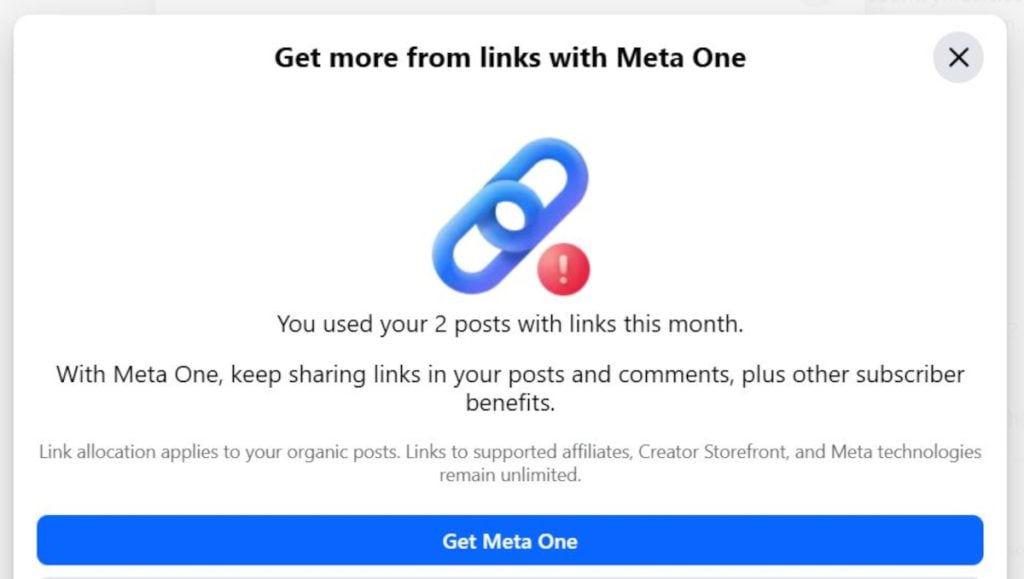
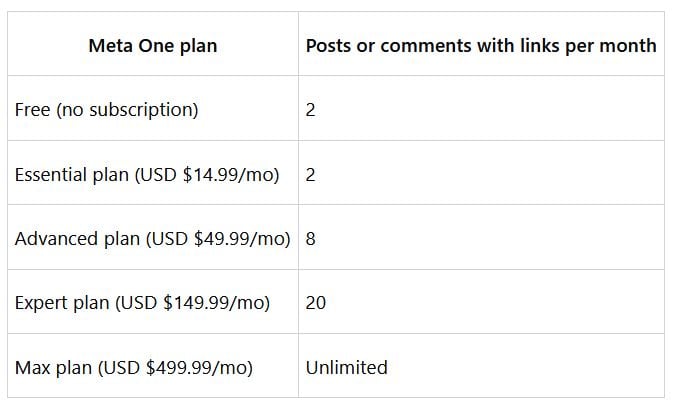
Now, all of that is going away. After launching Meta One for Business packages last week, Facebook is now limiting links for pages to two per month. This even includes pages that pay a $14.99 monthly subscription fee to the company as part of their “Verified” program. To go from unlimited links to only two per month is a dramatic haircut, and one that could kill the business model for artists, bands, and venues who primarily use Facebook to communicate with fans, especially smaller and more independent performers and entities, let alone small businesses of all kinds.
You can pay more to be able to post more links, but the cost is quite expensive, and exponentially so. To post more than two links, you can pay for an “Advanced” plan for $49.00 and post eight links a month, or $149.00 for an “Expert” plan for 20 posts a month. Want to post an unlimited amount of links like you used to be able to do for free? Well that will cost you $499.00 a month.
Facebook is often seen as the “old person’s social media platform” compared to Instagram and TikTok. However, it was also one of the more reliable for artists, bands, venues, and music brands to stay in touch with their fans and customers, and directly facilitate economic activity. Unlike Instagram and TikTok, Facebook has a strong textual component to it instead of a visual one, including the ability to publish links in posts.
Older fans often tend to be more affluent, have more expendable income to purchase merch, more free time to attend shows and travel to do so, to support artists on Patreon, to pre-order albums and pre-save singles, and to purchase concert tickets in advance. But most all of these activities are dependent on outbound links that are now being dramatically limited unless page owners pony up. Ironically, Saving Country Music has been advocating for younger artists to not ignore their Facebook presence, but attempt to foster it to make sure they’re reaching older fans, and fans that don’t use Instagram or TikTok.
Some might say, “We’ll why would Facebook allow people to use their platform for free advertisement?” But many artists and bands already pay Facebook the $14.99 a month subscription to be verified, and have been for many months or years. Many also pay Facebook to advertise their shows, merch, or music in dedicated ads and post boosts. Independent venues that have shows daily often include links to purchase tickets. Even 20 links a month at the “Expert” level would not be able to cover a venue’s monthly calendar.
Facebook’s new link policy is especially catastrophic for independent media outlets. For corporate media like Rolling Stone or Billboard, paying $500 to Meta to be able to post unlimited links is a drop in the bucket. For an outlet like Saving Country Music, that’s a one-third of the outlet’s entire monthly operating budget. SCM posts an average of 13 articles a week, and 52 articles a month. That means the only option to share all links to Facebook would be Meta’s “Max” plan. But that tier only seems to make sense of an outlet is posting 150+ links a month.
Meanwhile, the money spent to be allowed to post links would never be recouped by the amount of traffic those links would bring, because even though Facebook is now charging upwards of $500 a month to post links, there is no indication those links will be more visible in the algorithm. That is the irony of this new restrictive, pay-to-post policy by Facebook: they don’t serve posts with links to your followers anyway, if they see any of your posts at all between ads and viral content.
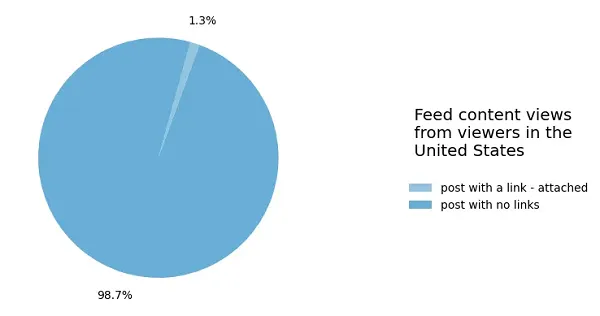
According to Facebook’s own Viewed Content report from Q1 2026, 98.7% of post views in the U.S. did not include a link to a source outside of Facebook. The exposure of link posts was as high as 9.8% as recently as 2022, and was much higher previously, but has been in sharp decline. In other words, Facebook was dramatically killing off links even before charging for them.
What could be even more devastating is if other social media platforms see what Facebook is doing, and choose to adopt similar policies. Previously, users never had to pay for blue checkmark verification. They only had to go through a protocol. It was a trust and safety feature of social media platforms. But when a paid-for verification process was implemented on X/Twitter, the Meta platforms followed. Could we see X and the Meta equivalent Threads follow suit with paid-for links? We very well could.
Instagram and TikTok already limit link sharing. Instagram severely depreciates posts with links in their “stories,” which is the only place on the platform they’re allowed, unless you pay for one of their new premium Meta One plans, though this still doesn’t guarantee anyone will see the linked content, let alone click on it. Even typing “link in bio” in an Instagram description can limit that post’s reach.
And no, you cannot side step all of this by posting a link in the comments anymore on Facebook. The new policy expressly states the link limits apply to links left in the comments as well.
But perhaps the biggest cost that will be incurred by this change is how it once again centers internet users on social media as the sole place to browse the internet. All the content produced for Facebook and other social media platforms is only meant for these platforms, and is often done by amateurs instead of professionals—if not rogue actors—and is completely unregulated, and ripe for pay-to-play schemes. People only getting their news through an algorithmic environment fosters echo chambers, the narrowing of viewpoints, and forces people to interact more with fake news, false information, and AI-generated content.
At the moment, we’re already witnessing the Great Purge of the Blue Collar Musician in 2026. Artists are getting squeezed by extremely high gas prices and other inflationary effects, ticket sales are dramatically down, and musicians are having to fight more and more for attention in social media algorithms like Facebook’s. This steep new Facebook link cost adds to the expense of existing musicians, raises the barrier of entry for new musicians, while making the platform less useful for independent entities across the entertainment industry, and well beyond. All small business that relies on Facebook will be squeezed.
Sure, Facebook is providing a service, and nobody should be expected to do this service for free. But musicians creating content to share with others is one of the reasons Facebook has grown into the juggernaut that it is. Facebook lured so many musicians, venues, promoters, journalists and outlets etc. onto their platform with a free model. Now are charging to facilitate important business connections with this outbound link policy. Some music entities have spent many years and much effort to built a Facebook following that no longer sees their content, and now they cannot service links to.
For some, if not many musicians and venues already struggling to stay afloat and fight the algorithm every day for attention, this new Facebook policy could be the nail in the coffin.
– – – – – – – – – – –
If you found this article valuable, consider leaving Saving Country Music A TIP.
September 21, 2026 @ 7:18 am
I know that to some people who don’t use Facebook or social media at all, or that don’t get into all of this technical gobbledygook, this all might come across as trivial. But I don’t know that I can emphasize enough how catastrophic this is going to be for certain creators, including myself. It will take some time to asses the ultimate impacts. Saving Country Music gets the majority of its traffic via people coming to the site directly on a daily basis and via Google. But Facebook has always been a strong #3, and there’s just not a universe where I can pay them to service links at the exorbitant prices they’re asking, especially since the trend for them is to continue to hide links even more as time goes on.
I think independent media outlet, and independent venues are going to be the most affected. It very well could be a kill shot. Artists will figure ways around it, but especially come single/album release time when they’re trying to get folks to pre-save and pre-order, it’s going to be debilitating.
And all of this couldn’t come at a worse time.
September 21, 2026 @ 10:28 am
Independent music is dead anyway , because their is real God given talent out there and nobody cares or helps, that’s the bottom line not to be negative it’s true,
September 21, 2026 @ 10:47 am
Man, that’s just aggressively untrue. Cody Jinks is completely independent, and draws more people to his shows than most mainstream radio country artists. I go to the Under The Big Sky Fest in Montana, and there’s 30,000 fans watching music you’ll never hear on the radio.
No doubt independent music still faces massive challenges. But it’s nowhere near “dead.”
September 21, 2026 @ 11:08 am
It’s so not dead. We have an amazing array of people listen to it. I hear independent country artists showing up on the radio at Grocery Outlet and sometimes hardware stores of all things. Would never have happened 20 years ago.
It was dead in the 80’s and it was weird in the mid 00’s.
September 21, 2026 @ 3:06 pm
Actually I’m definitely wrong about the ’80s but I think those were super regional scenes. There’s definitely some incredible cowpunk and rockabilly that happened in places like LA (and I think the UK before that) and that directly influenced the alt-country and even some of the neotraditional revival.
As far as I understand anyway. I wasn’t there. I hope somebody writes a book.
September 21, 2026 @ 7:26 am
Zuckerberg needs more money to build data centers.
September 21, 2026 @ 7:39 am
Well he ain’t getting it from me.
September 21, 2026 @ 7:36 am
if it means less of the barrage of that grotesquely fat guy ‘singing’ about damn the law or the rich kid from Appalachia playing poor and singing about cigarettes then I’m with it.
September 21, 2026 @ 8:36 am
Artists aren’t going viral on Facebook for the most part. That’s happening on Instagram and TikTok. Facebook is where they build and sustain a more long-term fan base.
September 21, 2026 @ 7:38 am
The purposeful en-shittification of all things.
Some dorks have spread sheets somewhere telling them how this will keep X amount of traffic in the Facebook platform rather than steering out of it, and they get to jack up the fees for those that do opt in to this.
Making your product worse for the user is not a keen idea, and will make even the older folks use it less. Eventually.
September 21, 2026 @ 7:43 am
There is a very good change that all catastrophically backfires on Facebook, and sends them in a doom cycle. They’re already losing market share to TikTok and Instagram, and if all you can do is post photos and videos, those are so much more cleaner and better formats to do that. Of course, Meta owns Facebook and Instagram. But Facebook has always been the flagship franchise. Artists that have spent years trying to build up their fan base there are not going to continue to create content for a format that’s trying to squeeze them at every turn.
September 22, 2026 @ 8:05 pm
What’s all over tech media right now is a bunch of stories about how these guys don’t care about humans at all and the more they do AI the more convincing themselves that they don’t have to.
Large chunks of the silicon Valley elite are in the grips of a sort of sci-fi cult, a little bit similar to Scientology but not as formal, which researchers have been calling TESCREAL (actually more of a cluster of beliefs which is why it’s an acronym) . Central to quite a few of these beliefs is the idea that they should rule the world and accelerate the growth of their tech products at any cost. It’s a convenient excuse to have an ideology that happens to align with your profit motives, but it really is actually a delusional ideology that many many people have compared to a cult recently. I actually randomly had a few brushes with some of the true believers via libertarian circles (what else), and they really do truly believe that their AI mission is more important than the lives of millions of people or the American economy, or global warming or any other impact they may have.
So yeah, they’re not considering humanity when pondering whether or not to screw people over and consolidate wealth at any cost.
September 21, 2026 @ 8:06 am
Many of my younger friends/artists have completely abandoned Facebook because, of course we all know it skews older. I guess they really don’t understand many of us Boomers literally have an enormous amount of “spending cash” to throw at them at will on merch, tickets, etc…. I don’t know how many times I’ve thought to myself in the last few years “These kids don’t want my money” when I know they need it. If you’re going to post on IG and Tik Tok it might take an extra few minutes to put it on FB too, and many of the pros I follow do that. I guess I’ve never paid attention to how many links are in my own or their posts, but I will now. Either way, this link charge will lose them more folks.
September 21, 2026 @ 9:36 am
JB
Your comment is fascinating. Are these young artists in the Americana/ country space? Do you think they genuinely find middle agers at their shows to be a turn-off? As in not young and relevant, a threat to the artists relevance if they are perceived as a ” boomer band”? If that’s the case it’s really short sighted and economically disastrous. Music is universal and age of the fan should not matter. Your point about the older crowd being the ones with expendable money is so true. Im reminded of a young Nashville based guitarist named Grace Bowers who is disgusted by the boomer white men populating her fanbase, so much so she announced she’s done with that crowd and is moving towards other genre styles to shake them off.
September 21, 2026 @ 10:50 am
Kevin, most of them are in our little world. Their crowds are in fact 30 and up, mainly because, as we all know, the Zoomers (many of whom, don’t drink) and direct age group above seem to have not taken to the bar scene for watching live music like the 35-70 yr olds are used to, at least not the shows I’m at, which are all the artists we talk about on here daily.
Many of the younger ones, but not all, don’t think it’s “cool” to be on Facebook for any reason because that’s where their parents post and hang out. They don’t mind what crowd they draw, and I’ve never heard any of them complain about the ages of us, or buying too much merch, which I always give them more money then they’re asking for if I’m in a “good mood”…lol They can’t grasp they’re leaving $$$ on the table!!! Easy $$$
September 21, 2026 @ 11:40 am
I’ve been telling younger artists for years they are foolish to ignore Facebook. I think it’s been a critical place to cultivate a grassroots following. But now, I wouldn’t recommend it. Because this move is bad, and we don’t know what’s next.
The other issue is that if you’re established on Facebook, it’s great. Getting established though is really really hard. It takes a lot of time and effort. And then they pull something like this and all the work you’ve done is for naught.
I’ve got 156,000 followers over there. But it doesn’t work for me if I can’t share links with them, and those links are only getting 1.8% traction anyway. People follow the page to keep up with Saving Country Music, not because they think I’m cute. But if I can’t share the links, what’s the point?
September 21, 2026 @ 8:19 am
If it’s a post with low traffick, the hack of having a separate profile make a comment with the link might still work?
September 21, 2026 @ 8:20 am
Do we know if they are taking away the ticket link on the event pages?
September 21, 2026 @ 8:32 am
That’s a good question. Before writing this, I tried to post numerous links on my restricted page to pre-order album pages, pre-saves links on Spotify, and ticket sites. None were allowed. But I did not test event pages. My hope is they still work.
September 21, 2026 @ 8:39 am
Remember when the whole point of the internet was links? Pepperidge Farms remembers…
Unless we’re getting back to “just your friends” content on facebook, which I don’t believe for a second, then this policy makes the platform useless. I have no interest in engaging with random probably-AI posts with no link to verify anything. And any link you do see is also suspicious, because somebody paid a bunch of money to put it there.
It feels like the time is ripe for a new platform for artists. The metas of the world are clearly not interested in them.
September 21, 2026 @ 9:00 am
Looking at this from the perspective of music journalism, SCM being the example, say Trig does a festival wrap- up article with pics and posts it, typically it’s linked on Facebook as a means to get it out there in the wild to artists, venue owners, festival fans who were there, etc.It drives traffic and comments rather efficiently. Facebook had been making money via ads and subscriptions. It was a win for everyone you would think. Now this move effectively ends all of it. I would think the inevitable consequence now is that thousands if not millions of folks are going to abandon Facebook entirely or at the least leave their accounts dormant. Seriously, no one can afford this so whats the point? Is Instagram also limiting use of links? Whole thing is a huge mistake.
September 21, 2026 @ 9:17 am
I have never had a Facebook account, and don’t plan on getting one, and my life is just fine without it, thank you. Who would want to use Facebook knowing that the nerd who created it has billions of dollars and still can’t afford a decent haircut?b
September 21, 2026 @ 2:58 pm
And his wife dresses him funny…
September 22, 2026 @ 9:51 am
Well duh, hes a robot
September 21, 2026 @ 9:34 am
Technology is great. It’s done things like help extend our lives, make them easier in alot of ways, and has given someone like me who really isn’t that techy, a chance to do my small part of trying to help carry on the torch of traditional country and bluegrass in Ohio by starting an online station.
But I fear we reached “peak technology about 10 years ago, and is now reverting to making our live’s rougher or harder now as it progresses. You now need hand fulls of subscriptions to watch shows and sporting events, appliances are now almost header to use with all the features, buttons, and wifi connectivity.
And I feel like the Internet is slowly imploding on it’s self with ads and and junk AI content. This seems to be the latest in lots of examples.
September 21, 2026 @ 11:12 am
Ben you know the term “enshittification”? It’s what you’re describing.
Off to check out your radio shows, if theyre linked from your user name.
September 21, 2026 @ 11:39 am
I did not. Just read up on it, and yep that’s exactly it!
Yes, the station is linked to my name. I post almost daily on the station Facebook page with a link to our website, or our app download links. Looks like that will come to an end soon. Not a big deal for me as it’s not my lively hood. I am self-employed and luckily don’t have to use social media for it other than posting project pictures.
The station is just a labor of love that’s become a fun hobby for me. I do feel bad for folks like Trigger, local artists, and other small businesses that will be directly affected by this.
September 21, 2026 @ 12:22 pm
Around 2016-2017 was the sweet spot for technology. You could stream any song at your fingertips, and the playlists and recommendations would turn you on to new stuff. You could go to Twitter and aggregate all the news of the day in one place. You actually reached your Facebook friends and followers with posts. Instagram was almost 100% positive stuff.
Today, all of that is gone. Most of my job these days is fighting with technology. All the tools I had to build Saving Country Music into a viable outlet that could compete with big corporate ones are now virtually all gone. There used to be a Google Analytics program that gave me great insight into what to post, when to post it, and where. It’s been replaced with a bunch of data slop now because the company thought it was too good.
I had to give such a bleak outlook, but there is no doubt we are heading in the wrong direction.
September 21, 2026 @ 10:02 am
I just made sure I’m subscribed to Saving Country Music’s email list.
Meta isn’t even trying to pretend that it hasn’t completely enshittified its flagship product. It’s astonishing.
September 21, 2026 @ 10:20 am
Promoting the email list may be a way to work around the Facebook issue, though it definitely wouldn’t have the same reach as Facebook. Facebook’s older demographic tends to rely on their email, but getting people to actually sign up for and click the emails is a whole other adventure.
September 21, 2026 @ 12:25 pm
Yes, folks can subscribe to the email list here:
https://savingcountrymusic.com/links/
The think is, I have about 7,000 email subscribers, and 156,000 Facebook followers. So it’s sort of an apples and bowling balls comparison. And I can’t tell my Facebook followers to subscribe to it, because I can’t share the link, and even if I could, they wouldn’t see it.
September 21, 2026 @ 10:02 am
Yeah, this is a big deal. Facebook already really squashed outside links, especially links to a Youtube video. Unless it was something REALLY INTERESTING that everyone was going to watch anyway, it didn’t give the post any traction. I use Facebook to drive folks to YouTube a lot. This is why it’s important for content creators to diversify. It’s scary having all your eggs in one basket. A good way to get around that was to post an engaging photo describing your video, and then put the link in the first comment, but I noticed that quit working a few days ago.
Youtube is the most stable platform, in my experience. They don’t really change big policies on a dime and they seem to genuinely care about creators. It’s a good reminder that the tech bros can change policy with a moment’s notice that can really impact your livelihood if you really to heavily on any one of the platforms for your income.
It’s tough out there. At the onset of AI, one of my friends gave me the advice “Focus on what’s real.” That has been helpful to me.
September 21, 2026 @ 12:12 pm
Ironically I’ve been thinking about asking something about YouTube enshittification here:
My YouTube Music homepage has been really annoying lately because in the last few weeks they added like 10 new recommendations sections with shitty algorithmic recommend (I don’t know what they call it but it’s like a section where they either surface new material for you to check out or try to remind you of stuff in your library, or try to recommend playlists).
Streaming services have done that forever, and they’re always trying to get you away from your own library and get you endlessly streaming random new crap, but recently they really tried to bury the “new releases” section.
That’s pretty minor as far as enshittification goes because I can always just click on my own library but it’s more of that tech industry thing of trying to get you away from your own preferences and trying to get you to mindlessly scroll whatever the algorithm is surfacing
I’ve been thinking for a while that it’s kind of like the same strategy that malls had in the 90s. The entire environment was designed to get you spaced out and confused and wandering aimlessly, so that you bought crap you didn’t need.
September 21, 2026 @ 7:35 pm
I must use Youtube very differently. When I go to Youtube, I already know what I want to watch. I watch Rick Beato, Andy Edwards, and then once a year when I have to fix something on the van or clean the carburetor on my mower I watch a YouTube video on how to do that. Or I look up a specific artist or song that I want to listen to. Their weird recommendations don’t really bother me. I don’t really pay attention to them. Youtube is the platform I feel gives the most and takes the least. And YouTube premium is worth it.
The way they sort out royalties for cover songs tho is an active crime scene and should be investigated. I’ll get flagged by my own BMI account for songs I have registered and own, and then I’ll post a cover, and sometimes it slides by without even recognizing the song. I’m constantly dealing with copyright claims, but that’s another story.
September 22, 2026 @ 1:26 am
Yeah that’s the subscription tab in regular YouTube that you’re talking about, or at least you can use it that way and I certainly do.
I’m talking about the Spotify clone crap over at YouTube music. I do want to see new releases when I have the algorithm tuned to actually show me stuff I want to see regularly. I’m not always subscribed to those artists so I don’t necessarily see that content unless I engage with the “new releases” thing.
Somewhere in the last couple of weeks they severely downgraded that feature to where a lot of other crap shows up first and you have to really scroll around to find where “new releases” is hiding
September 21, 2026 @ 2:52 pm
The Facebook policy expressly states that links in the comments are not allowed. People dive bombed my post on Facebook with them, and they won’t hyperlink or populate a preview.
The issue with YouTube is similar to the issue with Facebook: If you’re established over there many years ago, you might be golden. But starting a new channel is a massive difficulty, which burdens independent and up-and-coming artists. The Saving Country Music YouTube channel has 5,000+ followers, but no traction. The Hook channel only has 400 followers, but actually has decent engagement for the amount of followers.
Also saw a bunch of people complaining this morning that YouTube just changed the rules for monetization from 1,000 followers and 4,000 watch hours to 8,000 hours. Once again, the burden of entry just keeps getting raised, and creating a gulf in between the have’s and have not’s.
September 21, 2026 @ 7:30 pm
I started my YouTube channel a long long time ago but it has never been very successful in YouTube terms but it pays the mortgage now which is great. I guess I should be more grateful for what I do have. The crazy thing is that they put ads on videos from channels who aren’t monetized, so they are making all that money anyway.
8,000 watch hours makes about $800 on a music channel if you aren’t doing a lot of covers, fyi.
September 22, 2026 @ 1:29 am
I’ve always heard that YouTube music itself pays worse per stream than Apple music or Spotify or whatever, although my information is several years old
I do think that’s all set by what you’re talking about, where you can get a regular creator YouTube channel monetized, and people make a decent living at that. I’m sure it’s all going away because they’re clearly chipping away at all the requirements like trigger mentioned above.
I heard a horrifying thing on a podcast tonight. David pakman who does progressive politics channel said that people have cloned his voice and overlaided on a fairly similar looking AI face that isn’t exactly him but close enough somebody wasn’t looking, and then used the monstrosity to deliver a script under a name that was kind of similar to his.
He was able to get that one taken down but that era of 100% synthetic influencers is coming, and it’s terrifying that they are outright cloning real people now for fun and profit.
September 22, 2026 @ 7:22 am
*offset by. I think artists make less on YouTube Music but regular YouTube creators make decent money (compared to artists streaming royalties anyway).
September 21, 2026 @ 10:13 am
Facebook: “Gee, how do we prevent AI slop scam pages from posting dozens of links per day to malicious content? Let’s charge them $500 a month!”
They really are targeting the national and local news organizations with this move; a cable news network or a network affiliate isn’t going to bat an eyelash at paying $500 a month. However, as you stated, it really isn’t fair to independent journalists and artists trying to stay afloat.
Do you know if these changes affect nonprofits that use Facebook? I’m not advocating for you to become a charity, but it would be doubly awful if nonprofits are forced to pay that much.
September 21, 2026 @ 11:49 am
This is catastrophic for independent journalism. We can no longer link to government documents, statements of public officials, outside sources.
This is going to harm so many creative industries and community journalists.
September 21, 2026 @ 3:21 pm
Yes, non-profits are affected by this new policy as well. The only way they can circumvent it is by getting one of the above “Meta One” accounts.
Even if they weren’t, nobody would see their links anyway.
Yes, non-profits are REALLY going to get hurt by this. And instead of spending donated money or grants on their cause, they’re going to have to shovel that money to Meta so people see their stuff, if they choose to play ball.
September 21, 2026 @ 11:17 am
At a fresh 60 years old, I’m WAY too young to be on Facebook. Sure as hell ain’t giving them money. 🤣
September 21, 2026 @ 11:34 am
I’m not sure if it’s a good solution, or a solution at all, but you could post entire pieces right to Facebook. You’d stand out because it’s clear a person writes the pieces. That doesn’t seem great, though — FB has far too much power already.
As you say, this is gonna hammer local venues. The thing that gets me is their devs could easily craft some algorithms that let indie/smaller outfits post unlimited free links while charging the big dogs like Rolling Stone or arenas. They just don’t want to do that.
September 21, 2026 @ 2:33 pm
Respectfully, this is abuse victim talk.
The solution isn’t to “give Meta even MORE content and time”. The solution is to move off platforms that treat users like garbage.
It sucks in the short term, but long term it is the only way forward.
Meta is never going to get better. They will continue to squeeze users and make their products worse well shittier if it makes them a penny more in profit.
People need to move off the platform. It sucks, it will be annoying, but long-term it is only path forward.
September 21, 2026 @ 2:54 pm
I totally agree. It sucks because I use Facebook to keep up with and maintain relationships with old friends and family members who live in other regions, but there’s got to be another platform for that. I can’t continue to support a platform that’s deliberately harming it’s most important users.
September 21, 2026 @ 3:44 pm
There is no way to make a sustainable income by posting content directly on social media unless you’re taking money under-the-table to do it, which is what many people do. TikTok has a slightly more advanced system and a way to do it above board, but Facebook doesn’t. There is a way to earn money on posting directly on Facebook, but you make almost nothing.
Saving Country Music has a very light ad set on the site, but it makes money. If I was posting on social media only, it’s wouldn’t be sustainable, unless I was taking dar money, which I won’t do.
I don’t want to act like this is the death of Saving Country Music. But it is most definitely a major setback.
September 21, 2026 @ 6:06 pm
Have you considered Patreon? It might be a way to augment the website income to the point it offsets the lost Facebook revenue.
I know you have the tip jar, but Patreon would be an easy way to get people to contribute on a consistent basis.
September 22, 2026 @ 5:27 am
I second this. I know Patreon can be a double-edged sword because you don’t want to paywall content, but people would donate each month even without member-exclusive stuff. You could always do occasional member-exclusive posts for behind the scenes stuff or more personal musings, but you wouldn’t have to sink a ton of time or effort into managing it.
September 22, 2026 @ 2:13 pm
I have numerous issues with Patreon as a journalist. I’d rather fans support their favorite artists with their Patreon dollars. This is also why I don’t sell merch. And no, I don’t want to paywall content.
Also, when you have people giving you money monthly without anything in return, you can end up producing only two podcast seasons in nine years.
I don’t want it to come across like Saving Country Music is going to go under because of this. It’s going to take some time to really understand the effects. But this morning, I posted a review for Joe Stamm, who has a huge Facebook presence, and there’s no way to really share it on the Facebook format, at least through my page with its 156,000 followers.
September 22, 2026 @ 5:15 am
“For the latest news on your favorite country stars, tip me Facebook stars! For just pennies a day, your stars will go far!”
September 21, 2026 @ 12:17 pm
The internet was built on links, and now Cuckerberg wants big money each month to let you post
Facebook spent a decade luring bands, venues, and independent papers onto the platform with the promise of a free audience, and now those people have tens of thousands of followers they can’t talk to without paying a toll.
This is late stage capitalism at its finest.
September 21, 2026 @ 12:23 pm
The big companies bleeds money every day, that’s why.
September 21, 2026 @ 1:05 pm
I hope they all bleed to death then.
September 21, 2026 @ 2:30 pm
I think you mean Wall Street demands infinite growth.
Meta was making all their products worse well before the Metaverse flopped and AI came calling.
This is just Meta being Meta. A garbage company top to bottom with zero redeeming qualities.
September 21, 2026 @ 12:55 pm
But poor Mark Zuckerberg needs a new yacht! You can’t expect him to show up at the billionaire gatherings with last years yacht! And those independent musicians, it’s giving them song material to have to eat dog food while they live in a cardboard box in an alley!
Social media is a poison, use it as little as possible.
September 21, 2026 @ 7:21 pm
He can currently buy several new yachts. He does not need any more money to buy anything. This has nothing to do with Zuckerberg needing more money. He and all of his fellow billionaires have more money than they could ever spend. They could end most of the world’s ills any time they wanted and still have all the money they will ever need. It has to do with power and being powerful. How they can be aware of fellow humans’ serious struggles with adequate food, water, sanitation, and healthcare and do nothing to make a real difference is immoral. I’m certain many will disagree.
September 21, 2026 @ 1:11 pm
Zuckerburg strikes again !!!!!!!!!!!!!!!
September 21, 2026 @ 2:16 pm
eat the rich.
September 21, 2026 @ 3:01 pm
I hate Facebook and haven’t had a personal account active on there for years. Anything I’ve tried to do from a business perspective, I’ve purposefully ignored a Facebook page. I have an instagram which is owned by Zuckerberg and that’s bad enough.
Trigger, I hope this doesn’t impact your business too much and that it backfires spectacularly on Facebook.
September 21, 2026 @ 5:00 pm
Years ago I read a good article (I wish I had saved a link or created a PDF) in which the author was giving advice on promoting yourself or your band. He warned that Facebook is not a music website that artists should have a real website. Like most creative industry that will be completely destroyed by AI, the social media world will collapse as it’s rotting from the inside out. This is only the beginning.
Good luck to you Trigger and all the indie artists who will be squeezed out by this.
September 21, 2026 @ 5:08 pm
I always recommend that artists have their own website too, use it, keep an email list, and all the old school stuff as well.
I would also never recommend an artist stay off of social media. At this point, it’s a requirement. But you have to diversify instead of focusing on only one.
September 22, 2026 @ 1:51 pm
For artists or venues on bandsintown.com or substack- do they get to keep an email list out of it? Lots of them use both sites as an email list mailer but do they actually know who they’re sending those updates to or are they chained to the platform still?
September 21, 2026 @ 6:16 pm
We all need to keep reading and supporting our local news and music rag like the Houston Chronicle or whatever equivalent you have in your town. Especially to help support a local music scene
September 21, 2026 @ 7:45 pm
Out of all of the people who read this, isn’t there anyone who is smart enough to outsmart Mark Fuckerburg?
Come on people we know the dudes a douche waffle with extra cheese . Why spend more data on beating a dead horse? Ok that’s not enough. Imagine a fentanyl addicted horse that has been narcaned over and over.
That kind of dead horse.
So make a new social media platform. Or if yall are really sower go back to MySpace. That’s a good Fuck you to fuckerber but it’s not immune to greed.
Point being make a new social media platform with a bill of rights so to speak stating that this is free data transfer social media outlet for all types non profit. I bet you could even get some nerdy attorney out there reading this because he hates his job and needs something to block out his caseload , yep I’m talking to you sir and mam. To draw up a contract preventing the use of all the data on said platform from being ai food or research material aimed at skyrocketing stockholders bank accounts and keeping us mindlessly tapping away till our deaths.
In fact I’m willing to bet if such a free thing existed its creator would be on the cover of time magazine. Its use would trump Facebook and leave facebook in worse shape than MySpace.
We are not powerless people. If you don’t like something do something about it. Besides rip on fuckerberger for his funny clothing and bad haircut. I mean are we in grade school guys?
The man profits off data consumption, i’m willing to bet that every time his name is mentioned he’s gonna profit off of that somehow too. He’s hard-core in cahoots with neo Nazi musk , all you’re doing here is feeding The cycle.
No, why not fight back? Leave Facebook in the same place the Facebook left my space. Likely sitting in rehab along side geocities and hotdog. Still sneaking thier drugs in through some mysterious butt smuggling process. Attending daily through hard-core therapy, all from abandonment issues.
September 22, 2026 @ 5:31 am
Very mature, accusing Musk of being a neo Nazi.
September 22, 2026 @ 2:19 pm
Musk only has himself to blame when people call him a nazi, he’s the one who did that nazi salute at a convention and is responsible for an AI that declared itself mecha hitler.
September 22, 2026 @ 4:56 pm
Folks, this is way off topic, and nothing we’re going to resolve here. Let’s please keep comments on the topic at hand.
September 22, 2026 @ 8:43 am
“He’s hard-core in cahoots with neo Nazi musk , all you’re doing here is feeding The cycle.”
What a misinformed and obtuse comment. Get professional help.
September 22, 2026 @ 2:08 pm
Hadi,
Facebook currently has 3 billion users. The reason someone hasn’t made a better alternative is because the existing platforms have a monopoly, and you need millions upon millions of people to make any social media platform work. If Bluesky struggles to compete, a brand new format will too.
September 23, 2026 @ 6:27 am
Trigger, someone mentioned a workaround by sharing a Facebook post containing a link from their personal page to their business page and that post sharing didn’t count against the link limit (i.e., Kyle Corones posts shared on SCM’s page). It seems like a wonky workaround, but it may be something to test.
September 21, 2026 @ 7:53 pm
Any of you tech wizards know how to make an app dedicated to connecting artists, venues, fans, etc?
September 22, 2026 @ 1:53 pm
That’s what bandsintown and patreon and Bandcamp are. Patreon was started by a musician
October 12, 2026 @ 6:43 am
There are a few musician friendly platforms such as mirlo.space and ampwall.com
Discovery / network effect however is negligent; audience is walled within big tech environments (Facebook, YouTube et all) and therefor out of reach.
Getting heard on Spotify is next to impossible with a gazillion ‘new’ songs uploaded each day.
Knowing the road is key, i’d like to encourage everybody to use Mirlo and Ampwall and listen to independent musicians who made their way there.
September 22, 2026 @ 2:52 am
I believe you can file this one under “Killing the Golden Goose…”
September 22, 2026 @ 4:09 am
Zuckerberg: how can we make sure people hate our products even more
Random employee: let’s do this shit
Facebook is dying and im sure once they pick over the bones of its corpse they’ll do the same shit to Instagram
September 22, 2026 @ 7:26 am
First off thank you for this excellent summary of the problem I woke up to this morning when trying to post on the FB page of a small volunteer chapter of an environmental non-profit I help manage. I would share this but, well, ya know. Our chapter just formed last month. We don’t even have a firm revenue stream yet, and have been basically using our Facebook page as our website for awhile now. This is a move that will cripple many, not only creative content for advocacy work as well.
September 22, 2026 @ 12:02 pm
Maybe the silver lining is fb dies finally like myspace. I left the platform for years the rejoined specifically because unlike Instagram I could post a direct link in my posts to my website and other places I was promoting because link in bio doesn’t do shite.
Welp a lot on my friends are in bands and who own bars and clubs are gonna get burned.
Maybe we will go back to zines, snail mail, email newsletters etc
Surprised these companies aren’t charging up the rear for gmail and what not.
September 23, 2026 @ 1:29 am
Trigger, I come to this website directly to get away from social media. I do not click on your links on social media. I prefer to use your site directly. I come periodically (not every day) so I can read several articles at a time. It’s like unwrapping Christmas presents. Thanks for everything.
October 3, 2026 @ 6:55 pm
This is a jerk move on Facebook’s behalf. Even if they decided they needed or wanted to start charging for links, it’s ridiculous and greedy that the paid plans run into the hundreds of dollars.
My Facebook feed is already overrun with annoying ads, AI slop, and annoying ads that are also AI slop, and I’m running out of reasons to keep using the platform.
October 12, 2026 @ 6:27 am
According to this page, publisher Pages are exempt from this new link policy:
https://www.socialmediatoday.com/news/facebook-pages-get-charged-for-link-posts/830743/
The question is: is that true and if so for how long?
Can’t speak for other musicians, but I’ve left big tech social media two years ago and don’t regret that decision. There’s no synergy (especially now that AI is deployed as entertainment), the game is rigged and drains energy. I didn’t quit my day job, play music on the side and am happy. For sure there are consequences, but they outweigh the alternative.
October 12, 2026 @ 6:54 am
I don’t even know what “publisher” pages is meant to denote in this instance, but I wouldn’t be surprised if big publishers like Rolling Stone, Billboard, CNN., etc. would be exempt from having to pay for links, and it would be the perfect icing on the cake of how it’s screwing the little guy, and benefiting big companies. $500 would be a drop in the bucket for them, but they don’t even have to pay it. Meanwhile, your local non-profit just went insolvent because of it.
October 12, 2026 @ 9:24 am
Indeed, screw the little guy. I don’t know how/if they make the distinction, what makes a page a publishing instance.
My guess is that they rely on their posts or have advertisement deals concerning those news outlets.