

Music Media Outlets ‘Holler’ and ‘Whiskey Riff’ Charging for Coverage
It’s hard enough for independent music artists to find the support they need to launch sustainable careers, let alone to become the stars of the next generation. As the music marketplace becomes increasingly crowded by the minute, social media loses its social capital, and now that human creators must compete with AI, the gulf between the have’s and the have not’s in music continues to increase, and the idea of meritocracy in the music business becomes more fleeting.
Even some of the most critically-acclaimed artists of the era are struggling financially to make their next album, or to plan their next tour. All these issues feel especially exacerbated when certain performers can simply pay their way to the front of the line when it comes to who benefits from the attention economy.
Similarly, independent festivals that are the lifeblood of the music farm system must constantly fight an uphill battle with major promoters like Live Nation and AEG Presents for attention. These locally and regionally-owned festivals often give the first opportunities to local and regional music acts to play in front of large audiences, and support touring bands traveling through the region.
Music journalism is supposed to be there to help all of this. Not the same as promoters or publicists who are paid to help performers—or ads that try to get the attention of the public directly—journalists are supposed to bring an impartiality to arts coverage. When you see coverage of music from a journalist, it’s supposed to confer a level of credibility to that coverage since it was earned and not paid for. Journalism then supports itself via ad revenue and/or subscriptions and sponsorships.
That is why it’s so critically imperative that performers and their representatives are not able to pay journalists for 3rd party press coverage. They can pay a publicist to help line up coverage from the press, or pay for ads that populate on the pages or videos from media outlets that might cover them. There can also be “in-kind” sponsorship where perhaps an outlet runs ads for a festival in exchange for their logo on posters and other promotion, etc.
But outright paying for coverage is a patently unethical practice frowned upon by any impartial assessment, and participating in it risks the outright implosion of the credibility of the entire music industry as we know it. This is why paying for plays on radio, also known as “payola,” is illegal. The practice actually at one point resulted in a real “Murder On Music Row.”
That is also why it’s so alarming that multiple media outlets covering country music are actively participating in this paid-for media, namely the UK-based country music publication Holler, as well as the mammoth Grand Ole Opry-backed lifestyle publication Whiskey Riff, at least when it comes to festival coverage. Others are participating in it as well.
Without question, similar to artists and festivals themselves, trying to make it as an independent media outlet these days is very difficult. Saving Country Music can attest to this directly. But Whiskey Riff has benefited for a big investment in it by the Grand Ole Opry. Nonetheless, if you’re a festival and you want coverage from Whiskey Riff, it’s going to cost you.
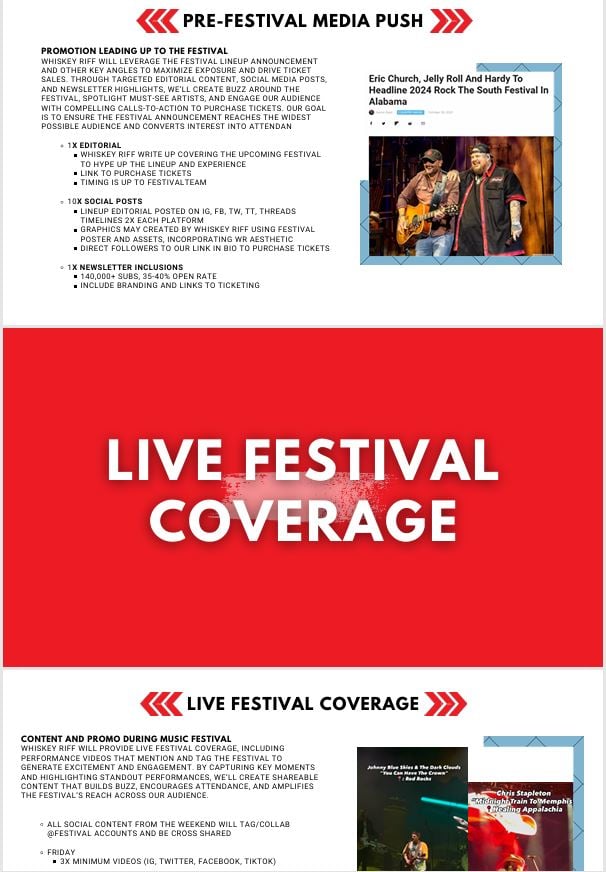
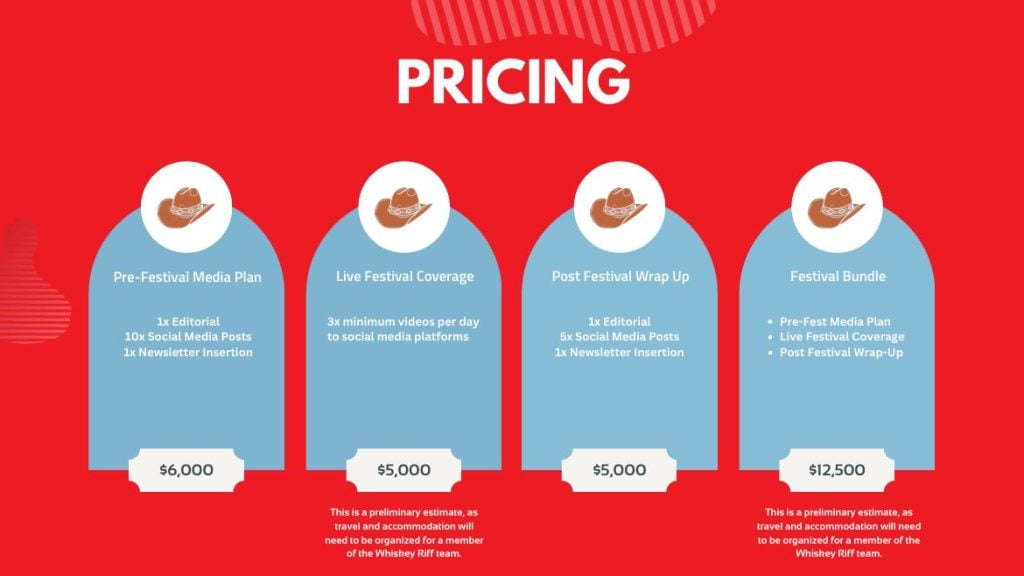
While many outlets like Saving Country Music feature the lineups of music festivals simply as part of the daily news routine, and routinely deploy in-person assets to important festivals to populate in-depth coverage from on the ground, Whiskey Riff is charging for such activity as can be seen by the pitch deck below obtained by Saving Country Music from multiple sources.
Yes, journalists and photographers covering live music events often receive free admission/press passes, and even VIP/pit access to these events, and it’s also not uncommon for events to offer free or discounted accommodations if necessary to get press to their events if they’re in a remote or exclusive location. Traveling to and covering live events can be a costly endeavor.
But outright paying for coverage is not only unethical, it virtually assures that no actual objective coverage of the event will occur. It will simply be promotional copy published by a 3rd party outlet. Unfortunately, this practice is not entirely unheard of when it comes to covering live events. It’s also fair to point out that it might not be required you pay Whiskey Riff for them to announce a festival lineup. But it is the way you can guarantee they will.
Holler has distinguished itself recently as one of the more healthy alternatives in the country music media space. But multiple sources have now reached out to Saving Country Music to confirm they are also beginning to charge for their press coverage. While it’s not mandated that performers pay for press at the publication, this is a way that an artist or band can be guaranteed posts in the publication, top placement in playlists, and on the outlet’s home page. And because this coverage is paid for, it’s a virtual guarantee it won’t be impartial.
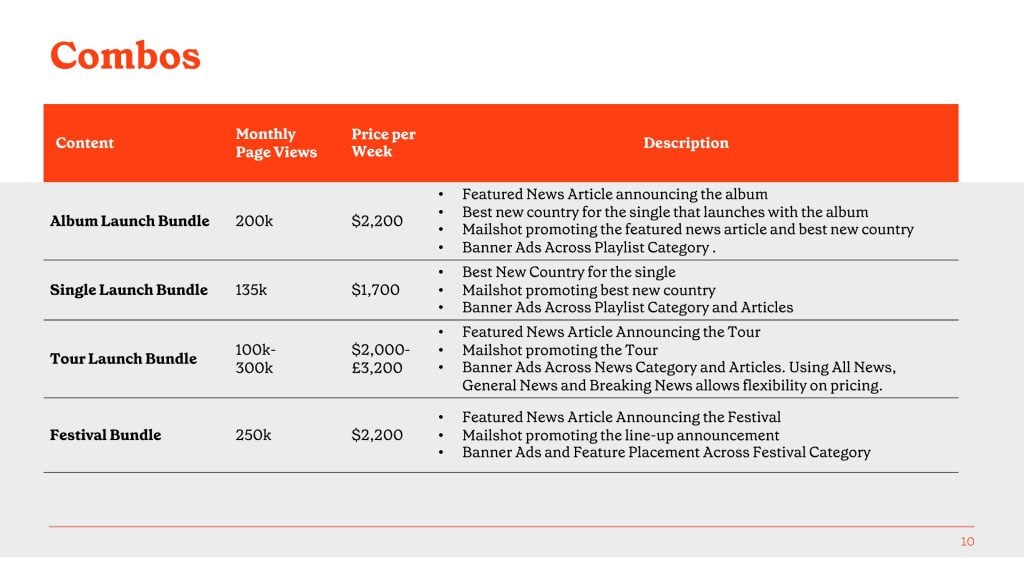
Due to the sponsorship packages and in-kind promotion, sometimes the media coverage of events or festivals can exist in a gray area. Where Holler ups the ante is by offering direct press coverage to artists in the publication for the right price. Paying for inclusion in the playlist is payola directly. Below are the rate cards that Holler has been disseminating to publicists, artists, and labels since at least February of 2024.

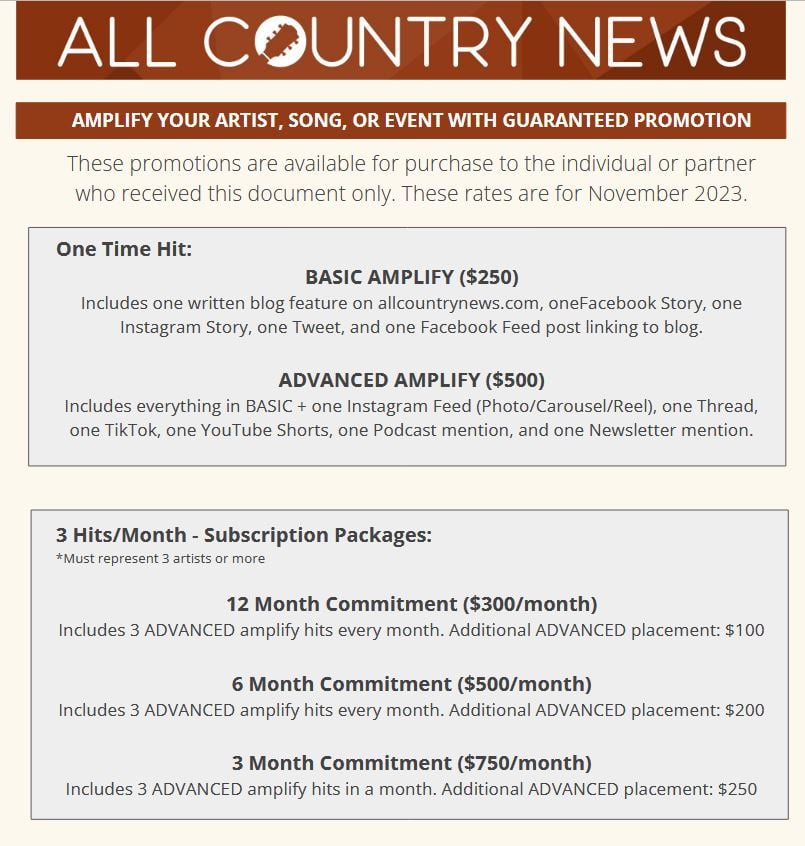
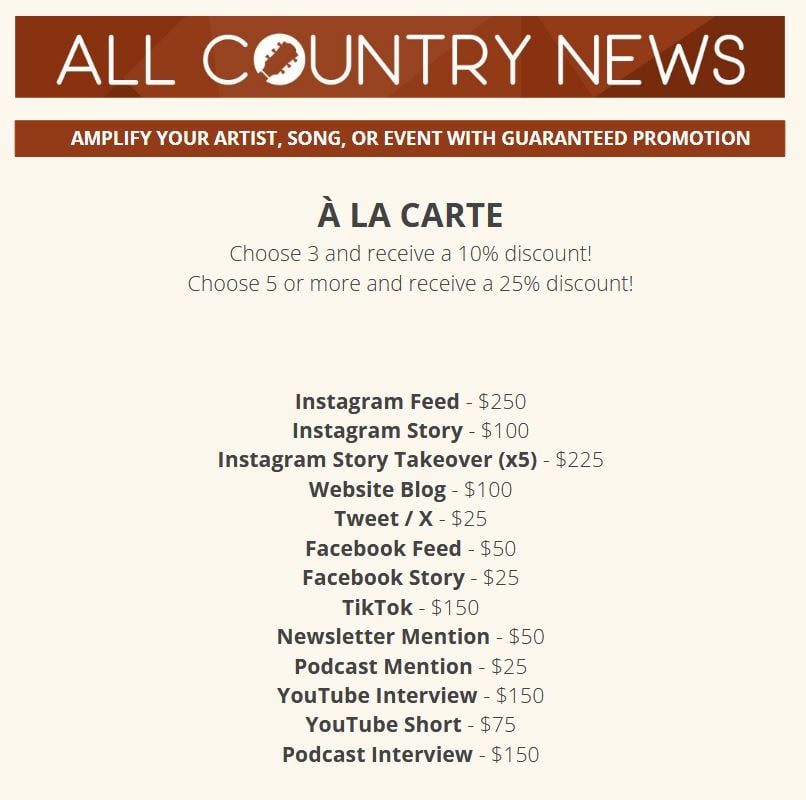
Another outlet Saving Country Music has confirmed is participating in this paid-for media coverage is All Country News. Their confirmed rate cards are below.
Though publicists, labels, and artists might feel like their doing themselves a favor by paying for this press coverage, doing so undercuts the integrity of the entire industry, while also compelling more outlets to start charging for coverage until these are the only options available. Trust in media is at historic lows, in part because the public distrusts what is objective, and what is sponsored.
Furthermore, some of these practices might be illegal in the United States if sponsored content is not disclosed. The Federal Trade Commission regulates sponsored content, and demands it is disclosed whether in conventional media outlets, or on social media. When reporting previously on some of Whiskey Riff‘s festival coverage, Saving Country Music has noted that the coverage was marked “sponsored,” which in these instances, is the correct thing to do.

Unfortunately, as budget cuts continue to affect arts and music coverage from the media, advertising revenues dwindle, and short form video on social media dominates the media landscape, legitimate and independent music outlets are getting squeezed. But charging for press is no solution. It’s simply a way to exacerbate the public distrust in the media, and ensure that the monied interests in music continue to get an unfair share of the attention while some of the best artists of our era continue to struggle in obscurity.
– – – – – – –
Saving Country Music reached out to Holler, Whiskey Riff, and All Country News for comment on this story. Whiskey Riff refused to comment. Holler and All Country News did not respond by the time of this post.
January 14, 2026 @ 8:48 am
Thank you for addressing this issue, Trigger, which highlights once again what an invaluable service SCM provides for the country music community. While this trend is troubling, it is not at all surprising. Given that fact that much of what many people consume across social media and music distribution platforms is either “passive” (e.g. Spotify playlists) or un-critical (i.e. people don’t know / don’t care where content comes from), we can expect this to continue. In fact, I think one can make the case that most of what most people read / hear / watch / scroll these days is paid for in one way or another. It simply gets harder to know where the money comes from and who’s profiting.
January 14, 2026 @ 8:52 am
Oh darn! Any evidence AmericanaHighways does this? Theyre the other site I check for news about the artists I like…
January 14, 2026 @ 8:57 am
Absolutely no evidence that AmericanaHighways does this, your favorite independent music outlet does this, and I don’t want to disparage all the media as if this is a pervasive practice. I’ve had lots of negative things to say about Rolling Stone and Billboard over the years. They do a ton of promotional articles directly hawking products and such. But as far as I know, they do not participate in this type of payola practice.
January 14, 2026 @ 8:52 am
I’ve seen Whiskey Riff go out of their way multiple times to state they are not “journalists.” Good for them if festivals want to pay for this kind of robust coverage.
Makes much more sense to spend your marketing dollars with a brand that has a direct connection to your target audience vs Meta. It’s called running a…business?
January 14, 2026 @ 9:07 am
If ‘Whiskey Riff’ wants to insist they’re not journalists, who am I to argue against that? I do think that some of the contributors over there have done quality journalism in the past, and I’ve made sure to say that I think they’ve had a significant impact on getting some important independent artists some deserved attention over the years.
But whether they’re journalists or not, Whiskey Riff is most definitely a media outlet, which means they’re regulated by the Federal Trade Commission. And if all media outlets start charging for festival press coverage—especially the pretty exorbitant prices Whiskey Riff is asking—it means that big monied interests are going to get an unfair advantage over the little guys who can’t drop $5,000 – $12,500 for one outlet to cover their festival. Somehow I’m able to cover about a dozen festivals a year—from lineup announcements, to on the ground festival coverage, and post 12-20 social media posts, and don’t charge a dime. Maybe I’m the sucker in this equation, but I’m also not backed by the Grand Ole Opry and NBC/Universal.
The rich get richer, and the popular get more popular under a paid-for system. That’s is why this information should be alarming to everyone.
January 14, 2026 @ 9:12 am
OTOH Whiskey Riff is ironically headquartered in a semi gentrified part of the absolutely non-country neighborhood formerly mainly occupied by the then dangerous Cabrini Green housing project near downtown Chicago.
On the other hand, it’s only 8 blocks from the about 1200 capacity Joe’s, where radio promotions can squeeze in an Aldean or Garth special, if you’re not paying less than $40 for Pat Green or Casey Donahew or Tanner Usery.
January 14, 2026 @ 10:16 am
Okay, Ill bite… what in the world is a “non-country” neighborhood ?
January 14, 2026 @ 11:57 am
Well annoying Mike. Usually in the context of Country music and in the context of rural living and the culture of rural life, it would indicate somewhere out in the rural areas of the US. The hills and hollars for example, though it could also include the plains, valleys, rivers,and the mountains as well. Typically in such areas there is a strong agrarian culture. You know, farming, ranching etc. Clearly a congested neighborhood in an area of Chicago controlled partly by gangs and surrounded by high rises probably wouldn’t be the most apt description of ” country” at least in the context of how country music fans see it. Ditto with other large sprawling urban areas like NYC, Cleveland, Baltimore, Detroit and the like.
January 14, 2026 @ 12:24 pm
I don’t see any value in criticizing Whiskey Riff for wherever they’re based. I thought they were based in Colorado, and they might be. The Chicago office might be their merch warehouse or business office. There are some great country and roots artists out of Chicago. Pat Reedy is based there now.
January 14, 2026 @ 2:37 pm
Yeah!!! I’m based out of Chicago ….. Oh, wait a minute, my headquarters is in the suburbs…lol Nevertheless, we have a great little small but mighty scene here. Pat loves it, and we’re lucky to have him. Thanks for sticking up for us Trigger!
January 14, 2026 @ 4:17 pm
JB, no one’s picking on you.
Your an SCM lifer.
Of course people in urban areas may like, listen and support country music. Thats a given. And I know Chicago has a scene, as did NYC at one time.
Glendels comment made me laugh though at the irony. Whiskey Riff, who seems so aligned with Nashville and pretends to be the arbiter of modern country culture and lifestyle, of all places is housed in a semi sketchy neighborhood in Chicago? Thats a hoot if true.
When Mike Annoys got a bit snarky, I thought id play along in fun, but from the country side of perspectives. Trig got annoyed. Oh well.
January 14, 2026 @ 5:17 pm
Oh Kevin I know that, your explanation was fine. I was just messing around, and even glendel was playing both sides. I laughed at the question “non-country” neighborhood….lol. And for the record, and glendel knows this, Joe’s on Weed St has shows of all genres like many venues. I think Trig took it too seriously, but I still appreciated his support because he really lives in a Country neighborhood.
January 14, 2026 @ 5:35 pm
Hey Kevin,
I’m not trying to come at anyone sideways here. I’ve spent the day fending off ad hominem attacks from Whiskey Riff trolls, so maybe I’m a little on edge. I’d actually like your perspective on this payola issue as someone who has personally covered multiple festivals for Saving Country Music, and not demanded $6,000 – $12,500 paydays to do so.
January 14, 2026 @ 9:28 am
Ok here is my take. The entire influencer model is built on trust. There are certain influences who are good at various skills that I want to be good at. I follow them. They act as outsourced “community” where I can learn things that I wouldn’t be able to learn in person. Then I go improve my business or my skills or try what they try based on their expertise. If someone in a business I want to be in uses a certain planner and shows how it improves workflow then because I trust them I may buy said planner.
When, however, something as personal and potentially expensive as music and festival travel info is fed to me on an advertiser-can-buy-my-attention-from-a-menu plan then that degrades trust. Especially when it is then fed to me as homegrown excitement. I remember your Zach Top posts that went organically viral and others. Your Rhythm and Roots posts. Your genuine excitement came through. Now knowing that “journalists” can be paid to fake that same level of hype simply makes the consumer more suspicious of everything.
And that stinks.
January 14, 2026 @ 10:19 am
What I can’t emphasize enough is how these practices erode the integrity of EVERYTHING, not just the specific outlets I highlighted, but artists, labels, publicists, outlets like Saving Country Music, festivals big and small. The public becomes cynical and assumes it’s all bought and paid for, and as trust erodes, none of it feels real anymore. And as we’re all staring into the teeth of an AI future, this could make the whole way music is covered and promoted fall like a house of cards.
January 14, 2026 @ 1:58 pm
This. Exactly- once again- thank you so much for all you do and for doing it with integrity in spite of the obstacles. And thank you for bringing attention to this.
January 14, 2026 @ 9:38 am
I’ll cut anyone a deal for festival coverage. All I’ll need is a media pass and a corn dog. Hook a sister up.
January 14, 2026 @ 10:04 am
Sponsored Content is becoming more and more a go-to for news publications to raise revenues, and its been going on for years. Flip thru magazines and see pages that ‘sorta’ look like the rest of the articles, and its labeled somewhere (usually small at the bottom ‘Sponsored’)
So I guess I’m not terribly surprised its been imported to country music sights, even if it pretty gross to think about especially if/when done by a specific performer and not just a business. For example, if Tecovas did a SponCon I’d probably shrug my shoulders and say hey, thats commercial business.
January 14, 2026 @ 10:20 am
Trigger did you see this?
Bandcamp has officially banned music generated using artificial intelligence from its platform.
January 14, 2026 @ 10:46 am
Yes, good on Bandcamp. Might have something on it at some point.
January 14, 2026 @ 10:28 am
“The music business is a cruel and shallow money trench, a long plastic hallway where thieves and pimps run free, and good men die like dogs. There’s also a negative side.”
Trig, i been reading this site every day for 6 years because of your talent and integrity. Thank you
Looking forward to the jeremy pinnell album review of “goodbye LA”
January 14, 2026 @ 12:24 pm
This seems like a power move directed at Whiskey Riff.
January 14, 2026 @ 1:27 pm
I can cover the events and give them crappy reviews for free.
January 14, 2026 @ 3:20 pm
Everything going toward a pay-to-play or subscription model is killing media and journalism for me. Apart from SCM, there’s no legit news (music or otherwise) journalism I can access anymore without hitting an expensive paywall. I get it, advertising is in trouble and people gotta eat, but what that means is that information is siloed and inaccessible to people who can’t afford it and information available to people who can afford it is increasingly tailor made just for them to keep those dollars flowing – so it’s not really journalism but catered slop that reinforces narrow viewpoints, heading further and further toward intellectual dystopia. It’s probably increasingly more and more difficult to keep things going but thanks SCM for doing what you do. You’ve been a real lifeline for years. Can’t imagine being as big a fan of country music without you.
January 14, 2026 @ 5:30 pm
Thanks for reading Tex Hex.
As I said in the article, I very directly know how hard it is to make a living writing about music. Generally speaking, I don’t fault outlets for trying to figure out how they can fund themselves so they can keep the lights on. But under a payola system, the rich get richer, and the poor get poorer. Paywalls segregate important ideas and perspectives from the public, and create walled gardens of elite perspectives, while free sites serve up slop and misleading information. It’s all a mess, and I don’t profess to have the solution. But I personally would rather cease operations or go part time before I took from an artist or festival. It’s my job to serve these communities, not be another siphon of money in an already blood sucking system. It’s a lot of work. But I never take for granted what a privilege writing about music for a living is.
January 14, 2026 @ 6:45 pm
Yo this is a gutsy move posting these prices. Good on you, Trigger. I imagine this took a little courage to post.
January 14, 2026 @ 7:51 pm
This story was definitely news to me. I had assumed some of these other outlets were getting paid mainly by ad revenue and sales of their merch. Whiskey Riff sells all kinds of “lifestyle” stuff.
I will say that having photographed for a few different outlets numerous times, it’s a no pay gig. Many contributors are working free, and they all have day jobs much like me. For me, this thing is a passion pursuit/hobby. I see myself as a photographer first and a writer second and a researcher third. The writing followed the photography for me as I discovered it’s easier to interest someone if there is meaningful writing to accompany photos. Helps that im a music freak. So I photograph and write about my passion as a hobby. My impression regarding most roots music journalists, is they are in a similar boat as me, they have a day job and do this for the opportunity to be published and the free tickets to concerts and festivals. It works for many of us. I do know a photographer who has a little income coming from the jam band scene, he charges promoters a modest fee for his work and the pics are posted on a jam base kind of site. He definitely aint getting 6 to 12k though. For him it’s a passion project, he’s got a retirement income from his day job years.
The idea that a media outlet would charge money to review a festival and photograph it and or do video clips is interesting. I do know that the festivals can be hungry for coverage from a reputable source as they hope to reap more ticket sales. There are too many music festivals imo and they are all competing from a similar pool of music fans. So, they do it seems, really appreciate good press. Gotta get people to THEIR music festival and skip the competition. If a festival owner wanted to hire say a video specialist to do promo videos for the festival like you see utilized on many festival sites these days, I think that’s fine. But leave the journalism to the independents who do it for the love of the music.
The problem as I see it with what Whiskey is doing , is they are taking on a role as a publicity company AND at the same time masquerading as a legit journalism outlet. You really can’t, or shouldn’t do both. A publicity agent is paid to only say what the promoter wants said. Their job is to promote ticket sales. And here we see in their own writing, this is Whiskey Riffs entire goal. But when you also are writing the reviews you really are being deceptive. They need to at the least say at the top of each article or news release that this is a paid for ad.
Whiskey Riff is creating bought and paid infomercials in a sense. Thats not journalism. Its also highly biased and as a consumer I am turned off by these approaches. Im much more interested in what an independent critic or reviewer has to say. If I know they aren’t bought by the person that owns the event, I feel like I can trust them more. This whole thing is weird.
A good publicity agent will get ahold of the SCMs, the No Depressions , in other words the legit independent roots music outlets and ask if they wish to cover the festival. Thats the way it should work. The Whiskey Riff approach is all about a wholesale takeover of everything, and not only are they trying to edge us all out, they are monetizing what shouldn’t be monetized IMO. Its the corporate approach.
Good on you for exposing this.
January 14, 2026 @ 8:05 pm
Yeah Trigger! Thanks for calling this out
January 14, 2026 @ 8:21 pm
I agree with the above comment that it was very gutsy and admirable of you to post these prices. Unfortunately, none of the prices are readable with a screen reader, leaving that information inaccessible for myself and any other blind readers of sCM. If you had not referred to them being posted below, and the commenters hadn’t mentioned them, I would not even know they were posted. It is probably the case that they were copied from an image, but in that case, a screen reader will usually recognize this as such and at least read something to the effect of: “graphic” or “image.” That doesn’t even happen here, which leaves me at a loss. Just something to be aware of. For my own curiosity, I would like to know what the prices are. Appreciate you and others who are out there trying to keep things objective and honest.
January 14, 2026 @ 8:44 pm
Hey Megan,
I apologize for that. This is the reason whenever I announce tour dates or festivals lineups I don’t only publish the poster, but list everything out. In this case, these price menus from these outlets are very graphic rich, and so I wanted to post them verbatim that way people could see them for themselves and verify their authenticity.
Long story short, Whiskey Riff offers four festival coverage packages ranging from $5,000 to $12,500 for various levels of coverage, including $6,000 for just one pre-festival post and social media posts.
Holler’s menu is much more complicated. It’s $1,000+ for an editorial feature, $500 for a news article, $200 to be featured on one of their playlists, which is basically direct payola. They also offer an “Album Launch Bundle” for $2,200, a single launch bundle for $1,700, and a festival bundle for $2,200.
All Country News offers up various things, including literally a tweet for $25, or a blog post for $100.
It’s really not just the brazen nature of what Whiskey Riff and Holler are doing. These prices in my opinion are exorbitant. I can usually knock out a news story about an album release in 90 minutes or so. To charge $500 to an artist for that just seems egregious to me. And by the way, Saving Country Music tends to get more traffic than Holler, so it’s not like you’re paying for some massive exposure. Whiskey Riff gets way more traffic than SCM or Holler. But that’s for the site overall, not individual articles, which might get less or more views than on other websites.
January 15, 2026 @ 3:35 am
Thank you so much for your response with all these details. I had no idea that is why you list out all the info when it comes to festival lineups, etc., but I have always appreciated that, and now even more so. Believe me when I say many would either not make that consideration, or else not realize it needed considering. I don’t take it lightly.
You’re right, the prices are, frankly, ridiculous. I understand that independent media outlets are struggling just like the artists they serve, but this will only contribute to the artists’ financial struggles, not to mention make the public even more distrustful of the media, if such a thing is even possible.
January 15, 2026 @ 4:20 am
I have a YouTube channel about country music, but the current copyright landscape makes it nearly impossible to sustain. The biggest hurdle is the ‘all-or-nothing’ revenue model. I can produce a one-hour episode, but if I include even a fraction of a second of a song, the entire video’s ad revenue is claimed by the publisher of that 1 song! While I believe in giving credit and sharing profits, losing 100% of my earnings over a short clip feels inherently unfair. If struggling artists and labels want to reach new audiences, there needs to be a more balanced way to allow their music to be heard without penalizing the creators who promote them.
January 15, 2026 @ 6:10 am
BREAKING: Country music festivals advertise with country music blogs…. More at 11.
January 15, 2026 @ 8:33 am
As explained in the article, festivals or artists advertising with media outlets is customary and in no way controversial. Paid-for editiorial content can be downright illegal when paid for in certain circumstances. That’s why seeing the actual menus of what is offered is so important. Both “Whiskey Riff” and “Holler” specifically offer “editorial” content in paid-for bundles.
Frankly, I’m surprised the outrage for this isn’t greater, especially for what Holler is doing. Straight up paying for songs to be placed on playlists is payola by definition. This should be the biggest story and scandal in country music right now.
January 15, 2026 @ 10:23 am
Holler doesn’t surprise me one bit. Looking at their top album lists, I would imagine people are paying for placement there also. Albums on big labels that no other website cares about suddenly pop up on Holler’s end of year list.
January 15, 2026 @ 9:09 am
I’m just a busted up old man but I have pretty good hearing still, and a real way with the longerishtic words – so if’n any of yall know her please reach out to Charlie Marie and let her know that I’m willing to cover her singing in the shower for like idk, $3.50. I have more than 500 followers on X, and one time Margo Cilker retweeted me, so yeah…
*crosses fingers*
Seriously though, what a world. You keep doing your thing man, integrity is like virginity, you only get to lose it once.
January 15, 2026 @ 9:31 am
My suspicion is that there are more music websites taking money than you realize. Same goes for artists sweetening their live performance vocals with electronic gimmickry in the audio chain. There’s no full-disclosure rule for any of these, no government agency oversight. We basically just assume that our favorite bands, singers and music journalists are giving it to us straight, on some sort of honor system. I hope they are, but truth itself is getting more elusive by the day.
January 15, 2026 @ 4:57 pm
You’re catching too much flack for this post on social media. I agree with what you’re saying. And shoot, Colby Acuff gave you crap after laurel cove, and you still covered Enjoy the Ride. If any artist did that to whiskey riff, you know they wouldn’t do the same.
January 15, 2026 @ 5:49 pm
Good job highlighting this Trigger. It’s actually not a very widespread problem in my experience as an Americana/country music publicist and these outlets are some of only a few that are brazenly asking for payment for reviews or coverage. It’s much more common in the social media influencer world where asking for pay for coverage from festivals is pretty mainstream. Obviously media outlets are really squeezed for money right now, but asking for pay for coverage is not the way to go. Lots of other outlets have experimented with this and given up when they’ve seen how much this erodes trust. I remember Paste Magazine was pay to play for a while and they just got flooded with a lot of terrible bands and folks tuned out. Not surprised by Whiskey Riff since that always seemed more of a lifestyle brand, but Holler is surprising. They had great journalists for a while and were founded on good principles. Oh well, I guess everything changes.
January 16, 2026 @ 9:26 pm
I’m surprised to see this about Hollar. I know for a fact American Blue that was released by Alma Russ in December and was added to their Best New Country Playlist without any paying for it.
January 17, 2026 @ 9:36 am
It’s definitely important to note that you don’t HAVE TO pay for coverage at Holler or Whiskey Riff. They cover plenty of stuff without payment. If you want to be guaranteed coverage at Holler, you can pay for that privilege. The problem is this creates a slippery slope where there’s a financial incentive on other outlets to adopt these policies, then limit the amount of free placements to the point where the entire industry is pay-to-play. In the fiction book market, that’s exactly what it is. If you want your book featured in a publication, you basically have to pay them, which has imploded the whole market except for the top name brand authors.
January 19, 2026 @ 6:58 am
I’m a country artist and finding this out was very disheartening.