

No, AI Is Not “Just Like AutoTune”
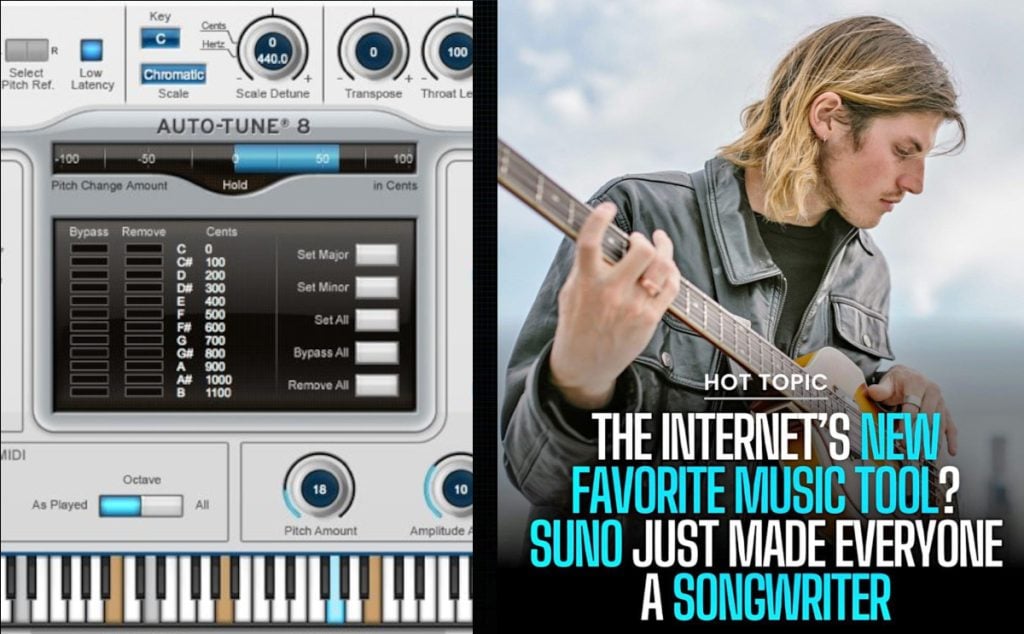
As the music industry wrestles with just what to do about generative AI programs like Suno that can quite literally compose an entire song including lyrics, instrumentation, production, and everything else in a matter of seconds solely based off of a textual prompt, there has been one dangerous falsehood parroted out by AI’s proponents and apologists: It’s no different than AutoTune—the software that allows a sharp or flat note to be brought in tune in either a recorded or live performance.
Most any time AI comes up, this common defense is found. West Coast rapper Tyga has been catching flack recently from some in the hip-hop community over his new album released under the pseudonym $starface on July 31st that leans heavy on ’80s-style synth sounds and guitar solos. The suspicion was that much of the album was generated with AI and Suno specifically. In a feature for hip-hop magazine Vibe, Tyga flat out admitted it.
“I’ve never spoken on this with anybody because I always felt like it’s similar to a magician explaining how he does his tricks. Like why are people over-explaining how they make sh– that’s good?” he said when directly asked if he used AI. “It’s supposed to give you an experience and a feeling. But we definitely used AI as a [tool]. And I know people are going to be mad about me saying this, but it’s where technology is going. It’s no different than when Auto-Tune came out. Some people were opposed to it, but real artists took it and used it.”
Sure, maybe it’s no different in how people were mad when AutoTune first came out. But to compare the technological leap of AutoTune to AI is an apples to bowling balls comparison. AutoTune when originally developed was never meant to be a blanket fix-all for performers who couldn’t sing whatsoever. Its purpose was to tune a sour note or two in an otherwise stellar studio performance so the singer wouldn’t have to waste time singing the part again, and perhaps not as well as the first take, aside from the sour notes.
Then Cher used AutoTune for the vocal effect in the chorus of her song “Believe” released in 1998, and all of a sudden artists were using the program to purposely give vocals a more robotic sound. If anything, that was a more artistic use as compared to the one of using it to tune off-pitch vocals. Then you had T-Pain, who built his entire career off of AutoTuned vocal tracks, and performers using the program not just to tune one or two notes in the studio, but entire performances, and in live settings.
But it was never a situation where the public and the industry completely accepted AutoTune use. Jay-Z famously release the anti-AutoTune song “D.O.A. (Death of AutoTune)” in 2009. And even today, artists get accused all the time of using AutoTune to cover up for vocal flaws or a general lack of singing talent.
Yet even at its most sinister, deceiving use—which is a singer performing live with full pitch correction to make up for the fact they can’t sing in tune at all—there is no way you can compare it to the kind of capabilities and ramifications of AI. With AutoTune, you still need a human singing to create the performance. With Suno, you don’t need anything, except the unauthorized use of copyrighted material from existing recorded music that Suno pulls from to generate its tracks, or the parts of tracks. This is the reason every major label is suing the company at the moment.
But what Tyga is right about is that many are using the technology, and unabashedly. And it’s most definitely not just confined to the hip-hop space. Traditional country artist Joe Nichols recently explained how country songwriters are using Suno to create demo recordings of songs they write to pitch them to artists. It’s become commonplace to see these kinds of practices as harmless, as long as the AI demos don’t make it out into the wild, and it’s simply used as a song development tool.
But again, those demos built through Suno are relying on the work of artists that never gave the company permission to use them. Those artists are also not being compensated, and those artists are having their entire livelihoods put at risk by the technology. It is the most slippery of all slopes when people start apologizing for AI use, or equating it to marginal technology leaps like being able to tune vocals.
Rapper Tyga goes on in the interview to clarify that all the writing and the vocals on his new album are his. It was just the music that was generated by AI. “There’s nothing wrong with using technology as a tool,” he says. This is true … until that technology completely replaces the humans that are trying to use that tool by making them obsolete. Then you have an existential crisis in the music industry, and in humanity. This is the technological dystopia you trundle toward when you try to act like AI is just as trivial as the use of AutoTune.
– – – – – – –
If you found this article valuable, consider leaving Saving Country Music A TIP.
August 10, 2026 @ 8:43 am
Funny how things devolved to the point where Auto-Tune is being defended like it’s a Solid State amp vs Tube amp argument. Acceptance and ignorance over the use of Auto Tune and pitch correction is why generative AI music has a level of acceptance.
August 10, 2026 @ 9:05 am
Again Strait, your brain is broken when it comes to the whole AutoTune argument. No, nobody is defending the use of AutoTune. That’s why it said in the article,
“But it was never a situation where the public and the industry completely accepted AutoTune use. Jay-Z famously release the anti-AutoTune song “D.O.A. (Death of AutoTune)” in 2009. And even today, artists get accused all the time of using AutoTune to cover up for vocal flaws or a general lack of singing talent.”
August 10, 2026 @ 9:57 am
Wow….I’m gonna choose to be not be equally rude in response to that. You and many other people have ignored the widespread use of live pitch correction by major acts for 5+ years now. You have cherry picked some obvious examples of pitch correction and held that up like some kind of integrity plaque. Just to be clear I’m putting you in the ignorance category of my previous statement, not the acceptance side. (even though willful ignorance is a form of acceptance)
August 11, 2026 @ 6:52 am
There’s a YouTube channel Wings of Pegasus that calls out the live pitch correction you’re talking about. Both interesting and insane at the same time. AutoTune sucks and absolutely is normalized at this point.
I don’t know why he’s even bringing up D.O.A. Probably should just stay in his lane of what he knows about. AutoTune is still rampant in rap and never went away. Hell, it’s rampant in literally every genre at this point.
The general public doesn’t care about AutoTune like they don’t care about AI music. Both suck, but so does the general public so it makes sense. AutoTune IS just like AI, and they both should just be gone from music creation.
August 11, 2026 @ 8:35 am
“The general public doesn’t care about AutoTune like they don’t care about AI music. “
The whole reason I wrote this article is because the way we talk about AI is critically important to making sure we’re not trivializing its impact. The “general public” absolutely most definitely cares about AI music, and AI in general. Widespread dissent against AI from the public is currently the only major thing keeping it in check. People taking the default position of “the public doesn’t care” are frankly uninformed about what is happening. It has been remarkable how much the public cares about these AI matters, because deep down they know they’re existential.
As for AutoTune, it’s also irresponsible to paint its use as “rampant.” In the independent country, Americana, bluegrass, folk, roots space, it’s is extremely uncommon to non-existent, and strongly stigmatized. I go to festivals all the time, and no AutoTune is being used. Sure, it’s different in the mainstream and other genres, but it’s irresponsible to paint with such a broad brush, and to assert such a cynical notion.
Strait wants me to write a dedicated article saying: Oliver Anthony is Right: Parker McCollum uses five AutoTune modulators to tune his voice live.” The problem is there’s no evidence of this, Parker McCollum has denied it, Oliver Antony did not name Parker McColllum by name, “five AutoTune modulators” doesn’t even line up with the way AutoTune is employed in the live space (it’s a rack-mounted console), and I would potentially be participating in slander by saying such a thing.
Is AutoTune used in the live content in popular music commonly? Yes. Do pretty much every live performer use it? Absolutely not. And it’s irresponsible to say that because it damages creators who refuses such technological crutches.
August 11, 2026 @ 9:54 am
You are badly and willfully mischaracterizing points I’ve made. I have never once claimed that there is live pitch correction in: independent country, Americana, bluegrass, folk, and the roots space. you are lazily moving the goal post. I have been clear that it is basically an industry standard with mainstream Country artists on major labels. I have also been clear and gave specific examples from live videos of Parker McCollum on why I believe he has engaged in the same industry standard live vocal tuning. I also criticized Oliver Anthony’s framing of the issue and stated each time that I am not a fan of his.
We have statements from Ella Langley stating that another major performer approached her about ‘tuning” her vocals live and how everyone is doing it. (everyone meaning other major artists). Trigger you keep deflecting this point by shifting it back to bluegrass and independent acts – WHICH MYSELF AND OTHERS HAVE NOT CRITICIZED FOR USING PITCH CORRECTION LIVE.
The whole issue is that there is a stimga around tuning vocals. The general public doesn’t know about it. It’s the same with actors taking ‘steroids’ to gain muscle for movie roles. The general public believed the lie that it was a strict diet and workout plan. It took decades for the truth to finally start coming out on that. People generally don’t want to accept that there is some kind of “trickery” going on with music and actors that they like.
It was the Wings of Pegasus videos that opened my ears to be able to tell what live “tuned” vocals sound like. Once I could hear it it’s been impossible to unhear it.
August 11, 2026 @ 10:02 am
@Basically Alabama
It amazes me how unaware and uninformed the general public is. I came across a recent live clip of the 80’s band Loverboy that Sammy Hagar commented on. The singer was badly lipsyncing and none of the commenters on the clip could see this.
Socially it’s better to believe the lie than it is to be critical and call out the lie and ruin the illusion. On the issue of live pitch correction that holds true for dipshit journalists with a press pass.
August 10, 2026 @ 10:09 am
You vehemently denied that Parker Mccollum would lie about using live pitch correction. You also denied my accusation that Charley Crocket used heavy pitch correction on his Bad Company cover. I think you should stay in your lane as a drummer because hearing pitch isn’t your thing.
August 10, 2026 @ 9:05 am
The unstoppable march of ‘progress’. Sadly.
August 11, 2026 @ 3:16 am
The march or regress, it seems.
August 10, 2026 @ 9:13 am
I’m as anti-AI as anyone, and am generally against autotune usage (with an exception for artists like T-Pain for whom the pitch manipulation is part of the art, rather than covering a flaw).
But the cold-hearted reality is that if it sells, it’s going to get made. And it’s going to sell, because most people don’t care. The best outcome is to twist the arms of the producers into some sort of labeling requirement, and even that will be tough.
Again – not a fan, just a realist.
August 10, 2026 @ 10:23 am
The question of “if it sells” is TBD IMO. You are seeing a few “viral” AI songs pop up, but it seems once people realize it is AI-generated, the popularity of said song sharply declines.
Grifters and folks locked in AI-delirium due to chatting with a bot all day are convinced AI-music is the future. I’m not so sure that is the case. I think it is inevitable that AI tools become a part of the music process – if it isn’t already – and I also think certain genre’s are more apt for AI music to take over (EDM seems obvious for one). But the immense public pushback against this tech is something unprecedented in modern times. Not sure that just goes away over time.
August 10, 2026 @ 11:49 am
Some of the experts in this are the people who run deezer, one of the streaming services that is pushing back on ai. They’ve released a lot of information about streaming and ai. Apparently nobody’s actually listening to that shit on purpose. It’s all being pushed to stream platforms as part of streaming fraud.
August 10, 2026 @ 12:06 pm
I suggest people read The Honest Broker, a Substack blog by the jazz musician and music historian Ted Gioia. He also has a background in Wall Street consulting and he has some very interesting takes on where AI is going. He makes an interesting case that the humanist resistance to AI in the arts is winning and that the tech companies have set themselves up for disappointment.
August 10, 2026 @ 1:39 pm
Maybe you could share more about that. Ted’s substack is paywalled.
August 10, 2026 @ 2:07 pm
“He makes an interesting case that the humanist resistance to AI in the arts is winning and that the tech companies have set themselves up for disappointment.”
I’ve been making that same point here (and not behind a paywall). I though we were cooked in 2026. It’s really been the public backlash that has kept AI music at bay, not anything else. So when people default to “Nobody cares! They’ll listen anyway,” they’re really making an uninformed statement.
August 10, 2026 @ 9:39 am
The biggest fear to me is that Gen Z seems to be embracing AI without reservation. They use it for everything. Sadly, they don’t seem to care if the music they listen to is generated by AI or not.
I fear that sooner rather than later, we will lose the real art and the real artists.
August 10, 2026 @ 10:03 am
That’s not my experience whatsoever. Gen Z and Mellenials seem to be wholesale rejecting it vociferously because they see it eroding their future, while boomer tech oligarchs and celebrity types like Jeff Bridges sing its praises. Granted, many younger people are using things like Ai-enhanced search on a regular basis. But as far as things like Suno, they’re not interested to a greater degree. They’re also less easily tricked by AI, while Facebook is full of viral AI content being pushed by unsuspecting 65-80+-year-olds.
August 10, 2026 @ 10:33 am
Millennial here to agree with you. I use it for a lot but I refuse to accept it for art.
August 10, 2026 @ 11:08 am
I suppose my experience with Gen Z is more limited than yours. I guess I was generalizing based on the behavior of some of my relatives and children of my friends. Breaking Rust was big in their circle, but like I said maybe that’s an anomaly.
I also agree that Boomers and Gen Xers are way more easily fooled by AI, but not sure they seek it out so much as it has infected their timelines.
August 10, 2026 @ 11:18 am
Boomer here who is already sick of having ridiculous AI slop shared by friends that I thought were smart enough to know better. When it “infects” my timeline I squash it like a bug and don’t care whose feelings I hurt.
August 10, 2026 @ 10:05 am
Do they? Gen Z is also the same generation booing every dipshit commencement speaker who lectured them on how AI is the “new industrial revolution”.
If we want to pain with a big brush, Boomers seem to enjoy AI slop more than any generation based on the prevalence of it on platforms like Facebook and YouTube where it is routine to see AI slop videos and photos posted. And not a lot of Gen Z-ers are hanging out on Facebook these days…
August 10, 2026 @ 10:20 am
I think that’s all generally correct, though I do see lots of young Millennials and Gen Z rapidly becoming accustomed to using ChatGPT or similar to do their writing for them.
That won’t necessarily transition to the arts, but I think the relationship between age and AI uptake is complex.
August 10, 2026 @ 11:05 am
Agreed on using ChatGPT as a tool and such. Though if you look at polling, a lot of those same students use is quasi-begrudgingly. A lot of those same Gen Zers and Millenials that use ChatGPT or Claude or Gemini or CoPilot (lol on that last one, everyone hates that one) are using it, but also will readily admit they don’t particularly like using it and question if they should be using it.
So even in that generation that has been most vocal in opposition to AI, the ones that use it treat it almost like it is like eating fast food. You know it isn’t good for you and you don’t particularly WANT to do it, but because it is so prevalent they pull in the drive thru lane.
Outside of a very vocal minority, the vast majority of people seem to fall in the “I don’t particularly likes these tools, but I will use them occasionally”. Which ain’t great for long-term mass adoption that the AI industry needs to actually turn a profit. But that is another story entirely.
August 10, 2026 @ 10:31 am
Yeah it’s Boomers who are choosing to listen to AI slop. I believe the majority of casual listeners don’t even know it’s AI – it’s just something that auto-played on Youtube. Gen Z doesn’t understand that the overwhelming majority of modern music that they listen to has been heavily pitch corrected. It’s why comments on a genuinely live vocal performance online will say that it’s bad.
August 11, 2026 @ 9:11 am
I’m around Gen Z a lot and see the opposite.
August 10, 2026 @ 9:59 am
The timing of your article… A close friend (Gen X/Boomer age range) sent me a Gospel song this morning that sounds AMAZING. It sounds like Eric Church + Stapleton + Bluegrass without sounding Contemporary Christian. I was really really wanting it to be a real artist. I was ready to binge. If this were to be a real artist I would travel to see them.
There’s no social media presence, no tour dates, not even an artist Facebook page.
And I just cant do it. I just can’t.
August 10, 2026 @ 12:01 pm
I had a similar situation with a channel that was setting the Psalms to blues music. When I realized what it was I felt defrauded.
August 11, 2026 @ 4:31 am
Awwwwwwww man. Can we get an actual artist setting the Psalms to blues music? The Statler Brothers set the gold standard with their Old & New Testament albums imo. [For the sake of this discussion- I’m a millennial parent and my Gen Alpha kids currently love those albums as well.] I know there are amazing artists with the talent out there and I’m open to suggestions.
August 10, 2026 @ 10:30 am
Man I’m listening to that album now out of curiosity. In sparse, almost corny 80s synth and drum machine production, I guess he picked a genre that would almost work. But it sounds extra cheesy, Casio-like (not in a good way), and amateurish.
The auto-tune excuse is indeed lame. But I understand the argument that the over-incursion of technology into music over the last several decades primed the average listener to not know or care. Most EDM is programmed on a computer with a mouse. Hip hop beat makers typically, at most, tap a beat into a machine or chop up and repurpose other people music. There are truly pop stars who can’t sing without autotune. Even a Metallica album is over edited to death (and they used to do that when they recorded on tape). So much music is overly produced, machine made or perfected, and too perfect sounding. AI text prompts are definitely a huge leap over some of these technologies, but it’s been a slow and steady march of the human element being removed from music, for a long time.
I think AI has a place in engineering, research, eliminating mundane tasks, etc. But there is a reason I’ve gravitated to country music and other full band type music. I like the feel, spontaneity, and energy of human made music. Maybe AI will force the mainstream back to human made music. But then again, most people are dumb, so I’m not holding my breath.
August 10, 2026 @ 11:22 am
I think it’s pretty hard to argue against the idea that this technology exists on a scale of inhumanity from recorded music (no longer requiring a human in the room to perform for you if you want to hear music) to synthesizers (producing inhuman sounds) to MIDI tracks (simulating humans playing instruments) to AutoTune (simulating carrying a tune) to AI.
We can all make our decisions on where we get off the train, but it’s a train, not AI as some brand new inhuman factor haunting the previously snow-white field that is human music.
August 10, 2026 @ 11:50 am
: D Not for Drinkin’ Songs?
Well, hear ya go.
Niece sent this from this weekend.
Kind of cute.
August 10, 2026 @ 6:13 pm
https://youtube.com/watch?v=X35z7RemHOA&si=flzWlAja0fTLRYPJ
: D Well, gosh …
Would have been great if i had actually attached the video.
These guys are pretty funny
August 10, 2026 @ 12:48 pm
Ugh, well, I guess I’ll be at a point in my life soon where I have to research whether an artist is using AI and actively avoid them – but I’m guessing most of the artists I listen to now aren’t going to be a problem for a long time (or ever). Thankfully I don’t and never have listened to trash like Tyga.
August 10, 2026 @ 1:49 pm
The CEO of Fender compared making music with AI to a musician performing a cover song. He thinks it will make musicians more productive. This is the same guy who is suing guitar manufacturers who produce guitars with a similar body style to a Stratocaster. I guess in the CEOs mind ripping off artists to make fake music is ok, but make a guitar that looks like all the other guitars for the last 50 years or more one and you’ll get sued.
August 11, 2026 @ 9:13 am
No surprise there: intelligence is not his strong suit.
August 11, 2026 @ 9:59 am
“All animals are equal, but some animals are more equal than others”
– Animal Farm (1945) by George Orwell
Kinda out of context, but the quote came to mind…
We make excuses for hypocrisy, just seems a lot more shameless nowadays, but I am old (“back in my day”)
August 10, 2026 @ 2:50 pm
Personally as a songwriter and musician I won’t use either. As a consumer of media I have stopped streaming anything except live music from Internet Archive (free without ads BTW) and for the most part listen to CDs and vinyl. Interestingly, when I do end up performing my songs people find them interesting because my influences are not widely known.
August 11, 2026 @ 1:46 pm
If it brought you lots of wealth, you would embrace it.
People are lazy by nature. If a shortcut works, we will use it.
August 10, 2026 @ 6:35 pm
Auto-Tune can be a great tool when used as an instrument for artistic effect–think Bon Iver or Daft Punk–though it is too often used to prop up a poor singer with a marketable image. However, at least underneath all the processing, it’s still a human.
AI is a Blade Runner Replicant, a robot pretending to be human. Anyone that uses it is admitting that they do not have the creativity needed to conjure an independent thought. Even if it’s just to “bounce ideas off” or “work out a demo,” you’re handing over your potential for artistic foundation to an unfeeling machine that reduces it down to ones and zeroes.
August 10, 2026 @ 7:55 pm
They arent exactly the same but it is the problem with anything like this. Once you take the horse out of the pen, it can be hard to get em back in, if impossible. Ive argued this point on drones, robots, and cameras. Now they have it curtailing your freedoms, watching your every move. Killing people. Its kind of funny with that every one seems ok but cant let ai create songs. Im against it all but ive been so since the beginning.
August 11, 2026 @ 3:54 am
The real test will come when AI announces its new tour.
August 11, 2026 @ 8:40 am
Lol. Sadly, you’d get tons of fools, the same ones who defend their favorite artists and bands who barely sing or play live as ‘putting on an experience’, going to the shows to sit and stare at a computer with a giant screen behind it ‘playing’ this shit.
August 11, 2026 @ 1:48 pm
Lots of people shows up when Weird Al tours.
August 11, 2026 @ 1:55 pm
Yes, because Weird Al is killer, and usually has a killer band too.
August 11, 2026 @ 2:10 pm
He’s a treasure, for sure.
August 11, 2026 @ 4:32 am
Obvious pitch correction can ruin an otherwise good song for me. The instant I hear those unnatural markers, I’m out. It’s one thing if it’s obvious and intended to be part of the artistry. It’s another to compensate for a person who lacks the vocal talent needed to sing the material. Some of the recent Dylan Scott singles are a prime example of this. It’s a shame–he is capable of releasing good material, but damn is the bad stuff bad and full of things that should be unacceptable in country. He’s just one example that came to mind. Obviously, there are more.
Add AI into that mix? Pure disaster. Now, did I recently say AI could make better music than Keith Urban in another comment thread? Yes. Do I still believe that? Yes. That’s not support for AI–that’s a knock on who Keith Urban has been as an artist for the last 2 decades, because he’s sold out just as hard as anyone in that timeframe.
August 11, 2026 @ 4:49 am
…after coming across an ai impression of ms. langley with the song “good enough” on youtube the other day my stance that ai can’t match any proper original ever is somewhat in tatters. whether it was the “vevo” stamp on it or simply the sound (voice and production) i must admit, it fooled my completely. that “creative” experiment is almost more ella than she herself. and a damn good song her camp might have liked to have come up with themselves.
August 11, 2026 @ 5:59 am
Trigger, have you consider reaching out to Suno’s PR for a one-on-one interview? Your music industry knowledge and concerns could make for a fascinating back and forth with them.
August 11, 2026 @ 6:54 am
I have no desire to “talk” to Suno, and they would have no desire to talk to me. They have reached out to me numerous times to try and recruit me as an “influencer” despite my negative coverage of them, because they have no idea what they hell is going on. To a company like Suno, the media is irrelevant and obsolete. And they’re right. You must pay off influencers with social media followings to assuage the public.
August 11, 2026 @ 8:49 am
“You must pay off influencers with social media followings to assuage the public.”
There is so much truth in this statement, and it goes far beyond AI; nearly every so-called influencer is being paid to tell you what to think. The political ‘influencers’ on both sides are the worst.
It blows my mind that as a society we are the point where most (not all) listen to people who are in no way informed, but simply read what is set in front of them for a paycheck. I would even go further by saying they are not simply paid to “assuage,” they are straight up being paid to lie.
Thank you for staying on top of AI created music, Trigger (and for not selling your soul).
August 11, 2026 @ 9:07 am
All cars will soon be SUNO-enabled with voice-activated prompts.
“What are people for?” is a pressing question.
August 11, 2026 @ 9:12 am
So many “creative gatekeepers” here. “I can play an instrument / paint / etc, so only I can be “creative””. I am a musician who plays multiple instruments (one very well, the others passable). I’ve seen sequencers, sampling, DAW’s threaten the existence of man! In the end, creative people can use these technologies to advance their art. I do NOT believe that prompt ONLY art (music/art) should/can ever replace the real thing. But .. a lot of VERY creative people can use these tools in a very creative way. And, it can help the “weekend warrior” creative to round out their “presentation” of their craft. Suno IS being used by many in the industry .. at various points in their production process (demo, inspiration), but hopefully they replace 95 percent of it in the “studio”. Also, people have been stealing ideas from everyone else for decades .. so I can’t fathom how some here say ANY use of AI is an immediate fail and renders anything/everything AI influenced as “slop”. Also .. there is a TON of human made slop everywhere too. anyway .. go ahead and flame on. But you simply can’t brand everything and anything with an AI element as slop and/or is an indication of someone without creativity. That is a hard no.
August 11, 2026 @ 4:35 pm
Nonsense. As I’ve said a few times already on here, AI is for the lazy, the talentless, and useless parasites who can do nothing but steal from those with actual skills.
Nothing created using AI is art. That’s the argument of someone who lacks any real talent and needs to use a computer to create for him. Very creative people don’t need a computer to generate anything for them. Those without a creative bone in their body need this.
The ways people justify allowing a computer to create for them is astounding. At least the no-AI slop was written, played, recorded, and produced by a human.
August 11, 2026 @ 10:31 am
I would love to hear from some music teachers (both primary/secondary and those who freelance teaching adults one-on-one): What feedback are they receiving from their students? Do they ever mention these tech tools and if so are their comments pro or con? I’m very interested in knowing their motivation; are they all trying to become stars or “merely” wanting to develop some new skills and not necessarily try to monetize them.
August 11, 2026 @ 12:42 pm
A couple of months ago I released my first album in a few years (Pieces Of The Truth). I had an excellent, throwback producer (Ben Jarrell) who helped me hold the line on no pitch correction. When I listen back, I’m proud to hear the uncorrected vocals, warts and all. And using AI to “help” write, play and arrange? No thank you.
August 11, 2026 @ 1:35 pm
Great record it is too, just the way it is!!!
August 11, 2026 @ 4:37 pm
An artist with a creative soul. Good for you. I will check out your album.
Wait, where do I find your music? Lol.
August 12, 2026 @ 7:11 am
Sigh. You’re right- the overlords are in charge of digital distribution.
August 12, 2026 @ 9:55 am
https://www.halinthemountains.com/
August 13, 2026 @ 9:23 pm
Spotify, iTunes etc. Album is Pieces Of The Truth, by Hal Odell
August 12, 2026 @ 5:37 am
There’s always a new tech gadget or tool being brought out every week. I come from a bit of a mobile dj background and it makes my blood boil how stems and other fx is taking priority instead of focusing on the music selection and transitions. I’m no vinyl purist and I converted to digital many moons ago but it’s as if dj’s are expected to be ecstatic and fully embrace every new waste of space invention since. Makes me want to cut back from the dj group forums and never get back to dj’ing. Let’s hope AI doesn’t force me away from the music I Iove.
August 15, 2026 @ 8:39 pm
Wait till you hear about AI performers haha. Massive followings, posting fully AI-generated artists and albums.
hmm… I think calling Suno something like autotune is completely wrong. Autotune is like a tool in your toolbox; you still need DAW, lyrics, arrangement, humans to sing it, real/virtual instruments to play stuff, mixing skills, and more things like that. I’m not defending AutoTune or saying that real artists would never use autotunes or capos; but I see the validity of its use there. To me, autotune is somewhat fine thought I don’t use it. Lipsyncing is absolute lack of integrity.
In a way, I think Suno empowers regular people to make music. Some of my friends who never would have picked up instruments have started to make tracks- maybe someday they’ll learn instruments. Most of us who started learning instruments did not think we’d be rockstars the very next day; AI music seems to sell you that dream; once they realise that it’s not going to happen, I think the hype might die away.
But the fact stands that, the AI models behind Suno have stolen the work of artists, much like how powerful chatbots have scraped Reddit and StackOverflow and forums and books. Fully agree with you there.
August 25, 2026 @ 1:19 pm
Do a bit of a deep dive on artists admitting they wrote songs based on existing songs–that they stole from or copied existing works. It can be informative. It really is counter intuitive to hate on AI for stealing. A quote:
I copied–don’t be afraid to copy–and eventually something that I suppose I would call my own appeared. David Gilmour
If music gets monetized that sounds like an existing work, then there are already remedies to deal with that. See, My Sweet Lord vs He’s So Fine, etc, etc.
If good music gets produced, people will listen. If bad music gets produced, people won’t. The market dynamics will change, but the market will sort it out.
I personally enjoy trying to tell if something is AI or not. I enjoy both kinds of music, but I do set the bar higher for AI.