

Roger Miller Gets New Featured Exhibit at Country Hall of Fame
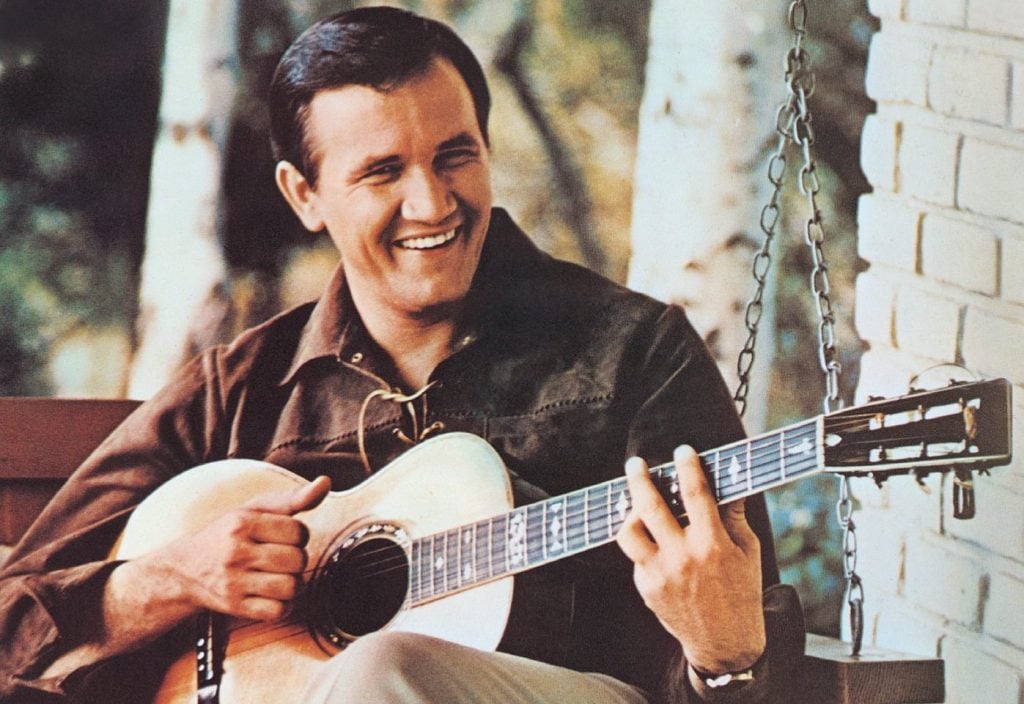
The man, the myth, the weirdo in the best of ways, you’d be hard pressed to find someone who could equal or imitate what Roger Miller did during his illustrious and ultimately Country Music Hall of Fame career. You can almost forget about him with all the emphasis in ’90s country these days, and the continued veneration of country music’s “Outlaws.” But Roger Miller was as an important character to the history of country music as any. And he was most certainly a character.
Miller’s plaque has been hanging inside the Country Music Hall of Fame rotunda since 1995. But in November, he will get his own special exhibit at the museum as part of their rotating, featured exhibit schedule. Called “Roger Miller: Wit, Wisdom, and Wonder,” it will feature artifacts and infographics from his career, along with programming from the Hall of Fame to coincide with the exhibition. It will run from Friday, Nov. 6, until March 2028.
“Roger Miller was a singular creative force,” said Kyle Young, CEO of the Country Music Hall of Fame and Museum. “Though considered a musical genius and humorist, his greatest gift may have been his ability to connect with people. He channeled his many sides into fantastically absurd, touching and astute songwriting that still resonates today.”
Some of the artifacts that will be included in the exhibit are:
Fiddle – When Miller was around 10 years old, musician and actor Sheb Wooley, who was married to Roger’s cousin Melva at the time and lived nearby, bought him this fiddle.
Drawing – During his senior year in high school, Roger Miller drew this portrait of one of his musical heroes, Hank Williams.
Army shirt – Miller wore this shirt while serving in the U.S. Army from March 1954 to March 1957. He was stationed in South Korea for a time, where he drove a Jeep and played in a country band with other soldiers.
Guitar – This 1963 Gibson C-1E nylon-string model was Miller’s primary guitar for most of the 1960s. He used it to write, record and perform many of his biggest hits, including “King of the Road.”
Song manuscript and statuette – The credit card application, on which he started writing lyrics to “King of the Road,” and a wood carving of a hobo, which inspired him to finish writing the song, are housed together in a shadow box built by Miller.

Grammy awards – Miller won 11 Grammy awards in 1965 and 1966. In addition to Miller’s wins in nine country music categories, “King of the Road” earned him Grammys for Best Contemporary (Rock & Roll) Single and Best Contemporary (Rock & Roll) Vocal Performance, Male.
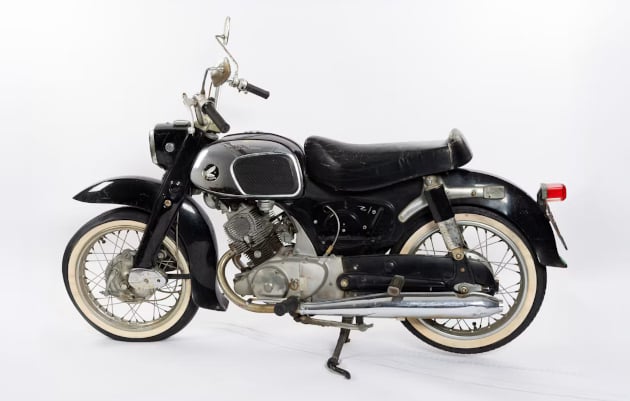
Motorcycle – Miller purchased this Honda CA95 Benly Touring 150 motorcycle in 1965, following his financial windfall with the success of “Dang Me,” “Chug-a-Lug” and “King of the Road.”
Hand-written notes – Roger Miller often wrote down song ideas and lyrics on scrap pieces of paper. Mary Miller, Roger’s wife, called them his “droppings.”
Western shirt – Miller wore this western shirt, designed by Manuel Cuevas, when he performed at a taping of “Roger Miller: A Soundstage Special” at WTTW Studios in Chicago in 1982.
Tony awardand tuxedo – Miller won this Tony award for “Best Original Score (Music and/or Lyrics) Written for the Theatre” for the Broadway musical “Big River,” for which he wrote all the songs. The musical won a total of seven Tonys. He wore this tuxedo at the 39th Annual Tony Awards, June 2, 1985.
– – – – – – – – –
There will also be programs surrounding the exhibit, including:
Panel Discussion – Saturday, Nov. 7, at 2:30 p.m. (Ford Theater)
The museum will host a conversation with some of the people who knew Miller best: the late musician’s wife, Mary Miller, a former member of Kenny Rogers’ band the First Edition; Country Music Hall of Fame member and Miller’s close friend Bill Anderson, who first met Miller in Atlanta in the 1950s when both were struggling songwriters; and Randy Hart, Miller’s musical director and bandleader of eight years who currently serves as staff pianist and assistant music director at the Grand Ole Opry.
The talk will be hosted by the museum’s exhibit co-curator Erin Osmon and illustrated with archival images, audio and video from the museum’s collection.
Songwriter Session with Dean Miller – Saturday, Feb. 6, 2027, at noon (Ford Theater)
Dean Miller is Roger’s son and an accomplished singer and songwriter. He will perform and discuss some of his father’s songs, as well as his own. During Songwriter Sessions at the museum, songwriters share stories and songs behind classic and current hits.
– – – – – – – – – – –
If you found this article valuable, consider leaving Saving Country Music A TIP.
October 8, 2026 @ 8:39 am
So good to see Roger Miller recognized like this. One of the greats in the country music world!
And, though he’s best remembered for his funny, lighthearted songs today, he could write a serious tune, too – “Husbands & Wives,” for example.
Hopefully this will help turn a new generation on to Roger’s music. It was great to see it become available on streaming services a couple of years ago, too, as before that all that was around was a couple of hits comps. There are a lot of hilarious and brilliant album cuts from him, too…
October 8, 2026 @ 8:48 am
Thats great. There is no one more deserving than roger to get the light shined on him. Some of us havent forgotten our passed on country heroes. He was def a character, we could use a few more just like him.
October 8, 2026 @ 9:09 am
My parents played a lot of Roger Miller when I was growing up. Kinda funny to think about me as a little kid singing Chug a lug at the top of my lungs
He had some great songs and was an incredible songwriter. Nice to see him being honored.
October 8, 2026 @ 9:27 am
Miller deserves all the praise for his musical compositions, but let’s not forget that he was also a great comedian. One of my favorites of his was the time he said one of his grade-school teachers asked him to make a sentence using the word “peanut.” Miller responded by saying, “Peanut, your foot’s on fire!”
October 8, 2026 @ 9:53 am
I remember Roger on Nashville Now telling Ralph Emery about songs he’d written that his publisher had rejected. One of them was called “If I Can’t Be Your Number One, Then Number Two on You.”