

The Soul-Stirring Tribute to Dolly Parton on the Soul Train Awards
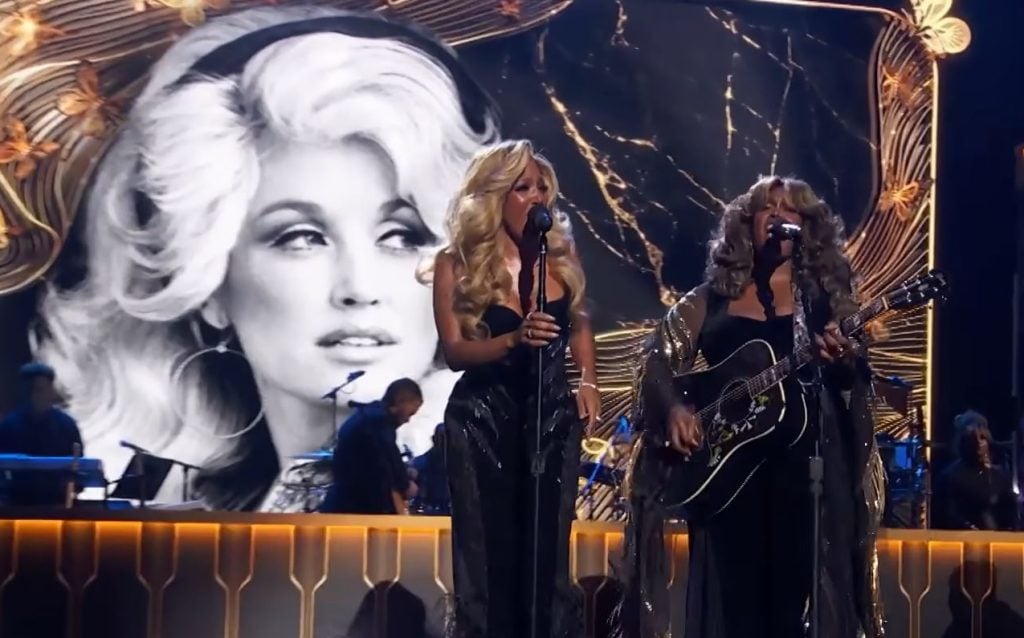
The annual Soul Train Awards transpired on Friday, November 27th on CBS and BET, and at first glance, there was little reason for a country fan to pay any attention. But lo and behold, there ended up being a huge country tie-in.
Mickey Guyton and Brittany Spencer, who are both best known for their ties to the country music world, came out to perform a tribute to Dolly Parton, reprising her signature song “Jolene.” The two put a ton of soul, gusto, and soaring vocals behind the soul-stirring performance, and even used their nails as a percussive instruments. As an added bonus, they were accompanied by steel guitar maestro Robert Randolph for the song.
The rousing and inspired rendition of “Jolene” has many comparing it to the performances on both the CMA’s dedicated Dolly Parton tribute on October 21st, as well as the one on the CMA Awards proper on November 18th, and saying the performance on the Soul Train Awards bested them all.
When it comes to the dedicated Dolly Parton tribute in October, they’re probably right. Though it definitely had its moments, the CMA special featured mostly lackluster talent and safe performances in tuned down keys that didn’t give anyone the opportunity to have a “moment” like the one Mickey Guyton, Brittany Spencer, and Robert Randolph delivered. The CMAs also failed to reach out to performers from other genres, or strong singers like Guyton and Spencer, and instead stuck to the safe names in the CMA’s regular Rolodex.
The tribute to Dolly Parton on the actual CMA Awards in November featured Vince Gill singing with a surprisingly strong falsetto on “I Will Always Love You” accompanied by Lainey Wilson. It was pretty stellar, and probably right up there with Mickey, Brittany, and Randolph. But this is not a competition, and shouldn’t be approached as such. If we learned anything from Dolly, it was to love thy neighbor, and to reach out across aisles and divides to cooperate instead of compete.
Good on the Soul Train Awards for showing love to Dolly, who certainly had a significant influence in the world of soul, R&B, Gospel, and pop. The Soul Train Awards illustrated that the love of Dolly’s music is universal across genres and races.
But despite the worthy attention being paid to Mickey Guyton and Brittany Spencer for their inspiring performance on the Soul Train Awards, you didn’t see them actually compete on the awards proper.
Despite all the talk over the last few years of how integral the Black community is to country music, The Soul Train Awards—just like the BET Awards—feature just about every major genre of American music except country. Soul Train recognizes soul, R&B, hip-hop, Gospel, jazz, and reggae. But they stop short when it comes to featuring country artists with any accolades. That’s one of the reasons the Dolly Parton tribute, and the appearance of three artists from the country and roots world was so exceptional.
There was a lot of talk around the CMA Awards in 2026 how there wasn’t a single nominee that was Black or Brown, underscored by an in-depth piece in The Tennessean. It was the first time since 2017 that no artists of color received CMA consideration. But if Black artists are so integral to country, why aren’t they being recognized by the Soul Train or BET Awards either, even if in just a simple album or song category?
This argument was then bolstered when Darius Rucker went viral talking about how certain members of the Black community have criticized him for performing country, and how Charley Pride faced similar criticism, while popular Black media like magazines Ebony, Jet, and events like the Soul Train and BET Awards never integrated them into their system.
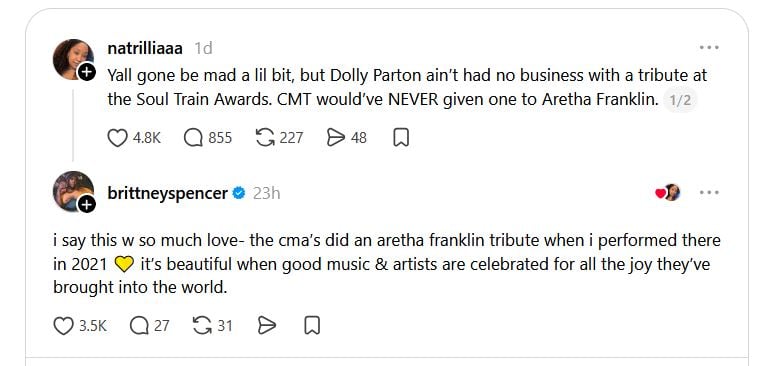
As you can imagine, honoring a White music legend like Dolly Parton on the Soul Train Awards stirred controversy. As one viral social media post said, “Yall gone be mad a lil bit, but Dolly Parton ain’t had no business with a tribute at the Soul Train Awards. CMT would’ve NEVER given one to Aretha Franklin.”
But it was Brittany Spencer herself who showed up to help point out that this isn’t entirely true. “i say this w so much love- the cma’s did an aretha franklin tribute when i performed there in 2021 💛 it’s beautiful when good music & artists are celebrated for all the joy they’ve brought into the world.”
The poster apologized for being wrong on that specific point, but said, “…my feelings do not change 💛. We lost artists who were amazing. Who were listened to and cherished and they did not receive a tribute. They were Black. They loved Black life. They deserved to be honored by their people and the award show was well intentioned, but they missed the mark by making space for Dolly in place of our own.”
But the point she is missing is that paying tribute to Dolly Parton was the excuse and the opportunity for artists from the country and roots world to get up on the stage of the Soul Train Awards—something they’ve been mostly excluded from in the past.
It’s not that the critics of honoring Dolly Parton on the Soul Train Awards don’t have a point. Dolly Parton wasn’t going to be ignored if they didn’t step up. But the systematic exclusion of Black country performers in these Black spaces is something that long needed to be rectified, just like Darius Rucker said last week, and Charley Pride pointed out for his entire career. The Dolly Parton tribute was an opportunity to do that, and worked like an answer to the CMAs.
Instead of waiting around for the CMA Awards and others to right the ship, there’s no reason these Black-specific awards couldn’t start recognizing Black artists in the domain of country and roots. Perhaps also include blues players and artists like Rhiannon Giddens, Mavis Staples, Allison Russell, Kashus Culpepper, and so many more. Why are these performers so commonly overlooked in these mainstream Black music moments?
But let’s not let that discussion overshadow the moment Mickey Guyton and Brittany Spencer had paying proper tribute to a country legend. Perhaps this will be the moment we can point back to as the time popular Black culture finally started recognizing country and roots music as an important part of its ecosystem too.
– – – – – – – – – – –
If you found this article valuable, consider leaving Saving Country Music A TIP.
November 29, 2026 @ 8:54 am
1, 2, 3….