

The Unlikely Friendship Between Gram Parsons and Merle Haggard
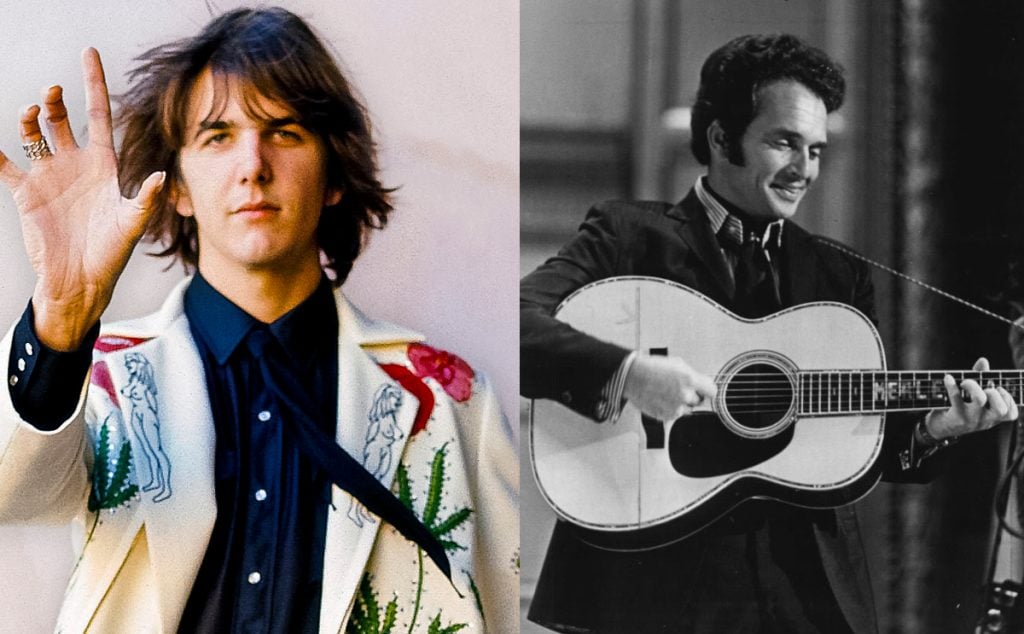
After it was recently announced that Gram Parsons would be inducted into the Rock and Roll Hall of Fame in 2026, it stimulated numerous discussions about Gram’s country music legacy. Some weigh Parsons as such a major contributor and influence, they think he should be in the Country Music Hall of Fame as well. Others see him as a lightweight, long hair, and “drug addict” that was rightfully booed off the Grand Ole Opry stage with the rest of The Byrds in the aftermath of their country album Sweetheart of the Rodeo.
However you feel about Gram Parsons, he definitely left his impact on the music, and country music specifically. His mentorship and championing of Country Music Hall of Famer Emmylou Harris, his role in influencing The Rolling Stones in a more country direction via their albums Let It Bleed and Sticky Fingers—let alone his own solo albums and his time in The Flying Burrito Brothers—it makes it difficult to measure Gram’s country impact at zero, despite the protestations of some.
But one country music relationship of Gram Parsons that has rarely been explored or publicly broadcast is his interactions with country legend and California native Merle Haggard. On the surface the two came from completely different worlds, even if geographically the epicenter of their music was only about 100 miles apart across the California mountains from Bakersfield to Los Angeles. But Gram Parsons cited Merle Haggard as a primary influence, and sought to work with Haggard on multiple occasions.
Believe it or not, Gram Parsons almost made an album with Merle Haggard, and the collaboration was explored in-depth by both men. Even though it never happened, the story of how it almost did gives some insight into these two complex and important characters in country music history.
The relationship and interactions between Gram Parsons and Merle Haggard were detailed in the relatively recent Merle Haggard biography The Hag by Marc Eliot published in 2022.
When Gram Parsons moved to Los Angeles and started playing with The Byrds, he’s given heavy credit for pushing the band in a country direction, and specifically for compelling them to record the 1968 country album Sweetheart of the Rodeo, and to record the album in Nashville to get that authentic country sound. One of the songs Parsons insisted must be on the album was Merle Haggard’s “Life In Prison.”
Though Parsons and The Byrds did not officially need Merle Haggard’s permission to cut the song, it was important to Parsons that he got permission anyway. So Gram traveled to Bakersfield, and requested an audience with Merle to get his blessing. Though the excuse to meet with Haggard was to get the “Life In Prison” okay, Parsons also wanted to explore collaborating with The Hag.
“He came to my house and we talked about what we were going to do .. It’s a form of flattery when someone records your music, when they accept it that way,” Merle was quoted about that first interaction.
So Merle Haggard signed off on it, and loosely agreed to work with Gram Parsons at some point in the future. But when schedules didn’t initially align, the idea was mothballed by both parties.
Just appreciate that this was in 1968, so three years before The Grateful Dead would cover Merle Haggard’s “Mama Tried.” Gram Parsons and The Byrds were the first of the California country bands to cover a Merle Haggard song proper. When Sweetheart of the Rodeo flopped initially (it’s now retrospectively considered a Byrds’ masterpiece), and The Byrds soon disbanded, Gram Parsons started hanging out with the Rolling Stones for a bit.
The Rolling Stones saw Gram Parsons very much like Gram Parsons saw Merle Haggard—the real deal. No different than Gram had persuaded The Byrds towards the beauty of country music, Parsons did the same for The Stones. Who was one of the primary artists Parsons was pushing at the Stones? Merle Haggard. That’s how you hear those country influences in Let It Bleed, Sticky Fingers, and subsequent works.
Then fast forward to 1973. This is when Gram Parsons and Merle Haggard came moments away from recording an album with each other, and probably should have, if it wasn’t for the two’s substance and alcohol abuses.
Don’t get it wrong though; Merle Haggard was generally skeptical, if not outright repulsed by elements of the country rock secne that had sprouted up in his native California, especially since it was competing with himself and Buck Owens for attention from Capital Records, radio stations, and local venues. Merle apparently got ticked off one time when his manager Frank Mull played a tape of Linda Ronstadt singing “Silver Threads and Golden Needles.”
When the Nitty Gritty Dirt Band reached out to Merle to be a part of their landmark album Will The Circle Be Unbroken, Merle allegedly said he didn’t want to play “with a bunch of long-hair hippie types like the Dirt Band.”
But due to Gram’s graciousness back in 1968 before cutting “Life In Prison” for Sweetheart of the Rodeo, Haggard had grown to see Gram Parsons as an exception. And according to accounts, Merle Haggard even liked Gram’s music. Gram said to Rolling Stone at the time about Merle, “He’s a nice, sweet cat.”
As part of the management of Merle Haggard’s career at the time, the idea was hatched that he should produce an album for another artist. It happened to be that the business manager for The Byrds named Eddie Tickner worked with the same lawyer that worked with Merle Haggard. So when it came time to pick the performer Merle Haggard would produce an album for, they picked Gram Parsons.
The collaboration started off great. Reportedly, the two spent hours together, playing with Merle’s electric train set like two kids, drinking, talking about country music, and getting along quite well. To Merle, he actually saw an opportunity by producing Gram Parsons bridge the gap between the old Bakersfield guard, and the new country rockers in Los Angeles.
As Marc Eliot recalls in the book The Hag, “Merle liked [Gram], at least in part because he saw producing Parsons as a way to expand the reach of his music into the cultural mainstream. Even though Parsons’s career had stalled between his departure from the Byrds and signing with A&M Records, his connections to the L.A. country rock scene were as authentic to Merle’s was to country.”
But despite the positive start, things went south from there, though not between Merle and Gram, but Merle and his then wife Bonnie Owens—incidentally, the ex of Buck Owens. Merle and Bonnie were fighting over an incident at a truck stop, and stressed over it, Merle went on a major bender. When the manager Eddie Tickner tried to get Merle to answer the door at his Holiday Inn room to sign the paperwork so the Haggard-produced Gram Parsons album could move forward, Merle refused to come to the door for anyone.
Meanwhile at the Roosevelt Hotel where Gram Parsons was staying, he got word that Merle was off his rocker, which started stressing him out, and next thing you know, Gram Parsons went on one of his legendary benders as well. Finally when Merle emerged, but then heard Gram was too gone to meet, Merle called the entire project off, at least at that time. Perhaps it could have been rekindled in the future, but there would be no future for Gram Parsons. He overdosed in Joshua Tree, CA on September 19th at the age of 26.
Merle Haggard told Exclaim in 2004, “I knew he liked my work and did a lot of my songs, so I was looking forward to working together. That was really a sad loss, because I think he had a lot of great work left in him.”
Who knows what might have been if Merle Haggard and Bonnie Owens hadn’t gotten into a fight, Gram hadn’t gone off his own rocker, or died months later. Perhaps a Parsons Haggard partnership would have produced a major West Coast/Bakersfield project that would have codified and joined the two veins of California Country, and minted Southern California as the second epicenter and primary alternative to Nashville.
Often it’s the “what if” that makes the legacies of performers like Gram Parsons loom larger than their actual output. About the only thing that has held back Parson’s legacy for some country fans has been a lack of true country credibility—something a Merle Haggard-produced album could have bequeathed.
But the fact that Merle Haggard even considered it, and got so close that meetings were had, hands shaken, and contracts drafted speaks to the respect Merle had for Gram. And of course, Gram thought the world of The Hag.
Maybe the two worlds of West Coast country weren’t so disconnected and at odds after all.
– – – – – – – – – – –
If you found this article valuable, consider leaving Saving Country Music A TIP.
April 20, 2026 @ 7:48 am
I own this book. I still haven’t cracked it open.
April 20, 2026 @ 9:40 am
I read about 4/5ths of it when it first came out, and then for some reason, stopped, I’m guessing because I got super busy, and never finished/reviewed it. It’s a really good biography though, and I learned a lot. I would recommend it.
April 20, 2026 @ 10:37 am
It is a solid book. I only wish it delved more into his music.
April 20, 2026 @ 9:47 am
It’s weird Merle was only 9 years older than Gram because it feels like they were decades apart. Sign of the times I suppose. Gram was a baby boomer at the beginning of the boom and Merle was from the silent generation, and both were very much products of their generations. Goes to show the difference a few years can make.
Philosophically these two were oil and water, but that may have produced a tremendous collaboration. Or a train wreck. Would’ve been interesting to hear how it played out.
April 20, 2026 @ 10:17 am
Sweetheart of the Rodeo was the end of Byrds’ up to that point stellar output.
Parsons was the kiss of death. The Byrds never recovered.
April 20, 2026 @ 10:37 am
Big Jilm always figuring out to find the negative in a story.
April 22, 2026 @ 6:30 am
Yeah, Marty Stuart would disagree with “Big”Jim, but who is a country legend and legendary musician compared to some unknown troll on the internet?
April 20, 2026 @ 3:28 pm
C’mon, it was a funny line, especially amid all the Gram hagiography.
Funny also because it seems that half of the Byrds’ fans shared Jilmbo’s sentiment.
April 20, 2026 @ 7:16 pm
Hey Luckyoldsun,
You win the prize! I believe that you are the first person on this thread to use the word hagiography.
April 20, 2026 @ 5:08 pm
White/Hillman/Parsons Byrds are the only Byrds
April 21, 2026 @ 4:29 am
Do you mean Gram or Gene? and no Roger?
April 21, 2026 @ 10:12 am
G.Parsons/White/Hillman/McGuinn Byrds are the only Byrds
April 20, 2026 @ 10:26 am
Fascinating article! Never knew there was a connection between Gram and Merle. I’ll have to get the book. So Merle didn’t like the long hair rock bands. That being the case is there any documentation about his reaction to The Dead recording Mama Tried?
April 20, 2026 @ 10:34 am
Great story, that album would have probably changed history
April 20, 2026 @ 12:54 pm
Thanks for this….a friendship I would never have imagined! So cool that Merle respected Gram’s talent. One quibble with this story: You say a couple of times that Gram pushed the Rolling Stones in a country direction. I think it’s more accurate to say Gram pushed Keith Richards in a country direction, and Keith pushed the Stones that way. As is well known, Mick was terribly jealous of Gram, and hated Gram’s influence on Keith’s bad habits (the influence was mutual, of course). And Mick never really did “get” country, imo. His attempts to sing country always fell flat for me.
April 21, 2026 @ 4:55 am
Mick is GREAT on Peter Wolf’s tune “Nothing But the Wheel.”
April 24, 2026 @ 7:33 pm
100%. Great song.
April 20, 2026 @ 1:18 pm
Keith Richards stated that ” no Gram Parsons, no Waylon Jennings.” Not saying I agree.
April 20, 2026 @ 3:07 pm
Great read, Trigger. Thank you. Such interesting times and collisions/collaboration/music scenes back then…love learning about all this…and love the Gram writings lately.
April 20, 2026 @ 9:37 pm
Wasn’t this a proposed project for A&M Records?
April 20, 2026 @ 10:23 pm
Yes, I believe A&M was the label involved.
April 20, 2026 @ 10:19 pm
Dunno, but I wouldn’t be surprised if Merle’s reaction to the Dead recording “Mama Tried” was similar to Jumping Bill Carlisle’s reaction to them doing his hymn “Gone Home.” (As recounted here:)
https://www.youtube.com/watch?v=6V0anguFR0k
April 21, 2026 @ 2:54 am
Well, there’s no telling what may surface in the vast vault of Haggard’s unreleased recordings…
April 21, 2026 @ 6:32 am
Hag was also friends with Guy Terrifico!
April 21, 2026 @ 5:12 pm
The Life and Hard Times of Guy Terrifico is an excellent movie. And the soundtrack is even better. I almost sent Trigger an email about it a few months ago when I searched this site and found zero about it. The songs are astoundingly good. What an achievement for Matt Murphy, along with director Michael Mabott, writing fantastic songs for a fictional character, with the songs so good that they easily transcend the reason they exist.
April 22, 2026 @ 5:19 am
Totally agree – criminally underrated! The Life and Hard Times of Guy Terrifico is……..TERRIFIC!
April 21, 2026 @ 7:32 am
Very interesting read. It would have been very cool if they had pulled it off.
April 22, 2026 @ 12:19 pm
Let’s be real. Anyone who measures Gram’s country impact at zero is just being a pig-headed jackass and ignoring reality. Gram should absolutely be in the country hall of fame. The man earned his status as and is indeed a country legend. The idea that you have to have been raised country or in a rural area to be a country musician is just asinine.
April 23, 2026 @ 6:29 pm
Hardly any actual country music artists have covered Gram Parsons songs. So no, he has very little country impact.
His legend is largely indulged in among indie rock bands, who most certainly vicariously idolize their overdosed junkies.
April 23, 2026 @ 7:58 pm
There’s actually a considerable “middle ground” between “Gram’s country impact is zero” and “Gram should absolutely be in the country hall of fame.”
May 8, 2026 @ 7:57 pm
Parsons was a big influence on country music in Australia. Slim Dusty and Bill Chambers covered several of his songs, and Slim recorded Emmylou Harris’s “In my Hour of Darkness”. Several of Parson’s songs have been recorded by other musicians in Australia.