

Why The Turnpike Troubadours Were Overlooked for the Grammys

Every once in a while, an album comes along that finds an uncommon consensus about its brilliance and importance in the musical landscape. As culture at large and people’s news feeds become increasingly fractured and sequestered from each other, creating a consensus about anything is becoming less and less common, let alone in something as subjective as music.
But as country and roots fans look back, they regard albums like Jason Isbell’s Southeastern, Sturgill Simpson’s Metamodern Sounds in Country Music, Purgatory by Tyler Childers, and other titles as all-time albums that helped shape the future of the country genre, and set the standard for what a country album could be. But none of these landmark albums won a Grammy Award. Only Metamodern Sounds received a nomination, and that was in Americana.
In 2025, country artists of all stripes had a greater opportunity to earn a nomination for a 2026 Grammy Award after The Recording Academy split the Best Country Album distinction in two: Best Traditional Country Album, and Best Contemporary Country Album. In a previous year, it was probably wishful thinking that any Red Dirt or traditional country artist would receive a nomination in any Grammy category.
But this year, it felt like Oklahoma’s Turnpike Troubadours were poised for a nomination due to their landmark, career-level album The Price of Admission, especially with the new Best Traditional Country Album category opening up such an obvious lane for them, and with a consensus feeling among a wide host of fans, industry, and press that it should be in contention, if not a front-runner.

But just like the Jason Isbell, Sturgill Simpson, and Tyler Childers titles of the past, The Price of Admission was passed over. In fairness to Grammy voters, they commonly make up for past mistakes. Jason Isbell has gone on to become almost a shoo-in for nominations and awards in the Grammy’s American Roots categories. Sturgill Simpson’s subsequent album A Sailor’s Guide to Earth won Best Country Album, and was nominated for the all-genre Album of the Year. Tyler Childers has yet to win a Grammy, but has been nominated for 11 of them, and ties for the lead in country this year with four.
Perhaps all the noise about how the Turnpike Troubadours got snubbed will increase their exposure with Grammy voters, and they’ll get a do-over with their next album. But that defeats the purpose of someone being able to go down a list of Grammy nominees and winners from the past, and see what the best of a given year was. It’s also unfair to performers in subsequent years if voters feel the need to make up for a previous year’s mistake.
Let’s not present that the Grammys as always getting it wrong, or always a year behind. In 2025, Sierra Ferrell walked away with four Grammy Awards in the American Roots categories from her album Trail of Flowers, and all seemed right in the world. Chris Stapleton’s landmark album Traveller should have won for Best Country Album in 2016, and did.
There is also little to complain about the ultimate nominees for the inaugural Best Traditional Country Album beyond the Turnpike Troubadours exclusion. Of course everyone’s opinions differ. Some thought Sunny Sweeney should finally get some recognition as a long-time country music traditionalist that has been criminally overlooked by the industry, and released a landmark album in Rhinestone Requiem. Others though Kelsea Waldon’s Every Ghost deserved to be a nominee.
And for all we know, if there was a sixth nominee, it would have been the Turnpike Troubadours. Maybe they came up just a few votes short. The finite nature of awards and nominations is what makes them so special.
But Charley Crockett’s Dollar A Day felt like a career effort from the prolific country artist, so did Margo Price’s Hard Headed Woman. Zach Top might be more responsible than anyone for the resurgence of interest in traditional country, so his album Ain’t In It For My Health felt like a shoo-in. The nominations for American Romance by Lukas Nelson, and Oh What A Beautiful World by Willie Nelson were perhaps more based on name recognition than anything, but are hard to complain too loudly about either.
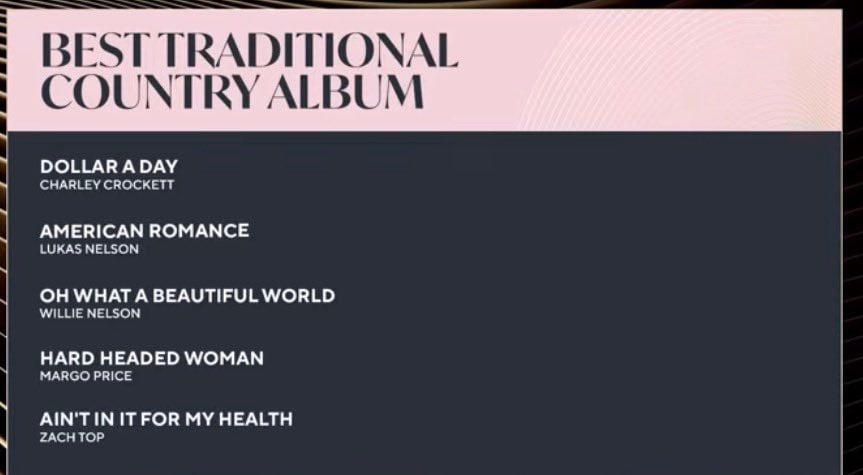
And looking at the demographic makeup of these nominees, this is what you want to see. There is a woman represented. There’s an old country legend in Willie Nelso. Charley Crockett helps represent a minority interest in country music, even if how Black Crockett might be is a convoluted topic. And it was important that “traditional” and “contemporary” weren’t just code words for “independent” and “mainstream.” Zach Top’s nomination ensures that, as does the nomination for Tyler Childers in the Contemporary Country Album category.
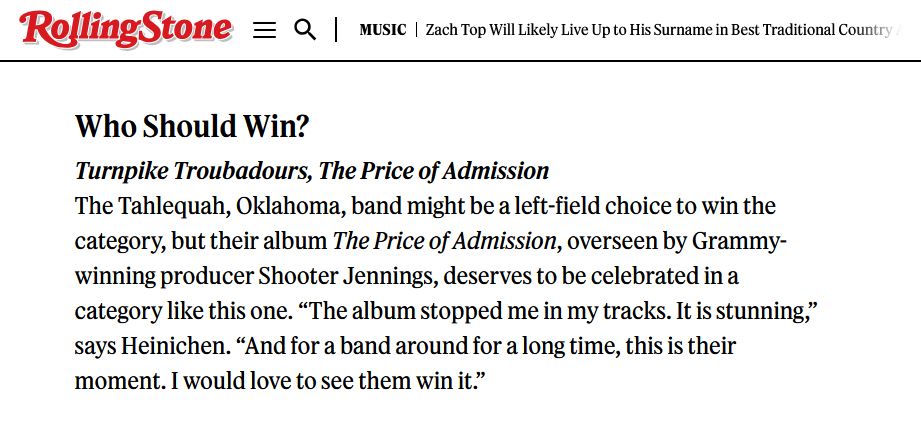
But what is it about the Grammy system that doesn’t allow that one consensus album of a given year to rise to the top like it should, like it didn’t for the Turnpike Troubadours in 2025? After all, it’s received nothing but praise in the press. Billboard mentioned it in their predictions for the Grammy categories. Rolling Stone had it in their predictions for the five nominees, and even said it should win.
The answer might be the same as to why there are no country artists represented in the “Big Four” of the Grammy Awards, meaning Album of the Year, Song of the Year, Record of the Year, and New Artist of the Year. It’s also the reason why widespread name recognition appears to reign supreme over everything else in the Grammy process: The Grammy voting body just doesn’t include a lot of voters knowledgeable about country music.
In a Billboard article written by Melinda Newman called “Country Continues To Be The Grammys’ Poor Relation,” it’s explained point blank, “Only 7% of Grammy voters come from the country genre, according to the Recording Academy (compared to 24% for pop and 16% for jazz). It’s clear among the winners and nominees that many of them, such as Beyoncé and Shaboozey, had projects with crossover appeal, which likely garnered them votes from beyond the country community.”
But it gets even worse from there. As the Billboard article explains, “Unlike other genres, such as rap and alternative, country often still remains its own island and doesn’t always cross over with other genres … but there still seems to be a bigger divide: country listeners (including voters) likely listen to other genres of music, while fans of other genres don’t necessarily listen to country.”
The Grammy Awards are unique since it’s a peer-voted award, meaning you have to be a musician, performer, songwriter, producer, or engineer to vote, unlike the CMA and ACM Awards that let industry people also participate in voting. But clearly, the responsibility of picking nominees and winners is being put on a population that is just not aware enough of country music to make smart, informed decisions for the country categories.
This is why you keep seeing name recognition getting picked over merit, and similar names get picked each year. People from outside of country recognize these names, and pull the lever for them. This also gives outsized influence to artists that cross over from other genres. In this environment, a band like the Turnpike Troubadours is put at a significant disadvantage.
What could be done to tilt the weight of influence towards country music so the Grammy Awards could get it right more often? The most obvious answer is to add more country artists and contributors to the ranks of voting Grammy members. As the Billboard article goes on to say, “The Recording Academy is well aware of the country lag, and even added a new country category this year, Best Traditional Country Album.” So adding the new category was in part to address this known issue.
But at the same time, the Grammys are adding a massive amount of new members overall. And this isn’t helping the Grammy’s country dilemma. It’s exacerbating it.
“The Recording Academy has been on a massive drive over the last several years to diversify its ranks especially among women, younger voters and people of color, adding 2,900 new voting members this year alone,” Melinda Newman reports. “Total voting membership is now approaching 15,000, with 73% joining since the Academy introduced a new membership model in 2019. Tellingly, only 1% of this year’s new voting members identified as being most aligned with the country genre.“
From club-level independent artists all the way up to mainstream stadium headliners, many country artists and their fans feel alienated in the Grammy process.
The biggest artist in all of country music at the moment is Morgan Wallen. Right now Wallen has the top three albums in the country genre. Morgan Wallen publicly recused himself from being considered for the Grammy Awards this year. If there was any artist that might have been considered for one of the big all-genre awards, it might have been Wallen. But he felt so alienated from the process, he didn’t even participate. Zach Bryan also refused to participate in the Grammy process last year.
One radical idea to address the Grammy’s lack of country knowledge in voters might be to only let country-oriented Grammy members vote on the country awards. But this still doesn’t solve the lack of representation for country in the all-genre categories. In the last decade, only five country projects have received Album of the Year nominations out of 74 contenders, and only two have won: Golden Hour by Kacey Musgraves, and Beyoncé’s Cowboy Carter, which many country fans would not consider country.
Reaching out to more members of the country music community through the new Best Traditional Country Album category was a good idea. But ironically, not including Turnpike’s The Price of Admission in the nominations soured the well with some in the very community the Grammys were trying to appeal to. If The Price of Admission had been nominated, it might have codified that independent/Texas/Red Dirt country support.
The Turnpike Troubadours don’t need the Grammy Awards. The Grammy Awards need bands like the Turnpike Troubadours, and albums like The Price of Admission and other universal consensus picks to not just help them represent the best in country music, but to make sure they’re representing the country music community and their interests through their awards show process.
– – – – – – –
If you found this article valuable, consider leaving Saving Country Music A TIP.
November 13, 2025 @ 8:40 am
Turnpike aside its nice to see the level of talent nominated. Crockett and Price stand the most to gain from a win here IMO. It would really elevate their careers. Pullin for ol Charley
November 13, 2025 @ 9:40 am
I agree that the field in the Best Traditional Country Album category is very strong, and we shouldn’t look that gift horse from the Grammys in the mouth. We all might have different opinions about who should or shouldn’t be nominated. But each year, five artists that otherwise wouldn’t be nominated at all now will be, and this will only open up the process for traditional country artists and the fans they represent.
November 13, 2025 @ 9:25 am
I would just ask like turnpike are more popular than Margo price and Charley Crockett. At least that’s my perception. Is it just their fans are a more insular group? Like I try to be self aware about this. But I really don’t think turnpike are my indie fave that I’m mad nobody likes the obscure thing I like. This wasn’t their debut. They have six well received albums and a big fanbase and they’ve only grown in popularity. I guess I really just thought the stars were aligning on this.
November 13, 2025 @ 9:47 am
The Turnpike Troubadours are the bigger act. They have 2.2 million monthly Spotify listeners compared to Charley Crockett’s 1.4 million, and Margo Price’s 900K.
That said, numbers aren’t everything. This shouldn’t be a popularity contest. Who had the “best” album?
What I can guarantee you though is that outside of country, Charley Crockett and Margo Price are going to pull way more name recognition with Grammy voters and people outside of the genre. The Turnpike Troubadours might be bigger in Texas/Oklahoma, but they’re still in many respects a regional band. They just don’t have the name recognition with pop/rock/hip-hop fans, who unfortunately, help make these Grammy decisions in the country genre.
To solve this, you either need to recruit more Grammy voters from country, or you need to make sure people knowledgeable about country get an outsized vote.
November 13, 2025 @ 10:00 am
I don’t remember if you addressed this in some past article, but what is the process by which Grammy voters are recruited?
November 13, 2025 @ 11:09 am
https://members.recordingacademy.com/s/?language=en_US
Recording Academy membership is community-driven and peer-reviewed annually, similar to the GRAMMY Awards process.
Step 1: Have two fellow music professionals submit letters of recommendation on your behalf. Ensure both recommenders refer to the exact email address you plan to use for your membership so we can link them to you.
Step 2: After the recommendations are submitted, you will receive an email to complete your application. Both recommendation forms and the application must be submitted by March 1 each year.
Step 3: In the spring, the Peer Review Panel reviews all submissions and selects the new membership class.
Step 4: Approved candidates will receive an invitation by early July, and new members have until that year’s GRAMMY Awards voting deadline to accept.
– – – – – –
The problem is that the country music community—both independent and mainstream ,traditional and contemporary—is not participating in the process. So each year, the influence country has in the Grammys diminishes. We also see this in how few albums get submitted to the country categories. There were roughly 70 albums submitted to the two country album categories. To Americana, there were over 300.
November 13, 2025 @ 11:13 am
I don’t know if it”s “stomp and clap” fatigue of the ’10s or because I’m more drawn to singer songwriter types, but I am much more willing to give people who use their names (Charley Crockett, Margo Price) a chance and a listen than I am people who use band names (turnpike troubadours, American aquarium). I think this makes me an outlier though. On Joe Pug’s podcast I heard him say he wishes he would have billed himself as a band name from the very beginning, just making it clear that he was the decision maker. This may have nothing to do with the conversation at hand, but maybe it does.
November 13, 2025 @ 11:40 am
How reliable do you think the Spotify monthly stream numbers are as a barometer of a bands overall popularity
November 13, 2025 @ 1:04 pm
I don’t know. It’s the only barometer I have available. Also, the Turnpike Troubadours regularly headline festivals. Charley Crockett and Margo Price usually are playing in the direct support positions. But again, The Grammys aren’t supposed to be a popularity contest. Who had the best album? All three release career efforts in my opinion. But only one didn’t get nominated.
November 13, 2025 @ 1:21 pm
I guess to me popularity is what I’m asking about since who had the best album seems so obviously to be turnpike
November 13, 2025 @ 9:49 am
Of course most Grammy voters don’t understand country so they vote mostly by name which is sad but an age old tale. It’s arguably even worse in the metal world where Grammys are won by has beens and acts arguably not even within the genre.
November 13, 2025 @ 10:25 am
I would posit that when it comes to the Grammy’s and its recognition of country music, name recognition and political alignment are both among the larger factors being considered by the voters who aren’t familiar with the music itself or even the genre. This is in my view partially responsible for why Childers, Isbell, Simpson and others all get recognition from the Grammy’s after they have both manufactured name recognition for themselves with great albums or catalogs and then in the aftermath been vetted for alignment with certain views. This is of course not the case in every instance especially when the numbers just are unimpeachable like Stapleton’s Traveller, but I don’t think it can be completely ignored either.
November 13, 2025 @ 11:28 am
Political alignment can definitely play a role, but it’s not always in a direct way. Performers like Margo Price, Sturgill Simpson, Jelly Roll, and Tyler Childers get favorable press coverage in outlets decidedly outside of the country music fold like GQ and The New York Times. Often that coverage is more human interest and/or political-based and opposed to about the music itself. And often, the journalists themselves come with a political bias. So even though folks outside of country might not hear the music from these artists, they recognize the names, and might have a positive sentiment about it. Think about the huge spread Tyler Childers got in GQ ahead of his last album that created an uproar when he explained why he wouldn’t play “Feathered Indians.”
This is one of the many examples of the downstream effects of the journalists covering country music not just not aligning with the country culture, but actively attempting to contravene the opinions of country fans in a misguided attempt to reshape America’s political alignment through music coverage. Though this media coverage might create favorable opinions on some artists for fans outside of the country genre, increasingly it alienates country fans from the institutions that are supposed to represent them, whether that’s a media outlet, or the Grammy Awards.
Don’t take my word for it. Read the quotes from Billboard I cited, and comments in this very comments section. The Grammys are not connecting with the country community. So even if Tyler Childers and Margo Price win Grammy Awards based not off of merit, but because of their political values published in puff pieces, that’s not going to be a win for the progressive left. It’s only going to further diminish the value a Grammy award has in the country music community, because it’s going to be perceived as not being merit based, and chosen by voters outside of the genre for political reasons.
All that said, Tyler Childers and Margo Price might have the two best albums in 2025, irrespective of politics. You also have artists like Zach Top, Chris Stapleton, and Miranda Lambert who are being nominated where politics is playing little or no role. But the progressive puff pieces are not helping the public perception of these artists in country music. They’re making it worse, and increasing the distrust of the entire process.
This is the difficult problem the Grammys have to address.
November 13, 2025 @ 6:31 pm
Agreed, Trigger. I’m not knocking the music of anyone on this list and they are all deserving of recognition for their work. And although I’m not a fan of Childers new album, mostly because of the unnecessary weirdness in the production, I think Tyler deserves recognition for what he has done. All I meant to say is for the Grammy voters, the political alignment plays a significant role in who they vote for on the country categories because they likely don’t have any depth in the genre or the music itself.
November 13, 2025 @ 10:35 am
I really only marginally care about ” The Grammys”, that is to say , not at all. Haven’t watched them in probably a decade or more. But, I find the discussions intellectually interesting, if nothing more than it shines a light on people’s true motivations, and reveals a truth about listening habits.
As you are pointing out, the voters by and large don’t listen to Country Music. Doubtless, most are firmly in the pop realm. I think the results each year demonstrate that. I go back to a previous comment I made recently where I mused that the names Sunny Sweeney and Kelsey Walden simply aren’t known to Grammy voters, as they are very obscure names in music in general. On this point Im doubling down. Those names represent wishful thinking, sure they are talented ladies, no dispute there, but they lack name recognition to anyone outside of indie country, Sirius XM Outlaw Country, The Outlaw Country Cruise, SCM, and Americana.
Thats just a fact. The 1% Grammy voters aligning with Country haven’t likely heard of them. They probably barely know who Crockett is and most certainly know nothing about TT.
As for the notion that the TT album is in actuality ” the album of the year”
well, what are the metrics other than streaming numbers or of course personal taste. Its at the end of the day, a popularity competition with The Grammys, nothing else.
And for that matter, do these voters actually evaluate and listen to the nominated individual albums at all? Doubtful that many do. So is it REALLY about the ” best album”?
November 13, 2025 @ 1:48 pm
I haven’t taken the Grammys seriously since Jethro Tull won the Best Hard Rock/Metal Performance Vocal or Instrumental award in 1989. And that was the first time I had watched the Grammys because it was the first time they featured a category that appealed to me.
November 13, 2025 @ 2:40 pm
Tom, I love you, but this argument makes my head explode, and I see it every.single.time the Grammys come up. You don’t need to go back 36 years to find a reason to say the best artists get passed over. They did it right here in 2025. Most of the people who voted for Jetro Tull are dead. What are we going to do right here, right now to make sure the best artists are the ones getting these nominations and awards?
November 13, 2025 @ 3:42 pm
No, I don’t have to go back that far to find a reason to say the best artists get passed over. I have to go back that far to find an instance where the best artists getting passed over actually surprised me.
And that’s my point, the omission of The Price of Admission from the slate doesn’t really move the needle for me at all in 2025 because of what happened in 1989; so, although I don’t like it, I’m not going to get worked up about it because it’s exactly the sort of thing that I expect.
November 13, 2025 @ 2:34 pm
Again Kevin, I have to respectfully disagree. The artists, songwriters, producers, and engineers that make up the Grammy voters are probably more likely to vote for Sunny Sweeney and Kelsey Waldon than Luke Bryan and Jason Aldean. This is who makes up that 7% of country-oriented Grammy voters. This is what Dan was alluding to above. That is why Morgan Wallen didn’t even submit his music to the Grammys this year. That’s how artists like Robbie Fulks, John Fullbright, Wood & Wire, and other tiny artists have received nominations previously. That doesn’t happen every year, but it happens commonly. Last year, Sierra Ferrell beat out Beyonce for a Grammy award.
I 100% agree that popularity and name recognition are important factors here. That’s mostly what this article is about. But that popularity and name recognition crosses unique lines in the Grammy process where you have these critically-acclaimed artists that are better well-known than big mainstream ones. That’s how you got nominations for Charley Crockett and Sierra Ferrell over Riley Green and Parker McCollum. One of the reasons for this is the very active participation of Americana in the Grammy process. Sunny Sweeney is a DJ on SiriusXM, which is the biggest radio hub for Americana radio. Kelsey Waldon is on John Prine’s Oh Boy Records. So could I see them getting a nomination at some point? Absolutely. In fact, I would be very surprised if the Turnpike Troubadours and Sunny Sweeney weren’t at the #6 and #7 positions in the nominations.
November 13, 2025 @ 10:41 am
Troubadours are a big act with a consistent and strong drawing power. The awards mean very little. The Texas Red Dirt artists have always built a career one gig at a time. No Nashville or award shows needed.
November 13, 2025 @ 2:32 pm
I’m with you personally, but nominees don’t select albums on their own, they have to be submitted by the artists for consideration. It obviously meant something to them or they wouldn’t have submitted it.
November 13, 2025 @ 10:47 am
We keep talking about Grammy voters, but who exactly are the Grammy NOMINATORS, i.e. the people who select the nominees? I’ve always assumed that nominations were selected by an elite board and then the final vote was made by the entire body of Grammy voters. Perhaps I have it backwards.
November 13, 2025 @ 11:10 am
In the past, there were Grammy nomination committees or selection committees. Those were done away with. It’s now an open vote for both nominees and winners, and as long as you’re a Grammy member, you can vote in any category.
November 13, 2025 @ 11:19 am
Thank you for that, and for the detailed response to Stellar’s question above. Now I see why the process is so flawed, esp. when it comes to country.
November 13, 2025 @ 11:52 am
Trig, how much do you think that particular wrinkle has contributed to the problem? I remember 20-ofd years ago Pat Green was getting nominations out of the Texas/Red Dirt scene and that was before he broke nationwide with Wave On Wave…at that time I thought the Grammy nominees were more country than the CMA’s. Was that because they had a dedicated country nominating committee and now the nominations are from the monogenre general public?
November 13, 2025 @ 5:28 pm
From my understanding of the process, all Grammy members can vote in a certain amount of categories (I think 10) in addition to the six all-genre awards. They’re also limited to voting across no more than three different “fields”. This is done to try and limit the amount of people randomly voting in categories that they have limited knowledge of. So yes, theoretically a classical musician or a pop producer could vote in the country/American roots categories if they really wanted to, but why would they waste their votes when they’d presumably much rather vote in the classical field or pop/electronic field?
Obviously it’s not a perfect process and I’m sure there are some people who have a few votes left over and throw them into categories they’re perhaps not as knowledgeable about/associated with, but I don’t think it’s as common as people think, and presumably isn’t enough to majorly tip the scales. I think this is particularly true for the country field since you’ve already laid out that a relatively small percentage of the Academy identifies with the country genre anyway.
I’m not saying the process is perfect, and you’re right that technically anyone could vote in the country categories, but I just wanted to highlight that this is something thr Grammys have tried to manage as best as they can.
November 13, 2025 @ 11:08 am
My #2 favorite album of all of 2025
November 13, 2025 @ 11:37 am
Honestly, I am not too upset as a fan whose most-listened band is Turnpike. It wasn’t their best album and only tops their first joint “Bossier City.” Even then, no song on “Price of Admission” is superior to “Come November” or “Three Rivers Song.”
The real snubs were “Diamonds and Gasoline” and self-titled album. “The Bird Hunters” is the one of the greatest songs ever.
November 13, 2025 @ 12:04 pm
Have you ever done a list of best country album for each year in your estimation? If not, you really should, going back to the 1950’s when the album format became established. I’d be curious to see your picks.
November 13, 2025 @ 1:05 pm
No I haven’t, and that would be a hard list to put together. I would need to start by updating my “Greatest Albums of All Time” list.
November 13, 2025 @ 9:46 pm
Is there a reason my innocuous comment wasn’t published?
November 13, 2025 @ 9:49 pm
Sorry man, just found it in the spam folder for some reason.
November 13, 2025 @ 10:08 pm
The nominees are solid, and I love Charley and Margo, but I know I’ll still be listening to the Turnpike album years from now after the others have faded away.
My only ding on it is the album cover. I’m certain they were going for a certain old school vibe with the old font and all, but it just looks cheap and shitty to me. When I was a kid, I would listen to an album and study the hell out of the cover. I can’t imagine doing that with this one.
November 14, 2025 @ 4:53 pm
Glad you mentioned Kelsey Waldon’s album. This is my 2nd favorite album this year behind POA. I never hear about her. Has her career grown since its release?
November 14, 2025 @ 6:03 pm
I have to say though, the nomination made me go back and listen again to Luke Nelson’s album and I was blown away. A phenomenal album. I’m rooting for him in the traditional category (and Tyler in the contemporary).
November 15, 2025 @ 6:25 am
I’m smack in my mid 40s, grew up pre-internet, and the big award shows were big deals—e.g. Oscars, Grammys, etc. At the time when my parents were my present age, they would have had the same perception. In this era, and myself now that age, I could not care less about them. To me, and all but a handful of people in my extended family, they are totally irrelevant.
I dont begrudge any artist the recognition, and if winning a Grammy motivates them to some degree, great. But it’s become a meaningless award for me. There is far more value, for example, in the opinions and recognition of places like SCM, for me.
November 15, 2025 @ 9:16 am
One of the reasons the Grammys matter is because they tend to matter more to the artists. As a peer voted award, this isn’t just a popularity contest. This is often validation for them.
November 19, 2025 @ 8:04 am
the nominations feel driven by factors that go beyond talent. Charlie is undeniably talented, but it’s clear that his ethnicity likely contributed to his nomination. Willie and his son seem to be included largely because of name recognition. Margo Price is a raging liberal and feminist. In contrast, Zach Top stands out as the only nominee whose selection appears to be based squarely on genuine merit. I would say that Turnpike was robbed 4 times, not just once.
January 24, 2026 @ 7:05 am
I love TT. Hell, I wrote likely the best song I will ever write about Evan, back when his continued existence was not a sure thing.
I don’t think Price is their best record, not by a long shot. I hear 3 or 4 A+ songs on it, compared to pert-near every track on several of their shockingly good, undeniable earlier efforts.
Maybe that’s why they got overlooked?
Thank God for rehab, Stacey Felker and Troubadours patiently waiting for Evan to figure shit out. May he write even more brilliant songs and have a long, fruitful sober career and family life.