

Willie Nelson’s 4th of July Picnic Art Criticized for AI
Poster art is not merely “advertisement” in country music, or in music in general. It’s an art form and often a strong medium of expression all unto itself.
This is the reason that the long-running historical letter press/wood carved printing business Hatch Show Print in Nashville has been preserved for over a century, and currently operates at the Country Music Hall of Fame to keep these customs and the human touch of the art form alive in perpetuity.
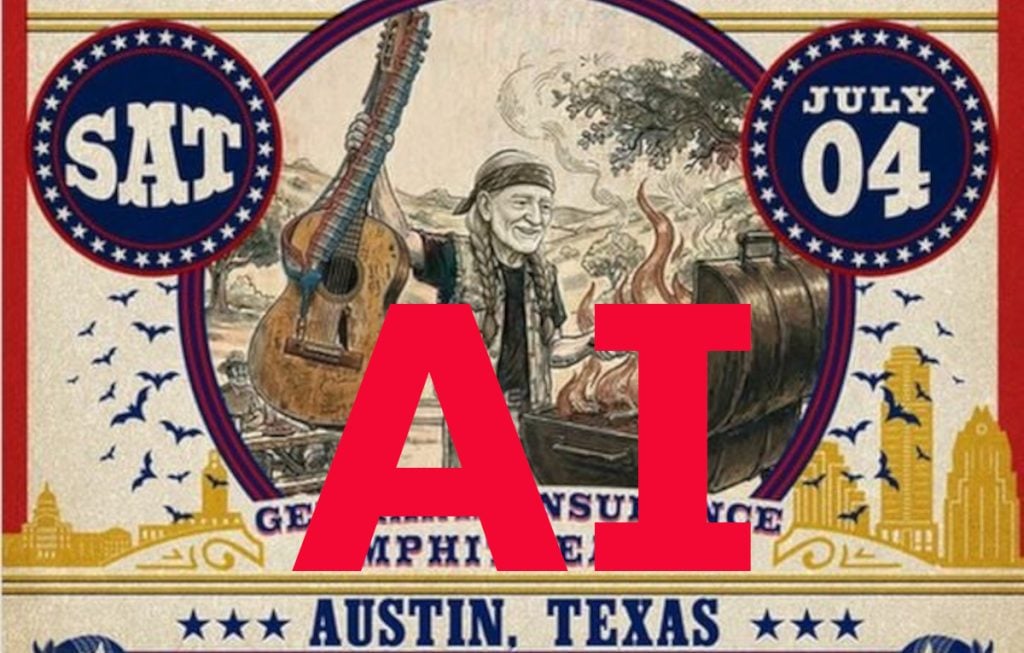
That is also why it was so disappointing to many music fans when they spied that the poster for Willie Nelson’s pending 4th of July Picnic at the Germania Insurance Amphitheater in Austin, TX clearly used AI to generate the graphic.
These days, it’s easy to assume almost every graphic is AI-generated. And if a poster or promotional flyer is primarily text and texture and done by a small-time performer with little or no budget, perhaps it’s innocent. But when you’re talking about something like Willie Nelson’s 4th of July Picnic that’s a historical event itself—with the poster art being part of that legacy—it seems especially egregious, and frankly, lazy.
As soon as the 2026 4th of July Picnic cover art was released to the public, it started to receive some side eyes. Though sometimes it can be hard to tell if something is AI or not, figures having six fingers and others such tell-tale anomalies give away the game. When fans spied eight tuners on Willie Nelson’s beloved guitar Trigger as opposed to six, they started to call foul.
Instagram account The AI Cop was one of the first to call out the infraction. “A show featuring a bunch of millionaires produced by a monopoly can’t afford to hire a designer. So they used AI slop. 8 tuning pegs on Trigger? AI steals from working artists. Hire professionals, not prompters.”
When Austin visual artist and self-professed “Willie Nelson superfan” Taylor W. Rushing saw the AI image, he decided to do something about it. Rushing has been hired to make posters for Willie’s Luck Reunion and other Willie-adjacent events in the past.
“I was hurt and I was bummed out,” he told San Antonio Current. “This is a gig that I would have done for free had someone reached out to me. I was bummed that they hired a robot for free instead.”
In lieu of just bellyaching about the situation, Taylor Rushing decided to make an alternative poster inspired by a photo from a 1977 catalogue called The Mystic Willie Nelson, and done in the style of 1970s concert posters when Willie Nelson’s 4th of July Picnics first began.
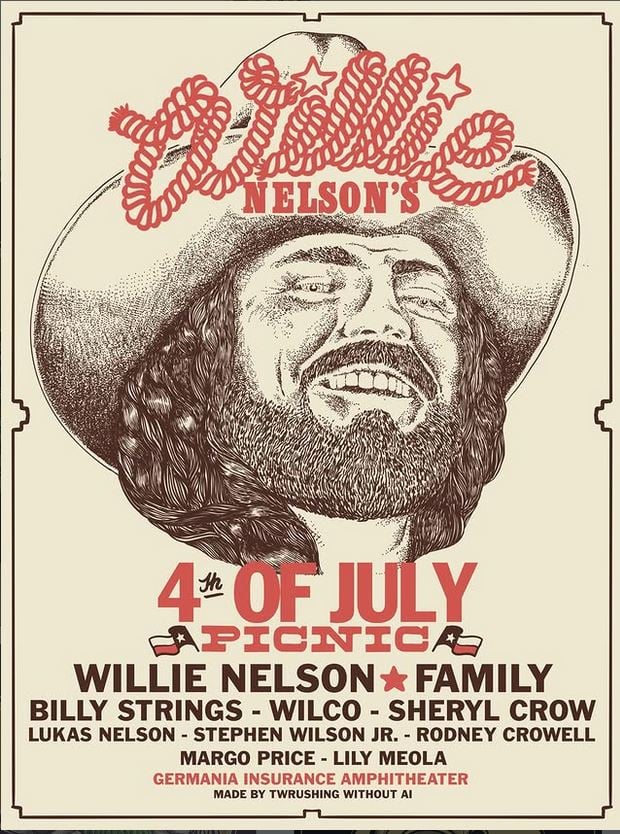
“This is an unofficial alternative poster I’ve made in exchange for the AI poster made for this event. I made it by hand. Let’s reject AI art and maintain the legacy of our oracle Willie Nelson,” Taylor Rushing said.
Rushing’s poster is what 2026 4th of July Picnic performer Margo Price posted on her social media as opposed top the original one. Headliner Billy Strings wrote out a letter on a piece of paper promoting the event as opposed to using the AI poster. “Who is the artist?” someone asked Billy. “William Apostol,” he responded (Billy’s real name.)
It’s unclear who created or signed off on the AI-generated poster, whether it was promoter Live Nation, Blackbird Presents who is curating the event, or if the Willie Nelson camp even knew about it, let alone Willie Nelson itself.
But the reaction from both musical and visual artists, and the backlash from the public speak to grassroots nature of trying to support human creators as AI encroaches on all sectors of life and society. Today it’s the poster makers being replaced. Tomorrow it could be the musicians.
Sure, the adoption of AI is in many respects inevitable, especially for quick and easy image creation. But some things are sacred, like Willie Nelson, Willie Nelson’s 4th of July Picnic, and the poster art that has chronicled the event ever since the 1972 Dripping Springs Reunion. It’s the human connection and camaraderie these picnics have fostered over the decades that has made them so meaningful. Protecting and preserving that feels imperative.
– – – – – – – – – – –
If you found this article valuable, consider leaving Saving Country Music A TIP.
March 29, 2026 @ 7:13 pm
Look, I grew up in NJ. One time, I asked my Dad, may he rest in peace, why NJ should maintain the law that requires full service humans to pump gas instead of self-service. My father responded, “well, what would the gas attendants do then?”
I’m not defending AI. I don’t use AI at all, whatsoever in my daily life, and there’re reasons for that. But if the only reason we can come up with is, “It’ll replace the humans,” that’s not good enough. We need to show clearly and definitively why the humans are superior to AI. Only then will we win this argument.
March 29, 2026 @ 7:58 pm
The argument is in the article…. 8 turning pegs.
You are being sold a sloppy, erroneous product.
I don’t know how I feel about AI. I’m only commenting because this time it affects my most favorite artist, Willie; someone I never thought would be connected to the AI debate.
But I hear what you are saying in general. Are cars put together by robots any inferior to the ones put together by humans? Are orders picked in a DC created by AI and robots inferior to ones picked by humans? My winter job is at a brand new automated DC. It takes wear and tear off my body, I can work longer shifts, and my wages are higher due to the automation streamline and waste elimination savings. It’s better for those who have the jobs.
But music (and like Trig pointed out in the article by extension these concert posters) should be pure. It should be the last standing arena affected by AI.
March 29, 2026 @ 8:19 pm
Idk when it comes to art I think cause its human is sufficient. I am simply not interested in the art of a computer. Art is not utilitarian. It has no purpose except human expression.
March 29, 2026 @ 8:00 pm
Will Taylor Rushing be allowed to sell that poster? If so, I’d buy one.