

Joshua Slone, and the Emerging World of Contemporary Folk Pop
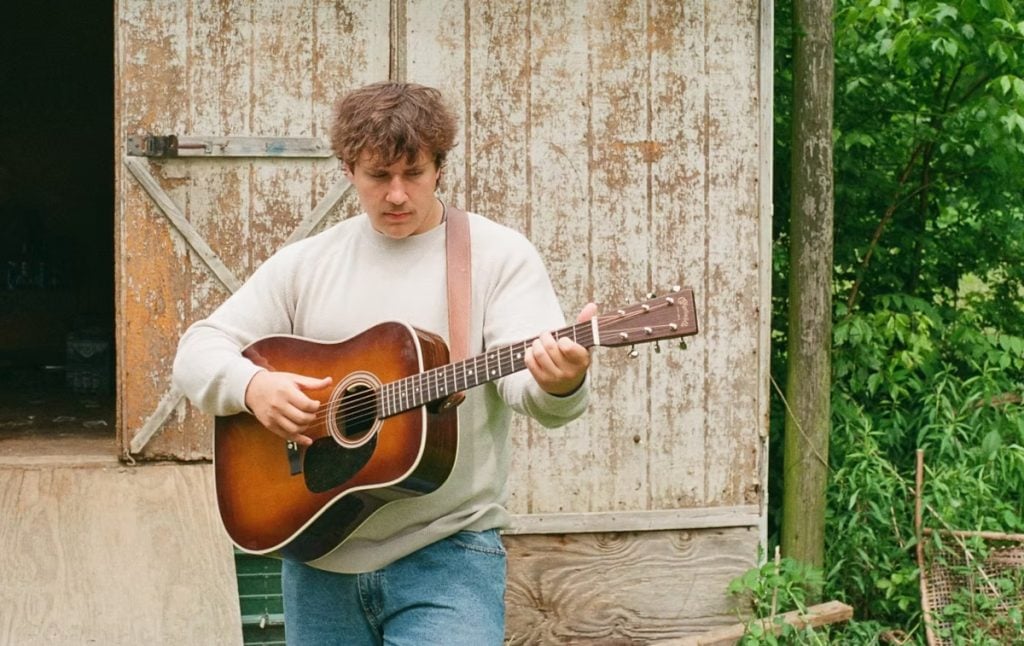
On Tuesday afternoon, October 28th, word proliferated online that Kentucky-based songwriter Joshua Slone’s debut album Thinking Too Much would be released at midnight, making for a rare, Wednesday album release. To say the album came highly anticipated by certain fans is sort of a quaint understatement. To those in the new folkish, countryish, popish singer/songwriter world seeded by Zach Bryan, Joshua Slone’s debut album was perhaps the most anticipated release all year.
Slone’s career was given a jump start when he appeared in a handful of collaborative videos with Zach Bryan in April. This subsequently blew Slone up on TikTok and Instagram where he’s been posting videos of himself singing songs or snippets of songs, and building up a strong social media presence. It’s sort of the stereotypical, new school way many young songwriters build their career, only Slone benefited from a Zach Bryan turbo boost.
When Joshua Slone’s debut album was released, it shot up the iTunes charts to #2 in country, only behind Morgan Wallen’s latest release. Requests started flooding into Saving Country Music to review or feature the new album. Incidentally, no other outlet had reviewed Thinking Too Much until Country Central posted one recently, nor was there really any press coverage for Slone or the album at all.
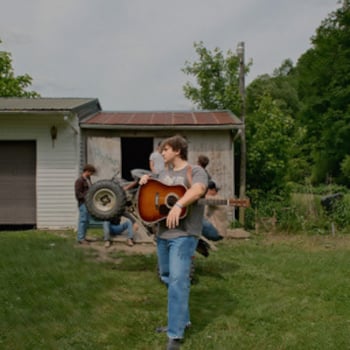
Aside from playing some shows in September—including a sold-out date at The Burl in Lexington, and opening Zach Bryan’s record-crushing mega concert at Michigan Stadium on September 27th—Slone doesn’t have a lot of touring experience either. He currently doesn’t have any future show dates on his calendar.
But in this current TikTok-driven environment that Joshua Slone occupies, none of this conventional music business stuff really matters, verified by the success of Thinking Too Much. In some respects, this new paradigm is advantageous to performers since they can side step certain gatekeepers and take their songs and message directly to listeners. But in other respects, this has resulted in some unseasoned performers wilting under pressure when big opportunities do present themselves, and can also enter into the seedy world of paid-for TikTok boosting and influence.
Interestingly, delving into the behind-the-scenes situation with Joshua Slone, you find his music is being distributed by Interscope, even though the copyright for the music is attributed to Slone himself. He’s also being represented by the big talent agency WME, though none of this is being broadcast publicly. Does this mean Slone’s career is being “astroturfed”? Not necessarily. But Slone is definitely part of the new approach to music that pays no attention to media, publicists, radio, or even really touring.
But the most important takeaway from Joshua Slone’s album Thinking Too Much is that it’s not a country album whatsoever. Where Zach Bryan might occupy a space that singer/songwriter-based folk intersects with country through certain sonic similarities, Joshua Slone veers straight into the folk pop space that was seeded by Zach Bryan’s popularity in part, but since has bounded well beyond anything resembling “country,” with pop production and sensibilities being the most obvious signifiers of the music.
This is not a criticism of the music specifically. But it is fair to criticize the characterization of this music as country. On Apple Music where they show the genre metadata information, Joshua Slone’s Thinking Too Much is categorized as “Alternative Country.” But really where this album fits is in the emerging “Contemporary folk” or “Folk pop” realm, which might be one of the biggest emerging categorizations in all of music, not just from the volume of new artists or how prolific they are, but the incredible commercial success these artists are finding.
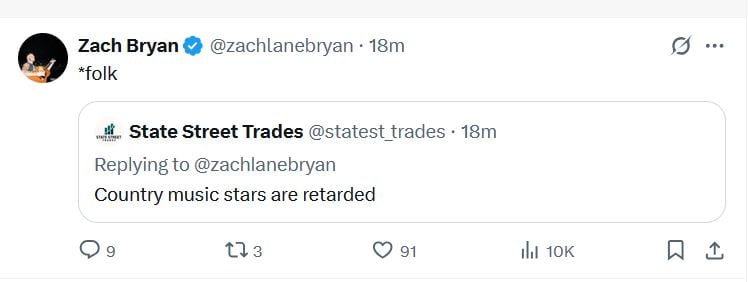
A few months back when a fan was criticizing Zach Bryan on X/Twitter as a “country” artist, Zach clapped back saying that he was “folk.”
The next performer on the folk pop totem pole would be Noah Kahan, who’s also famously said he doesn’t want to be considered country. Kahan has also put together insane numbers in his short career.
In October, Folk Alliance International sent a survey out to its members to ask if they believe they should petition for a new category in the Grammy Awards for contemporary folk, kind of like what happened with country this year with the splitting of Best Country Album into Traditional and Contemporary categories. There used to be a contemporary folk category at the Grammys. Albums like Emmylou Harris’s Wrecking Ball were winners in its era before merging with traditional folk.
With artists like Zach Bryan, Noah Kahan, and Joshua Slone—along with other massively successful artists like Gregory Alan Isakov and Jessica Pratt releasing albums in this folk pop space—a new designation seems to be warranted. Even former One Direction member Zayn Malik’s last album fits this profile, and was produced by Dave Cobb. Last year, Zach Bryan recused himself from Grammy consideration, in part because he didn’t feel he fit anywhere and didn’t want to be a distraction in country. If there was a “Best Contemporary Folk” category, Zach Bryan would probably be perfect for it.
Joshua Slone is a great songwriter, and just like in the early stages of Zach Bryan’s ascent, it’s heartening to see younger audiences connecting with music that’s so intentional, expressive, honest, and enriching as opposed to pure, superfulous pop. This moment we’re experiencing in music is the reason Zach Bryan might be one of the most important artists of a generation.
But what Joshua Slone is doing is not country. Saving Country Music was going to review the album, but frankly, it doesn’t feel like it qualifies, and instead should be recognized among its peers in this new contemporary folk pop universe. And just as importantly, the music universe should make a conscious effort to recognize this important, quickly growing, and already commercially relevant folk pop scene, and give it the autonomous recognition it deserves.
– – – – – – –
If you found this article valuable, consider leaving Saving Country Music A TIP.
November 5, 2025 @ 10:41 am
To challenge your point slightly does this mean that you are not going to cover Jesse Welles anymore? I mean, he’s the folkiest folk singer/song writer since Dylan hit Greenwich Village. So much so that unlike Zach Bryant they brought him to Newport and he ended up stealing the show. He’s right out of the Woody Guthrie tradition of populist songs written in reaction to current events. But, I think Marty Stuart’s commentary on the Folk/Country split in the Ken Burns documentary was pretty dead on.
I think maybe it’s not “folk” you don’t want to cover so much as the boring emo pop side of folk.
November 5, 2025 @ 11:05 am
I do cover and will continue to cover folk music as a cousin of country. Just like Dylan and Jesse Welles, Johnny Cash and Kris Kristofferson had huge legacies at Newport.
What I’m saying is there is an entirely new genre or subgenre that’s a subset of folk that brings very strong pop sensibilities to music that’s otherwise acoustic, singer/songwriter material. And moreover, that genre/subgenre is leagues bigger than the entire genre of traditional folk, including some of the biggest names in all of popular music. So categorizing these performers as “folk” immediately undercuts the actual folk artists in the existing “folk” world.
If you listen to this new Joshua Slone album, it defines this new “folk pop” or “contemporary folk” categorization perfectly. Jesse Welles is what I would consider pure folk. When you listen to Jesse Welles and Joshua Slone side by side, it’s like two completely separate genres. Because it is.
November 5, 2025 @ 10:42 am
Are you sure that Zach wasn’t “correcting” State Street Trades’ jibe to indicate that folk music stars are the retarded ones? I know he didn’t add a “fixed that for you” as some do to make their point, but it still can be taken both ways.
Anyway, this album and artist aren’t country. He reminds me of David Gray, Noah Kahan, even Ed Sheeran in his more reflective moments. Folk-pop, just as it was 50 years ago when similar songs were coming from people like Jesse Colin Young and Dan Fogelberg.
November 5, 2025 @ 11:08 am
The context of the Zach Bryan tweet was that he was calling himself a folk artist. He’s done this in the past and gone on record saying he doesn’t really consider himself country.
“I don’t want to be a country musician. I don’t want to be a country musician. Everyone calls me it. I want to be a songwriter.”
https://savingcountrymusic.com/on-zach-bryan-declaring-i-dont-want-to-be-a-country-musician/
Acoustic singer/songwriters are often lumped in with the folk realm.
As I’ve always said, I think Zach’s music has country signifiers where I don’t personally feel offended if someone calls it country or country-adjacent because it is. Joshua Slone is where you really cross a line into territory where the music is just as much pop as it is folk, and not really country at all.
November 6, 2025 @ 7:16 am
If you’re going to be covering folk/singer-songwriter or “country adjacent” in addition to strictly country music, you should really be covering/giving attention to Josh Ritter. He falls into that Folk/Americana realm and he’s among the best singer-songwriters out there and he and his band always out on a great show. He’s an artist that definitely deserves more attention but always gets ignored by sites like this.
November 6, 2025 @ 3:12 pm
I cover as much music as I absolutely possibly can. But even if I covered twice as much and hired multiple other writers, I still couldn’t cover everything. I agree though, in an ideal world, Josh Ritter could get covered here.
November 5, 2025 @ 2:14 pm
The handle ‘State Street Trades’ automatically leads me to assume it’s one of those Reddit “Stonk” wannabe finance bros – who are only known for bad takes on stock predictions and hating on things they don’t like or don’t understand.
November 5, 2025 @ 10:52 am
Trig, I’m curious if you’ve listened to any of Cory Asbury’s latest album ‘Pioneer’ and EP ‘Still Pretty Good’, especially the Deluxe version. For years he was a Christian Worship artist who’s music was not country at all. But here lately his music has been purposefully more country. He’s even done collabs with Lori McKenna and other country artists who’s music isn’t focused on their faith. His song ‘My Inheritance’ albeit Christian is also just a good country song about his relationship with his dad.
November 5, 2025 @ 11:09 am
I have not, but I will check it out.
November 5, 2025 @ 11:38 am
How did he appear in videos with Zach Bryan in the first place? I (like a lot of people) just started hearing about him in the last couple weeks and feel like i am missing the bigger picture of how he got so popular. Do you know anything more about his career history?
Jeremy pinnell just put out a new album i’m about to listen to it and i hope it rips
November 5, 2025 @ 12:15 pm
Dallas, Save you, Stuck in the rain…
straight to the “that rips” playlist.
November 5, 2025 @ 12:42 pm
There are so many of these contemporary folk pop artists that got huge on TikTok that if you’re not dialed into that universe, you’ve never heard of, but if you go to their Spotify pages, they have songs with 500,000,000 listens. With some of these artists, it’s not that they aren’t actively seeking press coverage, they’re purposely avoiding it. Everything stems from TikTok, and maybe some Instagram.
I do not know much more about Joshua Slone.
November 5, 2025 @ 2:18 pm
It’s weird to me that Youtube isn’t the main platform for measuring music fame anymore. I don’t have TikTok and refuse the browse it.
November 5, 2025 @ 6:16 pm
I was wondering if you’ll switch to touting the new album now.
November 5, 2025 @ 11:48 am
Country, folk, whatever it may be, this is such a great project. Glad to see you giving him a stand-alone piece. Hoping he goes on a solo tour next year.
November 5, 2025 @ 12:02 pm
Agreed.
I’d also consider Taylor Swift’s “folklore” and Shawn Mendes’ most recent album to be fitting examples of contemporary folk pop records.
November 5, 2025 @ 2:11 pm
The genre-bending going on now is good thing. On a first listen ‘Your Place at My Place’ could have been a hit for Keith Urban 15 years ago. That isn’t a diss. Keith Urban had some good songs.
I saw this meme going around that said “The worst part about being a white slave is the only field songs we know are by the Lumineers.” I can’t stand the Lumineers or anything “Stomp Clamp Hey” sounding but I found that hilarious. So yeah this kind of music does qualify as a modern version of “Folk.” In my opinon to be “Country” an artist has to be able to internalize how to perform music to a shuffle beat. Something that Zach Bryan and many on his coat tails cannot do.
November 5, 2025 @ 5:44 pm
Joshua is a 20yo kid, born and raised in Prestonsburg, KY. He’s as country as it gets. You literally have to take the Mountain Parkway to get there. We’re talking the same region as Sturgill, Childers, Stapleton, and Lynn. It’s a different flavor of country, but his songs and style were birthed in Appalachia… making it country.
When country music is classified by some random combination of twang and telecaster riffs, and not by its roots and heartbeat, it’s just becomes someone’s opinion based on stylistic similarities. Listen to the cry of the lyric, and vocal tonality of his hope and ache. It’s the same voice of those hills.
November 6, 2025 @ 7:19 am
To say that everything Appalachian = country extremely minimizes the variety of textures and cultures within Appalachia. It can be authentic to him and be Appalachian in his sense and still not be country. Shape note style singing in some churches is super different from the wide open Rockabilly style in Holiness churches which is different from “southern Gospel”. There are different styles of making biscuits in Appalachia. They have different labels to distinguish them. It’s perfectly fine for words to have definitions and it’s not an insult to say that something doesn’t belong to a certain definition.
November 6, 2025 @ 6:18 pm
He, the artist, identified his tunes under the genre umbrella of country (which is why I’m making this argument), while he’s also from the country, and wrote his songs in the country. Yet, Saving Country Music was quick to say “nope, you don’t sound like us”. So who’s minimizing?
SCM aims to preserve the genres roots, yet in this case refuses to acknowledge its own due to stylistic typecasting. Joshua isn’t bro country. From the get, his artistry isn’t a gimmick or schtick. He doesn’t write songs about trucks, beer, or bluejeans. Ok, his whole stage get-up isn’t from Boot Barn or Bass Pro Shop, but the kid is country.
Joshua Slone is a representation of country’s natural evolution, with roots recognizable from its heart not the howls.
November 6, 2025 @ 7:32 pm
Hey Will,
Thanks for chiming in, and giving some more background information and your perspective. I’m not here to question anyone’s “country” bonafides based on where they’re from or what they’ve done. I’ve been on record saying that ANYONE can make country music if it’s sincere and authentic to themselves. I also think the music that Joshua Slone is making feels sincere and authentic to himself. It also doesn’t feel country whatsoever, and labeling it as such with only induce conflict, while also separating him from people who might find this music appealing, which are fans of acoustic pop, indie rock, and contemporary folk. You try to serve this up to rednecks, and they’ll laugh at you. I’m not “gatekeeping” Joshua Slone. As I explained in the article, he doesn’t need me or anyone else to succeed. He’s already leagues ahead of most artists. But I do think his music makes for an important discussion point.
November 13, 2025 @ 6:31 am
Exactly! To say this is not country, but consider Jason Aldean, Morgan Wallen, FGL, Kane Brown, and Luke Bryan’s highly over produced music “country” is just so sad to me. Joshua Slone wrote everything himself, from his OWN life (not some ghost writer) in Kentucky, using many of the “traditional” instruments of country music. What more do you want? His stripped-down, emotionally raw songs reflect the roots of country: storytelling, vulnerability, and rural soul. But because they lack the polish and radio-ready hooks of mainstream acts like Morgan Wallen etc, Slone is being dismissed as “not country enough??” Very ironic, considering many mainstream country artists very often lean heavily into pop, rock, or hip-hop over-production…not to mention their lyrics are all about “farms” and “trucks” and “tractors” yet they haven’t worked in that environment or lived that blue collar lifestyle at all or in decades.
November 13, 2025 @ 7:45 am
This article is absolutely most definitely NOT an argument that Morgan Wallen, Florida Georgia Line, and Kane Brown are country, but Joshua Slone isn’t. If any of these artists deserve to be called country, it would be Joshua Slone. But the simple truth is calling Slone country will create the same conflicts around his music that we see with Morgan Wallen, Florida Georgia Line, and Kane Brown, and artists like Zach Bryan, and previously, Taylor Swift, who removed herself from that drama when she came out and said (parahprasing) “I’m not country, and I never really was.”
Joshua Slone is Contemporary Folk, Folk Pop, Indie Folk, whatever you want to call it. Trying to push him as “country” when the music clearly is not will only stunt his growth, and create unnecessary conflict. Slone might be country himself. His music is not. If he wants to be considered country, then make a country album.
November 5, 2025 @ 6:06 pm
The mention of Jessica Pratt in this context seems to me completely random. For one thing, she could be these boys’ mom in more ways than one. I would argue that she’s a part of a different story, to wit the incredible explosion of female indie folk talent over the course of the last 20+ years.
November 5, 2025 @ 10:22 pm
This had been going on long before Zach Bryan, although he is one of the more popular ones.
Personally, I’d say recent folk-pop artists include
Avett Brothers
Lumineers
Mumford and sons
Jason Mraz (don’t know much of him)
I agree it should be more recognised, mainly because I’m sick of people telling me that Anthony Oliver did anything new.
November 6, 2025 @ 6:50 am
Country, Alt. Country, Singer Songwriter, Folk. I listened to this and don’t hear a big difference to albums released by Shawn Mendes or Ed Sheeran. In fact these guys could have released this album 10 years ago and no one would have thought that the album was in any way country. Zach Bryan’s popularity has shifted the teenage girl attention away from the white boy acoustic pop from 10 years ago to the white boy acoustic folk of today.
Call this what you want I guess, it sounds like Pop to me.
November 6, 2025 @ 7:34 am
Perhaps we need a DDS 500.579 Country folk
November 6, 2025 @ 4:58 pm
It already sits at #575 but this ain’t it.
November 6, 2025 @ 7:27 pm
Yes, country folk, folk-inspired Americana, or straight up folk music intersects directly with country. It’s a project like this that I think is a bridge too far because you just don’t hear any country roots in what’s going on. Again, not a commentary on the quality of the music at all.
November 6, 2025 @ 3:03 pm
Similar to you, I’d never heard of the dude until I saw one of the Western Grunge girls tweet that he had sold out The Burl on a Monday with no recorded music out, which is damn impressive.
I gave the album a spin when it came out. It’s good. It’s very heavy on pop elements. I think too many people get hung up on what they’re hearing in terms of subject and dialect, instead of the actual music.
To me, it’s pop music leveraging simple, acoustic chord progressions behind an eastern Kentucky kid’s voice. It’s well written and relatable, but it’s really not “Country”.
I thought the same when the Ole 60 album dropped. It’s kids from rural(ish) Kentucky making alternative rock music, but the accent taints people’s perception of the music.
Everything hits somewhere on our arbitrary spectrum, but I think there’s a pretty wide musical classification gap between a Josh and an Ian Noe.
November 6, 2025 @ 5:24 pm
His music bores me, but Zach Bryan bores me too.
Kudos to him for finding success tho. Tough thing to do these days.
November 10, 2025 @ 6:44 pm
I dont know. As im getting older, it doesnt seem to matter what you call something. Just find music you like. Ive recently discovered brennan edwards off of tik tok I dont know exactly how to label him. Its not country but his stuff def tells a good story. Its a little folksy but def not pop. Hes somewhere between dylan and prine or maybe a combination. Great stuff though.