

Challenging The Stigma That Good Musicians Can’t Have Day Jobs
One of the things most every independent music fan should want for their favorite independent music artists is for them to be able to put together a sustainable music career where they can support themselves via their music, have health insurance and at least a semblance of financial security, and maybe even own a house and be able to support a family one day. You also want them to be able to make a living through music so they keep making the music you love.
But so often, deciding to become a musician comes with a significant amount of sacrifice. For some it might be difficult to impossible to find that sustainability level while still holding onto their integrity, especially in the music industry in 2026 when you have surging touring costs, more competition for attention than ever, AI’s impending disruptive if not devastating effects, and mainstream artists overshadowing the more worthy independent ones.
It’s been stigmatized over the years for a performer to have a second job, if not an entirely separate career while pursuing music on the side. Whether it’s fair or not, some perceive that working a second job makes you a second-class musician. But increasingly, it’s actually the path that makes the most sense, allows the pressure to “make it” in the music business to be alleviated to some extent, and can allow artists to make the music they want, when they want, without having to write the songs or play the gigs they otherwise would have to just to pay the bills. The musician/second job combination might also be what allows them to be homeowners, husbands, wives, and mothers/fathers.
On the 5th Episode of the songwriting showcase The Hook, Grammy-nominated songwriter and bluegrass musician Tony Kamel was the featured performer and guest panelist. After being a professional musician for nine years with the bluegrass band Wood and Wire and doing quite well compared to others, he decided a few years ago to start another business so he could be at home more, while not quitting music entirely, but still pursuing it on his own terms.
“For nine years, it’s all I did,” Tony Kamel explained. “It was the only way I made money. And I really feel like it’s a true privilege to have any point in your life when you can make that your only source of income. But then I started having kids, frankly. And I love being a dad, and I want to be around like my dad was. And I do love to travel and I still do. I’ll go out once a month, hop on a plane and play a couple of shows, which I adore doing. But I also love coming home.”
The truth is, a lot of your favorite artists probably have second jobs, or entire careers that you might not know about. Part of the reason for this is because they hide it, feeling like they’re lesser than their full-time peers. It’s not something they promote or post about on Instagram. But as the occupation of music gets tougher—especially as the population of Gen X and older Millennial performers age—the stigma surrounding the musician with another job is something that should be questioned, if not vanquished. If nothing else, working another job is a sign a musician puts their art and integrity first.
“It took a little time to figure out how to do both, and give as much energy to both, but it freed up the artistic part of my brain,” Tony Kamel continued. “It really stifles me to make it the only way I make money … If you manage to weather whatever the music industry is now, and you’re out there playing a lot and you’re making good money doing it, good for you. But I take issue with people saying that you can’t do both. You can’t have another source of income. I think that’s wrong. I think you should do whatever serves your music career and your family. If you’re an artist, you should do what serves your art. And your art will be better, because you’ll be more relaxed about it.”
You can see the full interview below.
The reason some believe that having a day job is bad for a musician is because it implies they’re not talented or good enough to pursue music full-time. “Don’t quite your day job” is the quip. But with the inverted talent scale that often plagues popular music with the most unskilled and untalented finding the most popularity, that’s just a foolish notion.
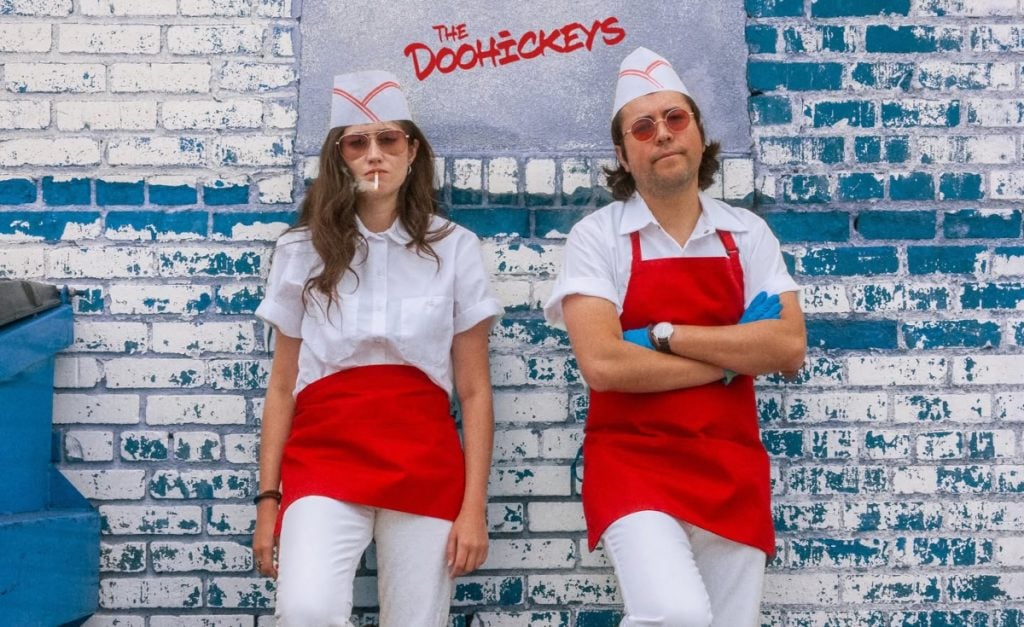
The Doohickeys are a country duo from California who’ve caught some buzz from mixing side-splitting comedy with addressing the real-world issues that face both independent musicians and young people in general. They do this once again with their new single “Day Jobs.”
You see us honky tonkin’, but things ain’t what they appear.
These troubadour personas, are all just smoke and mirrors.
‘Cause we can make the rent, just from playin’ these country shows.
The cost of livin’s high, and the price of music’s low.
As they reveal in the song, Doohickey Jack Hackett sounds like he’s an executive assistant, and Doohickey Haley Spence Brown tutors SAT student and also does Nanny work. They’re from Georgia and Missouri respectively, but met while attending USC in California studying film, and worked on a satirical news program together. Both probably could have lucrative professional careers if they chose to dedicate themselves to that, but choose the flexibility of other work so they can pursue music.
None of this is to say we should cease striving for our favorite musicians to be able to find that vein of attention that shoots them to the theater level where they can tour in a bus instead of a van, and keep a family fed back home, let alone become “stars.” Without another job in the way, they can spend more time pursuing the creative process. But if you’re simply playing shows or trying to write hits to pay the bills, often the creative process is suffering already.
Instead of hiding the other occupations of musicians, we should be talking about them. It often makes them more interesting, relatable, and human. Because after all, most all of us are just slogging away at what we have to do each day, biding out time until what we really want to do presents itself. Sometimes pursuing your dream means doing something else to get there. Some of the best music ever made is about that very thing.
– – – – – – – – – – –
If you found this article valuable, consider leaving Saving Country Music A TIP.
July 9, 2026 @ 7:44 am
Whatever it takes to pay rent and put food on the table, while enabling you to make art — do it. Times are tough for artists. Should be no stigma at all attached to this. I actually find it very interesting to learn what other jobs a musician may have.
July 9, 2026 @ 8:01 am
Don’t quit your day jobs.
July 9, 2026 @ 9:02 am
Why are you even commenting here? Everything you post seems intended to piss in someone else’s cornflakes. Are you really that lonely and desperate for attention that you want people to be mean to you? Go find something that you enjoy.
July 9, 2026 @ 9:38 am
Big Jilm is a fixture here.
July 9, 2026 @ 9:46 am
A “fixture”? More like one of the mentally ill people who taken advantage of the open comment forum here to chase off sane commenters like a deranged homeless person on the street corner. And if you think the stuff you see is wild, you can’t even imagine what I delete.
July 9, 2026 @ 11:44 am
I get likes.
July 9, 2026 @ 10:30 am
Not in a good way. He’s a toxic troll who just shows up to be a jerk, why should we put up with it?
July 9, 2026 @ 11:55 am
Aw come on guys, Big Jilm is an important part of our community! To quote the great Roger Miller: “It takes all kinds to make a world”
July 9, 2026 @ 8:03 am
I watch a lot of youtube videos about woodworking or aquariums and over the years I have been more and more impressed by the creativity and quality of what some people (seem to be able to) produce by themselves with not too expensive equipment.
I wonder whether musicians can do more of that. Set up a youtube channel which can also be seen as one prominent way to have some sort of online presence, where a musician can publish their music. It could also be seen as a way to advertise oneself, and get asked to do paid gigs.
Perhaps student film makers can be asked to make some video for a couple of hundred bucks to go with a song. Live recordings at a bar might even be possible to show on a youtube channel. And if I am not mistaken, at a certain level of viewers or number of videos one can get monetized (if that’s the correct term) and earn some money from people watching (if I am not mistaken).
There is a great rendition of a musician named James Reed, where he performs a song titled “She’s of the hook again” which seems recorded at some bar or center and the quality is pretty decent for my ears at least. The entire scene with the older people walking around, and some shouting something at certain points, fit the entire vibe. It’s almost a complete music video to got with the music, I would guess for free.
July 9, 2026 @ 8:59 am
There are some performers who’ve been able to do well on YouTube. Conrad Fisher who is a regular contributor here has built a business around building his career up via YouTube. But for every successful YouTube channel, there’s 1,000 that aren’t. You really had to be established before the pandemic to make it work. Not saying you couldn’t start one now and be successful, but just like music, there’s thousands and thousands of others like you will less than 100 followers trying to get traction too. Ironically, the creative economy and the amount of people pursuing it has made it more difficult for any individual artist to break out.
July 9, 2026 @ 9:31 am
Yeah, I guess it’s difficult to buillt a business around it or make lots of money but I reason it’s a reletively cheap and easy way to try something and add something. I assume it just takes an e-mail adress and some time, but I am no expert.
I also think it’s something that might be worthwhile just as a way to have some online presence (or whatever the appropriate term is) so people can put a face to a name, see and hear some songs, and maybe have acess to some extra information and an e-mail adress (which are sometimes present on the youtube channel somewhere).
I think Jesse Welles is doing okay on youtube looking at the views- and channel member numbers. Some of his videos seem to me to be pretty basic with him just performing outside somewhere, which might be something more musicians can relatively easily do (?). I think “only1noah” may also be an example of someone who may have benefited from being on youtube and simply posting videos of him playing (he has that one great and original and creative cover of “Sexy and I know it” from 14 years ago).
July 9, 2026 @ 9:48 am
Jesse Welles is obviously a dramatic success story, but you can’t use that as an example because it’s such an outlier. For every Jesse Welles, there’s 50,000 aspiring musicians recording themselves out in the woods and getting 26 views. The volume of this material is the reason and actually super talented artist trying to get traction can’t get heard through the noise.
July 11, 2026 @ 3:02 pm
I was just coming here to say Conrad Fisher! Been watching his YouTube stuff since you reviewed the 2020 (?) album. His music on YT is every bit as handmade as fine woodworking or any other art yet he makes it look so effortless. Also the Neighborhood album has some fantastic songwriting.
July 9, 2026 @ 9:04 am
Isn’t that kind of the thing now? The way to get discovered as a musician or filmmaker or whatever is YouTube or Soundcloud or band camp?
July 9, 2026 @ 9:10 am
I think you’re thinking more of TikTok and Instagram, at least when it comes to music. But even the TikTok discovery mechanism has dramatically diminished over the last few years. The realy story in music is that NOBODY is being discovered, no artists are breaking out. Ella Langley has been the huge exception to that rule, but the Grammys just expanded their “New Artist” eligibility because it’s often taking five years now just for an artists to develop into a “new” one.
Film is a bit different, and I’m no expert. But yes, filmmakers now are starting on YouTube, then getting green lit for bigger budget productions.
July 9, 2026 @ 10:37 am
My mistake, I don’t keep up with which social media is cool and which is done, posting here is as close as I get to social media. And honestly, the examples from within the last few years I had were Ella Langley, the guy who directed Backrooms, and the guy who made Iron Lung. One single musician. Maybe it isn’t a real thing for music anymore?
July 9, 2026 @ 10:42 am
I think many YouTubers would say that building a successful channel is a full time job in itself. It is in some ways similar to supporting yourself through music, really.
July 9, 2026 @ 8:45 am
“Starving artist” is a trope, not a mark of quality. Kris Kristofferson wrote some of the best songs ever written while working a bunch of different jobs to pay the bills. Most of your favorite novels were written on nights and weekends by somebody paying the bills with a 9-5. Etc.
July 9, 2026 @ 8:48 am
I’ve been in and around this business for 50 yrs. And I know for a fact that 40 yrs ago, if you didn’t “make it” by the time you were 30, 99% of musicians just quit and got a serious day job (if they didn’t already have one) like I did at 29. “Making it” back then meant you had a major label deal and you could sustain some kind of success over a period of time from royalties and constant touring. Everyone I knew on a major was on some kind of “salary” as well. Oh sure, there might have been some “independent full timers” in various genres eking out a living, but it certainly wasn’t a comfortable one by any means and rarely lasted long.
I’ve been watching our Midwest Country scene with, let’s just say, 30 or 40 artists on a daily basis for close to 10 yrs now, and very few of them are “full timers.” The ones that are have to play a large percentage of “Solo acoustic” gigs, which doesn’t help the people in their band at all. That’s one reason, as Rick Beato put it…”there are a lot fewer bands these days.” I’m out in the wild on a weekly basis watching our National independent favorites, as well as my locals, and I just think to myself “The math doesn’t add up to a profit for anyone”. A “$5.00 cover charge”?? We were getting that and more in 1983!!! I’m afraid to ask my friends how much they’re getting for a gig because I would cry. They’re teachers, truck drivers, and painters by day, hell, one is even a dental hygienist, but they write my favorite songs, and I love and support them any way I can and always will.
July 9, 2026 @ 9:01 am
One plus I would think about having a steady 9-5 is not having to sacrifice the type of music you want to make, worrying about hitting it big to pay the bills.
How many young traditional country music artists caved into the bro country sound last decade trying to cash in.
July 9, 2026 @ 10:09 am
As I’ve mentioned before, I have a career in Civil Construction. Bridge work, waterline work, storm sewers, roadbuilding etc. A few years ago I arrived at one of the projects i supervise, and was looking down into a sanitary sewer installation and the guy shooting grade down in the ditch looked familiar to me. I couldn’t place where I had met him and then it occurred to me he might be a semi- famous blues guitarist that I had seen countless times. It was! He laughed when I recognized him. He told me his wife HATED that he still got dirty for a living like this, he was quite muddy. ( the nature of these jobs) But he had always worked in this field and had an understanding boss that allowed him to do brief tours each year and still come back to the day job. He was essentially a foreman/ surveyor for the excavation company. This guy has fans throughout the US and Europe but keeps that day job because it gives his family Healthcare and pays into a retirement. While we talked one of his co- workers cranked up one of his original songs and he cracked me up doing air guitar to his own recording while down in the ditch! We chatted a bit and told me about touring back in the day with John Lee Hooker, mentioning that nearly all those blues guys had day jobs in construction including Hooker and Muddy Waters and many many others. He said you aren’t a real blues man unless you have a blue collar day job. But its not just blues music, honestly, the bluegrass world isn’t any different. Unless you are in that upper tier of musicians, it’s next to impossible to feed a family entirely with music. Most of the pickers in mid level and below bands have a day job. Makes you respect these pickers, players and writers even more.
July 9, 2026 @ 11:46 am
So you’re a dirt guy, Kevin. I worked around that for years— surveys, layout, grade, etc. I enjoyed it all— really liked being out in the woods surveying.
July 9, 2026 @ 12:26 pm
Surveying is a good career, one that pays pretty well and it’s a very under the radar job most folks barely even know exists. Precision GPS , robotic total stations and mobile GPS receivers/roversf have totally changed the game though. Yes, im in the dirt world albeit these days more the management end , so i dont come home as dirty as most.
July 9, 2026 @ 2:09 pm
I’m a geotechnical engineer and manage a materials testing department and the technicians that are out testing the soil compaction, which sometimes due to scheduling, I also cover myself. When I was finishing my civil degree, I interned doing structural engineering/bridge design and absolutely hated it. 20 years later I still get to get dirty in the field and in the lab, which some people may not like, but it beats just being at the computer 45-55 hrs/week.
July 9, 2026 @ 4:12 pm
Ahh your compaction guys …always driving contractors crazy. More water! Hit that again with the roller…really we only need 98% and your at 96%. Hahaha. Good on you Travis.
July 9, 2026 @ 4:25 pm
I moe lawns. Does that count?
July 9, 2026 @ 5:17 pm
And I mow Bandy.
July 11, 2026 @ 3:05 pm
I think Slackeye Slim made the album of the year with his last album (the year being 2022 or so ) but it would have such a small audience (it’s “ugly” gothic country about very real psychological issues and histories) that there’s no universe in which we could have gotten it without him having a totally different career to pay the bills.
July 9, 2026 @ 9:10 am
Thumbs up for the Doohickeys. Great, fun song.
July 9, 2026 @ 9:41 am
I saw The Doohickeys open for Dale Watson not too long ago and even though i really, really, wanted the new Dale Watson record (one week before it was out) I bought the Doohickey’s album to support these young musicians.
July 9, 2026 @ 9:58 am
“(…) I bought the Doohickey’s album to support these young musicians.”
This ties in to another thought I had which is whether it would be interesting, feasible, and worthwile for relatively unknown musicians to produce a small amount of vynil records. I think vynil is cool again, also with some younger people, and the size of a vynil record also makes for a great art piece (or whatever term is appropriate) in one’s home in some way.
If vynil records were available, I could see how some people might buy a record to support the musician (like you may have done if I understand correctly). Even when not all tracks are great, the idea of supporting, and the possible function of the vynil record as an art piece or something to remember a certain night at the bar might be why some people might buy a vynil record when available somewhere.
July 9, 2026 @ 11:36 am
I also want to point out that anytime you want to support bands directly but don’t want to buy vinyl or something physical,, go see if they just sell MP3s. Even if you’re never going to listen to it as an MP3 and you’re just going to keep streaming their music, buying an MP3 is extremely cheap and it’s a good way to just tip your favorite bands.
Pass it on!!!
Usually it’s available on bandcamp, Amazon or apple music, or once in awhile from the person’s own website. It usually takes a little bit of doing to figure out where they are if they’re not on Bandcamp.
Band camp also gives you kind of a streaming type platform if you don’t want to run a separate MP3 player locally or whatever
July 13, 2026 @ 1:15 pm
As The Doohickeys surely know, vinyl is a pretty expensive proposition. Once you get done with all the costs of recording / producing / mixing / mastering — looking at 5 figures for a full length album with pro musicians — you have to come up with another $5K to get 500 vinyl LPs made. And they’re heavy as hell to carry to gigs. So potentially effective but another complicated element.
July 14, 2026 @ 12:12 am
Yeah, I thought about the carrying vinyl records to the gigs-part but I also thought about the buyer having to carry the record back from the bar or gig or holding on to it after buying it.
It does seem complicated, but the selling and buying can work differently of course. I saw the bandcamp page from River Shook, as the new record was mentioned on here recently, and it looks like a vinyl record can be bought via that website (?). If bandcamp is free, or very cheap, for a musician to be featured on, the whole vinyl record buying and selling-part might be more feasible for some musicians via such a website.
I also checked out some prices concerning producing vinyl records, and it looked like some options were available where if you would sell your record for 25 dollars you would break even when selling 100-200 records or something like that. I’m not sure though, but that’s what I remembered and I remember thinking that it might indeed be interesting for some musicians. I also reason that was without the actual recording or the music, just the pressing (or whatever term is appropriate), so I am not sure what additional costs would be involved. Perhaps today’s phone or computer recordings, or some very basic other recording devices, provide decent enough sound quality to then be used for vinyl records production.
July 10, 2026 @ 1:06 am
Thanks for buying a record, Ells! Hope you enjoy some of the easter eggs in the insert. Also opening for Dale Watson is a blast. He’s the man.
July 9, 2026 @ 11:36 am
Great article. When I moved to Nashville I worked as an undertaker and/or a carpenter for 5 years til I was able to make a living full time in music. These days, you have to know how to do a lot of things to make it work even if you are a full time musician. You can’t just be a songwriter, musician, producer, performer, or engineer anymore. You have to be all of them, bonus points if you can shoot a video too. It’s a tough gig. There are exceptions of course, but the most consistent success stories I see come from people like this.
I manage multiple YouTube channels besides my own, play live gigs, and have clients in the studio that I work for regularly that keep me floating. You have to make a little bit of money a lot of different ways. Songwriting royalties are horrible but getting cuts advances your career in other ways.
It is getting continually harder to cut through the noise on social media. The internet really seems like it is imploding on itself. I scrolled through 50 Facebook posts three days ago before I finally was shown one post from a friend I actually wanted to see. Everything else was ads, news stories about people dying in strange ways, and AI slop. Weird. I had to think of all the artists that I follow that doubtless are promoting tours and records, and I never even saw it.
It also makes it harder because everyone posts the best of their life. Artists will post a pic riding in a bus down 81 to a sold out show in Virginia, never mind that they probably owe 150k on the bus, and the gig last night they sold 30 tickets to a room of 300. Then you compare your own life to that and feel like you’re not “making it”
The best advice I’ve been given is “Focus on what’s real.” That’s helped me a lot the last year.
July 11, 2026 @ 3:07 pm
Ha I just posted about you up thread I think.
The internet degradation that you are describing. Know about”enshittification” (platform decay) theory? That’s exactly what you’re describing.
July 9, 2026 @ 11:38 am
Great article and helluva lyric from the doohickmasters: cost of living’s high, price of music’s low. Damn that bangs
Also big jilm on a generational run towards establishing himself as the most unlikable commenter in SCM history 🔥🔥 (rip honky)
Also jeremy pinnell rips. Wonder if he has a day job
July 9, 2026 @ 2:22 pm
Please don’t summon the honky. We’ll all have to hear how the communists have brainwashed every public school kid in the country for the last century…for the thousandth time.
July 10, 2026 @ 6:54 am
Big Jilm is a generational talent.
July 14, 2026 @ 1:49 pm
I wasn’t aware that Big Jilm had any competition?
July 9, 2026 @ 12:52 pm
Wonderful article. How many times has any of us chatted with the bartender, barista or Uber driver to find out he/she is a musician, professional or otherwise? Admiration, not stigmatization, is the only acceptable response. I recently listened to a youtube podcast with Sheyna Gee who seems to have figured it out, albeit with Nashville providing the means to do so. Sheyna has 67K monthly Spotify listeners, pretty darn respectable for an independent country artist but not the kind of numbers that buy you a house. Four days a week she plays covers for 3-4 hours in the largest bars on Broadway. That money pays her band, her living expenses, and funds recording a single or EP on a regular basis. Are there songs she despises playing over and over in those bars – absolutely. But she’s paying the bills and calling her own shots. There’s my soft sell on Sheyna. For my hard sell: you guys need to be listening to her, she is freaking great with her one-of-a-kind rasp and actual traditional country instruments played by the best studio musicians in Nashville on her songs.
July 9, 2026 @ 1:29 pm
Just had to say, 10 seconds into the first Sheyna Gee song I’m gonna be a regular listener. Hell, I’d be happy to see her singing Wagon Wheel/Tennessee Whiskey/Choosin Texas down on Broadway!
And since I came back to comment… Here’s an anecdote about the musicians you find in other places. I play in a local Rock n Roll Christmas Band and we just did our annual Xmas in July gig (what, you don’t have this in your town? LOLOL). We have a solid core lineup, rhythm section, singer, lead guitar, etc., but we often have to grab a piano player or a sax player from the pond. Well our drummer happened to be exchange numbers with an uber driver who was also a sax player and lo and behold he ended up playing in the most recent gig. I’m proud to say we got him a 20 dollar bill and one free beer!
July 9, 2026 @ 12:59 pm
I do a pretty good Albert King impersonation, right down to the picking, should I wave goodbye to these dreaded shifts (and to the wife and the daughter and the house and the car and the old cabin)?
July 9, 2026 @ 1:23 pm
Good article. I have much more respect for an artist that works while pursuing their craft as compared to one who wants to pursue their dream and expect to be supported by others who bust their can everyday but are unwilling to self-support. That doesn’t wash with the rest of us that have laid aside our dreams in order to make a living for our families.
Much respect for those who grind while pursuing their craft.
July 9, 2026 @ 1:29 pm
Great Article, Trigger! I don’t think people realize how little music is paying now. Another job (which may be music adjacent) is what’s allowing a lot of artists to make ends meet and continue making music. In the current economy, it is getting harder and harder to do both.
July 9, 2026 @ 1:59 pm
As stated above, the advantages of a day job include more creative freedom and greater financial security. The disadvantages, especially if the day job is full time, include still finding time and energy to focus on your music. If you’re going to work a day job, ideally you’d be able to earn enough from music to need the day job to be only part time.
July 9, 2026 @ 2:18 pm
I enjoyed the article and comments on this one. Lots of great stories! The Day Jobs video is really fun as well. The sentiment that talented people have to struggle in the music business while the pliable pretty faces rise to stardom is depressing, but something we’ve all know for a while.
July 9, 2026 @ 7:02 pm
I work in warehousing in the vicinity of Nashville, and I have worked with someone who’s been mentioned on this site. As a fan of their music, it didn’t change my perception of that person at all, except to show a bit of insight into what some people have to do in order to chase that dream. There are many such cases all around this town, from bartenders to vintage shops to construction workers. The music industry is extremely fickle, and dogged determination is not always rewarded, and with mouths to feed and bills to pay, hard choices sometimes need to be made. My hat’s off to anyone who can make it work.
July 9, 2026 @ 7:16 pm
Who else is a part time musician ? I know Tyler James Kelley was a teacher in Rhode Island and fronting the Silks before moving to Nashville ? Same with Joe Fletcher ? But he got caught up in some stuff. Any idea what a band like Deertick or Lucero who continuously pack 850ish capacity rock clubs would make a year ? It’s an age old question with my buddies and me …
July 11, 2026 @ 5:37 pm
Yes, some people judge a musician because they have a day job, but it’s perfectly ok to go online and beg for money to buy a van, make a record, etc. in other words they’re asking you to go to work so they don’t have to.
From Derek Sivers, founder of cdbaby- “Do Something for Love and Something for Money: Avoid making your art your only source of income. Choose a job that pays well, provides solid benefits, and leaves you with energy to pursue your art with serious professionalism.” He also once played music for a living. “It’s not the end of the rainbow.”
July 14, 2026 @ 8:45 am
Musicians are working. There’s an upper limit to how much money they can earn for their craft and that money is getting smaller and smaller every day thanks to decisions made by people other than musicians. None of us want a world where only people with Daddy’s money can afford to be musicians.
July 12, 2026 @ 7:23 am
…whether you’re an artist, a normal person or a hybrid of both, the only answer on this topic is: whatever it takes to make a decent, fairly honest living is commendable.