

Challenging The Stigma That Good Musicians Can’t Have Day Jobs
One of the things most every independent music fan should want for their favorite independent music artists is for them to be able to put together a sustainable music career where they can support themselves via their music, have health insurance and at least a semblance of financial security, and maybe even own a house and be able to support a family one day. You also want them to be able to make a living through music so they keep making the music you love.
But so often, deciding to become a musician comes with a significant amount of sacrifice. For some it might be difficult to impossible to find that sustainability level while still holding onto their integrity, especially in the music industry in 2026 when you have surging touring costs, more competition for attention than ever, AI’s impending disruptive if not devastating effects, and mainstream artists overshadowing the more worthy independent ones.
It’s been stigmatized over the years for a performer to have a second job, if not an entirely separate career while pursuing music on the side. Whether it’s fair or not, some perceive that working a second job makes you a second-class musician. But increasingly, it’s actually the path that makes the most sense, allows the pressure to “make it” in the music business to be alleviated to some extent, and can allow artists to make the music they want, when they want, without having to write the songs or play the gigs they otherwise would have to just to pay the bills. The musician/second job combination might also be what allows them to be homeowners, husbands, wives, and mothers/fathers.
On the 5th Episode of the songwriting showcase The Hook, Grammy-nominated songwriter and bluegrass musician Tony Kamel was the featured performer and guest panelist. After being a professional musician for nine years with the bluegrass band Wood and Wire and doing quite well compared to others, he decided a few years ago to start another business so he could be at home more, while not quitting music entirely, but still pursuing it on his own terms.
“For nine years, it’s all I did,” Tony Kamel explained. “It was the only way I made money. And I really feel like it’s a true privilege to have any point in your life when you can make that your only source of income. But then I started having kids, frankly. And I love being a dad, and I want to be around like my dad was. And I do love to travel and I still do. I’ll go out once a month, hop on a plane and play a couple of shows, which I adore doing. But I also love coming home.”
The truth is, a lot of your favorite artists probably have second jobs, or entire careers that you might not know about. Part of the reason for this is because they hide it, feeling like they’re lesser than their full-time peers. It’s not something they promote or post about on Instagram. But as the occupation of music gets tougher—especially as the population of Gen X and older Millennial performers age—the stigma surrounding the musician with another job is something that should be questioned, if not vanquished. If nothing else, working another job is a sign a musician puts their art and integrity first.
“It took a little time to figure out how to do both, and give as much energy to both, but it freed up the artistic part of my brain,” Tony Kamel continued. “It really stifles me to make it the only way I make money … If you manage to weather whatever the music industry is now, and you’re out there playing a lot and you’re making good money doing it, good for you. But I take issue with people saying that you can’t do both. You can’t have another source of income. I think that’s wrong. I think you should do whatever serves your music career and your family. If you’re an artist, you should do what serves your art. And your art will be better, because you’ll be more relaxed about it.”
You can see the full interview below.
The reason some believe that having a day job is bad for a musician is because it implies they’re not talented or good enough to pursue music full-time. “Don’t quite your day job” is the quip. But with the inverted talent scale that often plagues popular music with the most unskilled and untalented finding the most popularity, that’s just a foolish notion.
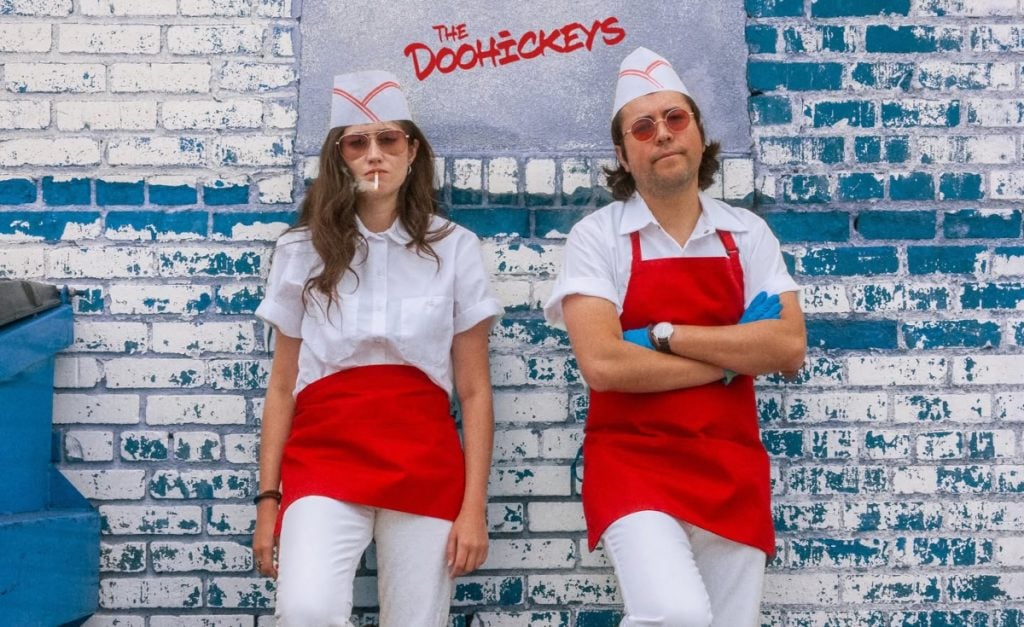
The Doohickeys are a country duo from California who’ve caught some buzz from mixing side-splitting comedy with addressing the real-world issues that face both independent musicians and young people in general. They do this once again with their new single “Day Jobs.”
You see us honky tonkin’, but things ain’t what they appear.
These troubadour personas, are all just smoke and mirrors.
‘Cause we can make the rent, just from playin’ these country shows.
The cost of livin’s high, and the price of music’s low.
As they reveal in the song, Doohickey Jack Hackett sounds like he’s an executive assistant, and Doohickey Haley Spence Brown tutors SAT student and also does Nanny work. They’re from Georgia and Missouri respectively, but met while attending USC in California studying film, and worked on a satirical news program together. Both probably could have lucrative professional careers if they chose to dedicate themselves to that, but choose the flexibility of other work so they can pursue music.
None of this is to say we should cease striving for our favorite musicians to be able to find that vein of attention that shoots them to the theater level where they can tour in a bus instead of a van, and keep a family fed back home, let alone become “stars.” Without another job in the way, they can spend more time pursuing the creative process. But if you’re simply playing shows or trying to write hits to pay the bills, often the creative process is suffering already.
Instead of hiding the other occupations of musicians, we should be talking about them. It often makes them more interesting, relatable, and human. Because after all, most all of us are just slogging away at what we have to do each day, biding out time until what we really want to do presents itself. Sometimes pursuing your dream means doing something else to get there. Some of the best music ever made is about that very thing.
– – – – – – – – – – –
If you found this article valuable, consider leaving Saving Country Music A TIP.
July 9, 2026 @ 7:44 am
Whatever it takes to pay rent and put food on the table, while enabling you to make art — do it. Times are tough for artists. Should be no stigma at all attached to this. I actually find it very interesting to learn what other jobs a musician may have.
July 9, 2026 @ 8:01 am
Don’t quit your day jobs.
July 9, 2026 @ 8:03 am
I watch a lot of youtube videos about woodworking or aquariums and over the years I have been more and more impressed by the creativity and quality of what some people (seem to be able to) produce by themselves with not too expensive equipment.
I wonder whether musicians can do more of that. Set up a youtube channel which can also be seen as one prominent way to have some sort of online presence, where a musician can publish their music. It could also be seen as a way to advertise oneself, and get asked to do paid gigs.
Perhaps student film makers can be asked to make some video for a couple of hundred bucks to go with a song. Live recordings at a bar might even be possible to show on a youtube channel. And if I am not mistaken, at a certain level of viewers or number of videos one can get monetized (if that’s the correct term) and earn some money from people watching (if I am not mistaken).
There is a great rendition of a musician named James Reed, where he performs a song titled “She’s of the hook again” which seems recorded at some bar or center and the quality is pretty decent for my ears at least. The entire scene with the older people walking around, and some shouting something at certain points, fit the entire vibe. It’s almost a complete music video to got with the music, I would guess for free.
July 9, 2026 @ 8:45 am
“Starving artist” is a trope, not a mark of quality. Kris Kristofferson wrote some of the best songs ever written while working a bunch of different jobs to pay the bills. Most of your favorite novels were written on nights and weekends by somebody paying the bills with a 9-5. Etc.
July 9, 2026 @ 8:48 am
I’ve been in and around this business for 50 yrs. And I know for a fact that 40 yrs ago, if you didn’t “make it” by the time you were 30, 99% of musicians just quit and got a serious day job (if they didn’t already have one) like I did at 29. “Making it” back then meant you had a major label deal and you could sustain some kind of success over a period of time from royalties and constant touring. Everyone I knew on a major was on some kind of “salary” as well. Oh sure, there might have been some “independent full timers” in various genres eking out a living, but it certainly wasn’t a comfortable one by any means and rarely lasted long.
I’ve been watching our Midwest Country scene with, let’s just say, 30 or 40 artists on a daily basis for close to 10 yrs now, and very few of them are “full timers.” The ones that are have to play a large percentage of “Solo acoustic” gigs, which doesn’t help the people in their band at all. That’s one reason, as Rick Beato put it…”there are a lot fewer bands these days.” I’m out in the wild on a weekly basis watching our National independent favorites, as well as my locals, and I just think to myself “The math doesn’t add up to a profit for anyone”. A “$5.00 cover charge”?? We were getting that and more in 1983!!! I’m afraid to ask my friends how much they’re getting for a gig because I would cry. They’re teachers, truck drivers, and painters by day, hell, one is even a dental hygienist, but they write my favorite songs, and I love and support them any way I can and always will.