

Sorry Rolling Stone, But Ian Noe Is Not an “Obscure” Artist
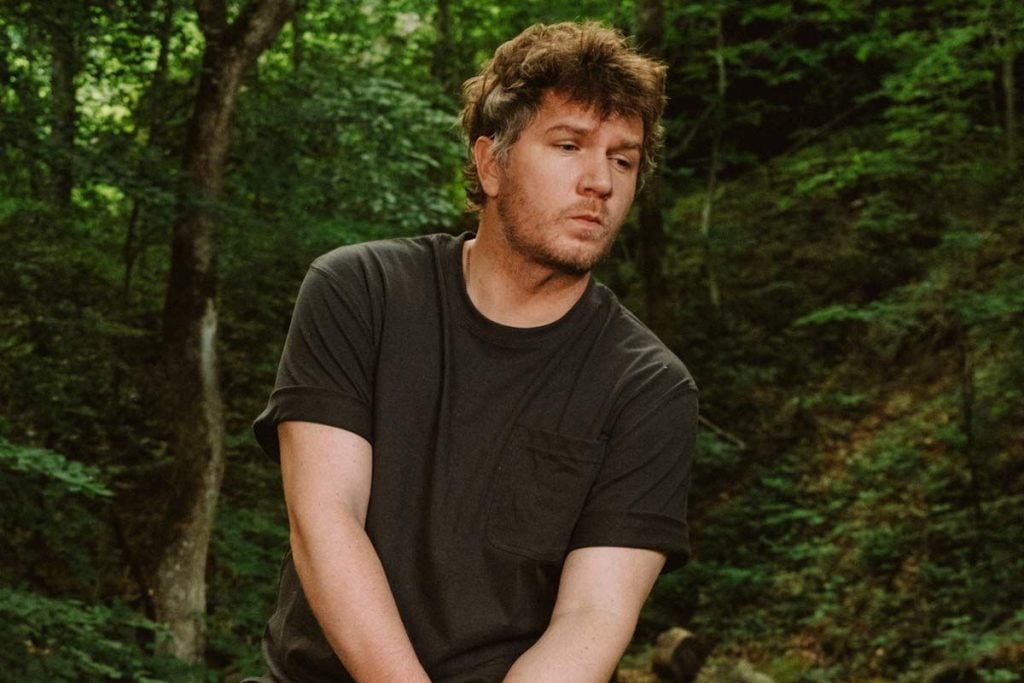
Something really cool happened earlier this week. In the wake of the release of his new album Young Manhood and Other Donatable Organs in mid October, Zach Bryan didn’t release a live version video for one of his new songs. Instead he decided to hire a film crew, a Gospel choir, called up fiddle player Billy Contreras, strung some extension chords out into a field, and recorded a song off of Ian Noe’s new album Canyon Falls Trailer Band released in late September.
Throughout his career, Zach Bryan has made a habit out of covering other people’s songs, and creating massive career spikes for these performers. Whatever you think about Zach Bryan and his music, this has been a massive, world-shaping phenomenon that’s hard to not give Zach credit for. Noeline Hofmann might owe much of her career to the moment Zach Bryan championed her song “Purple Gas.” On Zach’s latest record, he collaborated with the Turnpike Troubadours on the song “Plainsman,” which became the Oklahoma band’s first appearance on the Billboard Hot 100 at #45.
Sierra Ferrell, The War and Treaty, Charles Wesley Godwin, and others owe huge attention spikes to Zach. And aside from John Moreland, most have been infinitely grateful. There’s a good chance Kacey Musgraves wouldn’t be playing arenas these days if it wasn’t for her collaboration with Zach Bryan on “I Remember Everything” that has now been Certified Diamond, and has 1.5 billion streams on Spotify alone, making it far and away her biggest song for an artist who has multiple big organic hits.
Ian Noe probably can’t expect those kinds of numbers after Zach Bryan’s live video version of his song “Kentucky Hurricane.” But clearly both Ian Noe himself and Ian’s version of “Kentucky Hurricane” are seeing fresh interest, especially since Zach didn’t release a studio or recorded version of the track himself, at least not yet.
Zach might be beyond the moment where releasing a cover song could bequeath massive stardom to somebody. We just live in a different musical moment now where really nothing is resonating far and wide. We’re too compartmentalized in our information bubbles.
But one thing anyone who’s been following the career of Ian Now for some time now understands is that the Kentucky songwriter is in no way “obscure.” In fact, similar to the career trajectory of Colter Wall, Ian’s enjoyed incredible interest in his career, despite what some might think is music of a comparatively niche appeal. And just like Colter Wall, Ian Noe doesn’t tour very much. Even before the Zach Bryan shout out, Ian had nearly a million monthly Spotify listeners, and his song “Letter to Madeline” has nearly 50 million Spotify spins.
That’s why it’s so frustrating to see Rolling Stone craft a headline that 1) Portrays Ian Noe as “obscure,” and 2) Doesn’t even name him in the main title, which ironically, could help him overcome any supposed “obscurity” he might have.
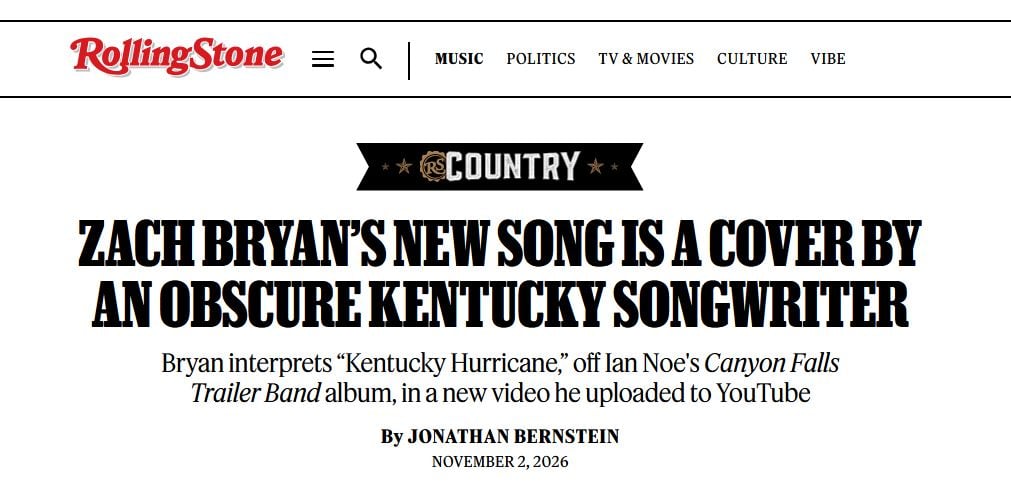
You really hate to sound like a broken record constantly harping on the doings of Rolling Stone. But it’s almost uncanny how commonly they step in it these days. Pretty much every day they do or say something about important country and roots artists or topics that illustrates a lack of depth in knowledge and real-world understanding of where things sit in the music universe. Often this is tied to the political slant or agenda they bring to coverage. But in this case, it’s just an outright insulting use of words.
As is regularly the case with Rolling Stone coverage, they’re getting ratioed hard by their own readers, with the comments section on social media almost universally renouncing the characterization of Ian Noe as “obscure.”
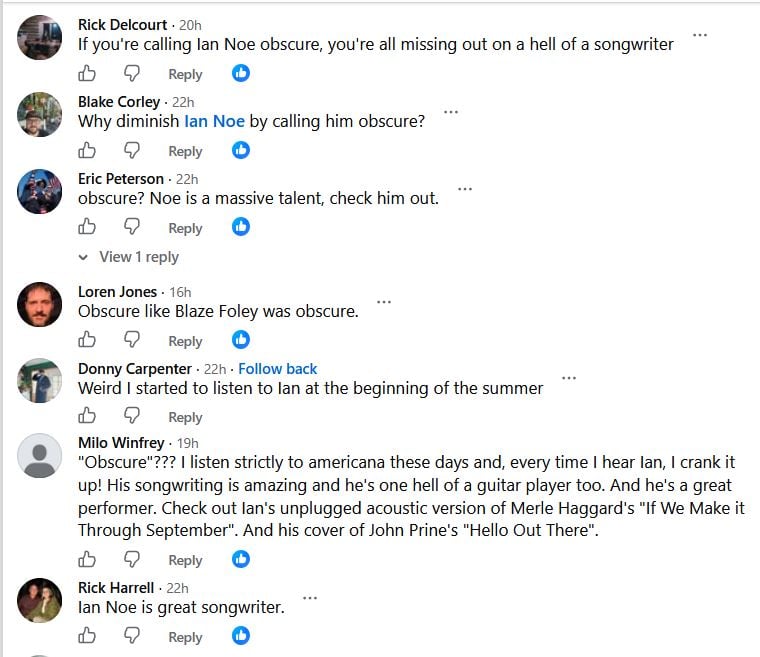
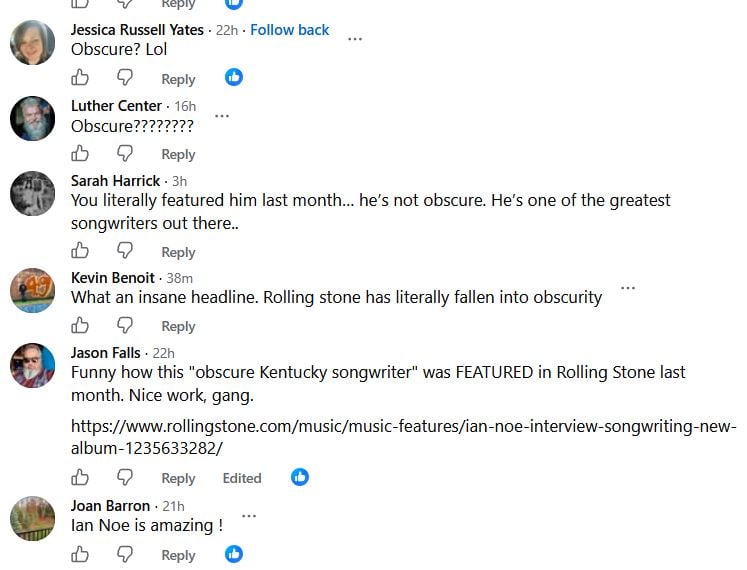
As some have pointed out, Rolling Stone even featured Ian Noe recently, and good for them.
The author of the new article, Jonathan Bernstein, is not a bad writer. He’s also the author of the excellent biography on Justin Townes Earle. And it might not even be his headline, but that of an editor. In the article itself, Bernstein characterized Ian Noe as “relatively obscure.” And sure, you’re trying to set a contrast to underscore just what a beneficial moment this is for Ian Noe, thanks to Zach Bryan.
But this characterization isn’t just insulting to an artist like Ian Noe. It’s also insulting to other supposed “relatively obscure” folk singer/songwriters that deserve so much more attention than they get, and that aspire to be in the position Ian Noe is to support their music and their message. Performers like Emily Scott Robinson (made me cry), or Anna Tivel would love to be as “obscure” as Ian Noe, just like there are many songwriters that would love to be as well-known as Emily Scott Robinson and Anna Tivel, and don’t feel they’re “obscure” either.
The words we use matter, especially when put in a headline. And too often, independent performers are systemically downgraded by being portrayed as lesser than just because they’re not as big as an artist such as Zach Bryan. Many of them would never want the burden of having to play football stadiums. Many of them are proud to have strong-enough fan bases simply to fill living rooms for house shows, or small clubs or mid-sized theaters.
This same systemic downgrade is the reason many wrestle with the use of the term “Americana,” especially when it’s employed to portray country artists that are otherwise ignored by the mainstream. This othering that happens through language often then creates artificial barriers to performers finding their true station in life and their careers, wherever that station happens to be. Is a big festival going to book Ian Noe if Rolling Stone thinks he’s “obscure”? Will the Grammy Awards properly regard his music?
The true story behind Ian Noe in 2026 is how incredibly well he’s doing despite the lack of touring, in lieu of the involved and heady nature of his music, and in opposition to whatever perceived “obscurity” that comes with more folk-based songwriting.
Zach Bryan himself considers himself a folk artist, not a country one. The whole “contemporary folk” category has grown so massive, the Grammy Award made an entirely new category for it this year. Along with Zach Bryan, artists like Noah Kahan and a host of others are packing out arenas by making folk-based singer/songwriter music. Many of these artists are much bigger than mainstream country stars. “Obscurity” is the antithesis of what is happening here, and Ian Noe is one of the beneficiaries of this move towards more meaningful songs, especially now that Zach Bryan has championed him directly.
Many Ian Noe fans will say it’s really Ian Noe who should be bequeathing opportunities to others, and Zach Bryan is the lightweight. But that’s not what happened. Whatever weird combination of luck, timing, and circumstances that collaborated to shoot Zach Bryan into the stratosphere where now he’s selling out consecutive nights at football stadiums, Zach himself sees the responsibly this stardom has given to him, and understands a simple video can shine a massive spotlight on an artist that deserves it.
But Ian Noe is not “obscure,” any more than Sierra Ferrell, or the Turnpike Troubadours are. Just like them, Ian Noe might have released the best album of the year with Canyon Falls Trailer Band, and come the end of 2026, don’t be surprised if you see it in end-of-year lists beside or above Zach Bryan, perhaps even in Rolling Stone.
But just like Zach Bryan, Rolling Stone has a responsibility. Though some still fancy it as some sort of hip, edgy, current, relevant, tastemaking cutting-edge outlet, the truth is its a corporate mouthpiece for the industry, and part of the Penske Media holdings along with Billboard, making it part of the LiveNation/Ticketmaster monopoly of music media that even when it puts independent artists forward, it does so behind an obtrusive paywall so it benefits themselves more than the artist. Then Rolling Stone turns around and portrays these artists as “obscure” to make sure the order of things in the mainstream industry is kept in equilibrium.
We all know that music is not a true meritocracy. Zach Bryan will be the first to tell you that he’s not musician; he’s a poet with a broken voice and out-of-tune guitar. That’s why he quick to defer to artists like Ian Noe when he sees an opportunity to lift them up instead of discounting them. We should all do the same, especially in the media.
– – – – – – –
If you found this article valuable, consider leaving Saving Country Music A TIP.
November 3, 2026 @ 12:31 pm
Just…Noe
November 3, 2026 @ 12:44 pm
Just say Noe! It’s my album of the year so far. I got to seem him in Hazard, Kentucky last month with full band. It was exceptional. He’s been hard to catch with sporadic tour dates but he’s well worth catching live. Hoping the best for him!
November 3, 2026 @ 12:49 pm
Hes not been obscure to me because I was lucky enough that he opened up for Colter Wall a few years ago so Ive been on board since the beginning , and all three full albums including this one have been brilliant but he probably is obscure, except to us.
He shouldnt be and theres a lot of people missing out on some wonderful songs but he probably is obscure isnt he? Maybe we can help by making his latest album our album of the year.
Going off subject I reckon Colby T Helm’s has also made an enormous leap on his 2nd album for a kid of what 23 I think he shouldnt be obscure either.
November 3, 2026 @ 1:57 pm
In some respects, every single music artist these days is “obscure.” Elly Langley has been #1 for 26 weeks now, and you still have people saying they’ve never heard the song, and never heard of her. Bad Bunny is one of the biggest artists in the world, and you had folks saying they’d never heard of him ahead of the Super Bowl. It’s probably less than 50% of the US population could tell you who Zach Bryan is.
But I still would never use the term “obscure” to describe Ian Noe, or really anyone else who clearly has a strong career and momentum. ANYONE who is able to make music as a living at this point should be disqualified from being considered “obscure” because it’s so hard.
As the comments from people illustrate, “obscure” has an insulting connotation. Use a term like “rising,” “up-and-coming,” “independent,” or just call him a “Kentucky songwriter.” I just can’t imagine being an editor, and letting that title get published, even if it’s technically true from some sort of standpoint, especially if you in any way have your finger on the pulse, and Noe Ian’s album is really creating a lot of buzz at the moment.
Think if you’re a festival promoter or venue owner, and you get an email looking to book Ian Noe, and you might not know him. You do a Google search and see Rolling Stone called him “obscure,” that’s going to discourage you from booking him. Meanwhile, Ian Noe actually has a pretty strong following, and can probably draw quite well.
November 3, 2026 @ 1:23 pm
Been a fan since his first full album. Tremendous talent. The sad thing is to most of America and probably to most casual country fans he is exactly that…obscure. So are a lot of the artists we all love. It’s a shame, but it is reality.
It’s kind of like one of the greatest songwriters, James McMurtry, who’s out there constantly playing shows in small venues to a couple of hundred people. Too few of these artists get to bust out to the mainstream. Even the most celebrated “Americana” artists have trouble getting past the small theaters and into arenas. Bad for their income, but great for those of us who are fans.
I played the new Ian Noe album for a friend and they said he was OK but it wasn’t as good as Ella Langley or Morgan Wallen. Good friend but bafflingly bad taste. I think that is most people out there.
November 3, 2026 @ 1:35 pm
I do hope Ian Noe tours and I can see him. His album and John r millers are my two favorites this year. Not sure which I will prefer in the end. One thing you can’t deny about Zach Bryan he has great taste in other artists